
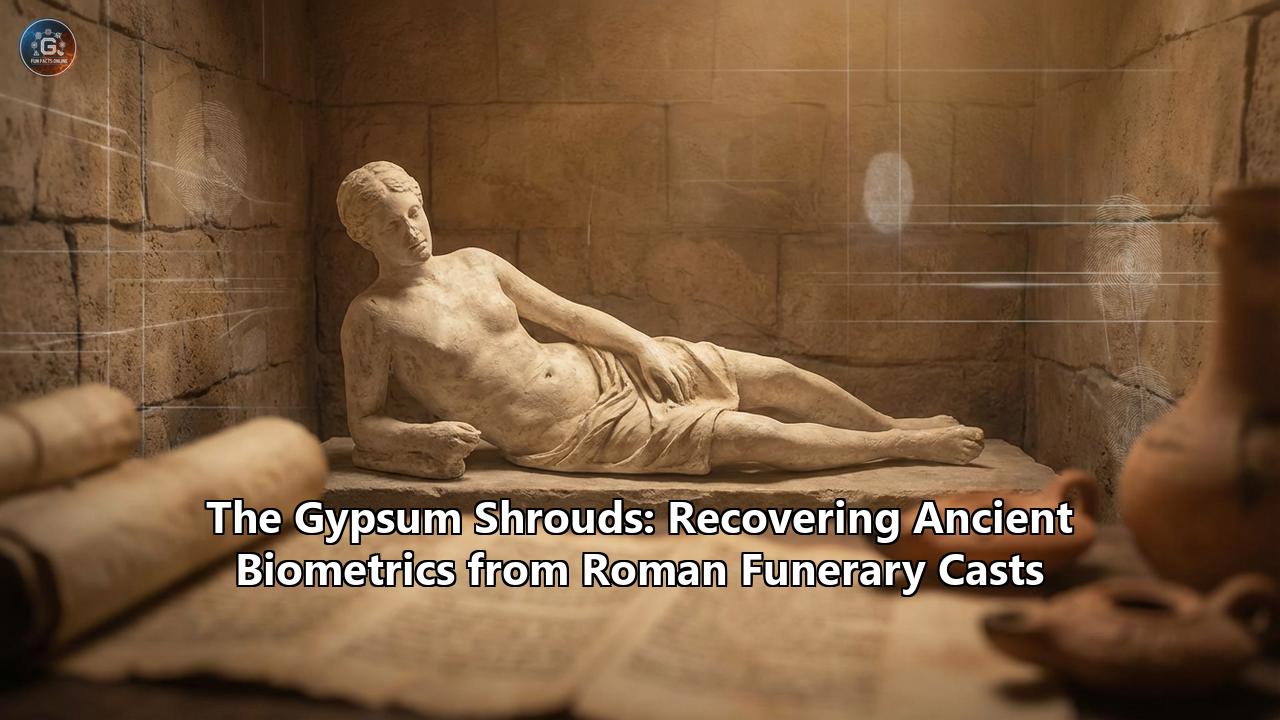
In the subterranean silence of a museum archive in York, England, lies a collection of nondescript white blocks. To the uninitiated, they look like construction debris—lumps of hardened plaster, rough and unformed. But to the eyes of archaeologists, they are something far more haunting: they are the negatives of the dead. These are the "gypsum shrouds," rare and fragile casings that once enveloped the bodies of Roman elites, preserving not their bones, but the very shape of their existence.
For centuries, these casts sat largely silent, their secrets locked inside the opaque white mineral. But today, a revolution in archaeological science is turning these static lumps into dynamic windows into the past. Through the use of cutting-edge 3D scanning, chemical residue analysis, and forensic reconstruction, researchers are recovering "ancient biometrics"—precise measurements of bodies, textiles, and even the fingerprints of the undertakers who smoothed the wet plaster over the dead 1,700 years ago.
This is the story of how modern technology is breathing life back into the ghosts of Eboracum, revealing a funerary practice that was as expensive as it was mysterious, and as intimate as it was grand.
The Ghosts of Eboracum: A Unique Burial Rite
The city of York, known in antiquity as Eboracum, was a military and cosmopolitan hub of the Roman Empire's northernmost province. It was a place where emperors died and were proclaimed, a city of stone and soldiering. It was also the epicenter of a peculiar and rare burial practice.
While most Romans were cremated or buried in simple wooden coffins, a select group of high-status individuals in the 3rd and 4th centuries AD received a treatment that bordered on mummification. Their bodies were laid in heavy stone or lead sarcophagi, clothed in their finest garments, and wrapped in linen shrouds. Then, in a final act of ritual permanence, a liquid mixture of gypsum—known today as Plaster of Paris—was poured or troweled over them.
As the gypsum hardened, it captured every fold of cloth, every curve of the limb, and every nuance of the body's position. Over the ensuing centuries, the organic body decayed, leaving behind a hollow void. The gypsum block became a perfect negative mold: a "ghost" of the deceased locked in stone.
While such burials have been found in North Africa and Continental Europe, nowhere are they as concentrated as they are in York. Over 45 recorded examples have been found in the city's ancient cemeteries, making it the global capital for this enigmatic rite.
Seeing the Dead: The Digital Resurrection
For decades, the only way to study these casts was to break them open—a destructive act that archaeologists were loath to commit. As a result, many of the casings remained stored away, their contents a mystery. This changed with the launch of the "Seeing the Dead" project, a groundbreaking collaboration between the University of York, York Museums Trust, and Heritage360.
Led by Professor Maureen Carroll, the team utilized advanced 3D scanning technologies, including the Artec Leo and Space Spider scanners. These handheld devices project structured light patterns onto an object, capturing millions of data points to create a sub-millimeter accurate digital model.
When the researchers turned their scanners on the negative cavities of the gypsum blocks, the results were nothing short of miraculous. By digitally "inverting" the scans—turning the negative void into a positive shape—they were able to virtually reconstruct the bodies that had long since turned to dust.
The Family in the Stone
One of the most poignant discoveries from the project was a single coffin containing not one, but three individuals: two adults and an infant. The scan revealed a heartbreaking domestic tableau frozen in time. The bodies were not just dumped together; they were arranged with care. The high-resolution data showed the texture of the shrouds wrapped around them, the ties that bound the fabric over their heads, and the tiny bands of cloth used to swaddle the baby.
The level of detail was such that researchers could identify the different weaves of the textiles—coarse outer wrappings versus finer inner linens—without a single scrap of actual fabric surviving. This "digital autopsy" allowed us to witness a family tragedy from nearly two millennia ago, suggesting the three died simultaneously, perhaps from an infectious disease, and were buried in a single, desperate, yet loving event.
The Science of the Shroud: Chemistry and Craft
To understand how these biometrics were preserved, one must understand the material itself. Gypsum (calcium sulfate dihydrate) is a soft mineral found in abundance in the geology surrounding York. When heated to about 150°C, it dehydrates and becomes a fine powder: Plaster of Paris. When water is added back, it rehydrates and crystallizes into a hard, rock-like substance.
The Romans of York had mastered this chemistry. But recent analysis has shown that this was not merely a construction process applied to the dead; it was a ritual performance.
The Fingerprints of the Undertaker
One of the most startling findings from the Seeing the Dead project was the discovery of human fingerprints preserved in the gypsum. For years, it was assumed that the liquid gypsum was simply poured over the body from a bucket. The fingerprints tell a different story.
High-resolution scans revealed drag marks and the distinct ridges of fingertips on the surface of the cast. This indicates that the mixture was applied as a thick, malleable paste, not a soup. An individual—likely a family member or a professional undertaker—reached into the coffin and smoothed the wet plaster over the shrouded body by hand. This act of touching the dead, of sculpting the final casing, adds a layer of intimacy to the burial that historical texts never recorded. We are not just seeing the dead; we are seeing the hands that cared for them.
The Scent of Status
The visual biometrics are complemented by invisible chemical signatures. Using mass spectrometry and Raman spectroscopy, scientists analyzed the microscopic residues left in the gypsum and on the few surviving textile fragments. They were looking for the "smell of the funeral."
What they found confirmed the immense wealth of these individuals. The chemical signatures revealed traces of frankincense (from Southern Arabia or East Africa) and other expensive resins like mastic and pine from the Mediterranean. These substances were not native to Britain. They had to be imported over thousands of miles of road and sea, at great cost.
The presence of frankincense serves a dual purpose. Practically, it is antimicrobial and helps mask the scent of decomposition. Ritually, it was a substance of the gods, used to purify the soul and perhaps speed its journey to the afterlife. To find it in a grave in northern England is a testament to the reach of Roman trade networks and the desire of York's elite to emulate the cosmopolitan fashions of Rome and the East.
Urban vs. Rural: The Cambridgeshire Discovery
While York is the hub of these burials, a recent discovery in 2025 has broadened the map. During construction work on the A47 highway in Cambridgeshire, archaeologists unearthed a limestone sarcophagus containing a gypsum burial in a rural setting.
This find is significant because it challenges the idea that this was exclusively an urban practice. The individual inside was clearly of high status, buried in a stone coffin quarried 50 kilometers away. Yet, they were interred in a small, rural settlement. This suggests that the "fashion" of gypsum burial had permeated the countryside, adopted by wealthy landowners or villa elites who wanted to distinguish themselves from the common cremation or soil burials of their neighbors.
Like the York examples, this rural burial preserved the imprint of the shroud, providing a crucial data point that helps map the spread of this funerary culture across the province of Britannia.
A Window into Roman Life (and Death)
What do these recovered biometrics tell us about the people of Roman Britain?
- Textiles and Fashion: The casts provide some of the best evidence for Roman textiles in Britain. We can see the width of the loom, the density of the weave, and the style of wrapping. Some bodies were wrapped in simple sheets; others show complex bandaging reminiscent of Egyptian mummies, hinting at a fusion of cultural influences.
- Physical Anthropology: The negative spaces allow for precise measurements of the body—height, build, and sometimes even facial features if the shroud was tight enough. In some cases, the "ghost" reveals footwear, showing the style of leather shoes or sandals worn into the afterlife.
- Social Hierarchy: The combination of stone coffins, imported aromatics, and the labor-intensive gypsum process marks these individuals as the top 1% of Eboracum society. These were military commanders, wealthy merchants, or high-ranking officials who wanted their death to be as impactful as their life.
Conclusion: The enduring imprint
The gypsum shrouds of York are more than just archaeological curiosities. They are time capsules that captured the ephemeral moments of a funeral that took place 1,700 years ago. Through the lens of 3D scanning, we can now "unwrap" these burials without destroying them, recovering the biometrics of the deceased and the gestures of the living.
These casts remind us that for the Romans, death was not an end, but a transition requiring care, cost, and ritual. The fingerprints left in the plaster are a touching testament to the human need to preserve, to protect, and to remember. As we gaze into the digital reconstructions of these ancient voids, we are meeting the Romans of York face-to-face, recovering their shapes from the stone that was meant to keep them safe for eternity. The gypsum hardened, the body faded, but thanks to modern science, the memory remains indelible.
Reference:
- https://www.smithsonianmag.com/smart-news/romans-burial-gypsum-york-180982354/
- https://www.york.ac.uk/news-and-events/news/2025/research/gypsum-mysterious-roman-burial-practice/
- http://www.thehistoryblog.com/archives/72140
- https://www.popularmechanics.com/science/archaeology/a63528414/liquid-gypsum-roman-burial/
- https://www.ancient-origins.net/news-history-archaeology/roman-gypsum-burials-0018600
- https://the-past.com/news/3d-scan-sheds-light-on-unusual-roman-gypsum-burials/
- https://onceiwasacleverboy.blogspot.com/2025/03/gypsum-burials-in-roman-yorkshire.html
- https://seeingthedead.ac.uk/blog/excavating-roman-gypsum-burial
- https://www.humanitarianlibrary.org/sites/default/files/2014/02/PA_GypsumProcessingAndUse.pdf
- http://www.palazzospinelli.org/plaster/essay/essay/CassarP2.html
- https://www.permutrade.com/five-stages-of-gypsum-production-process