
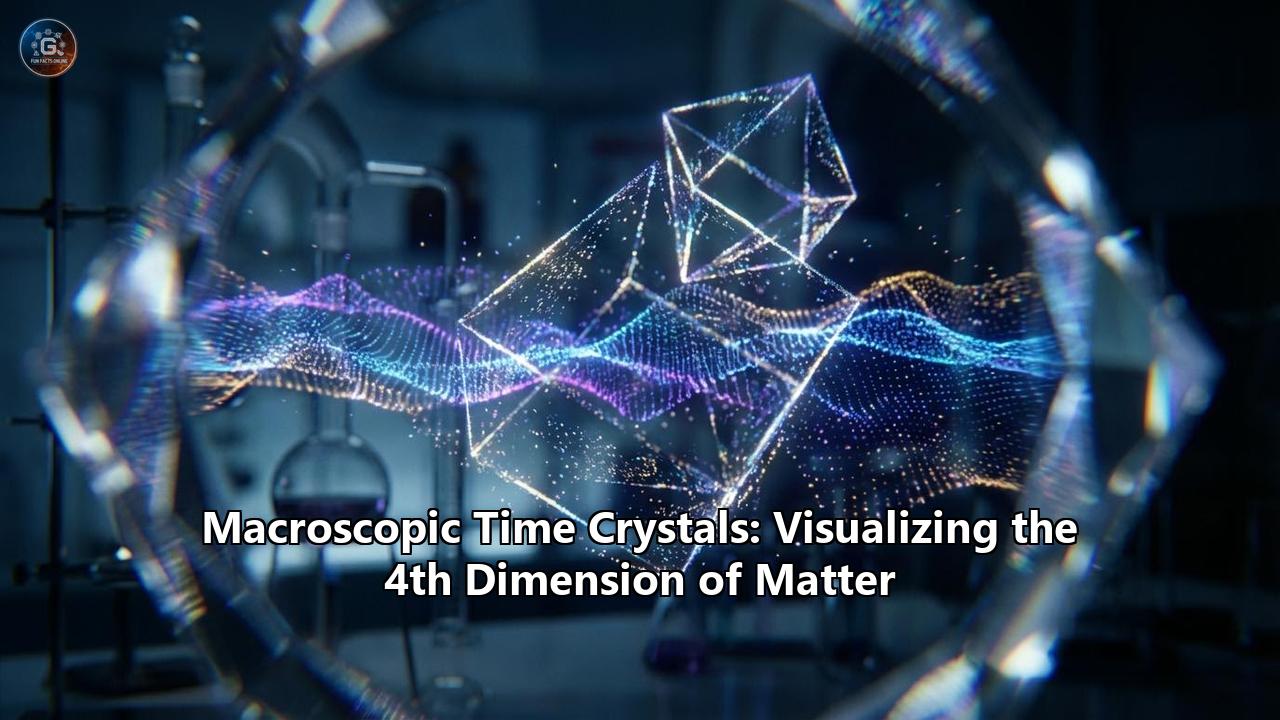
Imagine a clock without a battery, spring, or power source of any kind, yet its gears turn and its hands sweep across the dial for all eternity. In the macroscopic world of our everyday experience, such an object violates the most sacred tenets of thermodynamics. It sounds like the punchline to a naive dream of perpetual motion. Yet, in the cutting-edge laboratories of modern physics, this "impossible" perpetual clock is no longer a fantasy. It is a newly realized phase of matter known as a time crystal.
For nearly a decade, time crystals were ghostly, fragile phenomena confined to the microscopic realm—visible only indirectly through the output of quantum computers or ultra-cold atomic arrays. However, a cascade of recent breakthroughs has forcefully dragged time crystals from the esoteric shadows of the quantum realm into the macroscopic, observable world. Today, scientists are not just proving that the fourth dimension of matter exists; they are looking at it under microscopes, watching its patterns swirl, and even levitating it in the palm of their hands.
To truly understand the magnitude of this revolution, we must journey to the very foundations of how reality is structured, explore the visual majesty of these newly engineered macroscopic structures, and unravel how manipulating the fourth dimension of matter will fundamentally rewrite the future of technology, memory storage, and our understanding of time itself.
The Physics of the Impossible: Breaking the Symmetry of Time
To understand a time crystal, we must first understand a standard, spatial crystal—like a diamond, a snowflake, or a grain of table salt.
In physics, the defining characteristic of a crystal is "symmetry breaking." Imagine floating in a featureless, infinite void. Whether you move left, right, up, or down, your surroundings look exactly the same. This is known as continuous spatial translation symmetry. However, when matter cools and crystallizes—say, carbon atoms forming a diamond—this continuous symmetry is broken. The atoms lock into a rigid, repeating three-dimensional lattice. Now, the environment only looks the same if you move by the exact distance between two carbon atoms. The matter has sacrificed continuous symmetry for discrete, periodic order.
In 2012, Nobel laureate Frank Wilczek proposed a provocative question: If matter can spontaneously break the symmetry of space, could it also break the symmetry of time?
The laws of physics are generally time-invariant; an experiment performed today should yield the same results if performed tomorrow. This is continuous time translation symmetry. Wilczek theorized a state of matter that breaks this rule, just as a diamond breaks the rule of space. In this exotic state, the particles would not sit perfectly still at their lowest energy state (equilibrium). Instead, they would continuously move, oscillate, or "tick" in a repeating pattern over time, forever, without losing or requiring energy.
This concept initially sent shockwaves through the physics community. It seemed to violate the laws of thermodynamics, which dictate that moving systems eventually succumb to entropy and friction, grinding to a halt unless external energy is supplied. But time crystals exist in a "non-equilibrium" phase. Because they are already in their ground state—the lowest possible energy state—there is no energy left for them to lose. They move, but they cannot dissipate energy. They are forever locked in an eternal dance, a perpetual motion allowed by the bizarre loopholes of quantum mechanics.
The Leap to the Macroscopic: Visualizing the 4th Dimension
While the first time crystals were successfully created in 2016, they were microscopic, lasting only fractions of a second, and requiring extreme isolation from the environment. They were abstract data points on a physicist's monitor. But science did not stop there. The ultimate goal was to create macroscopic time crystals—structures large enough to interact with, observe, and utilize in the real world.
Between 2024 and 2026, the scientific community crossed this threshold in spectacular fashion, yielding creations that allow us to literally visualize the fourth dimension of matter.
The Dancing Liquid CrystalsIn late 2025, researchers at the University of Colorado Boulder achieved a historical milestone: the creation of the first time crystal that humans can actually see. Utilizing liquid crystals—the exact same ubiquitous materials found in the display screens of our smartphones and televisions—physicists Hanqing Zhao and Ivan Smalyukh brought the fourth dimension into the visible spectrum.
When illuminated by a steady, constant light source, these liquid crystals do not just sit passively. Instead, they organize into colorful, shifting stripes and bands that swirl into never-ending, repeating patterns. Under a microscope, these bands are completely mesmerizing. Because the time crystal is macroscopic, researchers can observe its internal patterns repeating through time rather than space. Even when ambient conditions shift, the material continues its eternal oscillation.
This visible time crystal represents a profound paradigm shift. Instead of inferring the existence of a time crystal through indirect quantum signals, we can now observe the breaking of time-translation symmetry directly. The material continuously cycles through its rhythmic dance, acting as a looping GIF written into the very laws of physics.
Levitating Acoustic ClocksIf seeing a time crystal under a microscope feels detached, a breakthrough in February 2026 at New York University brought the phenomenon squarely into the tangible world. Physicists constructed a macroscopic time crystal using millimeter-scale Styrofoam beads—the kind used in everyday packaging—that levitate on a cushion of sound waves.
Suspended in mid-air within a foot-high acoustic levitator, these beads can be observed ticking and moving back and forth with the unaided human eye. But what makes this levitating time crystal truly bizarre is its behavior. The beads interact by exchanging sound waves in a non-reciprocal manner, meaning they effectively defy Newton's Third Law of Motion. In classical physics, every action must have an equal and opposite reaction. But in this macroscopic time crystal, the forces are unbound from balanced pairs, allowing the particles to interact independently as they maintain their rhythmic, time-crystalline oscillation. It is an entirely new flavor of matter, hovering right in the palm of your hand, rewriting the fundamental rules of classical mechanics.
The 40-Minute MarathonFor macroscopic time crystals to be practically useful, they must endure. Earlier quantum time crystals deteriorated in mere milliseconds. However, in early 2024, physicists at TU Dortmund University engineered a highly robust macroscopic time crystal using a semiconductor material called indium gallium arsenide.
By manipulating the material akin to nuclear magnetic resonance, the atomic nuclei spins became polarized. The spontaneous interactions between the electron spins and the nuclei generated a time crystal of unprecedented stability. This crystal survived for at least 40 minutes—a staggering 10 million times longer than previous iterations. This monumental increase in lifespan proved that macroscopic time crystals are not just fleeting laboratory tricks, but robust phases of matter capable of sustaining their temporal structure long enough for practical, real-world applications.
The Quasicrystal RebellionAs if time crystals weren't mind-bending enough, researchers at Washington University in St. Louis introduced a stunning variation in 2025: the time quasicrystal.
In spatial dimensions, a regular crystal (like salt) has a perfectly repeating atomic grid. A quasicrystal, however, has atoms arranged in a highly ordered but strictly non-repeating pattern (like the intricate Penrose tiling found in some Islamic architecture). The researchers successfully translated this concept into the fourth dimension. Unlike a standard time crystal that repeats the exact same pattern of motion endlessly, a time quasicrystal's atoms vibrate at different frequencies, never repeating the exact same arrangement over time. This creates an infinitely complex, non-repeating temporal structure that operates without expending energy, unlocking entirely new avenues for exploring non-equilibrium physics.
Why Macroscopic Time Crystals Matter: The Dawn of 4D Technology
The visualization and stabilization of macroscopic time crystals is not merely a philosophical victory for physicists; it is the ignition spark for a new era of engineering. The ability to control matter that structures itself in time opens the door to technologies that previously belonged strictly to the realm of science fiction.
1. Time Barcodes and Infinite Data StorageThe swirling visible time crystals developed at CU Boulder offer a radical new approach to data storage. Traditional computer memory stores data spatially—on a hard drive platter or within the physical layout of silicon transistors. But a visible time crystal allows for data to be encoded in time.
By observing the shifting, repeating patterns of the liquid crystals, researchers can stack these visible patterns to create a "time barcode". In this architecture, information lives in both the physical image and its temporal cycle. Because the exact same spatial coordinate can represent different pieces of data depending on the specific moment in the cycle it is read, the storage density skyrockets. Theoretical estimates suggest that a two-dimensional barcode extended through the dimension of time could handle over 100,000 bits of data per second. Once encoding and error control mechanisms are perfected, this could lead to autonomous storage systems that require practically zero energy to maintain their stored states, drastically cutting the energy demands of global data centers.
2. The Ultimate Anti-Counterfeiting MeasureSecurity and authentication are in a constant arms race against counterfeiters. Currently, we rely on spatial complexity—like the holograms on credit cards or the micro-printing on currency. Visible time crystals introduce an unforgeable security metric: temporal signatures.
Imagine a microscopic dot of time-crystalline liquid embedded in a passport, high-value product, or secure communication device. To authenticate the object, a scanner wouldn't just look at what the material is; it would measure how it moves through time. Because the non-equilibrium physics governing the time crystal's oscillation are incredibly complex and self-sustaining, it would be virtually impossible to counterfeit. You cannot easily spoof a phase of matter that relies on the perpetual breaking of time-translation symmetry.
3. Quantum Analog RAMQuantum computing promises to revolutionize processing power, but it faces a massive bottleneck: quantum states are incredibly fragile (a phenomenon known as decoherence). Time crystals, by their very nature, are robust and resistant to environmental noise because their repetitive motion is locked into their fundamental ground state.
Researchers, including the team behind the time quasicrystal, envision utilizing these structures as a form of quantum memory. Because the structural integrity of a time crystal is maintained over long periods, it could act as the quantum analog of RAM (Random Access Memory), holding complex quantum information stably so that quantum processors can perform their calculations without the data degrading.
4. Ultra-Sensitive Environmental SensorsBecause macroscopic time crystals are intricately tied to the subtle interactions of their constituent particles (whether they be electron spins or acoustic waves), any external force that interacts with them can alter their precise ticking. This makes them unparalleled candidates for next-generation sensors.
By monitoring the resonant frequencies and periodic resets of a stabilized macroscopic time crystal, scientists could develop probes sensitive enough to detect minute fluctuations in gravitational fields, magnetic anomalies, or even indirectly probe elusive phenomena like quantum field fluctuations and dark matter. The time crystal becomes a hyper-sensitive, eternally beating heart; any change in its rhythm alerts us to a change in the invisible fabric of the universe around it.
Redefining the Fabric of Reality
Beyond the technological applications—beyond the quantum memory, the time barcodes, and the acoustic levitators—macroscopic time crystals force us to confront a profound philosophical shift in how we view the universe.
For centuries, our understanding of physics was predicated on the relentless march of entropy. The Second Law of Thermodynamics dictates that all closed systems degrade from order to disorder. Clocks wind down. Hot coffee cools. Stars burn out. The universe, we believed, was fundamentally biased toward stillness and decay.
Macroscopic time crystals prove that this is not the whole story. They reveal that, under the right conditions, matter prefers perpetual, rhythmic motion. They show us that time is not just a passive river in which objects float and degrade; time is a dimension that can be crystallized, structured, and ordered just like the physical space we inhabit.
As we look at the swirling stripes of a liquid time crystal through a microscope, or watch styrofoam beads hover and pulse in the air, we are not just looking at a clever parlor trick of classical and quantum physics. We are looking at the fourth dimension laid bare. We are watching matter break the ultimate symmetry, carving out its own eternal heartbeat in the cold, silent void.
The era of macroscopic time crystals has arrived. We are no longer just passengers moving through time; we are finally learning how to hold it, shape it, and build the future upon it.
Reference:
- https://www.sciencedaily.com/releases/2025/09/250907024555.htm
- https://www.earth.com/news/scientists-create-first-visible-time-crystal-in-breakthrough-physics-experiment/
- https://torontostarts.com/2025/11/07/visible-time-crystal-discovery/
- https://www.nyu.edu/about/news-publications/news/2026/february/scientists-discover--levitating--time-crystals-that-you-can-hold.html
- https://www.iflscience.com/longest-lasting-time-crystal-to-date-achieved-in-new-breakthrough-72771
- https://www.livescience.com/physics-mathematics/scientists-unveil-new-type-of-time-crystal-that-defies-our-traditional-understanding-of-time-and-motion