
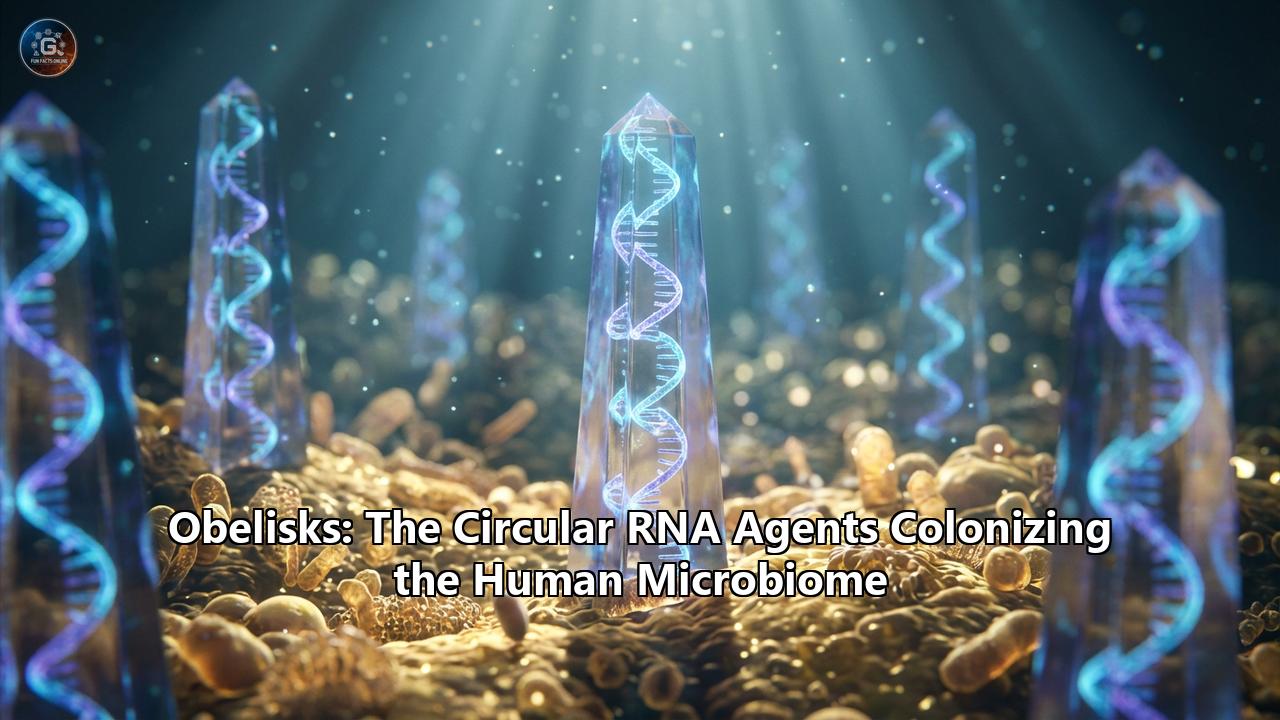
In the microscopic universe within our bodies, a startling discovery has fundamentally rewritten the map of the human microbiome. For decades, we believed we had a reasonable census of the inhabitants of our gut and mouth: a vast bacterial metropolis, patrolled by bacteriophages (viruses that infect bacteria), simpler plasmids, and the occasional fungal drifter. We were wrong.
In early 2024, a team of researchers from Stanford University, led by Nobel laureate Andrew Fire and graduate student Ivan Zheludev, unveiled a completely new biological entity. They are not viruses. They are not viroids. They are not plasmids. They are Obelisks—microscopic, rod-shaped loops of RNA that have colonized the human microbiome on a massive scale, hiding in plain sight for arguably the entirety of human history.
This article explores the definitive story of Obelisks: how they were found, their alien biology, their cryptic evolutionary origins, and what their existence means for the future of medicine and our understanding of life itself.
Part I: The Discovery of "Biological Dark Matter"
To understand the magnitude of the Obelisk discovery, one must first understand the invisibility cloak they wore. For the last twenty years, the "Golden Age" of genomics has relied on a specific method of exploration: sequence homology.
When scientists sequence the DNA or RNA of a microbiome sample (like a swab from your cheek), they get a torrent of genetic letters (A, C, G, T/U). To identify what is in the sample, they compare these sequences to a reference database. If a sequence looks 90% like E. coli, it’s identified as E. coli. If it looks like a known virus, it’s flagged as a virus.
But what if a biological agent looks like nothing we have ever seen before?
The VNom Breakthrough
Ivan Zheludev realized that looking for "similar sequences" would never find truly novel life forms. He needed to look for shapes, not letters.
The team developed a bespoke bioinformatic tool called VNom (Viroid Nominator). Instead of reading the genetic text, VNom looked for the structural hallmarks of simple RNA agents:
- Circularity: Most RNA in cells is linear (like a straight string). Viroids and some viral genomes are circular (like a rubber band), a shape that protects them from cellular enzymes that chew up loose ends.
- Rod-like Folding: To survive inside a hostile bacterial cell, naked RNA often folds in on itself, pairing its bases to form a tight, stiff rod that resembles a double-stranded DNA molecule.
Zheludev unleashed VNom on a colossal dataset: 5.4 million publicly available gene sequences from the Human Microbiome Project and global ocean repositories.
The results were shocking. VNom didn’t just find a few anomalies; it found a hidden empire. The tool identified nearly 30,000 distinct species of these RNA loops. They were everywhere—in samples from Tokyo to Timbuktu, in wastewater, in soil, and most intimately, inside us.
Because of their highly predicted rod-like secondary structure, the team christened them "Obelisks."
Part II: Anatomy of an Obelisk
What exactly is an Obelisk? Morphologically and genetically, they sit in a "biological uncanny valley"—a strange middle ground between the simplest known infectious agents (viroids) and the complex machinery of viruses.
1. The Genome: A Closed Loop
An Obelisk genome is tiny, comprising roughly 1,000 nucleotides (bases) of RNA. To put this in perspective:
- A human genome: ~3 billion bases.
- A coronavirus genome: ~30,000 bases.
- A typical plant viroid: ~300 bases.
Obelisks are significantly larger than viroids but far smaller than typical RNA viruses. This "Goldilocks" size is the first clue that they represent a distinct class of entity.
2. The "Oblin" Proteins
This is the defining feature that separates Obelisks from viroids.
- Viroids are "naked" RNA. They do not code for any proteins; they are purely parasitic genetic instructions that rely entirely on the host's enzymes to replicate.
- Obelisks, astonishingly, carry genes.
The Stanford team identified two primary Open Reading Frames (ORFs)—sections of RNA that function as instructions for building proteins. They named this new protein superfamily Oblins.
- Oblin-1: The larger of the two, found in all Obelisks. Structural predictions using AlphaFold suggest it may have the ability to bind metal ions (like zinc or magnesium). This hints that Oblin-1 might function as a stabilizer for the RNA structure or play a role in hijacking the host cell's machinery.
- Oblin-2: Found in some, but not all, Obelisks. It features a "leucine zipper" motif—a structure typically used by proteins to bind to other proteins or to DNA.
When the researchers blasted the amino acid sequences of Oblins against the global protein database, they found zero matches. These proteins are not distant cousins of viral capsids or bacterial replication enzymes. They are evolutionary orphans, unlike anything else in biology.
3. The Ribozyme Engine
How does an Obelisk replicate? Like some ancient RNA viruses, Obelisks contain a Hammerhead Type-III ribozyme. A ribozyme is an RNA molecule that acts like an enzyme.
In the Obelisk life cycle, the RNA likely replicates via a "rolling circle" mechanism. Imagine a photocopier that doesn't stop, producing a long, continuous ribbon of repeated genomes. The Hammerhead ribozyme acts as a pair of molecular scissors, cutting this long ribbon into individual circular genomes, which then seal themselves up.
Part III: Colonists of the Human Body
The study revealed that Obelisks are not rare, accidental tourists. They are established residents of the human ecosystem.
The Mouth vs. The Gut
The prevalence data is striking:
- Gut Microbiome: Obelisks were found in approximately 7% of stool samples.
- Oral Microbiome: Obelisks were found in ~50% of oral samples.
If you are reading this room with another person, statistically, one of you likely has Obelisks replicating in the bacteria on your teeth right now. The mouth, with its complex biofilms (plaque) and constant interaction with the external environment, appears to be a preferred sanctuary for these agents.
*The Host: Streptococcus sanguinis---
One of the most critical parts of the discovery was identifying who the Obelisks are infecting. By analyzing the data, the team found a "smoking gun": a specific strain of _Streptococcus sanguinis_ (a common, usually harmless bacterium found in dental plaque) was teeming with Obelisk RNA.
Unlike a bacteriophage infection, which usually ends with the virus exploding the host cell (lysis), Obelisks seem to be commensal. The S. sanguinis bacteria carrying Obelisks grew at the same rate as those without them. The Obelisks appear to be "quiet roommates"—reproducing efficiently but stealing so few resources that the host bacterium barely notices.
This "gentle parasitism" helps explain why they have remained undetected for so long. They don't cause their bacterial hosts to die, and they don't seem to cause obvious disease in humans. They just persist. In one dataset, a human subject was found to harbor the same lineage of Obelisks for over 300 days, indicating a stable, long-term colonization.
Part IV: The Evolutionary Puzzle
Obelisks have thrown a wrench into the already heated debate about the definition of life and the origins of viruses. Where do they fit on the Tree of Life?
Hypothesis 1: The Missing Link (RNA World Relics)
The "RNA World" hypothesis posits that before DNA and proteins evolved, life consisted of RNA molecules that could both store genetic information and catalyze chemical reactions. Viroids are often cited as living fossils of this era.
Obelisks might represent an intermediate stage—evolution's "step up" from simple viroids. They developed the ability to code for a single, versatile protein (Oblin) to help them survive, but never evolved the complex protein shells (capsids) of true viruses. If this is true, Obelisks are a window into life as it existed 4 billion years ago.
Hypothesis 2: Degenerated Viruses
Alternatively, Obelisks could be "failed" or "streamlined" viruses. Perhaps they once had complex genomes and protein shells but evolved to shed them, opting for a minimalist lifestyle where they rely entirely on the host bacterium for protection. In the cramped, resource-competitive environment of a bacterium, traveling light is a survival advantage.
Hypothesis 3: Escaped Plasmids
Plasmids are circular loops of DNA that bacteria swap to share traits like antibiotic resistance. Could Obelisks be "RNA plasmids"—a form of genetic message that became autonomous? The lack of homology to known plasmids makes this difficult to prove, but the "Oblin" protein's potential DNA-binding ability suggests they might interact with the bacterial genome in complex ways.
Part V: Why This Matters (The Implications)
Why should we care about microscopic RNA loops in our tooth bacteria? The implications extend far beyond basic biology.
1. A New Layer of Microbial Ecology
We now know that our microbiome has a "microbiome of its own." Just as we are hosts to bacteria, those bacteria are hosts to Obelisks. This Russian-doll arrangement means that when we study the effects of the microbiome on human health (digestion, mood, immunity), we might be missing a control variable.
Does an Obelisk-infected Streptococcus behave differently than a sterile one? Does Oblin-1 scavenge zinc that the host bacteria needs? We don't know yet, but the answers could change how we view bacterial behavior.
2. Potential for Synthetic Biology
Obelisks are essentially programmable, self-replicating nanobots. They are small, stable, and can persist in human-associated bacteria without causing harm.
Researchers are already speculating about their utility. Could we engineer an Obelisk to carry a therapeutic payload? Imagine an Obelisk that colonizes your mouth bacteria and produces an enzyme that breaks down cavity-causing plaque, or one that secretes a peptide to neutralize bad breath or combat throat infections. Their ability to persist for months makes them an ideal platform for long-term delivery of biological instructions.
3. The "Incertae Sedis" of Disease
While no Obelisk has yet been linked to human disease, history teaches us caution. Hepatitis Delta Virus (HDV) is a similar agent—a small, circular RNA that infects humans (but requires Hepatitis B to replicate). HDV causes severe liver damage.
It is entirely possible that some "orphan" diseases—idiopathic conditions with no known bacterial or viral cause—could be linked to Obelisks or Obelisk-like agents that modulate the immune system in subtle ways.
Conclusion: The Universe Inside
The discovery of Obelisks is a humbling reminder of our ignorance. In an era where we believed we had sequenced the building blocks of life, we missed an entire class of biological entities comprising tens of thousands of species.
Obelisks represent the "Dark Matter" of biology—abundant, ubiquitous, yet invisible until we learned how to look. As we stand on the precipice of this new field, one thing is certain: the human body is a far more crowded, complex, and mysterious vessel than we ever imagined. The Obelisks have been with us all along, silent passengers in the odyssey of human evolution. Now that we can see them, the real journey of understanding begins.
Reference:
- https://www.youtube.com/watch?v=fSIdbfMh2D4
- https://biomedicalodyssey.blogs.hopkinsmedicine.org/2025/06/entangling-the-concept-of-what-is-alive-the-obelisks/
- https://www.intelligentliving.co/microbiome-circular-rnas-obelisks/
- https://www.earth.com/news/new-life-forms-found-in-the-human-body-microbes-virus-like-rna-obelisks/
- https://www.biocodexmicrobiotainstitute.com/en/pro/insane-discovery-obelisks-new-virus-entities-found-human-microbes
- https://www.reddit.com/r/DebateEvolution/comments/1hlmez0/new_obelisk_discovery_how_does_it_relate_to/
- https://asteriskmag.com/issues/07/through-the-looking-glass
- https://pmc.ncbi.nlm.nih.gov/articles/PMC12226432/
- https://www.darkdaily.com/2024/03/20/stanford-university-scientists-discover-new-lifeform-residing-in-human-microbiome/
- https://en.wikipedia.org/wiki/Obelisk_(biology))
- https://www.s4me.info/threads/viroid-like-colonists-of-human-microbiomes-2024-zheludev-et-al.37055/
- https://compass.rauias.com/current-affairs/newfound-obelisks-join-viruses-viroids-third-unusual-life-form/
- https://interaksyon.philstar.com/trends-spotlights/2024/02/23/269906/a-new-virus-like-entity-has-just-been-discovered-obelisks-explained/
- https://microbiomepost.com/new-virus-like-agents-identified-in-human-gut-and-oral-microbiotas/
- https://www.biorxiv.org/content/10.1101/2025.02.24.639975v1.full-text
- https://pmc.ncbi.nlm.nih.gov/articles/PMC10827157/
- https://en.wikipedia.org/wiki/RNA_world