
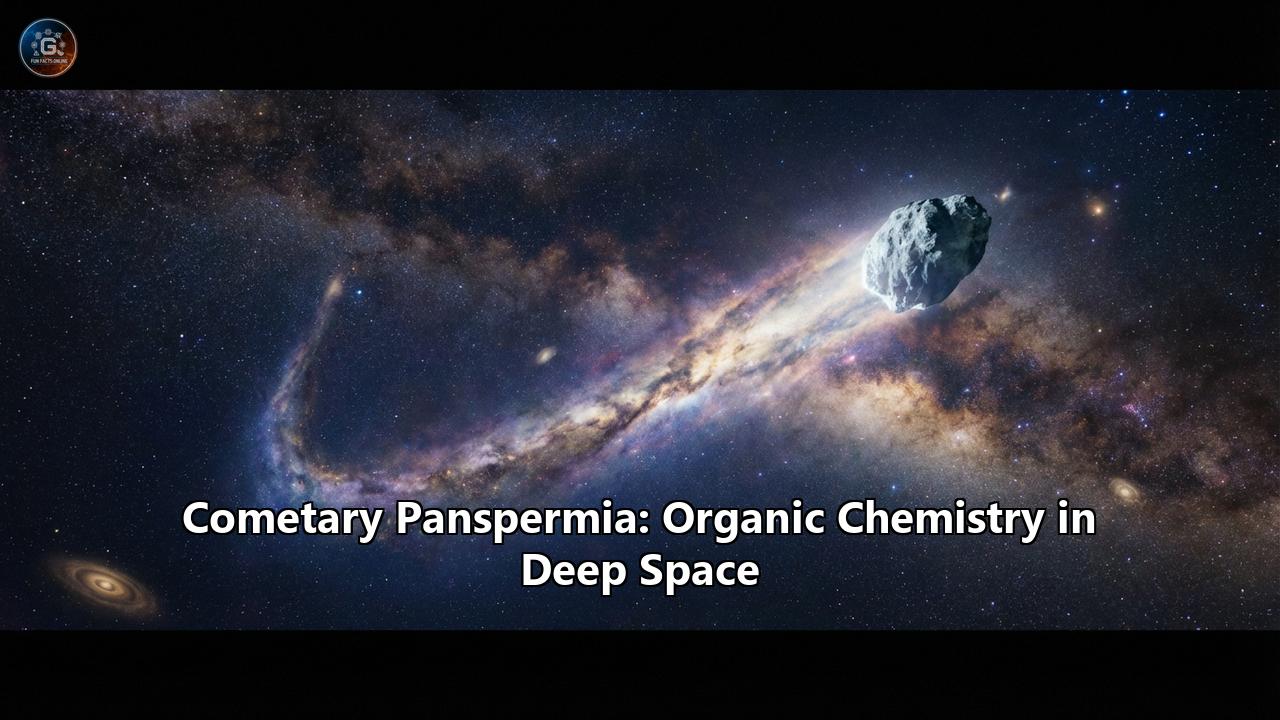
For centuries, we have looked at the night sky and wondered if we are alone. But perhaps we have been asking the wrong question. Instead of asking if life exists elsewhere, we should have been asking if the ingredients for life are universal. The answer, written in the frozen ink of cometary tails and the dusty archives of asteroid surfaces, is a resounding yes. We are not just living in a universe; we are made of it. The boundaries between biology and astronomy are dissolving.
The Cosmic Supply Chain: Redefining Panspermia
The term "panspermia" often conjures images of sci-fi B-movies—alien spores drifting through the void to infect a pristine Earth. However, the modern scientific iteration of this hypothesis is far more subtle and profound. It is known as molecular panspermia or pseudo-panspermia. It does not necessarily argue that living microbes hitched a ride on a meteorite (though that remains a fringe possibility known as lithopanspermia), but rather that the hard molecular work required to jumpstart biology was done long before the Earth even coalesced.
In this view, the early Earth was not a lonely laboratory struggling to invent chemistry from scratch. It was a recipient of a cosmic care package—a steady rain of complex organic molecules synthesized in the deep freeze of interstellar clouds, preserved in the bellies of comets, and delivered via the violent impacts of the Late Heavy Bombardment.
As we stand here in early 2026, the evidence for this cosmic supply chain has shifted from theoretical speculation to hard, physical proof. We have touched the asteroids. We have sniffed the comets. We have peered into the stellar nurseries of neighboring galaxies. And everywhere we look, we find the architecture of life waiting to be assembled.
Part I: The Cold Chemistry of the Void
To understand how a comet becomes a carrier of life's building blocks, we must look further back—to the birth of stars. The story begins in the Dense Molecular Clouds (DMCs), the coldest places in the universe.
The Interstellar Ice Mantle
In regions like the Chamaeleon I molecular cloud, temperatures hover just above absolute zero (around 10 Kelvin). Here, chemistry should theoretically stop. Atoms shouldn't have the kinetic energy to collide and react. Yet, these clouds are chemical factories.
The secret lies in dust grains. Tiny particles of silicates and carbon soot, ejected from dying stars, float through these clouds. They act as gathering points. Hydrogen, oxygen, carbon, and nitrogen atoms freeze onto these grains, forming an "ice mantle."
On the surface of these grains, a unique type of chemistry occurs. "Tunneling" allows hydrogen atoms to pass through energy barriers they shouldn't be able to cross, reacting with other elements to form water ($H_2O$), methane ($CH_4$), and ammonia ($NH_3$). But the real magic happens when Cosmic Rays and UV photons strike these icy grains. They break chemical bonds, creating reactive "radicals" that recombine into larger, more complex structures.
The JWST Revolution: The "Ice Age"
In the early 2020s, the James Webb Space Telescope (JWST) cracked open this hidden world. The "Ice Age" project (searching for ices in the extinction bands of starlight) revealed that these clouds are not just water ice. They are rich in "Complex Organic Molecules" (COMs).
By 2023, astronomers had identified methanol ($CH_3OH$), ethanol, and carbonyl sulfide in the deepest, darkest clouds. These are not biological byproducts; they are abiotic precursors. Methanol, for instance, is a gateway molecule.Irradiate methanol ice, and you get sugars.
Most strikingly, in late 2025, the scientific community was stunned by the detection of acetic acid (vinegar) and methyl formate in the ices surrounding a protostar in the Large Magellanic Cloud (LMC), a satellite galaxy of the Milky Way. This proved that the chemistry of life is not a local quirk of the Milky Way. It is a universal imperative. If a star system forms anywhere, it forms with an inventory of alcohols, acids, and esters already in stock.
Part II: The Cometary Time Capsules
As a molecular cloud collapses to form a star, the dust and ice grains clump together. They form pebbles, then boulders, then planetesimals. In the hot inner solar system, the ices vaporize, leaving behind dry rock (the rocky planets and asteroids). But past the "Snow Line"—somewhere beyond the orbit of Mars—the ices survive.
They gather into comets.
A comet is often described as a "dirty snowball," but a more accurate description would be a "frozen mousse of organic chemistry." For 4.5 billion years, comets have orbited in the Kuiper Belt and the Oort Cloud, preserving the pristine chemistry of the solar nebula.
The Rosetta Legacy and the "Yellow Goo"
The European Space Agency's Rosetta mission (2014–2016) to Comet 67P/Churyumov-Gerasimenko was a turning point. Its lander, Philae, and the orbiter's ROSINA instrument sniffed the coma and found a zoo of organics:
- Glycine: The simplest amino acid, essential for proteins.
- Phosphorus: A key component of DNA and cell membranes.
- High-molecular-weight organics: The surface of 67P was covered in a dark, refractory crust. In the lab, when scientists simulate cometary ice irradiation, they produce a sticky, amber substance dubbed "tholins" or "yellow goo." This goo is rich in complex hydrocarbons.
Rosetta taught us that comets are not just carrying water; they are carrying the soup.
Part III: Touching the Asteroids (The Sample Returns)
While comets are the ideal deep-freeze storage, they are hard to sample and return to Earth. Asteroids, however, are more accessible. We used to think of asteroids as dry rocks and comets as wet ices. We now know there is a continuum. "C-type" (carbonaceous) asteroids are essentially comets that have lost some of their volatiles or formed just inside the snow line. They are the fossilized remains of the primordial supply chain.
The Ryugu Revelation (Hayabusa2)
The Japanese Hayabusa2 mission returned samples from asteroid Ryugu in 2020. The analysis, completed between 2022 and 2024, fundamentally changed our textbooks.
Ryugu is a pile of rubble, a porous dark rock. But inside those grains, protected from the harsh vacuum, chemists found treasure:
- Uracil: One of the four nucleobases of RNA. This was the "smoking gun" that informational molecules can form abiotically.
- Niacin (Vitamin B3): A cofactor for metabolism.
- A Library of Amino Acids: Over 20 different types were found.
- Pyrene: A massive Polycyclic Aromatic Hydrocarbon (PAH).
The presence of PAHs like pyrene is crucial. These honeycomb-like carbon sheets are abundant in interstellar space. Finding them in Ryugu links the asteroid directly to the interstellar clouds we observe with telescopes. The carbon in your body likely spent time as a PAH floating between the stars.
The Bennu Breakthrough (OSIRIS-REx)
In September 2023, NASA’s OSIRIS-REx dropped a capsule containing 121 grams of asteroid Bennu into the Utah desert. By early 2025, the comprehensive analysis was released to the world.
Bennu confirmed everything Ryugu hinted at, but in higher fidelity. The samples were dripping with carbon (nearly 5% by weight). More importantly, they contained water-bearing clays (phyllosilicates). The "organic globules" found in Bennu suggest that the asteroid's parent body had flowing warm water for millions of years.
This is the Aqueous Alteration phase. Inside the early solar system's massive icy bodies, radioactive decay (Aluminium-26) provided heat. The ice melted. The simple organics (methanol, ammonia) dissolved in the warm water and reacted using the clay minerals as catalysts. This was a "hydrothermal vent" in space. This is likely where the simple interstellar molecules were cooked into complex amino acids and sugars before the body shattered and became the asteroids we see today.
Part IV: The Chirality Puzzle
One of the deepest mysteries of life on Earth is Homochirality.
Many organic molecules are "chiral," meaning they have a handedness. They exist in Left-handed (L) and Right-handed (D) forms, like mirror images.
- Abiotic chemistry (making molecules in a beaker) produces a 50/50 mix (racemic).
- Life on Earth is picky: We use only L-amino acids for proteins and only D-sugars for DNA.
If life came from space, did the "handedness" come from space too?
The Ryugu samples analyzed in 2023 were mostly racemic (50/50). This was a blow to the idea that all asteroids carry pre-sorted chiral molecules. However, the famous Murchison Meteorite (which fell in 1969) does show a slight excess of L-amino acids.
Why the difference? The answer may lie in Circularly Polarized Light (CPL).
In star-forming regions, magnetic fields can polarize UV light. This "corkscrew" light interacts differently with L and D molecules. It might destroy D-molecules slightly faster than L-molecules. Over millions of years, an interstellar cloud bathed in CPL would develop a slight "L-excess."
If a comet forms in that specific region, it inherits that excess. If it forms elsewhere, it doesn't. This suggests that the solar nebula was a patchwork of chiral environments. We might be "Left-Handed" simply because the specific comet that seeded the early Earth originated in a CPL-illuminated sector of the nebula.
Recent experiments in 2024 utilizing magnetite surfaces have also shown a "Spin-Selective" effect. Electrons moving through chiral molecules have a preferred spin. When crystallizing on magnetic minerals (common in asteroids), this quantum effect can amplify a tiny imbalance into a total dominance of one hand over the other.
Part V: The Delivery (Impact Synthesis)
It is one thing to have amino acids on a comet; it is another to get them safely to Earth's surface. A cometary impact is a cataclysmic event, releasing energy equivalent to millions of nuclear bombs. Wouldn't the molecules just burn up?
Paradoxically, the violence might be helpful. This is Shock Synthesis.
When a comet strikes, the extreme pressure and temperature last for only a fraction of a second. Computer simulations and hypervelocity gun experiments show that while some molecules are destroyed, others are broken into radicals that immediately snap back together into larger structures.
- Impacts can turn simple amino acids into peptides (short chains of proteins).
- The shockwave can fuse nucleobases into PNA (Peptide Nucleic Acid) backbones.
Furthermore, not every arrival is a dinosaur-killer. We now understand the importance of Cosmic Dust. Earth sweeps up roughly 40,000 tons of interplanetary dust every year. These micrometeorites act as "soft landers," gently floating down through the atmosphere, delivering their organic payload intact.
Part VI: The New Interstellar Visitors
For decades, we studied our comets. Then, in 2017, 'Oumuamua passed through. Then 2I/Borisov in 2019. These were interstellar objects—messengers from other stars.
Borisov looked reassuringly like our comets: it vented cyanide and carbon monoxide. It confirmed that the chemistry of our solar system is not unique.
Now, in February 2026, the focus has shifted to the new generation of surveys. The SPHEREx mission and the Vera Rubin Observatory are beginning to map the sky. The recent detection of the object 3I/ATLAS (observed flaring in late 2025) has provided us with a fresh data point. Its spectrum shows the same hydrocarbon fingerprints we see in the Orion Nebula and in Comet Halley.
The galaxy is teeming with these seeds. Estimates suggest that for every star in the Milky Way, there are ejected comets drifting through the void. We are swimming in a sea of frozen potential.
Part VII: Implications for Life Elsewhere
If cometary panspermia is the mechanism for the origin of life, the implications are staggering.
- Mars: Early Mars was wet and bombarded by the same comets as Earth. It received the same care package. If life didn't start there, it wasn't for lack of ingredients. The search for biosignatures by the Rosalind Franklin and Perseverance rovers is essentially a check on the "activation energy" of the panspermia hypothesis.
- Europa and Enceladus: These icy moons are built from cometary material. They have subsurface oceans. They have hydrothermal vents. They are the "comet soup" kept warm and stirred for billions of years.
- Exoplanets: When we see an Earth-sized planet in the habitable zone of another star, we now know it likely received organic delivery. The JWST detection of COMs in the LMC galaxy means this holds true even outside the Milky Way.
Conclusion: We Are Star Stuff, Delivered by Ice
The old view of the origin of life was a localized event: a warm pond on Earth, a stroke of lightning, and a lucky roll of the dice.
The new view is a cosmic collaborative effort.
- Carbon was forged in the hearts of dying stars.
- Organics were synthesized in the freezing silence of molecular clouds.
- Chirality was selected by the twist of starlight.
- Complexity was cooked in the warm interiors of water-rich asteroids.
- Delivery was achieved via the thunder of cometary impacts.
We are not separate from the cosmos. The distinct boundary we draw between "rock" and "life" is an illusion of timescale. Rock, given enough time, water, and cometary infall, becomes life.
As we analyze the grains of Ryugu and Bennu in our labs today, we are holding the physical receipts of our creation. We are looking at the molecular bridge that spans the gap between the Big Bang and the first heartbeat. The universe did not just create the stage for life; it wrote the script and provided the props. All Earth had to do was raise the curtain.
Reference:
- https://www.youtube.com/watch?v=_DoSoYT3iJM
- https://www.sciencenews.org/article/building-block-life-asteroid-ryugu
- https://www.skyatnightmagazine.com/space-science/panspermia-life-theory
- https://www.gadgets360.com/science/news/nasa-telescope-spots-interstellar-comet-3i-atlas-flaring-with-water-and-organics-while-leaving-solar-system-10974282
- https://www.eurekalert.org/news-releases/1102600
- https://www.insu.cnrs.fr/en/cnrsinfo/jwst-reveals-hidden-chemistry-pre-stellar-ice
- https://www.labroots.com/trending/space/24585/jwst-uncovers-mysteries-pre-stellar-ice-chemistry
- https://www.earth.com/news/organic-molecules-found-throughout-universe-hint-life-began-in-deep-space/
- https://www.space.com/astronomy/james-webb-space-telescope/jwst-makes-1st-ever-detection-of-complex-organic-molecules-around-star-in-galaxy-beyond-our-milky-way
- https://www.universetoday.com/articles/samples-of-asteroid-ryugu-contain-more-than-20-amino-acids
- https://pubmed.ncbi.nlm.nih.gov/36944653/
- https://www.global.hokudai.ac.jp/news/14447/
- https://www.sciencedaily.com/releases/2024/10/241024145311.htm
- https://chiralpedia.com/blog/chirality-in-space-cosmic-asymmetry-and-the-origins-of-life/
- https://www.spacedaily.com/reports/New_study_provides_novel_insights_into_the_cosmic_evolution_of_amino_acids_999.html
- https://www.sciencedaily.com/releases/2011/01/110107145634.htm
- https://astrobiology.nasa.gov/news/in-search-of-panspermia/
- https://www.mdpi.com/2075-1729/14/3/341