
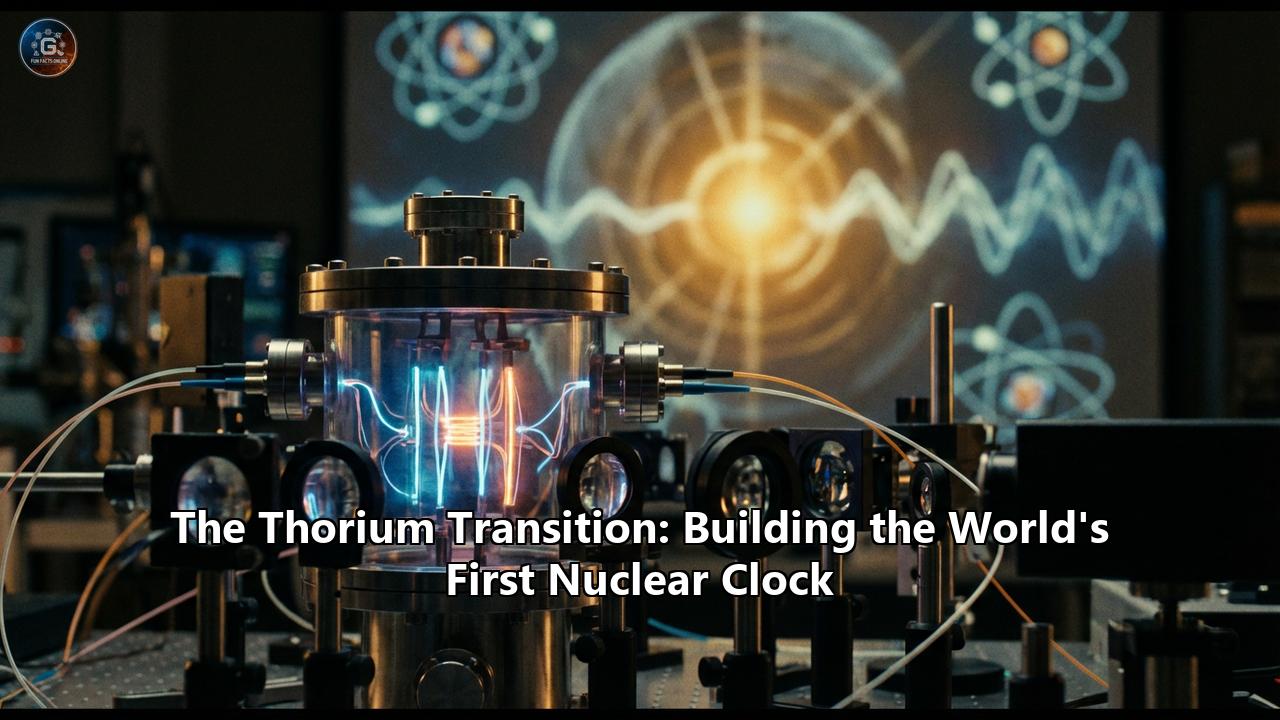
In the quiet hum of a laboratory at JILA, a joint institute of the National Institute of Standards and Technology (NIST) and the University of Colorado Boulder, the definition of a "second" just got a lot more interesting. For decades, humanity has marched to the beat of the atomic clock—a device so precise it would only lose a second every few hundred million years. But in September 2024, a team of physicists shattered that ceiling. They didn't just build a better atomic clock; they successfully demonstrated the core technology for a nuclear clock.
This is not merely an incremental upgrade. It is a paradigm shift—a transition from measuring the dance of electrons on the surface of an atom to measuring the heartbeat of the atom’s dense, protected core. It is a breakthrough that promises to revolutionize everything from GPS navigation to our understanding of the fundamental fabric of the universe, potentially unlocking secrets about dark matter and the constants of nature.
The Relentless Pursuit of the Tick
To understand the magnitude of this achievement, we must first look at the history of time itself. For most of human existence, time was astronomical. We looked to the rotation of the Earth (the day) and its orbit around the sun (the year). We built sundials, water clocks, and eventually mechanical pendulums to slice these celestial cycles into manageable human increments.
But the Earth is a terrible timekeeper. It wobbles. It slows down due to tidal friction. It is geologically alive and inconsistent. In the 20th century, we realized that to measure the universe truly, we needed a reference that was immune to the vagaries of planetary motion. We needed something universal, immutable, and identical everywhere. We found it in the atom.
The Atomic StandardCurrent atomic clocks work by measuring the frequency of electrons jumping between energy levels in an atom—usually Cesium-133. When you expose a cesium atom to microwave radiation at a very specific frequency (9,192,631,770 Hertz), its outermost electron makes a "quantum leap" between two hyperfine energy states. We define one second as exactly 9,192,631,770 of these oscillations.
This "tick" is incredibly stable because it is determined by the laws of quantum mechanics, not by gears or springs. However, even atoms are not perfect. The electrons orbit far from the nucleus, making them sensitive to external electromagnetic fields, temperature fluctuations, and collisions with other atoms. To keep today's best optical atomic clocks accurate, physicists must trap individual atoms in vacuum chambers, cool them to near absolute zero with lasers, and shield them heavily from the environment.
We had hit a wall. To get more precise, we needed a pendulum that was naturally protected from the noise of the world.
The Nuclear Solution: A Clock in a Bunker
The nucleus of an atom is about 100,000 times smaller than the electron cloud that surrounds it. It is held together by the strong nuclear force, the most powerful force in nature. Because it is so small and so tightly bound, the nucleus is naturally shielded from external interference. Stray magnetic fields and thermal noise that would send an electron spiraling off course barely register to the nucleus.
A clock based on the "ticking" of a nucleus—switching between nuclear energy states—would be fundamentally more robust and precise than any electronic atomic clock. It would be like moving your timekeeping pendulum from a windy front porch (the electron shell) to a deep, concrete-lined underground bunker (the nucleus).
There was just one problem: Energy.
In almost every element in the periodic table, the energy required to excite a nucleus is enormous. To get a nucleus to "tick" (jump energy states), you typically need high-energy X-rays or gamma rays. We don't have lasers that can produce coherent X-rays with the control needed for a clock. We can't simply "tune" a gamma-ray burst. For decades, the nuclear clock remained a theoretical dream because the energy key required to wind it was too heavy for us to lift.
The Thorium Anomaly: Nature’s Gift to Metrology
Enter Thorium-229.
Among the thousands of known isotopes, Thorium-229 is a freak of nature. It possesses a nuclear excited state (an isomer) that is tantalizingly close to its ground state. The energy difference is not measured in kilo-electron volts or mega-electron volts like other nuclei, but is a mere 8.3557 electron volts.
This is shockingly low. It corresponds to the energy of ultraviolet (UV) light. This is a crucial distinction because humanity has developed lasers that operate in the UV range. Thorium-229 is the only nucleus known to science that can be excited by a laser. It is the only "keyhole" in the nuclear fortress that we can reach with our current technological keys.
The existence of this state was predicted nearly 50 years ago, but finding the exact frequency was a scientific "needle in a haystack" search that spanned decades. Because the transition is so narrow and specific, you have to hit it with exactly the right color of UV light. If you are off by a fraction of a nanometer, nothing happens.
For years, researchers at institutes like LMU Munich, TU Wien, and JILA circled the target.
- 2016: The first direct detection of the Thorium-229 isomer’s decay confirmed its existence but couldn't pinpoint the precise energy.
- 2023: Researchers finally measured the energy well enough to know roughly where to aim their lasers.
- September 2024: The breakthrough.
The September 2024 Breakthrough
The experiment that made headlines involved a collaboration between the Vienna Center for Quantum Science and Technology (TU Wien) and JILA.
Unlike traditional atomic clocks, where atoms float in a vacuum, the team used a solid-state crystal. They took a crystal of calcium fluoride—a transparent, durable material—and "doped" it with billions of Thorium-229 nuclei. Because the nucleus is so insensitive to its environment, the crystal lattice (which would ruin a normal atomic clock) doesn't disturb the nuclear tick.
The Setup:- The Crystal: A fingernail-sized crystal containing the thorium was placed in the path of a laser.
- The Frequency Comb: To hit the ultra-precise UV note required to excite the thorium, the team used a "frequency comb." Invented by Nobel laureates (including JILA's own Jan Hall), a frequency comb acts like a ruler for light. It creates hundreds of thousands of perfectly spaced laser frequencies.
- The Strontium Master: They linked this setup to one of the world's most precise existing clocks—the JILA strontium lattice atomic clock. The strontium clock provided the stable reference "ruler," and the frequency comb converted that stability into the UV light needed for the thorium.
The researchers scanned their UV laser across the predicted frequencies. Suddenly, the thorium nuclei responded. They absorbed the light and jumped to their excited isomeric state. The team had successfully established a "frequency link" between a standard atomic clock and the nuclear transition.
They measured the frequency of the "thorium tick" with unprecedented precision: 2,020,407,384,335 kilohertz.
While this prototype is not yet a standalone clock (it currently relies on the strontium clock to keep the laser steady), it proved the concept works. It demonstrated that we can drive a nuclear transition with a laser and count the ticks.
Why This Changes Everything
A fully operational nuclear clock offers advantages that go far beyond just "knowing the time better."
1. Unmatched Precision and StabilityWhile the best atomic clocks lose a second every 30 billion years, a mature nuclear clock could theoretically run for the age of the universe without losing a beat. This stability is crucial for deep space navigation. Currently, spacecraft rely on signals sent from Earth to determine their position. A nuclear clock is robust and solid-state (literally a crystal chip), meaning it could be put on a spaceship. A spacecraft with its own nuclear clock could navigate autonomously to the edge of the solar system with millimeter precision.
2. The Search for Dark MatterThis is where the physics gets wild. We know dark matter exists because of its gravitational pull on galaxies, but we have never detected it directly. Some theories suggest that dark matter might interact with ordinary matter not just through gravity, but through tiny, subtle shifts in the fundamental constants of nature.
Because the thorium transition is determined by the interplay of the strong nuclear force and electromagnetism, it is incredibly sensitive to changes in these forces. If a wave of dark matter passed through the Earth, it might "jiggle" the tick of a nuclear clock in a way that differs from an electronic atomic clock. By comparing the two, we could turn the nuclear clock into a dark matter detector.
3. Are the Constants Constant?Physics relies on numbers like the "fine-structure constant" (alpha), which determines the strength of the electromagnetic force. We assume this number is fixed everywhere in space and time. But is it? Some theories of the early universe suggest it might drift over billions of years.
A nuclear clock is roughly 10,000 times more sensitive to changes in the fine-structure constant than an atomic clock. By monitoring the ratio of the nuclear tick to the electronic tick over a few years, scientists could test the stability of the universe's fundamental laws with accuracy never before possible.
4. Relativistic GeodesyEinstein’s theory of general relativity tells us that time passes slower closer to a massive object (gravity). This means a clock on the floor ticks slower than a clock on a table. Current atomic clocks are sensitive enough to detect a change in height of about one centimeter.
A nuclear clock could be sensitive enough to detect height changes of less than a millimeter. This would turn the clock into the ultimate sensor for Earth sciences. We could measure the lifting of continents in real-time, detect the swelling of magma chambers before volcanoes erupt, or monitor rising sea levels with microscopic accuracy—all by measuring the warping of time itself.
The Road Ahead
We are not quite at the finish line. The device built in September 2024 is a prototype. It successfully excited the nucleus and measured the frequency, but it hasn't yet "closed the loop" to run autonomously as a clock. The next steps involve:
- Improving the Laser: Developing portable, ultra-stable UV lasers that can lock onto the thorium frequency without needing a room-sized strontium clock as a guide.
- Crystal Purity: Refining the calcium fluoride crystals to ensure the thorium nuclei are perfectly arranged, maximizing the signal clarity.
- Cooling: While the nucleus is shielded, cooling the crystal further will reduce remaining thermal noise, pushing precision to the theoretical limit.
Conclusion: The Nuclear Age of Time
The transition from the pendulum to the quartz crystal gave us modern electronics. The transition from quartz to the atom gave us GPS and the internet. The transition from the atom to the nucleus promises to give us a window into the deepest mysteries of physics.
The "Thorium Transition" is no longer just a dot on a chart of isotopes. It is a working machine. We have successfully picked the lock of the atomic nucleus, and inside, we found the rhythm of the universe. The world's first nuclear clock is no longer science fiction; it is an engineering challenge, and the countdown has already begun.
Reference:
- https://www.sciencealert.com/breakthrough-scientists-create-worlds-first-nuclear-clock-prototype
- https://www.sciencenews.org/article/nuclear-clock-thorium-physics
- https://www.tuwien.at/en/tu-wien/university-life/news/news/die-erste-atomkern-uhr-der-welt
- https://www.nist.gov/news-events/news/2024/09/major-leap-nuclear-clock-paves-way-ultraprecise-timekeeping
- https://www.tuwien.at/en/all-news/news/die-erste-atomkern-uhr-der-welt
- https://www.popsci.com/technology/nuclear-clock/
- https://www.azom.com/article.aspx?ArticleID=24834
- https://en.wikipedia.org/wiki/Nuclear_clock
- https://jila.colorado.edu/node/31643
- https://www.semanticscholar.org/paper/Frequency-ratio-of-the-229mTh-nuclear-isomeric-and-Zhang-Ooi/f44772e2c27e9a257f79dc9b8dbe753a098b03bf
- https://thoriumclock.eu/uncategorized/the-first-ultra-precised-nuclear-clock-is-built/
- https://jila.colorado.edu/news-events/articles/moving-nuclear-timekeeping-domain
- https://www.sciencefocus.com/future-technology/nuclear-clocks
- https://www.researchgate.net/publication/333768488_The_229-thorium_isomer_doorway_to_the_road_from_the_atomic_clock_to_the_nuclear_clock
- https://physics.stackexchange.com/questions/383955/what-makes-the-thorium-229-nuclear-transition-special
- https://www.researchgate.net/publication/349609178_The_thorium-229_low-energy_isomer_and_the_nuclear_clock
- https://physicsworld.com/a/excitation-of-thorium-229-brings-a-working-nuclear-clock-closer/
- https://pmc.ncbi.nlm.nih.gov/articles/PMC11637039/
- https://fys.kuleuven.be/nuclear_clock_thorium-229
- https://www.smithsonianmag.com/smart-news/worlds-first-ultra-precise-nuclear-clock-is-within-reach-after-major-breakthrough-researchers-say-180985048/