
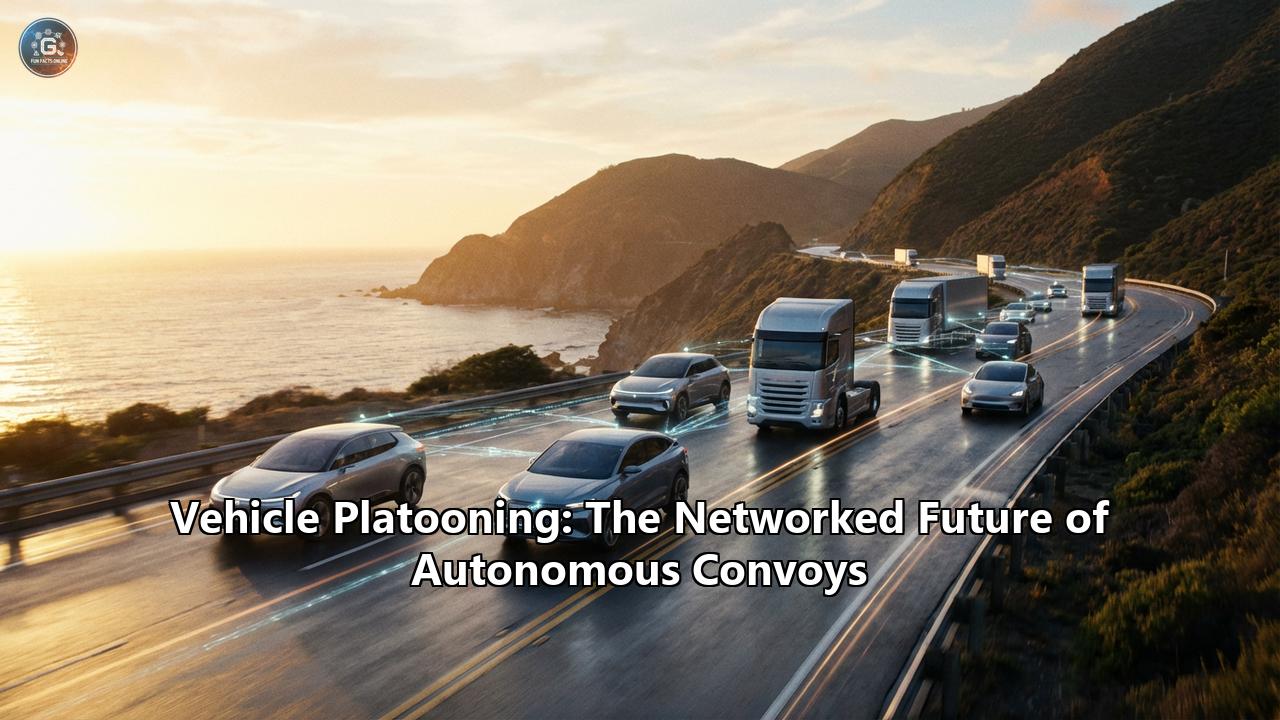
Imagine a desolate stretch of Interstate 80 at two in the morning. A convoy of three massive, 80,000-pound Class 8 semi-trucks hurtles down the asphalt at 65 miles per hour. Visually, they look like any other freight trucks, but a closer inspection reveals something extraordinary: the distance between them is a mere 30 feet, a gap that would be suicidal for human drivers at such speeds. In the lead truck, a driver monitors the road, hands resting lightly near the wheel. In the two trailing trucks, the driver's seats are empty, or the drivers are resting, reading, or logging off for the night. The trucks brake, accelerate, and steer in perfect, telepathic unison, functioning not as three separate vehicles, but as a single, multi-segmented organism.
This is not a scene from a science fiction film; it is the reality of vehicle platooning in the modern era.
As global supply chains face unprecedented pressure, fuel costs remain volatile, and environmental regulations tighten, vehicle platooning has emerged as one of the most transformative developments in the history of transportation. By bridging the gap between advanced aerodynamics, artificial intelligence, and instantaneous digital communication, platooning represents the networked future of autonomous convoys. It is a paradigm shift that is actively rewriting the rules of logistics, redefining road safety, and paving the way for fully autonomous highways.
To truly grasp the magnitude of this revolution, we must look under the hood of the technology, examine the profound economic and environmental benefits, and navigate the complex roadblocks that stand between today's driver-assisted convoys and tomorrow's fully autonomous freight networks.
The Mechanics of the Hive Mind: How Platooning Works
At its core, vehicle platooning is the linking of two or more vehicles in convoy using state-of-the-art connectivity technologies and automated driving support systems. These vehicles automatically maintain a set, close distance between each other, communicating real-time data to ensure synchronized movement.
The magic of platooning lies in its ability to eliminate the most unpredictable element of driving: human reaction time. A human driver takes roughly 1.5 seconds to perceive a hazard and apply the brakes. At 65 mph, a truck travels over 140 feet before the brakes even engage. In a platoon, the digital reaction time is measured in milliseconds. If the lead truck detects an obstacle and applies the brakes, the trailing trucks brake simultaneously, maintaining the gap with robotic precision.
This "hive mind" is made possible by a convergence of several critical technologies:
1. Vehicle-to-Vehicle (V2V) and Vehicle-to-Everything (V2X) CommunicationThe lifeblood of a platoon is its communication network. V2V technology allows vehicles to broadcast and receive data regarding speed, heading, braking status, and acceleration up to ten times per second. Moving beyond V2V, V2X encompasses communication with infrastructure (V2I), such as traffic lights and toll booths, and the broader cloud network. Driven by 5G and early 6G networks, this ultra-reliable, low-latency communication (URLLC) ensures that the electronic tether connecting the convoy is never broken. As of 2025, V2V communication accounted for over 57% of the platooning technology market, supported by thousands of new technological patents focused on creating unhackable, instantaneous data streams.
2. Cooperative Adaptive Cruise Control (CACC)Traditional Adaptive Cruise Control (ACC) uses radar to maintain a safe distance from the vehicle ahead. Cooperative Adaptive Cruise Control (CACC) takes this a step further by integrating V2V data. Instead of reacting to the physical presence of the vehicle in front, CACC reacts to the digital intent of the lead vehicle. When the lead truck decides to brake, the command is sent to the trailing trucks’ powertrain and braking systems before the lead truck even begins to physically slow down.
3. Sensor Fusion: LiDAR, Radar, and Machine VisionWhile V2V handles the coordination, the trucks must still understand their physical environment. A robust suite of sensors acts as the eyes of the platoon. Radar penetrates fog and rain to measure distance and velocity, LiDAR paints a high-definition 3D map of the surroundings using laser pulses, and high-resolution optical cameras read lane markings, traffic signs, and erratic movements from non-connected passenger cars.
4. Quantum and Predictive AI AlgorithmsAs we push deeper into the late 2020s, the algorithms governing platoons are becoming astonishingly complex. Researchers are now employing advanced predictive models, such as Quantum Long Short-Term Memory (QLSTM) neural networks. These models analyze historical data, road topography, and real-time sensor inputs to predict the future vehicle dynamics of the lead truck. This allows the trailing vehicles to adjust their behavior dynamically, optimizing control strategies, maintaining "string stability" (preventing the slinky-effect of delayed braking), and ensuring maximum fuel efficiency regardless of weather or road gradient.
The Driving Forces: Why Platooning is Taking Over
The explosive growth of the truck platooning market—projected to surge from roughly $200 million globally in 2026 to over $1.16 billion by 2035, and nearing $7.9 billion in the U.S. alone by 2036—is not being driven by novelty. It is being driven by cold, hard economics and an urgent environmental mandate.
Aerodynamic Alchemy and Fuel Economics
The physical principle behind platooning is "slipstreaming" or "drafting"—a concept well-known to professional cyclists and stock car racers. When a large blocky object, like a Class 8 semi-truck, moves through the air at highway speeds, it pushes a massive wall of air out of the way, creating a high-pressure zone in the front and a turbulent, low-pressure wake in the rear. This aerodynamic drag forces the engine to burn massive amounts of diesel simply to maintain speed.
When trucks link up in a platoon, the aerodynamic profile changes drastically. The lead truck still breaks the air, but the trailing trucks tuck into the low-pressure wake, virtually eliminating their frontal air resistance. Surprisingly, the lead truck benefits as well; the presence of the trailing truck smooths out the turbulent wake behind the leader, reducing rear drag.
The real-world savings are staggering. Studies and real-world pilot programs reveal that the lead truck experiences fuel savings of around 4% to 5%, while the trailing trucks can see efficiency improvements of 8% to 13%, and sometimes up to 17% in highly optimized corridors. In the fiercely competitive logistics sector, where fuel is a primary operational expense, these margins represent the difference between struggling and thriving. At an average diesel price of $4 per gallon, a two-truck platoon traveling 100,000 miles annually could save a following truck up to $12,000 a year. When extrapolated across fleets of thousands of trucks, the financial incentive becomes undeniable.
The Environmental Imperative
The transportation sector is one of the largest contributors to global greenhouse gas (GHG) emissions. In regions like the European Union and the United States, heavy-duty vehicles account for a disproportionate amount of transportation-related CO2 emissions. For example, heavy-duty trucks account for about 30% of CO2 emissions from road transport in the EU, despite making up a small fraction of total vehicles.
Platooning offers an immediate, actionable solution to this crisis. Tests by major manufacturers have confirmed up to 12% overall emission savings by minimizing aerodynamic drag. System dynamic modeling indicates that the widespread adoption of platooning in the United States alone could save nearly 292 million metric tons of CO2 emissions within 15 years of its introduction. As governments enforce stringent regulations—such as the EU's demand for a 15% reduction in CO2 emissions by 2025—logistics companies are turning to platooning not just to save money, but to remain legally compliant.
Shattering the Supply Chain Bottleneck
The global logistics network has been strained by a chronic and worsening driver shortage. In 2025, the American Trucking Associations (ATA) projected a deficit of over 80,000 drivers in the US alone, with similar labor crunches causing port delays across Europe and the Asia-Pacific. The lifestyle of a long-haul trucker—weeks away from home, grueling hours, and high stress—has made recruitment incredibly difficult.
Platooning, particularly in its more autonomous phases, provides a powerful pressure release valve. In Driver-Assistive Truck Platooning (DATP) configurations, drivers in trailing trucks can theoretically switch to "rest mode," allowing their hours-of-service clocks to pause while the vehicle continues moving. This enables a convoy to run 24/7 without violating labor laws or compromising human well-being. By amplifying the productivity of a single driver, fleets can move significantly more freight with fewer personnel, directly combatting the labor shortage.
Safety: Eradicating Human Error
Human error—distraction, drowsiness, and delayed reaction time—is the primary cause of over 90% of road accidents. A 40-ton truck colliding with passenger vehicles is often catastrophic.
Platooning systems support the driver by providing superhuman reaction capabilities. Advanced safety features such as Forward Collision Warning (FCW), Lane Keep Assist (LKA), and Active Braking Systems are foundational to the platoon. In the event of a sudden obstruction, the digital tether ensures that the entire convoy decelerates simultaneously, eliminating the risk of rear-end collisions within the platoon and drastically reducing the likelihood of striking external obstacles. The National Highway Traffic Safety Administration (NHTSA) suggests that widespread adoption of these automated technologies could eventually reduce highway trucking accidents by up to 90%.
The Current Landscape: The Era of DATP
While the ultimate vision is a highway populated by fully uncrewed robot trucks, the reality of the mid-2020s is firmly rooted in Driver-Assistive Truck Platooning (DATP). As of 2025, DATP dominated the market with a massive 95.1% share, and for good reason.
Fully autonomous operations require immaculate road infrastructure, perfectly predictable traffic patterns, and comprehensive regulatory approval—none of which currently exist on a global scale. DATP sidesteps these hurdles by keeping a human in the loop. In a DATP setup, a highly trained human driver operates the lead truck, making complex decisions regarding navigation, lane changes, and interaction with unpredictable passenger vehicles. The trailing trucks, while capable of autonomous following, braking, and steering, also have human drivers behind the wheel ready to take control in the event of a system failure, extreme weather, or when the platoon needs to decouple to exit the highway.
Major industry players such as Volvo Group, Daimler Truck, MAN Truck & Bus, and specialized tech firms like Peloton Technology have successfully transitioned from closed-track testing to real-world deployment. Pilot programs across the U.S. I-80 corridor, the Texas freight triangle, and Europe's A2 route have proven the viability of the technology. Cross-border convoys are actively moving goods from inland manufacturing hubs directly to major ports, validating fuel savings of 10% to 14% in active, mixed-traffic environments.
Roadblocks and Speed Bumps: The Challenges Ahead
Despite the momentum, the road to widespread, fully autonomous platooning is fraught with significant technical, regulatory, and social challenges.
1. The Cybersecurity ThreatA wirelessly connected convoy of 40-ton vehicles is a prime target for cyber-attacks. Increased vehicle connectivity inevitably exposes platooning systems to potential data breaches, signal jamming, or malicious hacking. If a bad actor were to spoof the V2V signal, they could theoretically force trailing trucks to brake abruptly or accelerate dangerously. To combat this, the industry is investing heavily in military-grade encryption, decentralized edge computing, and redundant analog fail-safes. The goal is to ensure that even if the V2V link is severed, the onboard radar and LiDAR systems can immediately bring the truck to a safe, controlled stop.
2. The Regulatory and Infrastructure QuagmireLogistics is inherently borderless, but regulations are not. In the United States, a truck traveling from California to New York passes through dozens of different state jurisdictions, each with its own Department of Transportation rules regarding following distances, automated driving systems, and liability. While some states have embraced platooning as a tool for economic growth, others retain laws strictly forbidding trucks from tailgating. Creating a unified, standardized legal framework is one of the highest hurdles facing the industry. Furthermore, legacy infrastructure—such as poorly marked lanes, narrow bridges, and archaic weigh stations—must be upgraded to interface seamlessly with V2I technologies.
3. The Mixed-Traffic ConundrumFor the foreseeable future, autonomous truck platoons will have to share the road with human-driven passenger cars. Human drivers are erratic; they speed, weave, and make unpredictable decisions. One of the most dangerous scenarios for a platoon is the "cut-in," where a passenger car attempts to merge into the small 30-foot gap between two platooning trucks. Advanced systems must be programmed not just to maintain distance, but to intuitively recognize aggressive human driving behaviors, temporarily break the platoon to allow a car to merge, and seamlessly reconnect once the path is clear. Handling dynamic traffic swiftly and accurately without jeopardizing the stability of the platoon is a major area of ongoing research.
4. Weather and Environmental ExtremesWhile AI is brilliant in clear, sunny conditions, its reliability plummets in blinding snowstorms, torrential rain, or heavy fog. Optical cameras can be blinded by glare or caked with mud, and LiDAR lasers can scatter when they hit snowflakes. While 2025 sensor technologies have achieved 95% reliability in adverse conditions, the remaining 5% represents a critical gap. Until sensor fusion algorithms can flawlessly interpret reality in a blizzard, platoons will remain dependent on human intervention during severe weather.
Beyond Freight: Expanding into Urban Transit and Passenger Mobility
While Class 8 freight trucks are the undisputed vanguard of the platooning revolution due to the massive economic incentives, the technology is beginning to bleed into other sectors.
The automotive platooning system market is rapidly expanding to include light-duty delivery trucks, ride-sharing fleets, and public transportation. In densely populated urban corridors, light-duty trucks are running pilot programs to optimize last-mile delivery operations, synchronize with smart traffic lights, and alleviate inner-city congestion.
Furthermore, the concept of "dynamic passenger platooning" is gaining traction among automotive designers. Imagine a future where individual autonomous pods—hired by commuters via an app—physically or virtually link up on the highway to form a temporary high-speed train, sharing aerodynamic benefits and drastically reducing traffic jams, before uncoupling to deliver each passenger to their specific destination. This blurs the line between personal vehicle ownership and mass transit, offering the privacy of a car with the efficiency of a bullet train.
The Road to 2035: The Fully Autonomous Ecosystem
As we look toward the horizon of 2030 and 2035, the nature of platooning will undergo a radical evolution. The DATP models of today will give way to Level 4 and Level 5 fully autonomous operations.
By the early 2030s, we will see the establishment of dedicated autonomous freight corridors. On these intelligent highways, infrastructure will actively communicate with platoons, dynamically routing them around construction, accidents, and weather anomalies. AI-driven logistics platforms will act as air traffic control for trucks, dynamically forming and dissolving platoons on the fly. A truck carrying microchips from Austin might merge with a truck carrying produce from the Rio Grande Valley on I-35, traveling together in an aerodynamically perfect slipstream for 500 miles, before decoupling at a highway interchange to head to their respective distribution centers.
The widespread rollout of Edge Computing will allow platoons to process massive data loads locally rather than relying purely on cloud servers, effectively eliminating latency. Zero-mass active flow control technologies—such as utilizing manipulated airflows and smart aerodynamics on the vehicles themselves—will further optimize drag reduction without the need for dangerous proximity, solving the risk of instability caused by external crosswinds.
Ultimately, the workforce will shift. While fears of job displacement are valid, the transition will be gradual. By 2035, the "truck driver" will evolve into a "fleet manager" or "logistics technician," overseeing the health and software of autonomous convoys from remote command centers, much like drone operators today.
The Networked Horizon
Vehicle platooning is far more than a simple exercise in tailgating. It is a highly sophisticated, multi-disciplinary engineering marvel that addresses the core crises of modern logistics: soaring fuel costs, environmental degradation, massive supply chain bottlenecks, and the devastating human toll of highway accidents.
As the digital threads connecting our vehicles grow stronger, the physical distances between them will shrink. The autonomous convoys of tomorrow will move across continents like blood through veins—silent, efficient, and perfectly synchronized. We are witnessing the end of the solitary driver fighting against the wind, and the dawn of the networked hive, moving as one toward a smarter, safer, and cleaner future.
Reference:
- https://www.sia-partners.com/system/files/document_download/file/2020-06/insight_platooning_-_benefits_drawbacks_and_future_outlook.pdf
- https://www.grandviewresearch.com/industry-analysis/truck-platooning-market
- https://www.freightamigo.com/en/blog/logistics/the-future-of-trucking-when-will-automation-revolutionize-the-industry/
- https://marksparksolutions.com/reports/us-truck-platooning-market
- https://www.gminsights.com/industry-analysis/truck-platooning-market
- https://www.computer.org/csdl/journal/oj/2025/01/10783047/22xb3u9rsXe
- https://www.coherentmarketinsights.com/market-insight/truck-platooning-market-5707
- https://www.preprints.org/frontend/manuscript/f6306f01330028f276de34e0d7969d3c/download_pub
- https://www.researchgate.net/publication/383571942_Automated_Vehicle_Platooning_A_Two-Stage_Approach_Based_on_Vehicle-Road_Cooperation
- https://www.futuremarketreport.com/industry-report/automotive-platooning-system-market