
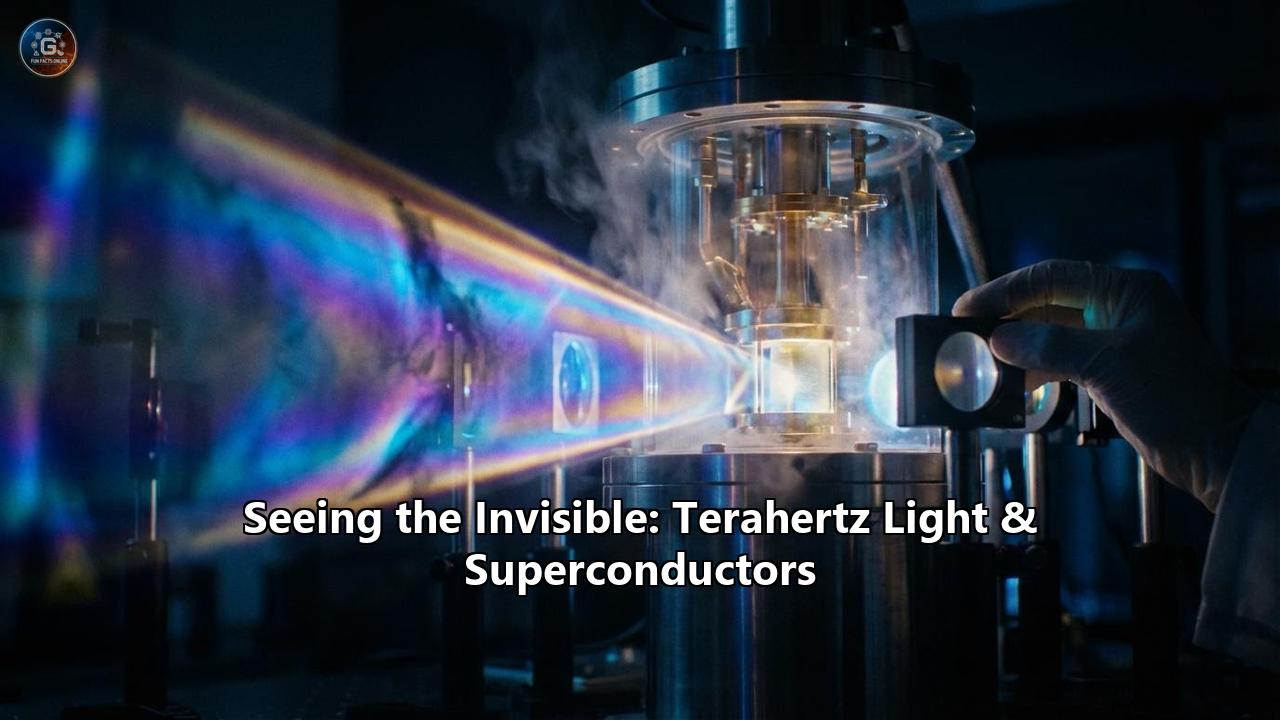
Imagine a realm of the electromagnetic spectrum that sits quietly between the warming glow of infrared and the ubiquitous hum of microwaves. This is the terahertz (THz) gap. For decades, it remained one of the most elusive frontiers in modern physics—a band of light oscillating over a trillion times per second, notoriously difficult to generate, manipulate, and detect. Yet, this "invisible light" holds the key to unlocking some of the deepest mysteries of quantum mechanics. When terahertz light meets superconductors—materials capable of conducting electricity with absolutely zero resistance—a spectacular synergy occurs.
By merging the unique properties of the terahertz gap with the frictionless quantum world of superconductors, scientists are not merely observing matter; they are bending it to their will. From squeezing light down to microscopic dimensions to observe the "jiggle" of a frictionless electron fluid, to firing precisely tuned laser pulses to induce room-temperature superconductivity, the intersection of terahertz light and superconductors is rewriting the rules of condensed matter physics.
The Terahertz Sweet Spot and the Quantum Chill
To understand why terahertz light and superconductors are a match made in quantum heaven, we must look at their fundamental energy scales. Terahertz radiation vibrates at a rhythm that perfectly matches the natural jiggling of atoms, molecules, and electrons inside crystalline materials. Much like radio waves and visible light, terahertz radiation is non-ionizing, meaning it does not carry enough energy to strip electrons from atoms or damage delicate biological tissue. It can effortlessly pass through plastics, ceramics, cardboard, and fabric, making it a highly coveted tool for non-destructive imaging.
Superconductors, on the other hand, are the undisputed champions of electrical efficiency. When cooled below a specific critical temperature, the electrons within these materials overcome their mutual repulsion and pair up into what are known as "Cooper pairs." These pairs condense into a macroscopic quantum state—a superfluid that glides through the material's crystal lattice without colliding with impurities. This zero-resistance state is protected by a quantum energy barrier known as the "superconducting gap," which represents the exact amount of energy required to break a Cooper pair.
In a beautiful cosmic coincidence, the energy of the superconducting gap in many high-temperature superconductors corresponds precisely to the energy of terahertz photons. This makes THz light the ultimate, finely-tuned probe for exploring the delicate architecture of superconductivity.
Piercing the Diffraction Limit: Watching the Quantum Jiggle
While terahertz light is the perfect energy scale to probe superconductors, it has historically suffered from a massive physical limitation: its size. Terahertz wavelengths stretch across hundreds of microns, making them enormous on a microscopic scale. According to the laws of optics, a light beam cannot be focused into a spot smaller than its own wavelength—a hurdle known as the diffraction limit. This meant that terahertz beams would traditionally wash over entire material samples, blurring out the intricate, nanoscale quantum dances happening within.
In early 2026, a groundbreaking leap was made by physicists at the Massachusetts Institute of Technology (MIT). Led by physicist Nuh Gedik and postdoctoral researcher Alexander von Hoegen, the team constructed a highly specialized terahertz microscope that successfully squeezed THz waves down to microscopic dimensions, bypassing the diffraction limit entirely.
To achieve this, the MIT team utilized advanced spintronics. When laser light struck a specially designed multilayer magnetic stack, it forced electrons to respond in a chain reaction, culminating in the emission of a short, concentrated burst of terahertz energy. The true stroke of genius lay in the placement: the researchers positioned an atomically thin flake of a high-temperature cuprate superconductor called bismuth strontium calcium copper oxide (BSCCO) extremely close to the emitter. This trapped the terahertz field in the "near-field" before it had any chance to spread out and diffract. A Bragg mirror was also integrated into the device to filter out leftover near-infrared laser light, allowing only the pure terahertz field to interact with the superconductor.
When the compressed terahertz pulse kicked the ultra-cold BSCCO sample, the researchers observed something previously relegated to theoretical physics. The terahertz field became dramatically distorted, exhibiting distinct, lingering oscillations. This indicated that the material itself was emitting terahertz light in response to the initial kick. The team had successfully excited and observed a collective, frictionless motion of the superconducting electrons, which behaved like a "superconducting gel" sloshing back and forth at terahertz frequencies.
By directly observing this new mode of collective quantum motion, scientists now have an unprecedented lens through which to evaluate which materials hold the greatest promise for robust, higher-temperature superconductivity. Furthermore, analyzing how microscopically small devices interact with terahertz light paves the way for the ultra-fast terahertz antennas and receivers of tomorrow.
Alchemy of Light: Inducing Room-Temperature Superconductivity
If using terahertz light to observe superconductors is akin to using a stethoscope, using it to create superconductors is akin to wielding a magic wand. For decades, the holy grail of condensed matter physics has been achieving superconductivity at room temperature, a feat that would eliminate the need for expensive cryogenic cooling and revolutionize the global energy grid.
Researchers at the Max Planck Institute for the Structure and Dynamics of Matter (MPSD) in Hamburg have been pioneering a radical approach: using tailored laser drives to force quantum materials out of their normal equilibrium and temporarily bestow them with superconducting properties. In late 2023, a team led by physicist Andrea Cavalleri achieved a spectacular milestone using an organic fullerene compound known as K3C60.
The MPSD researchers discovered that by bombarding K3C60 with laser light meticulously tuned to a low-frequency resonance of exactly 10 THz, they could manipulate the material's crystal lattice to induce a metastable, superconducting-like state at room temperature. This specific 10 THz frequency targets a critical molecular vibration, driving the electrons into the highly coherent pairings required for superconductivity.
Remarkably, by hitting this precise resonance, the team was able to generate the room-temperature superconducting state using a laser fluence (intensity) 100 times lower than previous, higher-frequency attempts. While this light-induced, non-equilibrium phase currently lasts for only a fleeting fraction of a second—persisting for about 100 picoseconds, with predictions of lifetimes up to 0.5 nanoseconds—the implications are staggering.
The research team hypothesizes that this transient state could be made permanent. By utilizing a terahertz light source with a much higher repetition rate—delivering consecutive 10 THz pulses faster than the material can relax back to its non-superconducting equilibrium—it may be possible to sustain the room-temperature superconducting-like state continuously. This bridges the gap between theoretical physics and future technologies, suggesting that light itself could be the structural scaffolding that holds room-temperature superconductors together.
Flipping the Script: Superconductors as Terahertz Lasers
The relationship between these two phenomena is not a one-way street. Just as terahertz light can manipulate superconductors, superconductors can be engineered to generate terahertz light, solving one of the most persistent engineering challenges in physics: creating compact, continuous, and tunable THz sources.
Traditional electronics are generally too slow to generate terahertz frequencies, while conventional optical lasers operate at energies that are far too high. Superconductors bridge this divide through a phenomenon known as the intrinsic Josephson effect. In layered, high-temperature superconductors like BSCCO, superconducting copper-oxide planes are separated by thin, non-superconducting insulating layers. This creates a natural, atomic-scale stack of "Josephson junctions."
When a direct-current (DC) voltage is applied across this material, the quantum tunneling of Cooper pairs across the insulating gaps naturally converts the DC voltage into a high-frequency alternating current, resulting in the emission of terahertz photons. By engineering the dimensions of the superconducting crystal to act as an electromagnetic cavity—much like the acoustic cavity of a guitar—the emissions from millions of intrinsic junctions can be synchronized to oscillate in perfect phase. This macroscopic coherent state allows for the extraction of continuous-wave terahertz radiation with remarkable power, reaching frequencies up to 0.85 THz and functioning at temperatures up to 50 Kelvin. Best of all, the exact frequency of the emitted terahertz light can be widely tuned simply by adjusting the applied bias voltage.
Beyond the Josephson effect, scientists have recently discovered other anomalous ways superconductors can generate light. Researchers at the MPSD, led by Daniele Nicoletti, demonstrated that exposing certain high-temperature cuprates to ultrashort optical pulses causes them to emit coherent terahertz radiation without the need for any external magnetic field or polarizing current. This unusual emission is intricately tied to a quantum phase known as "charge-stripe order," where electrons naturally segregate themselves into one-dimensional chain patterns rather than flowing freely.
This charge-stripe order breaks the fundamental crystal symmetry of the superconductor. When the material is hit with an optical pulse, the resulting breaking of Cooper pairs generates time-dependent supercurrents, launching "surface Josephson plasmons"—analogs of sound waves at the interface of the material—which radiate outward as pure, coherent terahertz light. This not only provides a powerful new method for building compact THz emitters but also serves as a highly sensitive diagnostic tool to detect hidden symmetries and complex quantum phases inside these enigmatic materials.
Sculpting the Invisible: Superconducting Metamaterials
As we gain the ability to generate and detect terahertz light with unprecedented precision, the next logical step is learning how to control and route it. Enter the world of superconducting metamaterials—artificial structures engineered at the sub-wavelength scale to exhibit optical properties not found in nature.
In standard terahertz plasmonics, traditional metals behave almost like perfect conductors, but they still suffer from inherent energy dissipation known as ohmic losses, which drastically limit their efficiency. By fabricating asymmetric metamaterial arrays out of high-temperature superconductors like Yttrium Barium Copper Oxide (YBCO), scientists can virtually eliminate these ohmic losses.
One of the most striking applications of this technology is the realization of Electromagnetically Induced Transparency (EIT). EIT is a profound quantum interference effect that essentially forces an otherwise opaque material to become transparent to specific wavelengths of light. By designing an asymmetric superconducting metamaterial that couples a "superradiant" (bright) plasmonic mode with a "subradiant" (dark) mode, researchers can create a sharp, highly controllable window of transparency within the terahertz spectrum.
Because the optical conductivity of a superconductor like YBCO experiences a massive surge at terahertz frequencies the moment it drops below its critical temperature, this transparency window can be tuned dynamically. By simply changing the temperature, applying external magnetic fields, or introducing electrical currents, the interaction between radiative and ohmic damping can be manipulated, modulating the transmitted terahertz light by up to 50%. This extraordinary tunability makes superconducting metamaterials the premier building blocks for advanced terahertz optical modulators, high-speed data buffers, and components designed to harness Fermi's quantum refraction for engineering light-matter interactions in 2D quantum systems.
The Grand Convergence: Shaping the World of Tomorrow
The intimate dance between terahertz light and superconductors is not just an esoteric curiosity for physicists; it is the bedrock of next-generation technologies that will redefine our modern infrastructure.
6G and Terahertz Telecommunications: As the global demand for data bandwidth skyrockets, traditional microwave and radio frequencies are becoming completely saturated. The future of wireless communication—6G and beyond—relies on migrating to the terahertz band, which can carry vastly more data at exponentially faster rates. The microscopic terahertz antennas and continuous-wave tunable superconducting emitters being developed today will serve as the backbone for tomorrow's ultra-high-speed wireless networks. Advanced Medical and Security Imaging: Because terahertz light is completely non-ionizing, it offers a perfectly safe alternative to X-rays for deep-tissue medical diagnostics. It can identify differences in water content and tissue density with incredible resolution. In the security sector, compact superconducting terahertz scanners can peer effortlessly through clothing and packaging to detect concealed materials without exposing humans to harmful radiation. The Room-Temperature Power Grid: The insights gained from tracking the "superconducting gel" in cuprates and stabilizing photo-induced superconducting states via tuned 10 THz lasers bring us agonizingly close to practical, room-temperature superconductors. Such a discovery would fundamentally rewrite global energy economics, allowing for power grids that transmit electricity across continents with zero thermal loss, and enabling the mass production of frictionless, magnetically levitating high-speed transit systems. Quantum Computing Integration: Finally, the energy scales of terahertz light are perfectly aligned with the operational requirements of solid-state quantum bits (qubits). Superconducting metamaterials and universal quantum dots operating in the terahertz regime will enable lightning-fast manipulation and readout of qubits, shielding them from thermal noise while facilitating the high-fidelity operations required for error-corrected quantum computers.We stand at the precipice of a new era in physics, looking through a lens that was, until recently, entirely opaque. By learning to see the invisible through the terahertz gap, and pairing it with the frictionless magic of superconductors, we are moving from passively observing the quantum world to actively choreographing its movements. The light we cannot see is rapidly illuminating the path to a radically advanced future.
Reference:
- https://www.thebrighterside.news/post/global-first-physicists-use-light-to-reveal-quantum-vibrations-in-a-superconducting-material/
- https://news.mit.edu/2026/terahertz-microscope-reveals-motion-superconducting-electrons-0204
- https://www.techexplorist.com/ultrafast-jiggles-superconducting-fluid/102055/
- https://www.sciencedaily.com/releases/2023/10/231012111629.htm
- https://www.eurekalert.org/news-releases/1004553
- https://physicsworld.com/a/terahertz-laser-induces-room-temperature-superconducting-phase-in-a-fullerene-compound/
- https://www.osti.gov/biblio/1395088
- https://www.mpsd.mpg.de/651808/2022-09-stripes-nicoletti
- https://spectroscopyworld.com/news/terahertz-emission-spectroscopy-superconducting-stripes
- https://www.growkudos.com/publications/10.1073%252Fpnas.2211670119/reader
- https://www.researchgate.net/figure/THz-emission-from-high-T-C-superconductors-a-Schematic-illustration-of-a-superconducting_fig2_371210770
- https://pubs.acs.org/doi/10.1021/ph500104k
- https://www.mdpi.com/2079-9292/14/4/679