
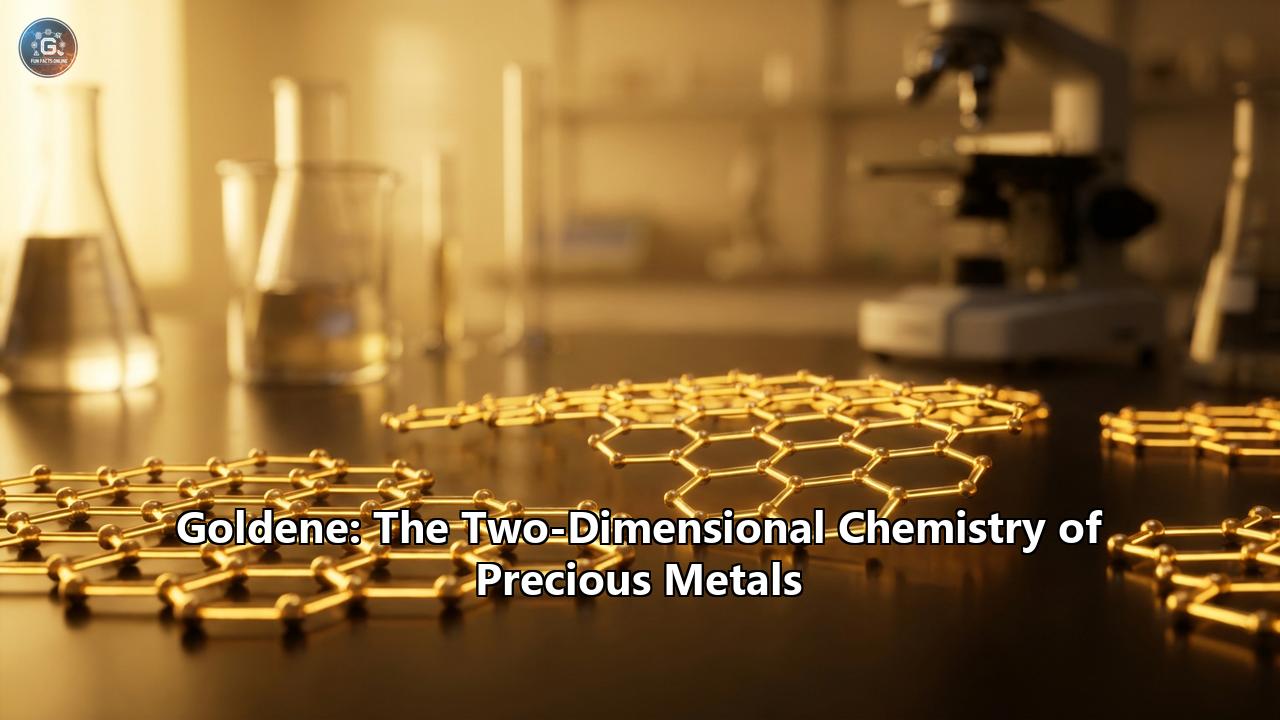
The world of materials science was forever altered in 2004 with the isolation of graphene, a single atomic layer of carbon. It sparked a "gold rush" for two-dimensional materials—substances with thickness measured in mere atoms, possessing exotic properties unseen in their bulk counterparts. For two decades, scientists successfully flattened carbon, boron, silicon, and even complex oxides. But one material remained elusive, stubbornly refusing to enter the flatland: Gold.
Known for its malleability and tendency to clump into nanoparticles, gold was thought to be impossible to exfoliate into a freestanding single-atom sheet. That changed in April 2024. Researchers at Linköping University in Sweden achieved the impossible, creating "Goldene"—the first free-standing, single-atom-thick sheet of gold. This discovery is not just a triumph of synthesis; it is a gateway to a new era of "metallenes," promising to revolutionize catalysis, hydrogen production, and carbon capture.
This is the comprehensive story of Goldene: from the ancient Japanese smithing techniques that unlocked its creation to the quantum mechanical shifts that turn a noble metal into a semiconductor.
Chapter 1: The Dimensional Frontier
The Allure of the Flatland
To understand the magnitude of Goldene, one must first appreciate the "Dimensional Frontier." We live in a three-dimensional world, and for millennia, our materials—wood, stone, bronze, steel—have been three-dimensional. Their properties are defined by their bulk: density, hardness, and conductivity are averages of trillions of atoms interacting in a lattice.
However, when you strip a material down to a single atomic layer, the rules of physics change. Electrons that were once free to move in three directions are confined to a two-dimensional plane. This "quantum confinement" fundamentally alters the material's behavior. Graphene, for instance, is not just thin graphite; it is a transparent, flexible superconductor of heat and electricity with a strength 200 times greater than steel.
This phenomenon launched the hunt for other "2D materials." We found Silicene (2D silicon) for electronics, Phosphorene (2D phosphorus) for optoelectronics, and Borophene (2D boron) for mechanical strength. Yet, metals—specifically noble metals like gold, silver, and platinum—posed a unique challenge.
The Metallic Problem
Why was 2D gold so hard to make? The answer lies in chemical bonding.
Graphite consists of layers of carbon atoms. Inside a layer, the bonds are incredibly strong (covalent), but between the layers, the forces are weak (van der Waals). This allows you to slide the layers apart, like a deck of cards—a process called exfoliation. You can essentially use sticky tape to peel graphene off graphite.
Metals do not work this way. In a bulk nugget of gold, the atoms are held together by "metallic bonding." Electrons form a sea that flows freely around positive nuclei, creating a non-directional, isotropic glue. There are no distinct layers to peel. If you try to thin gold out, the atoms—driven by high surface energy—will naturally clump together to minimize their exposed surface area. They form nanoparticles or islands, not sheets.
For years, "2D gold" existed only in cheats. Scientists would deposit gold atoms onto a substrate (like silicon carbide or graphene) that held them in place. While these were technically one atom thick, they weren't free-standing. They were chemically married to their support, altering their properties. The Holy Grail was a sheet of gold that could float alone—Goldene.
Chapter 2: Serendipity and the MAX Phase
The Unintentional Alchemists
The discovery of Goldene was not the result of a direct pursuit, but a serendipitous accident—a hallmark of great scientific breakthroughs. The story begins at Linköping University with Lars Hultman, a professor of thin film physics, and Shun Kashiwaya, a researcher in the Materials Design Division.
The team was working with a class of materials known as MAX phases. These are layered, ternary carbides or nitrides with a specific formula: $M_{n+1}AX_n$, where:
- M is a transition metal (like Titanium).
- A is an element from groups 13 or 14 (like Silicon or Aluminum).
- X is Carbon or Nitrogen.
MAX phases are fascinating because they behave like a ceramic (hard, heat-resistant) but conduct electricity like a metal. Hultman’s team was interested in Titanium Silicon Carbide ($Ti_3SiC_2$). They wanted to create a better electrical contact for this material, so they decided to coat it with gold.
The Intercalation Accident
When they exposed the titanium silicon carbide to gold at high temperatures, they expected the gold to sit on top, forming a conductive layer. Instead, something bizarre happened.
The gold atoms didn't just sit on the surface; they diffused into the material. More specifically, they kicked the silicon atoms out and took their place. The silicon evaporated away, and the gold atoms settled comfortably between the layers of titanium carbide.
The result was a new material: Titanium Gold Carbide ($Ti_3AuC_2$).
In this structure, the gold atoms were already arranged in single-atom-thick planes, sandwiched between titanium carbide slabs. The team had inadvertently created a "stack" of Goldene sheets, but they were trapped inside a ceramic prison.
This phenomenon is known as intercalation. It is similar to how lithium ions move into the graphite anode of a battery. But here, it was a total atomic substitution. The researchers realized they had a precursor material containing the prize. The challenge was now extraction: How do you remove the titanium carbide "bread" to leave only the gold "ham"?
Chapter 3: The Way of the Smith
The Challenge of Exfoliation
Usually, when scientists want to isolate a layer from a MAX phase, they use harsh acids like Hydrofluoric Acid (HF) to etch away the "A" layer (the middle element). This creates MXenes, a popular class of 2D materials.
But here, the "A" layer was Gold. If they used standard etching techniques, they would dissolve the gold and be left with titanium carbide—the exact opposite of what they wanted. They needed a chemical that would eat the chemically robust titanium carbide but leave the delicate gold monolayer untouched. This seemed chemically impossible.
Enter the Samurai: Murakami’s Reagent
Lars Hultman found the solution in the annals of history—specifically, in the metallurgy of Japanese craftsmanship.
For centuries, Japanese smiths have forged steel to create katanas and knives. A famous technique, sometimes associated with mokume-gane (wood grain metal), involves manipulating the carbon content of steel. To visualize the grain structure or aestheticize the blade, smiths used a specific chemical mixture to etch away carbon residues and iron carbides without damaging the high-quality steel.
This mixture is Murakami’s Reagent.
Chemical Composition:
- Potassium Ferricyanide ($K_3[Fe(CN)_6]$)
- Potassium Hydroxide ($KOH$)
- Water
In modern metallurgy, it is used to reveal the microstructure of cemented carbides. Hultman and Kashiwaya hypothesized that this ancient reagent could be tuned to etch away the Titanium Carbide layers of their precursor ($Ti_3AuC_2$) while sparing the gold.
The Dark Synthesis
The process was not simple. Shun Kashiwaya spent years tweaking the parameters.
- Concentration: If the reagent was too strong, it destroyed everything. If too weak, nothing happened. They found that a very low concentration was the "Goldilocks" zone.
- Time: The etching process was slow. It required days to weeks of gentle reaction.
- The Darkness: This was the critical insight. When Murakami’s reagent is exposed to light, the ferricyanide breaks down and releases free cyanide ions. Cyanide is famous for one thing in mining: it dissolves gold (the Macarthur-Forrest process).
Light ON: The reagent dissolves the gold, destroying the Goldene.
Light OFF: The reagent attacks the titanium carbide but leaves the gold intact.
Kashiwaya had to perform the etching in complete darkness.
The "Cornflakes" Problem
Even after successfully etching away the titanium carbide, a physical problem remained. The gold sheets were released into the solution, but gold atoms are chemically "sticky." Left alone, the sheets would curl up like dried leaves or clump together into a useless ball of gold nanoparticles.
The solution was the addition of a surfactant (a soap-like molecule). The team used Cysteine, a sulfur-containing amino acid. Sulfur has a high affinity for gold (forming Au-S bonds). The cysteine molecules attached themselves to the surface of the floating gold sheets, creating a protective buffer.
Imagine the Goldene sheets as cornflakes floating in milk. Without the surfactant, the cornflakes get soggy and mash together. With the cysteine surfactant, each "cornflake" is coated, keeping them separate and flat.
This marked the birth of Goldene: free-standing, stable, single-atom-thick gold.
Chapter 4: A New Face of Gold
Physics of the Monolayer
What is Goldene, exactly?
It is a crystalline lattice of gold atoms arranged in a triangular (hexagonal) pattern.
- Thickness: Nominal single-atom thickness (approx. 0.4 nanometers).
- Lattice Constant: The distance between atoms is contracted by roughly 9% compared to bulk gold. This "shrinkage" is due to the loss of neighbors; without atoms above and below to pull on them, the in-plane atoms pull tighter to each other.
The Metal that became a Semiconductor?
The most shocking property of Goldene is its electronic structure.
Bulk gold is the quintessential metal. It conducts electricity perfectly because its electrons form a continuous "band" with no gaps.
However, when you reduce a material to 2D, you limit the available energy states for electrons.
- Bulk Gold: Metallic, zero bandgap.
- Goldene: Investigations suggest it behaves like a semiconductor or has a drastically altered band structure.
X-ray Photoelectron Spectroscopy (XPS) revealed that the binding energy of the gold electrons (Au 4f) shifted by 0.88 eV compared to bulk gold.
This shift indicates a change in the chemical environment and charge density. The gold atoms in Goldene are "electronically different"—they are essentially a new element.
Possessing a bandgap (or a pseudogap) means Goldene could potentially be used to switch currents on and off—the basis of a transistor. This opens the door to gold-based electronics that are chemically inert, unlike silicon.
Optical Properties
Bulk gold is yellow because of plasmonic resonance (how its electrons slosh back and forth in response to blue light, absorbing it and reflecting the rest).
Goldene, being only one atom thick, interacts with light differently. While currently produced as a colloidal suspension (often black or dark in solution), theoretical models suggest its transparency and interaction with specific wavelengths could be tunable. It could be used for transparent conductive films, potentially replacing Indium Tin Oxide (ITO) in touchscreens.
Chapter 5: The Golden Age of Applications
The creation of Goldene is not just academic; it solves massive industrial problems. Gold is already one of the most important industrial catalysts, but it is expensive and inefficient.
1. The Surface Area Revolution
In a gold bar, 99.999% of the atoms are stuck inside the metal, doing nothing. Only the atoms on the surface can interact with chemicals to catalyze reactions.
In Goldene, 100% of the atoms are on the surface.
This means 1 gram of Goldene has the catalytic power of kilograms of bulk gold. This massive increase in efficiency could slash the cost of industrial gold catalysts.
2. CO2 Conversion (Carbon Capture)
One of the most promising applications cited by the Linköping team is CO2 conversion.
We need to capture Carbon Dioxide from the atmosphere and turn it into something useful, like ethanol or methane (fuel).
Current catalysts for this are often inefficient or require rare metals. Gold nanoparticles are good, but Goldene is better.
- The Mechanism: Goldene atoms have "dangling bonds" (unsaturated valency). Because they don't have neighbors above or below, they are desperate to bond with passing molecules. This makes them hyper-reactive. They can grab a $CO_2$ molecule, destabilize the Carbon-Oxygen bond, and facilitate its conversion into hydrocarbons.
3. Hydrogen Production
The Green Economy relies on Hydrogen. Currently, we produce hydrogen via electrolysis (splitting water). This requires catalysts like Platinum or Iridium, which are scarcer than gold.
Goldene offers a tunable surface. By attaching specific ligands (molecules) to the surfactant-stabilized Goldene, the electronic properties can be fine-tuned to lower the energy barrier for water splitting ($2H_2O \rightarrow 2H_2 + O_2$).
In the future, "Goldene Hydrogen" could be a term for hydrogen produced via these ultra-efficient monolayer catalysts.
4. Water Purification
Gold nanoparticles are already used to detect and degrade pollutants. Goldene, with its vastly superior surface area, could act as a "super-filter."
It could be used to catalyse the breakdown of organic pollutants or forever chemicals (PFAS) in water systems, utilizing light (plasmonic catalysis) to drive the reaction.
5. Medical Therapies
Gold is biocompatible (inert in the body). Gold nanoparticles are used in photothermal therapy for cancer: you inject them, they accumulate in a tumor, you shine a laser, the gold heats up and kills the cancer cells.
Goldene could be far more effective. Its 2D nature might allow for better absorption of specific laser wavelengths (NIR - Near Infrared) which penetrate tissue. Furthermore, it could be cleared from the body differently than spherical nanoparticles, potentially reducing long-term toxicity concerns.
Chapter 6: The "Metallene" Family and Future Horizons
Not Just Gold
The success with Goldene validates the "Murakami Etching" method as a generalizable technique. The Linköping team has already hinted at applying this to other noble metals.
- Iridene (2D Iridium): Potential for heavy-duty industrial catalysis.
- Platinene (2D Platinum): The holy grail for hydrogen fuel cells.
- Silverene (2D Silver): Unmatched antimicrobial properties.
The MAX phase precursor family ($Ti_3AuC_2$) is just one of hundreds of combinations. By swapping Gold for Platinum or Palladium in the precursor, we could forge a whole periodic table of 2D metals.
Stability and Scalability
The immediate challenge is stability. Goldene wants to curl up. While surfactants keep it flat in solution, integrating it into a dry device (like a microchip) is difficult.
Future research will focus on:
- Van der Waals Heterostructures: Stacking Goldene between layers of Graphene or Boron Nitride to "encapsulate" and protect it, while allowing electrical contact.
- Wafer-Scale Synthesis: Moving from "flakes in a beaker" to coating an entire 300mm silicon wafer with Goldene for mass production.
Economic Impact
Gold trades at roughly $75,000 per kilogram.
If a catalytic converter or a sensor currently uses 1 gram of gold, and Goldene allows you to do the same job with 1 milligram (due to the surface area ratio), the economic savings are astronomical. This essentially "democratizes" gold, making its unique chemical properties available for low-cost disposable electronics, sensors, and filters.
Conclusion
For thousands of years, gold was the symbol of immutability—the metal that never changes, never rusts, and stays forever golden.
Goldene proves that even the most stubborn elements can be transformed if we change their perspective. By forcing gold into two dimensions, we have stripped it of its nobility and given it a job. It is no longer just a shiny metal; it is a semiconductor, a catalyst, and a chemical worker.
The discovery of Goldene in 2024 by Kashiwaya and Hultman is likely to be remembered as a pivotal moment in materials science, comparable to the isolation of graphene. It reminds us that the periodic table is not a static list of ingredients, but a set of possibilities waiting to be unlocked by the geometry of the atomic world. We have entered the Golden Age of the flatland.
Reference:
- https://www.researchgate.net/publication/391242285_Gold_Recovery_via_Silicon_Powder_Cementation_from_a_Thiosulfate_Leaching_Solution_after_Gold_Metal_Dissolution
- https://www.metmuseum.org/essays/the-japanese-blade-technology-and-manufacture
- https://www.japan.travel/en/au/story/how-traditional-samurai-sword-made/
- https://en.wikipedia.org/wiki/Japanese_swordsmithing
- https://etchantstore.com/product/murakamis-reagent-500-ml/
- https://www.steeldata.info/etch/demo/data/10779.html
- https://www.reddit.com/r/whowouldwin/comments/t0oeb5/borophene_vs_carbyne_vs_graphene/
- https://www.shiftupcoatings.com/post/borophene-vs-graphene-which-coating-is-best-for-your-car-in-2025
- https://musashiswords.com/blogs/news/the-historical-development-of-samurai-swords-through-the-ages
- https://tigpnano.rcas.sinica.edu.tw/Course/2008_Spring/classnotes/CMNS_2008paperstudy/WilsonHo.pdf
- https://www.youtube.com/watch?v=NccKdgYQ5hs
- https://www.researchgate.net/figure/Co-etching-procedures-of-the-Murakami-acid-pretreatment-for-cemented-carbide-substrates_fig4_252056005
- https://www.azom.com/article.aspx?ArticleID=15872