
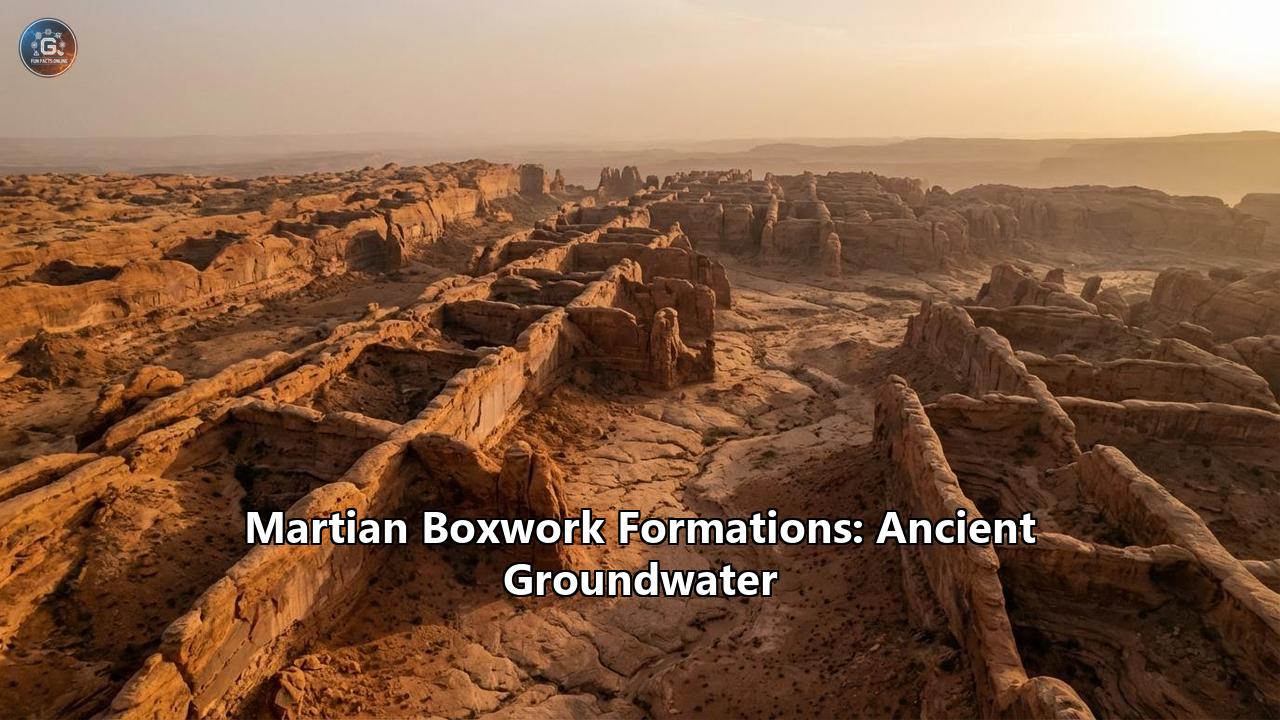
Imagine standing on the rusty, windswept plains of Mars, looking out over a desolate landscape that appears to have been woven by a colossal, mythical spider. Stretching for miles across the cratered terrain are intricate, raised geometric networks of hardened rock, intersecting to form a vast, grid-like labyrinth. From orbit, they look exactly like giant spiderwebs draped over the alien surface. Up close, they are a rugged maze of towering mineral veins. These are the Martian "boxwork" formations—one of the Red Planet’s most visually captivating geological mysteries and, arguably, the most compelling evidence we have for a deep, enduring history of ancient groundwater.
For decades, the story of Mars has been defined by a narrative of loss: a planet that billions of years ago possessed rushing rivers, sprawling river deltas, and potentially a vast northern ocean, only to lose its atmosphere and surface water to the harshness of space. But the sprawling boxwork structures tell a profoundly different, more resilient story. They reveal that long after the surface of Mars turned into the freezing, irradiated desert we see today, liquid water retreated underground, flowing through subterranean fractures and creating a hidden sanctuary that may have harbored the last surviving microbial life on the planet.
Through the lens of orbital satellites and the wheels of NASA’s Curiosity rover, the scientific community is now unpacking the profound implications of these mineralized networks. The discovery and subsequent close-up exploration of Martian boxwork represent a monumental leap in our understanding of Martian diagenesis, hydrogeology, and astrobiology.
The Anatomy of a Martian Spiderweb
To understand what a boxwork formation is, we must first look at the architectural bones of the Martian crust. In geological terms, boxwork (also referred to as polygonal ridge networks, reticulate ridges, or linear ridge networks) consists of mostly straight segments of raised rock that intersect in a lattice-like or honeycomb pattern.
On Earth, boxwork is a relatively rare phenomenon, mostly famously found in the intricate, delicate ceilings of Wind Cave in South Dakota, or occasionally in dry, sandy desert environments. However, earthly boxworks are typically diminutive, with delicate calcite ridges protruding only a few centimeters. The Martian boxworks exist on an entirely different, almost unfathomable scale.
In regions like Gale Crater, the boxwork ridges stand roughly 3 to 6 feet (1 to 2 meters) tall, separated by sandy, wind-sculpted hollows. In other, more extreme regions of the planet, similar polygonal ridges can span miles in diameter and feature blade-like walls as tall as a 16-story building. The defining characteristic of these formations is their rugged resistance to the elements. They are the skeletal remains of a landscape that has long since vanished.
Forged in the Dark: The Mechanism of Boxwork Formation
How does a planet sculpt giant, interconnected stone spiderwebs? The answer lies in a masterclass of planetary chemistry, fluid dynamics, and billions of years of relentless wind. The formation of water-derived boxworks is a multi-step process that requires specific environmental triggers, taking place deep beneath the surface over geological timescales.
1. The Fracturing of the FoundationThe process begins with a massive layer of host rock—often sedimentary bedrock laid down by ancient lakes or windblown dunes. Over time, these sediments undergo lithification, turning into solid stone. However, the Martian crust is a dynamic environment subjected to immense stresses. Massive asteroid impacts (which were highly frequent during Mars' early Noachian period), tectonic shifts, and the thermal contraction or dehydration of the surface caused this solid bedrock to crack. These fractures created a vast, interconnected subterranean plumbing system of fissures and faults extending deep into the crust.
2. The Infiltration of Ancient GroundwaterOnce the bedrock was shattered, it became permeable. As the Martian climate changed and surface lakes began to evaporate, the water table shifted. Mineral-rich groundwater percolated through these extensive fracture networks. This wasn't merely pure water; it was a potent chemical brine heavily saturated with dissolved minerals picked up from the surrounding basaltic rocks. Depending on the specific geological era and location, this fluid carried dissolved sulfates (like calcium sulfate and magnesium sulfate), silicates, carbonates, or iron-rich clays.
3. Cementation and Vein FormationAs the groundwater flowed through the dark, pressurized cracks, changes in temperature, pressure, or chemical acidity caused the dissolved minerals to precipitate out of the liquid. Over countless millennia, these minerals crystallized along the walls of the fractures, slowly growing inward until they completely choked and sealed the fissures. This process, known as diagenesis, essentially filled the cracks with a crystalline "cement" that was significantly harder and more durable than the surrounding host rock.
4. The Great ExhumationFor billions of years, the climate of Mars continued to dry out, and the subterranean water eventually disappeared entirely. The planet was left to the mercy of aeolian (wind-driven) erosion. Eons of relentless sandblasting by the Martian winds began to slowly wear away the landscape. Because the original sedimentary host rock was relatively soft, it was steadily scoured away and turned into the ubiquitous Martian dust. However, the mineral-packed, cement-like veins were highly resistant to the wind. As the softer rock retreated, the hardened fractures were left standing proud, emerging from the ground as the spectacular, crisscrossing boxwork ridges we observe today.
A Rover's Unprecedented Journey: Curiosity at Mount Sharp
For years, planetary geologists could only marvel at these massive spiderweb networks from orbit, using high-resolution cameras aboard orbiters like the Mars Reconnaissance Orbiter (MRO). While orbital data allowed scientists to map the sheer scale of the ridges, it left many pressing questions unanswered regarding their micro-texture, exact mineral composition, and precise formation timeline.
That all changed in the mid-2020s. For roughly six months leading into early 2026, NASA's SUV-sized Curiosity rover embarked on a daring and unprecedented campaign to study a sprawling boxwork region up close. Curiosity has been steadily climbing the foothills of Mount Sharp (Aeolis Mons)—a massive 3-mile-tall (5-kilometer-tall) layered mountain resting in the center of Gale Crater—since 2014. Because Mount Sharp's layers act as a chronological timeline of Mars' ancient climate, driving up the mountain is effectively driving forward in geological time.
When Curiosity finally reached the boxwork region high up on the mountain, the scientific returns were staggering. The physical navigation alone was an engineering marvel. Rover drivers at NASA's Jet Propulsion Laboratory faced the daunting challenge of steering the nearly one-ton (899 kilograms) nuclear-powered rover across a rugged labyrinth of fragile, sharp ridges that were often no wider than the rover itself. It required driving carefully along the crests of the mineral veins—acting almost like an elevated highway—before carefully dipping down into the sandy hollows between them.
Rewriting the Timeline of Martian Water
The most paradigm-shifting revelation from Curiosity's boxwork campaign is what the location of these ridges implies about the longevity of Martian water. The boxwork formations stretch across miles of a specific layer on Mount Sharp. Intriguingly, these boxwork patterns had not been spotted anywhere else on the lower, older portions of the mountain.
The rover had entered a stratigraphic layer rich in salty minerals known as magnesium sulfates. On Earth and Mars alike, magnesium sulfates typically form in environments where briny water is actively evaporating and drying up. It is an undeniable signature of a planet in the throes of a profound, drying climate shift.
Yet, the towering presence of the boxwork ridges within this exact same "drying" layer presents a fascinating paradox. The ridges prove that even as the surface lakes of Gale Crater vanished, and the surface transformed into an arid wasteland, massive volumes of liquid water were still vigorously pumping through the subsurface bedrock.
"Seeing boxwork this far up the mountain suggests the groundwater table had to be pretty high," noted Tina Seeger, a mission scientist from Rice University leading the boxwork investigation. "And that means the water needed for sustaining life could have lasted much longer than we thought looking from orbit."
The subsurface of Mars did not dry out simultaneously with the surface. Instead, it acted as a deep, insulating sponge, holding onto a vast, active aquifer long after the sun had baked the surface dry. This extends the habitable window of ancient Mars by millions, perhaps hundreds of millions, of years.
The Mystery of the "Crunchy Nodules"
Curiosity's high-definition macroscopic cameras and onboard chemical laboratories (like ChemCam and the drill assembly) allowed scientists to interrogate the boxwork at the microscopic level. As expected, drilling into the ridges confirmed that the lines were indeed heavily mineralized fractures, packed with bright white veins of calcium sulfate.
However, the rover also beamed back images of something entirely unexpected. Clustered around the ridges were dense fields of strange, pea-sized, bumpy textures the science team affectionately dubbed "crunchy nodules". Concretion nodules are a known byproduct of groundwater flowing through porous rock, but their placement baffled geologists.
Instead of being concentrated within the central fractures where the fluid flow was highest, the nodules were found studding the outer walls of the ridges and littering the sandy hollows between them. This spatial disconnect suggests a highly complex, multi-stage history of water activity. It is possible that the main fracture ridges were cemented solid during a primary era of groundwater flow, and millions of years later, secondary pulses of slightly different groundwater seeped through the remaining porous rock, leaving the bumpy nodules as a distinct, later-stage chemical residue. The rocks are essentially a multi-generational diary of ancient water.
A Planetary Phenomenon: The Diverse Ridge Networks of Mars
While the recent findings at Gale Crater are the most detailed close-ups we have to date, polygonal boxwork ridges are a global phenomenon on Mars. However, not all spiderwebs are spun by the same spider. Detailed orbital surveys have mapped thousands of these networks across the planet, revealing that while they share a similar geometry, their origins can be wildly diverse.
Nili Fossae and Nilosyrtis:Some of the most widespread ridge morphologies are found in the ancient Noachian-aged terrains of Nili Fossae and Nilosyrtis. Here, thousands of thin, crisscrossing ridges intersect at various angles across a massive swath of the planet. These are deeply tied to hydrated minerals like phyllosilicates (clays), indicating prolonged interaction with water. Because these regions also show signs of impact-induced hydrothermal systems—where the immense heat from a meteor strike melts subsurface ice and powers hot, circulating water systems—these boxworks might be the mineralized plumbing of ancient hot springs.
The Giant Polygons of Inca City:Near the Martian south pole lies a region dubbed "Inca City," where colossal ridges outline perfectly geometric rectangles, each stretching more than a mile (2 kilometers) across. The sheer scale of these structures dwarfs the boxwork in Gale Crater. These are hypothesized to be the result of deep crustal faults caused by massive ancient impacts, which were subsequently filled with subterranean fluids or magma.
The Lava Walls of Medusae Fossae:Not all polygonal ridges are born of water. In the Eastern Medusae Fossae Formation, a massive, previously undocumented network of intersecting ridges was discovered featuring dark, blade-like walls reaching up to 50 meters (160 feet) into the sky. Unlike the water-deposited mineral veins of Gale Crater, the simplest and most violent explanation for these gargantuan structures is volcanic. Millions of years ago, highly fluid lava may have flowed across the surface, plunging into deep, pre-existing tectonic fractures. The lava cooled into incredibly dense, hard dikes. When the softer surrounding ash and rock blew away, a giant skeletal fortress of hardened magma was left behind.
The Garden City Precursor:Curiosity actually encountered a miniature prelude to the great boxwork formations much earlier in its mission. In 2015, the rover explored a site named "Garden City" on lower Mount Sharp. Here, prominent, two-tone mineral veins (white calcium sulfate veins bisecting darker gray veins) protruded a few inches from the bedrock. Garden City provided the first three-dimensional, definitive proof that multiple, distinct generations of fluid had moved through the Martian subsurface at different times, perfectly setting the stage for the massive boxwork discoveries a decade later.
The Astrobiological Goldmine: Why Boxworks Matter
The obsessive scientific focus on Martian boxwork formations is not merely about understanding the planet's geological past; it is fundamentally about the search for extraterrestrial life.
When we look for ancient life on Mars, we are not looking for dinosaur bones; we are looking for microbial biosignatures—fossilized organic molecules, isotopic anomalies, or microscopic structural remnants of single-celled organisms. To find these, we need two things: an environment that could have supported life, and a mechanism that could preserve the evidence of that life for over three billion years. Boxwork formations brilliantly satisfy both criteria.
1. The Ultimate Subsurface RefugeAs Mars lost its magnetic field, its atmosphere was stripped away by solar winds. The surface became a nightmare of sterilizing ultraviolet radiation, extreme temperature fluctuations, and toxic perchlorates. Any life on the surface would have been rapidly annihilated. However, deep underground, within the aquifers that formed the boxworks, conditions were vastly different. The overlying rock provided a perfect shield against cosmic radiation. The geothermal heat from the planet's interior kept the water liquid, and the constant interaction between the briny water and the volcanic host rock provided chemical gradients—the exact kind of electrochemical energy that chemolithotrophic bacteria on Earth use to survive in deep, dark caves. The boxworks prove that this habitable, underground refuge existed for an incredibly long time, giving life a prolonged window to adapt and thrive.
2. The Perfect Preservation MechanismEven if life thrived in these underground fractures, proving it requires finding the remains. Organic molecules are notoriously fragile and easily destroyed by oxidation and time. However, the exact process that creates a boxwork ridge—the rapid precipitation of minerals like silica, carbonates, and sulfates from fluid—is one of the most effective fossilization mechanisms in nature.
When minerals crystallize out of a fluid, they can rapidly entomb anything caught in the water, perfectly preserving organic carbon and cellular structures within a microscopic crystalline vault. Because the boxwork ridges are composed entirely of these precipitated minerals, they are effectively giant, miles-long time capsules. The clay and sulfate veins that make up these Martian spiderwebs are among the highest-priority targets for astrobiologists, as they offer the highest probability of having preserved the chemical fingerprints of ancient Martian life.
A Legacy Carved in Stone
The boxwork formations of Mars stand as silent, towering monuments to a dynamic and watery past. From orbital imagery revealing continent-spanning polygonal grids to NASA's Curiosity rover meticulously analyzing the crunchy, sulfate-rich nodules of Mount Sharp, our understanding of these structures has undergone a profound evolution.
They are far more than just geological oddities. They are the physical scars of ancient aquifers. They map out the ghost rivers of the Martian subsurface, charting the final retreat of liquid water on a dying world. By demonstrating that liquid water persisted deep underground long after the surface rivers had turned to dust, the boxwork formations have fundamentally rewritten the timeline of Martian habitability.
As we continue to explore the Red Planet, these giant spiderwebs of stone will remain a primary focus. They beckon us to look closer, to drill deeper, and to read the chemical diaries locked within their veins. Somewhere within those crisscrossing ridges, perfectly sealed in a microscopic tomb of calcium sulfate, the answer to whether we are alone in the universe may quietly be waiting to be found.
Reference:
- https://www.sciencedaily.com/releases/2026/03/260314030449.htm
- https://www.nasa.gov/missions/mars-science-laboratory/curiosity-rover/nasas-curiosity-rover-sees-martian-spiderwebs-up-close/
- https://www.jpl.nasa.gov/news/nasas-curiosity-mars-rover-starts-unpacking-boxwork-formations/
- https://www.researchgate.net/publication/356764089_Irregular_polygonal_ridge_networks_in_ancient_Noachian_terrain_on_Mars
- https://en.wikipedia.org/wiki/Linear_ridge_networks
- https://www.lpi.usra.edu/meetings/lpsc2013/pdf/1875.pdf
- https://gizmodo.com/nasas-curiosity-finds-crunchy-nodules-where-ancient-martian-water-once-stood-2000725891
- https://www.jpl.nasa.gov/news/similar-looking-ridges-on-mars-have-diverse-origins/
- https://www.researchgate.net/publication/330503372_Mineral-Filled_Fractures_as_Indicators_of_Multigenerational_Fluid_Flow_in_the_Pahrump_Hills_Member_of_the_Murray_Formation_Gale_Crater_Mars
- https://www.jpl.nasa.gov/images/pia19921-veiny-garden-city-site-and-surroundings-on-mount-sharp-mars/
- https://www.researchgate.net/publication/307609319_Polygonal_Ridge_Networks_on_Mars_Diversity_of_Morphologies_and_the_Special_Case_of_the_Eastern_Medusae_Fossae_Formation