
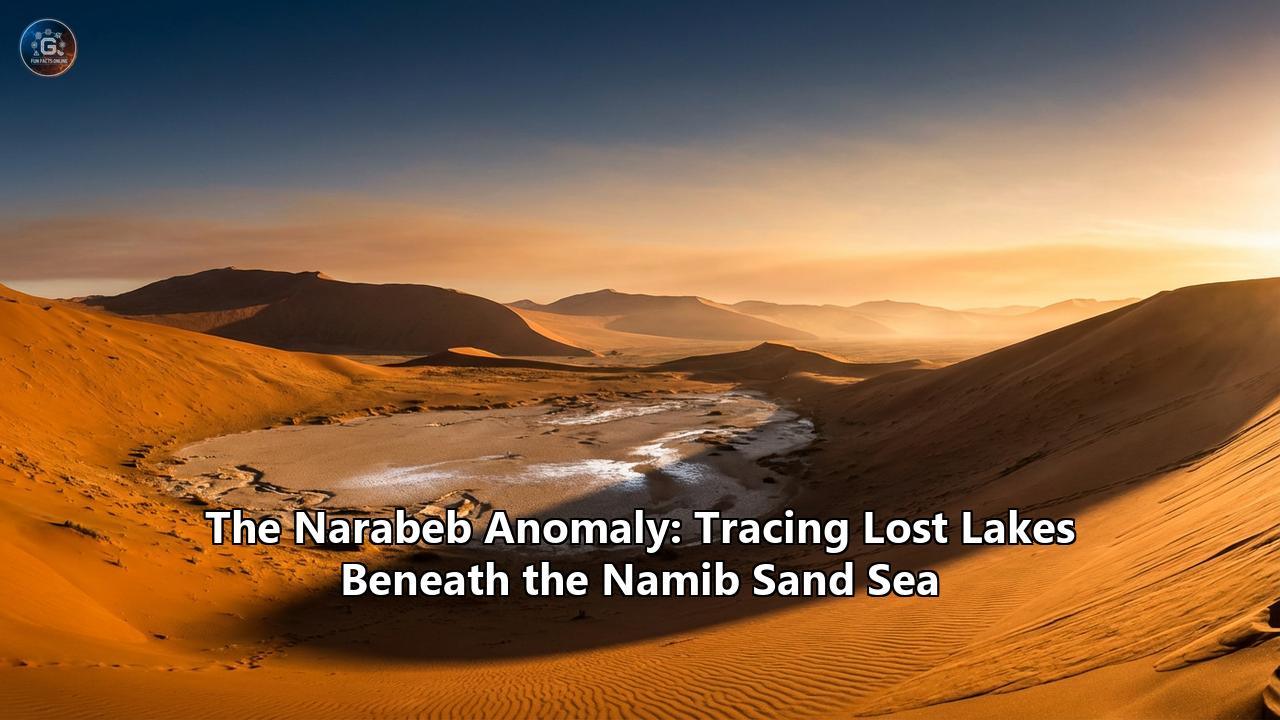
The Namib Sand Sea, a vast ocean of apricot-colored dunes stretching along the Atlantic coast of southern Africa, is often cited as the oldest desert in the world. Its very name, derived from the Nama word for "vast place," conjures images of eternal aridity, a landscape where silence is broken only by the wind hissing over razor-sharp dune crests. For decades, geologists and archaeologists viewed this hyper-arid expanse as a long-standing barrier to human life—a hostile void that our ancestors would have avoided at all costs.
But deep within the heart of the dunes, at a site known as Narabeb, lies a secret that shatters this perception. It is a secret buried beneath millions of tons of sand, written in layers of ancient mud and scattered stone artifacts. This is the Narabeb Anomaly: the startling discovery that this parched wilderness was once home to a shimmering chain of freshwater lakes, teeming with life and supporting communities of early humans who thrived in what is now one of the most inhospitable places on Earth.
This article traces the detective story of the Narabeb Anomaly, exploring the cutting-edge science that unveiled these lost lakes, the ancient climatic pulses that created them, and the implications for our understanding of human history in Africa.
Part I: The Mirage that Wasn't
The Forbidden Terrain
To understand the magnitude of the Narabeb discovery, one must first appreciate the modern reality of the Namib Sand Sea. Covering approximately 34,000 square kilometers, it is a UNESCO World Heritage site defined by its colossal linear dunes. Some of these dunes tower over 300 meters high, aligned in north-south ridges that can run for dozens of kilometers without a break.
The region receives less than 20 millimeters of rain a year. The only reliable moisture comes from the Atlantic fog that rolls in from the cold Benguela Current, sustaining beetles, lizards, and specialized plants like the Welwitschia mirabilis. For a human without modern supplies, the Sand Sea is a death trap.
In this context, the idea of a lake at Narabeb—located some 60 kilometers inland, deep within the high dunes—seems like a hallucination. Yet, in the late 1970s and early 80s, geological surveys hinted at something unusual. Researchers noted strange deposits of calcium carbonate and silts in the interdune valleys (the flat spaces between the dune ridges). These "pans" looked suspiciously like the dried-up beds of ancient water bodies, but the prevailing theory of the Namib’s eternal aridity made many hesitant to claim they were permanent lakes.
The 21st Century Breakthrough
The true nature of Narabeb remained ambiguous until a recent interdisciplinary study led by Dr. Abi Stone of the University of Manchester and Dr. George Leader, along with colleagues from the University of the Witwatersrand and Namibian institutions. They returned to Narabeb not just to map the surface, but to read the "memory" of the sand itself.
The team focused on the exposed sedimentary layers in the interdune flats. Unlike the shifting sands around them, these layers were hard, compacted muds and silts—classic signatures of standing water. But the presence of mud wasn't enough; they needed to know when this water existed.
They turned to a technique called Optically Stimulated Luminescence (OSL) dating. OSL is a method that determines the last time a grain of quartz sand was exposed to sunlight. When sand is buried, natural radiation from the surrounding soil causes energy to become trapped within the crystal lattice of the grains. This trapped energy accumulates over time like a ticking clock. By carefully extracting sand samples in total darkness and then exposing them to light in a lab, scientists can measure the released energy (luminescence) to calculate the precise age of burial.
The results from Narabeb were revolutionary. They didn't just find one wet phase; they found a recurring cycle of habitation. The OSL data revealed that a substantial freshwater lake existed at Narabeb during two distinct windows:
- 230,000 to 220,000 years ago (Marine Isotope Stage 7)
- Approx. 135,000 years ago (Marine Isotope Stage 5e)
These dates correspond to global interglacial periods—times when the Earth was warmer and, crucially for the Namib, wetter. The "anomaly" was no longer a mystery; it was a confirmed paleohydrological event.
Part II: The Ghost River
If there was a lake at Narabeb, where did the water come from? The Namib is a desert, and local rainfall, even in wetter times, would likely have been insufficient to sustain a permanent water body of that size.
The answer lies in a "ghost river" that no longer reaches the sea: the Tsondab.
The River That Lost Its Way
Today, the Tsondab River is an ephemeral watercourse that rises in the Naukluft Mountains to the east. In years of exceptional rainfall, it flows westward into the desert, but it never reaches the Atlantic Ocean. instead, it suffocates and dies at a place called Tsondab Vlei, a white clay pan surrounded by insurmountable red dunes, about 100 kilometers inland.
However, the geological forensics at Narabeb suggest that this was not always the case. During the wet phases identified by Stone and her team, the Tsondab was a mighty system. The increased rainfall in the Naukluft catchment area energized the river, allowing it to punch through the encroaching sand sea.
At that time, the dune field was not as extensive or as "tall" as it is today. The Tsondab flowed tens of kilometers further west than its current terminus, reaching the Narabeb area. There, it pooled to form a series of lakes and marshes.
The Battle of Sand and Water
The stratigraphy (rock layering) at Narabeb tells a dramatic story of a geological war between the river and the dunes.
- The Fluvial Victory: The bottom layers of the Narabeb deposits are rich in gravels and river sands, indicating a high-energy river capable of carrying heavy loads. This was the Tsondab in its prime, carving a path to the coast.
- The Stalemate: Above the river gravels lie the lake muds. This suggests that as the climate began to dry or the dunes began to encroach, the river's flow slowed. It could no longer push all the way to the ocean. Instead, it fanned out, creating a low-energy, standing body of water—a terminal lake.
- The Aeolian Conquest: Overlying the lake muds are pure aeolian (wind-blown) sands. This marks the death of the lake. As the interglacial period ended and the region returned to aridity, the river retreated east. The relentless southerly winds drove the linear dunes northward, burying the dry lakebed under meters of sand.
The "Tsondab Sandstone," a cemented geological formation that underlies much of the modern sand sea, is the fossilized remnant of this ancient proto-Namib struggle. Narabeb is essentially a window into this past battleground, a place where the dunes have momentarily shifted to reveal the defeat of the river.
Part III: The Stone Age Atlantis
The presence of water in a desert is significant for geology, but it is transformative for archaeology. Where there is water, there is life. And where there is life, there are humans.
Surrounding the ancient lakebeds of Narabeb, the research team found a staggering density of stone artifacts. These were not merely stray rocks; they were the toolkits of a sophisticated people.
The Middle Stone Age (MSA) Hunters
The artifacts found at Narabeb belong to the Middle Stone Age (MSA), a technological period spanning roughly 300,000 to 25,000 years ago. This era is critical in the story of Homo sapiens, as it marks the development of modern cognitive behaviors, complex tools, and perhaps the first stirrings of symbolic thought.
The tool assemblage at Narabeb includes:
- Points: Sharp, triangular stone tips that were likely hafted onto wooden shafts to create spears. This suggests the inhabitants were active hunters, capable of taking down the game that would have gathered at the water's edge.
- Blades and Flakes: Sharp cutting tools used for butchering meat, processing plant materials, or working hides.
- Core Preparation: The debris left behind indicates that these tools were manufactured on-site. The people didn't just visit; they stayed long enough to source raw materials (likely from river gravels) and knap their weapons.
Life on the Edge of the Dune Sea
We can now reconstruct a vivid picture of life at Narabeb 220,000 years ago.
Imagine standing at the site today. Instead of a horizon of sterile sand, you would see a shallow, glittering lake stretching for kilometers. The banks are lined with reeds and sedges. In the distance, the ancestors of the gemsbok and springbok graze on the grassy plains that border the water. The dunes are there, but they are smaller, perhaps forming a dramatic golden backdrop to the blue water rather than an overwhelming cage.
Groups of early humans—anatomically modern Homo sapiens or their immediate ancestors—camp along the shoreline. They are skilled artisans and hunters. They use the "green corridor" of the Tsondab River to move between the rich resources of the the interior mountains and the resources of the desert lakes.
The discovery challenges the "Empty Desert" hypothesis. For a long time, archaeologists believed that early humans migrated primarily along the coasts or through the lush savannas of East Africa. The "Green Namib" implies that even the continent's driest margins were viable habitats. When the climate pulsed wet, the desert opened its doors, becoming a crucial migration route or a refuge during times of stress elsewhere.
Part IV: The Science of the "Anomaly"
Why is the Narabeb find considered an "anomaly"? The term highlights the stark contrast between the site's current state and its history, but it also touches on a broader scientific puzzle regarding the stability of deserts.
The Oldest Desert Myth
The Namib is frequently cited as having been arid for 55 to 80 million years. While true in a general sense—the cold Benguela Current has maintained a dry coastal climate for eons—this "oldest desert" label can be misleading. It implies a static, unchanging environment.
Narabeb proves that the Namib is dynamic. It breathes. It expands and contracts. The "anomaly" is the revelation that during global warm periods (interglacials), the climatic belts of the Earth shift. The tropical rain systems that usually water the equator and the eastern interior of Africa were pulled south and west, spilling over the Great Escarpment and resurrecting the dead rivers of the desert.
The OSL Time Machine
The success of the Narabeb study showcases the power of modern luminescence dating. Radiocarbon dating, the most famous method, is useless here for two reasons: it only works back to about 50,000 years (too young for the early Narabeb lakes), and it requires organic material (bones, wood, charcoal), which rarely survives in the abrasive, oxidizing sand of the Namib.
OSL dating quartz grains is like reading a hard drive stored in the sand. It allowed the team to pinpoint the MIS 7 (240-190 ka) and MIS 5 (130-71 ka) windows.
- MIS 7: A complex warm period where the lake appears to have been most stable.
- MIS 5e: The "Last Interglacial," a time when global temperatures were 1-2°C warmer than today and sea levels were higher. The re-greening of Narabeb during MIS 5e aligns with evidence of "Green Saharas" and wet phases in the Kalahari, suggesting a pan-African humid event.
Part V: The Implications for Human Origins
The Narabeb Anomaly is more than a geological curiosity; it is a missing piece in the puzzle of us.
The Green Corridors
In human evolutionary studies, researchers talk about "Green Corridors"—temporary environmental pathways that allowed early humans to cross formidable barriers like the Sahara or the Arabian Desert. Narabeb suggests the Namib was one of these corridors.
200,000 years ago is a pivotal time. It is roughly the dawn of Homo sapiens. If the Namib was navigable, it means that populations in Southern Africa (a key cradle of human evolution) were not isolated. They could move, interact, and exchange genes and ideas with groups to the north and east. The stone tools at Narabeb show similarities to those found in the interior, supporting this theory of connectivity.
Adaptation to Extremes
Living at Narabeb would not have been easy. Even with the lake, the environment was likely fluctuating. The ability of these MSA humans to adapt to a "marginal" environment—one that could turn harsh within a few generations—speaks to the behavioral flexibility that defines our species. They were not just surviving in a garden of Eden; they were managing a complex, shifting landscape at the edge of the habitable world.
Conclusion: The Sands of Time
Today, the wind has reclaimed Narabeb. The ancient lake floor is a dry pan of calcrete and mud, dwarfed by the encroaching dunes of the Namib Sand Sea. To the casual tourist flying over in a Cessna or driving a 4x4 near Sossusvlei, the desert looks timeless, invincible, and empty.
But the Narabeb Anomaly reminds us that the Earth is never static. Beneath the apricot sands lie the ghosts of rivers and the scattered tools of hunters who once watched the sun set over rippling waters.
Tracing these lost lakes does more than correct a geological map; it expands the map of human possibility. It tells us that our ancestors were pioneers who followed the water into the unknown, thriving in the windows of opportunity opened by a changing climate. It turns the "oldest desert in the world" into a dynamic archive of human resilience, waiting for the wind—and science—to uncover its next chapter.
Reference:
- https://www.manchester.ac.uk/about/news/an-ancient-lake-supported-human-life-in-the-namib-sand-sea/
- https://www.anthropology.net/p/namibias-ancient-human-habitats-how
- https://essd.copernicus.org/articles/13/953/
- https://mbgecologicalrestoration.wordpress.com/2016/04/19/notes-from-the-namib-1-an-ancient-desert-in-transition/
- https://en.wikipedia.org/wiki/Namib