
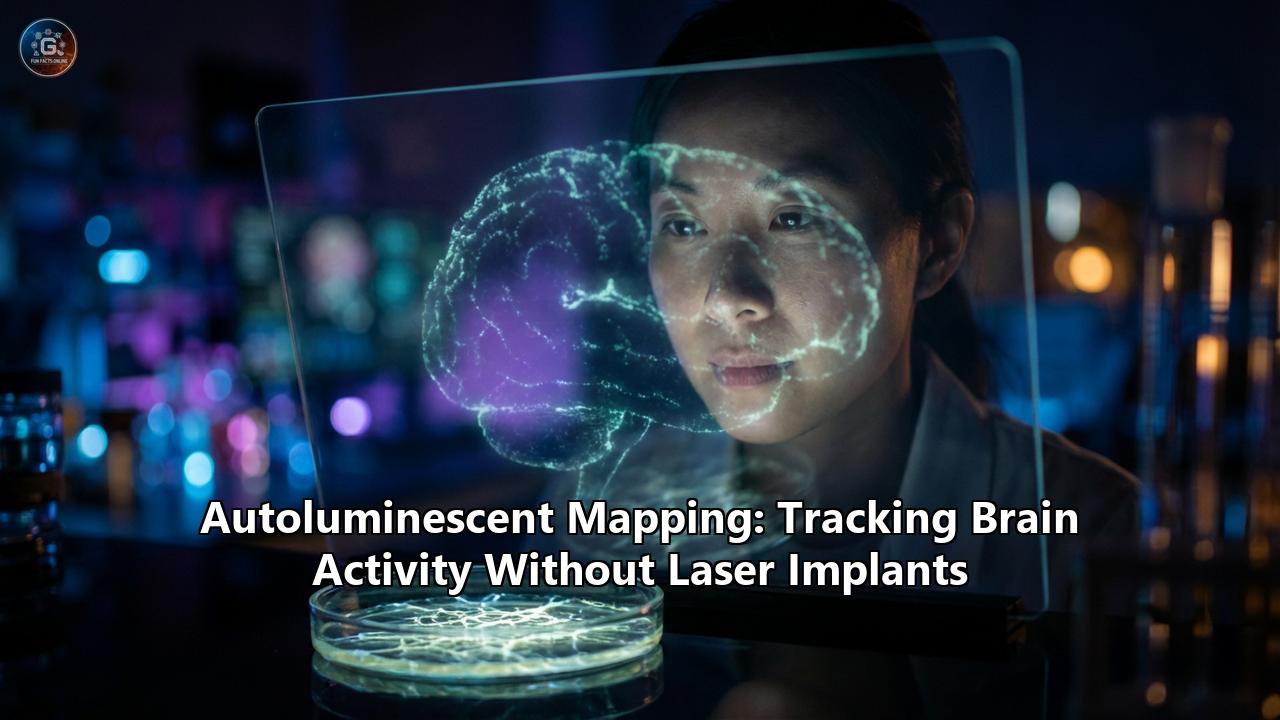
Imagine standing in a pitch-black room. Suddenly, a constellation of stars ignites, not above you, but suspended in the air. Each flicker represents a thought, a memory, a command to move a muscle. This isn't a planetarium; it is the interior of a living brain, glowing with its own internal light.
For decades, this vision was the stuff of science fiction. To see the brain work, we had to force light into it. We drilled holes, inserted fiber-optic cables, and blasted delicate neural tissue with lasers to make it fluoresce. We treated the brain like a passive object that needed to be illuminated by a flashlight to be seen.
But as we near the end of 2025, a quiet revolution has fundamentally altered our relationship with the mind. We have entered the era of Autoluminescent Mapping. We no longer need to shine light on the brain; we have taught the brain to shine for us.
This technology, which tracks neural activity without laser implants, external excitation sources, or physical tethers, represents one of the most significant leaps in the history of neuroscience. It is a shift from "fluorescence" (reflecting light) to "bioluminescence" (creating light). It promises to unlock the secrets of sleep, social behavior, and long-term memory in ways that were previously physically impossible.
The Problem with the "Old Light"
To understand why autoluminescence is such a breakthrough, we must first appreciate the limitations of the tools that dominated the last twenty years.
Since the early 2000s, the gold standard for visualizing brain activity was fluorescence. Scientists would genetically engineer neurons to express proteins (like GCaMP) that glow green when a neuron fires (specifically, when calcium floods the cell). But these proteins are not self-luminous. They are like glow-in-the-dark stickers; they only work if you charge them with a bright light source.
This requirement created a massive engineering bottleneck. To get that "charging" light deep into the brain, researchers had to:
- Implant invasive hardware: Optical fibers or heavy miniaturized microscopes (miniscopes) had to be cemented onto the animal's skull.
- Tether the subject: The animal was often physically leashed to a laser bank, restricting its movement and natural behavior.
- Battle Phototoxicity: Blasting biological tissue with high-intensity blue laser light is damaging. It heats the tissue, alters cell physiology, and eventually kills the cells you are trying to study.
- Accept Photobleaching: Like a poster left in the sun, fluorescent proteins fade over time. You might get 20 minutes of good data before the signal vanishes, making it impossible to study processes that take hours or days, like memory consolidation or sleep cycles.
The result? We learned a lot about the brains of mice that were stressed, head-fixed, and enduring laser blasts. We knew far less about the brains of animals behaving naturally in the dark.
The Bioluminescent Renaissance
Autoluminescent mapping flips this paradigm. It draws inspiration from nature's own engineers: fireflies, deep-sea jellyfish, and glowing fungi. These organisms don't need a laser to glow; they perform a chemical reaction inside their bodies that releases photons. This is bioluminescence.
The concept is elegant in its simplicity. If we can borrow the genetic code that makes a firefly glow (luciferase) and splice it into a neuron, the neuron becomes its own lamp.
However, for years, this idea failed in practice. Natural bioluminescence was simply too dim. A single neuron firing produced so few photons that no camera could detect it through the skull. The signal was lost in the noise. It was like trying to see a candle flicker from a mile away in a fog.
That changed with the development of "hyper-bright" synthetic bioluminescent indicators, culminating in the breakthrough known as CaBLAM (Ca2+ BioLuminescence Activity Monitor).
Enter CaBLAM: The Molecule That Changed Everything
Developed through a collaboration between the Bioluminescence Hub at Brown University and researchers at UC San Diego, CaBLAM is the superstar of the autoluminescent world.
CaBLAM is a genetically encoded sensor that solves the "dimness" problem. It is a molecular machine composed of a specifically engineered luciferase enzyme coupled with a calcium sensor. Here is how it works:
- The Fuel: The brain is supplied with a safe, non-toxic molecule called a luciferin (specifically, a synthetic analogue like furimazine) which acts as the fuel.
- The Spark: When a neuron is at rest, the CaBLAM molecule is "off." The enzyme is physically prevented from burning the fuel.
- The Fire: When the neuron fires, calcium ions rush into the cell. These ions bind to the sensor, causing the molecule to snap into a new shape. This shape change opens the enzyme's active site, allowing it to oxidize the luciferin.
- The Glow: The reaction releases energy in the form of bright photons.
The result is a neuron that flashes—brightly—the moment it processes information.
The "Dark" Advantage: Signal-to-Noise Ratio
The true genius of autoluminescent mapping lies in the concept of Signal-to-Noise Ratio (SNR).
In traditional fluorescence (the laser method), the brain is flooded with external light. This creates a lot of "noise"—autofluorescence from blood vessels, the skull, and other tissue that glows faintly when hit by a laser. Trying to see a specific neuron firing is like trying to see a flashlight beam during the day; the background is just too bright.
Bioluminescence works in the dark. The brain itself does not naturally emit light. It is a pitch-black canvas. Therefore, when a CaBLAM neuron fires, even if the light is fainter than a laser-excited fluorophore, it stands out with infinite contrast. It is like seeing a single candle in a sealed cave. The background noise is effectively zero.
This "zero-background" property allows researchers to:
- See Deeper: Photons generated deep in the brain (in emotional centers like the amygdala) can travel out through the tissue without being drowned out by the scattering of excitation lasers.
- Remove the Hardware: Because the light is coming from the brain, sensitive cameras placed outside the skull can detect it. There is no need to insert a fiber optic cable into the brain tissue itself.
Unshackled Science: What We Can See Now
The removal of the "laser leash" has opened up entirely new categories of neuroscience research.
1. The Social Brain
Have you ever tried to study social interaction between two mice when both are tethered to fiber optic cables? It’s a tangling nightmare. Autoluminescence allows for "wire-free" recording. Mice can chase, groom, fight, and mate naturally, while cameras overhead track the neural firing associated with these complex social behaviors. We are finally seeing the "social brain" as it actually functions, not as it functions when restricted by laboratory hardware.
2. The Sleeping Brain
Sleep is a long process. It cycles over hours. Traditional fluorescence bleaches out too quickly to capture a full night's sleep, and the heat from lasers can disturb the animal's rest. Bioluminescence is chemically powered and generates no heat. Researchers can now monitor brain activity continuously for hours or even days, tracking how memories are consolidated during REM sleep without ever waking the subject.
3. Developmental Neuroscience
Because autoluminescence is non-invasive (no implants needed), it can be used on developing brains. We can track how neural circuits form in young animals over weeks, watching the "lights" of the brain organize themselves into mature patterns. This was previously impossible because implanting hardware in a growing skull causes severe damage.
Beyond Neurons: The BLUsH Technique
While CaBLAM tracks electrical activity, other autoluminescent technologies are mapping the brain's infrastructure. A parallel breakthrough from MIT, known as BLUsH (Bioluminescence Imaging Using Hemodynamics), combines bioluminescence with MRI.
In this technique, blood vessels are engineered to dilate in response to bioluminescent light. This effectively turns the brain's own vasculature into a massive, 3D camera. When neurons light up, the nearby blood vessels react, and that reaction is captured by an MRI scanner. This allows for deep-brain mapping of the entire organ at once, bridging the gap between the single-cell precision of CaBLAM and the whole-brain scale of fMRI.
The Future: "Interrogating" the Mind
We are standing at the threshold of a new era. Autoluminescent mapping is moving us toward a "read/write" relationship with the brain that is purely biological, rather than mechanical.
Clinical Implications
The non-invasive nature of this tech holds immense promise for medicine. While we cannot yet genetically engineer human brains to glow, this technology is accelerating drug discovery. We can test epilepsy drugs on "glowing" mice to see—in real-time—how a drug suppresses a seizure storm across the entire cortex, rather than just at a single electrode site.
The "Internet of Brains"
Perhaps most futuristically, the Bioluminescence Hub is exploring inter-cellular communication via light. If one neuron can emit light (bioluminescence) and a neighboring neuron can be engineered to be activated by light (optogenetics), we can create synthetic circuits where neurons "talk" to each other using photons instead of neurotransmitters. This could allow us to "rewire" damaged brain circuits after a stroke, using light as the bridge.
Conclusion
For centuries, the skull was a black box. To see inside, we had to break it open. Autoluminescent mapping has turned that black box into a glass house.
By metabolizing the very energy of life into light, we have given the brain a voice that we can see. We have moved from the harsh glare of the laser to the soft, informative glow of the biological star. As we look at these maps of glowing activity, we are not just seeing data; we are watching the physical manifestation of a thought, burning bright in the darkness of the mind.
The brain is no longer a dark planet waiting for our flashlight. It is, finally, a star.
Reference:
- https://analyticalscience.wiley.com/content/news-do/illuminating-deep-brain-structures
- https://www.eurekalert.org/news-releases/738322
- https://www.youtube.com/watch?v=JoM0F6IP7L8
- https://www.news-medical.net/news/20251212/Bioluminescent-tool-illuminates-single-cell-activity-in-living-brains.aspx
- https://www.spiedigitallibrary.org/journals/neurophotonics/volume-11/issue-2/024203/Bioluminescence-as-a-functional-tool-for-visualizing-and-controlling-neuronal/10.1117/1.NPh.11.2.024203.full
- https://pmc.ncbi.nlm.nih.gov/articles/PMC10861157/
- https://pmc.ncbi.nlm.nih.gov/articles/PMC10883388/
- https://pubmed.ncbi.nlm.nih.gov/19012157/
- https://www.sciencedaily.com/releases/2025/12/251218060554.htm
- https://www.researchgate.net/publication/23476443_In_Vivo_Brain_Imaging_Fluorescence_or_Bioluminescence_Which_to_Choose
- https://www.brown.edu/news/2025-12-12/bioluminescence-brain-imaging-tool
- https://news.mit.edu/2024/using-mri-engineers-have-found-way-detect-light-deep-brain-0510