
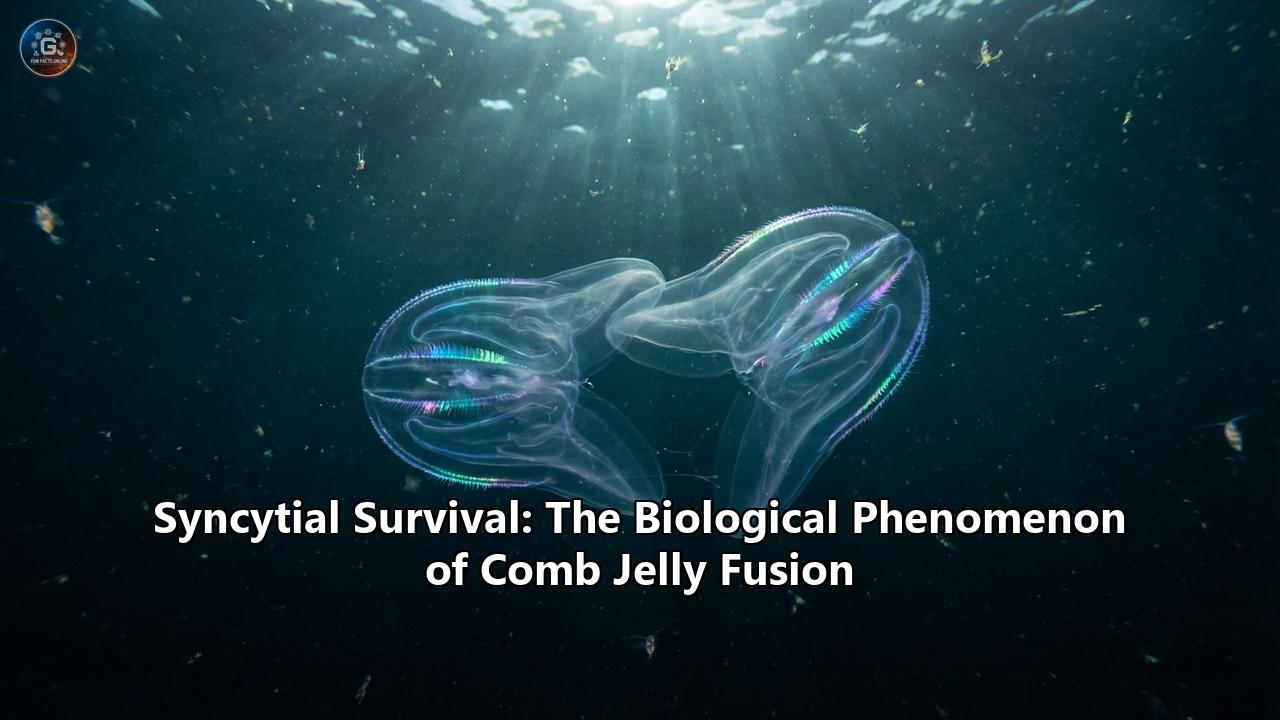
The scientific world was recently upended by a discovery that sounds like it was ripped from the pages of a science fiction novel: two separate animals, when injured, can fuse their bodies, nervous systems, and digestive tracts to become a single, functioning individual. This phenomenon, observed in the ctenophore Mnemiopsis leidyi (the warty comb jelly), challenges our most fundamental understandings of biological individuality, the immune system, and the very nature of the "self."
What follows is a comprehensive exploration of this "Syncytial Survival," tracing the discovery from a serendipitous lab accident to its profound evolutionary implications.
Part I: The Accident in the Tank
A Serendipitous Anomaly
In the sterile, hum of a marine biology laboratory, discoveries are often the result of years of meticulous planning. But occasionally, nature throws a curveball that no grant proposal could have predicted. This was the case for Kei Jokura and his team at the University of Exeter and the National Institutes of Natural Sciences in Japan.
While conducting routine maintenance on a population of Mnemiopsis leidyi—translucent, walnut-sized comb jellies kept in seawater tanks—Jokura noticed something odd. Among the drifting, solitary jellies, there was one individual that looked "wrong." It was unusually large, misshapen, and possessed anatomical redundancies that shouldn't exist: two aboral ends (the rear of the animal) and two distinct sensory organs.
In most biological contexts, such a creature would be dismissed as a developmental mutant or a pair of animals tangled in a death grip. But the jelly was alive, swimming, and seemingly thriving. Closer inspection revealed that there was no separation between the two distinct lobes. They weren't just stuck together; they were continuous.
The Ghost of 1937
History often rhymes in science. While Jokura’s observation was fresh, the phenomenon had been whispered about before. In 1937, a biologist named B.R. Coonfield had reported seeing fusion in comb jellies. However, the scientific landscape of the 1930s lacked the genetic and imaging tools to fully understand or prove the extent of physiological integration. Coonfield’s paper became a dusty footnote, largely forgotten as biology marched toward the Modern Synthesis and the age of genetics.
Jokura’s rediscovery revived a dormant mystery. Was this fusion a freak accident, or a reproducible biological strategy? To find out, the team moved from observation to experimentation. They took separate individuals, surgically removed small portions of their lobes (simulating injury), and placed them in close contact.
The results were staggering. In 9 out of 10 cases, the jellies didn't just heal; they merged. Within a single night, the boundary between the two animals vanished. They had become one.
Part II: The Alien Anatomy of Mnemiopsis leidyi
To truly appreciate the strangeness of this fusion, one must first understand the "normal" biology of the comb jelly. They are often mistaken for jellyfish (cnidarians), but they belong to an entirely separate phylum: Ctenophora.
The "Comb" Bearers
The name "ctenophore" comes from the Greek ktenos (comb) and phoros (bearing). These animals are defined by eight rows of ciliated plates—giant fused cilia—that run along their bodies. These combs are the engine of the animal, beating in metachronal waves that diffract light, creating a shimmering, rainbow-like effect that is often mistaken for bioluminescence (though many, including Mnemiopsis, are also capable of producing their own blue-green light).
Mnemiopsis leidyi is a lobate ctenophore. It possesses two large oral lobes used for feeding and four smaller tentacles. It is a voracious predator, acting like a biological vacuum cleaner in the plankton-rich waters it inhabits.The Nervous System Conundrum
Ctenophores are at the center of one of the fiercest debates in evolutionary biology. They are "basal" metazoans, meaning they branched off from the animal family tree very early—possibly even before sponges.
Unlike humans, who have a centralized brain, ctenophores operate with a "nerve net"—a diffuse mesh of neurons spread beneath their skin. For decades, it was assumed this nerve net functioned like that of cnidarians (jellyfish) or simple bilaterians, using chemical synapses to transmit signals between discrete cells.
However, recent research has thrown a wrench into this assumption. Studies using high-resolution electron microscopy have suggested that parts of the ctenophore nerve net are syncytial. In biology, a syncytium is a multinucleated mass of cytoplasm that is not separated into individual cells by membranes. If the ctenophore nervous system is indeed a continuous web rather than a chain of separate cells, it fundamentally changes how we view their ability to fuse.
The Voracious Invader
The "survival" aspect of Mnemiopsis is well-documented in ecology. Native to the western Atlantic, this species is infamous for its resilience. In the 1980s, it was accidentally introduced into the Black Sea via the ballast water of ships. With no natural predators and an endless appetite, the population exploded. At one point, the biomass of Mnemiopsis in the Black Sea was estimated to be greater than the entire global catch of fish.
They decimated the anchovy fisheries, crashing the local economy. This ecological adaptability—the ability to survive in varying salinities, temperatures, and low-oxygen environments—hints at a physiology that is incredibly plastic and robust. The ability to fuse bodies may be another tool in this arsenal of survival.
Part III: The Mechanics of Fusion
When two injured Mnemiopsis individuals are placed together, the process that unfolds is a masterclass in biological integration.
Step 1: The Glue
The fusion is triggered by injury. Uninjured jellies will bounce off one another, maintaining their individuality. But when the mesoglea (the jelly-like middle layer) is exposed, it becomes sticky and receptive. When two wounded surfaces touch, the cells do not form scar tissue to seal off the outside world; instead, they reach out.
Step 2: The Nervous Handshake
The most "sci-fi" aspect of the discovery is the speed of neural integration. In Jokura’s experiments, mechanical stimulation of one side of the fused "chimera" resulted in a synchronized muscle contraction on the other side within just two hours.
For this to happen, the neurons of Animal A had to physically connect with the neurons of Animal B. In most animals, severed nerves take weeks or months to regenerate, if they do at all. In Mnemiopsis, the connection was functional almost immediately. This lends massive support to the "syncytial nerve net" hypothesis. If the nervous system is already a fused web, linking two webs together might be as simple as fusing two drops of water.
Step 3: The Digestive Merger
The integration goes deeper than just movement. The researchers fed one side of the fused animal with fluorescently labeled brine shrimp. Under UV light, they watched the glowing food travel down the throat of Animal A, enter its digestive canals, and then—remarkably—cross the midline into the digestive canals of Animal B. The two animals had merged their guts into a single, shared metabolic system.
Interestingly, the expulsion of waste remained asynchronous. While they shared a stomach, they seemingly kept their own "bathroom schedules," expelling waste from their respective anuses at different times. This suggests that while the nutrient transport system fused, the autonomic control of the anal pores remained somewhat localized.
Part IV: The "Self" and the "Other"
To understand why this discovery is so shocking, we have to talk about allorecognition.
The Immune Gatekeeper
In almost all multicellular life, there is a strict biological bouncer known as the immune system. Its primary job is to distinguish "Self" (my cells) from "Non-Self" (bacteria, viruses, or cells from another individual).
If you tried to graft a patch of skin from one human to another (without immunosuppressant drugs), the recipient’s immune system would violently reject it. The cells would attack the foreign tissue, destroying it to protect the integrity of the individual. This is allorecognition: the ability to recognize and reject the "other."
Even simple marine animals like sponges and corals have this. If two genetically distinct sponges grow into each other, they will build a barrier of scar tissue or even release toxins to kill the intruder. This competition for space is fierce and ancient.
The Ctenophore Exception
Mnemiopsis leidyi seems to lack this bouncer entirely. The fusion experiments suggest that these animals do not possess the genetic machinery to distinguish their own tissues from those of another member of their species.Why would an animal evolve to lack an immune system?
- Simplicity: Evolution is a game of cost-benefit analysis. Developing complex receptors (like the MHC complex in vertebrates) to distinguish self from non-self is energetically expensive.
- Regenerative Potential: High regenerative capacity is often linked to a "looser" sense of self. Animals that can regrow entire limbs or heads (like hydras or planarians) often have cells that remain in a stem-like, plastic state. Rigid immune barriers might interfere with this plasticity.
- The "Oceanic Drift" Theory: In the vast, three-dimensional void of the open ocean, the likelihood of two Mnemiopsis individuals bumping into each other and fusing by accident is incredibly low. Unlike corals, which compete for limited rock space, comb jellies float freely. There may have been no evolutionary pressure to develop a mechanism to reject fusion because, in nature, it almost never happened—until humans put them in tanks.
Part V: The Syncytial Solution
The term "syncytial" in the context of this phenomenon is key. A syncytium is a biological structure that bypasses the "cell theory" rule that every nucleus must have its own private room (cell membrane).
The Reticular Theory Vindicated?
In the late 19th century, two titans of neuroscience, Camillo Golgi and Santiago Ramón y Cajal, debated the structure of the nervous system. Golgi argued for the Reticular Theory: that the nervous system was a continuous, fused meshwork. Cajal argued for the Neuron Doctrine: that neurons were discrete cells separated by gaps (synapses).
Cajal won (and they shared a Nobel Prize in 1906). The Neuron Doctrine became the dogma of biology.
However, the ctenophore nerve net suggests that Golgi wasn't entirely wrong—he was just looking at the wrong animal. If Mnemiopsis neurons are naturally fused into a syncytium, this explains the rapid fusion of the two individuals. The "wires" didn't need to regrow complex synaptic terminals; they just had to touch and fuse membranes, allowing the electrical ions to flow freely from one animal to the other.
This "Syncytial Survival" strategy allows for rapid healing. If a predator bites a chunk out of a ctenophore, the open nerve endings don't just sit there; they may seal over or, if they encounter another piece of tissue, integrate with it to restore the circuit.
Part VI: Evolutionary Implications
The discovery of whole-body fusion in Mnemiopsis adds fuel to the fire of the "Ctenophore Sister Hypothesis."
Who came first?
Traditionally, sponges (Porifera) were thought to be the first animals to branch off the evolutionary tree, followed by ctenophores and cnidarians. Sponges have no nervous system and no gut, fitting the idea of a gradual increase in complexity.
However, modern genomic analysis has repeatedly placed Ctenophora as the sister group to all other animals, branching off before sponges. This implies one of two earth-shattering possibilities:
- The Ancestor was Complex: The common ancestor of all animals had a nervous system and a gut, and sponges lost them.
- Convergent Evolution: Ctenophores evolved their nervous systems completely independently from the rest of the animal kingdom.
The fusion ability supports the "Convergent Evolution" narrative. If ctenophores have a syncytial nervous system and lack the allorecognition genes found in other animals, it suggests they built their complex bodies using a completely different genetic toolkit than the one that built humans, flies, and starfish. They are, effectively, "aliens" that evolved on Earth, solving the problem of multicellularity in a unique way.
Part VII: Philosophical and Practical Horizons
What is an Individual?
The Mnemiopsis fusion forces us to ask a philosophical question: If two animals can merge and function as one, were they ever truly two separate individuals?
In humans, "individuality" is defined by our isolated brains and distinct immune systems. In Mnemiopsis, individuality seems to be a temporary state of matter. They are fluid entities, capable of acting as one, then potentially dividing again (though the study didn't push them to separate). This challenges the Western biological concept of the discrete organism.
Regenerative Medicine
While we cannot fuse humans (our immune systems and complex brains prevent it), understanding the molecular mechanisms of Mnemiopsis fusion could offer clues for medicine.
- Nerve Regeneration: How do their nerves fuse so quickly? Is there a protein or fusogen involved that we could isolate? Could this help repair severed spinal cords in humans?
- Graft Acceptance: Understanding the lack of allorecognition might reveal new pathways for inducing "tolerance" in organ transplants, tricking the human body into accepting a donor heart as "self."
Conclusion: The Fluidity of Life
The "Syncytial Survival" of the comb jelly is more than just a biological oddity; it is a window into the deep past and potential future of life. It reminds us that the rules of biology we take for granted—discrete bodies, rejection of the foreign, synaptic nervous systems—are not universal laws. They are just one way of being alive.
In the drifting, ancient lineage of the comb jelly, life is more fluid. Boundaries are suggestions, not walls. When injured, they do not isolate themselves; they connect. In a world often defined by division, the comb jelly offers a radical alternative: survival through unity.
References & Further Reading
- Jokura, K., et al. (2024). Rapid physiological integration of fused ctenophores. Current Biology.
- Coonfield, B.R. (1937). Symmetry and regulation in Mnemiopsis leidyi. biological Bulletin.
- Burkhardt, P., et al. (2023). Syncytial nerve net in a ctenophore adds insights on the evolution of nervous systems. Science.
- Nicoll, R.A. (1906). The Nobel Prize in Physiology or Medicine 1906. NobelPrize.org.
Reference:
- https://detomaso-lab.mcdb.ucsb.edu/research/allorecognition-immunity
- https://pmc.ncbi.nlm.nih.gov/articles/PMC9761543/
- https://pmc.ncbi.nlm.nih.gov/articles/PMC7617566/
- https://gwern.net/doc/psychology/neuroscience/2023-burkhardt.pdf
- https://www.biorxiv.org/content/10.1101/2022.08.14.503905.full
- https://en.wikipedia.org/wiki/Allorecognition
- https://www.researchgate.net/publication/384707239_Rapid_physiological_integration_of_fused_ctenophores
- https://pubmed.ncbi.nlm.nih.gov/14963321/
- https://www.researchgate.net/publication/259268175_The_Genome_of_the_Ctenophore_Mnemiopsis_leidyi_and_Its_Implications_for_Cell_Type_Evolution