
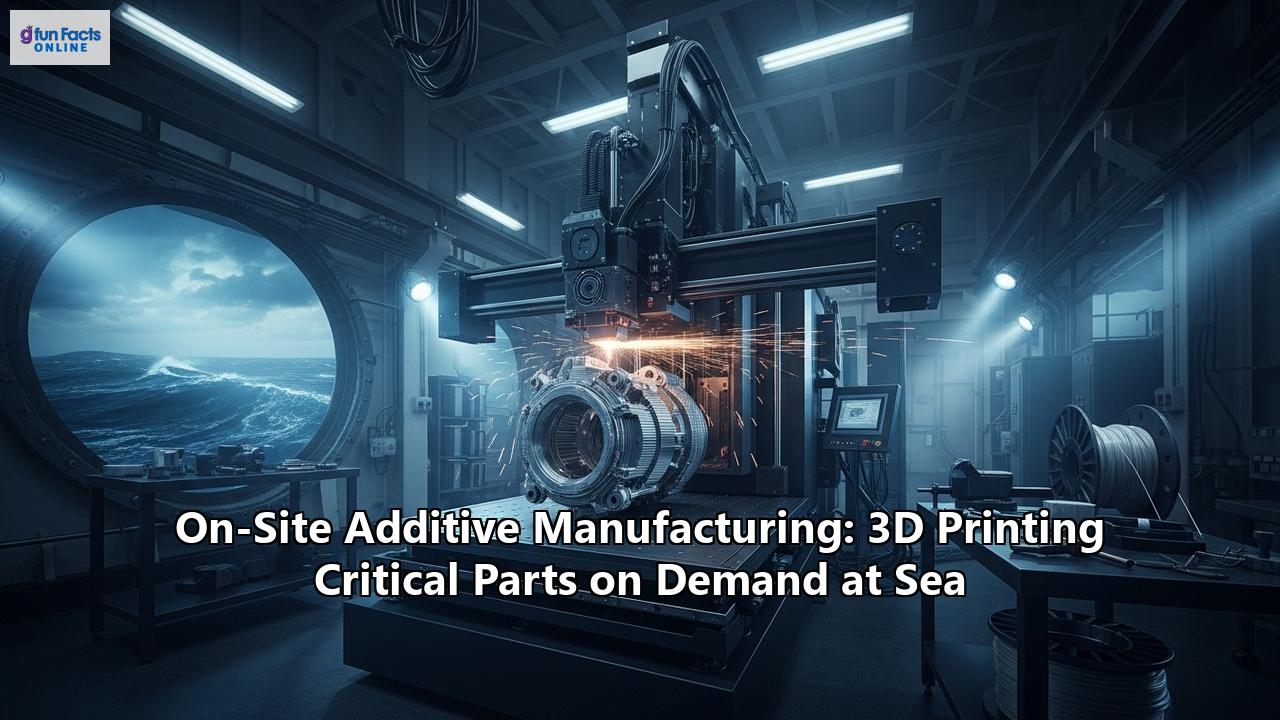
An unforeseen equipment failure in the vast, unforgiving expanse of the ocean can quickly escalate from a minor inconvenience to a mission-critical crisis. For centuries, maritime vessels have been at the mercy of complex and often sluggish supply chains, forced to carry a costly and space-consuming inventory of spare parts or wait days, even weeks, for a replacement to be delivered to the nearest port. This traditional model, however, is being fundamentally challenged by a technology that promises to bring the factory to the sea: on-site additive manufacturing (AM), more commonly known as 3D printing.
This revolutionary approach allows for the creation of critical parts on demand, directly on board a vessel, heralding a new era of maritime operations characterized by enhanced self-sufficiency, reduced downtime, and a paradigm shift in logistical thinking. From naval warships on deployment to commercial cargo ships navigating remote waters, the ability to print a vital component at the point of need is not just a futuristic concept but an emerging reality that is already making waves across the maritime industry.
The Dawn of a New Maritime Age: The Compelling Case for On-Site 3D Printing
The maritime industry, a sector that transports approximately 11 billion tons of goods annually and operates over 100,000 ships worldwide, is built on a foundation of reliability and efficiency. However, the traditional supply chain for spare parts is often a significant bottleneck. When a critical component breaks down on a vessel far from shore, the consequences can be severe, ranging from costly delays and operational standstills to compromised safety. It is this very challenge that has propelled the adoption of additive manufacturing, a technology that offers a compelling solution by enabling on-demand, distributed production.
The core principle of additive manufacturing is the layer-by-layer construction of three-dimensional objects from a digital model. This is in stark contrast to traditional subtractive manufacturing methods, which involve cutting away material from a larger block. This fundamental difference in approach unlocks a host of benefits that are particularly transformative for the maritime sector.
One of the most significant advantages is the drastic reduction in lead times for spare parts. Instead of a lengthy process involving ordering, manufacturing, and shipping, a digital file of the required part can be transmitted to the vessel and printed on-site within hours or days. This capability has been demonstrated to be invaluable in real-world scenarios. In one instance, the U.S. Navy was able to produce a replacement for a critical component with a six-to-nine-month lead time and a $30,000 price tag in just three days using on-board 3D printing.
This on-demand production capability also leads to significant cost savings. The expenses associated with the traditional procurement of spare parts extend far beyond the cost of the component itself, encompassing warehousing, packaging, airfreight, customs clearance, and the chartering of delivery vessels, which can collectively amount to thousands of dollars for a single part. By producing parts only when and where they are needed, vessels can minimize their physical inventory, freeing up valuable space and reducing the capital tied up in spare parts that may never be used. Studies have indicated that as much as 70% of the spare parts held in warehouses are never utilized, representing a significant waste of resources that on-site additive manufacturing can help to eliminate.
Furthermore, additive manufacturing offers unprecedented design freedom, enabling the creation of complex geometries and optimized structures that would be difficult or impossible to produce with conventional methods. This allows for the redesign of parts to be lighter, stronger, or more efficient. By optimizing the weight of components, for instance, vessels can improve fuel efficiency and lower operating costs, a crucial consideration in an industry where sustainability is a growing priority.
The Naval Vanguard: Pioneering Additive Manufacturing at Sea
The world's navies have been at the forefront of adopting and advancing on-site additive manufacturing, driven by the critical need for operational readiness and self-sufficiency in contested environments. The ability to repair battle damage or rectify equipment failures without returning to port is a significant strategic advantage.
The U.S. Navy, in particular, has been a vocal proponent and an early adopter of this technology. As early as 2014, the Navy began exploring the possibility of placing 3D printers on its ships, envisioning a future where not only spare parts but also custom tools and even unmanned systems could be fabricated on demand. This vision has rapidly materialized, with the Navy now deploying industrial-grade 3D printers, some housed in mobile, container-sized labs, on a variety of vessels, including aircraft carriers, amphibious assault ships, and submarines.
A pivotal moment in the Navy's journey with on-site additive manufacturing came with the deployment of polymer printers, which proved invaluable for creating low-risk components and temporary fixes. However, the feedback from sailors was clear: the real game-changer would be the ability to print with metal. This led to the deployment of hybrid metal additive manufacturing systems, which combine 3D printing with traditional CNC machining capabilities. One such system, the Phillips Additive Hybrid, which integrates a Meltio laser metal wire deposition head with a Haas CNC mill, has been successfully deployed on the USS Bataan. This system has been used to fabricate critical components, such as a sprayer plate for an air compressor, demonstrating the viability of on-board metal printing.
The Navy's approach to on-board additive manufacturing is not just about replacing like with like. It's also about innovation and problem-solving on the fly. In one notable incident, a small plastic coupler in a critical aircraft launch and recovery system failed on an amphibious ship at sea. The part was not available in the ship's inventory, and ordering a replacement would have taken a significant amount of time. The ship's crew, however, was able to reverse-engineer the part and, after several iterations to ensure it met the precise torque failure specifications, printed a functional replacement overnight. This quick thinking and technological capability allowed the ship to remain fully operational and fulfill its mission, which included engaging hostile drones and missiles.
The Navy's commitment to expanding its on-board additive manufacturing capabilities is evident in its fiscal year 2025 budget request, which seeks funding to install dozens of polymer printers and multiple metal additive manufacturing systems across its fleet. The long-term goal is to have metal additive manufacturing be an interchangeable and viable alternative to traditional manufacturing processes like casting and forging.
The applications of on-site 3D printing in the naval sector are not limited to mechanical parts. There is also growing potential for its use in addressing urgent medical needs during deployments, such as the printing of personalized prosthetics and other medical devices, further enhancing the resilience and self-sufficiency of forward-deployed forces.
The Commercial Wave: Additive Manufacturing in the Merchant Fleet
While the naval sector has been a highly visible pioneer, the commercial shipping industry is also increasingly embracing on-site additive manufacturing to enhance efficiency and reduce operational costs. For commercial operators, the primary drivers are economic and logistical. A cargo ship disabled at sea due to a broken part represents a significant financial loss, with the cost of downtime quickly running into the millions.
Major players in the maritime industry, such as Maersk, have been experimenting with on-board 3D printing for over a decade. As early as 2014, Maersk announced plans to install 3D printers on its container ships to fabricate spare parts on the move. The initial trials focused on polymer-based printers for non-critical components, but the long-term vision has always included the adoption of metal printing technologies. The fundamental value proposition for Maersk and other shipping lines is the ability to digitize their spare parts inventory. Instead of physically storing thousands of parts, a vessel can carry a digital library of components that can be printed as needed. This not only saves space and weight on board but also dramatically simplifies the logistics of getting the right part to the right place at the right time.
The collaboration between industry giants has been a key catalyst in accelerating the adoption of additive manufacturing in the commercial maritime sector. A significant development in this area is the joint venture between Wilhelmsen and thyssenkrupp, which resulted in the formation of Pelagus 3D. This partnership aims to become the leading on-demand digital manufacturing partner for the maritime and offshore industries by providing a platform for the efficient delivery of 3D-printed spare parts. Pelagus 3D leverages thyssenkrupp's expertise in additive manufacturing and Wilhelmsen's deep understanding of the maritime market to offer a comprehensive solution that includes a secure digital platform connecting customers with a global network of printing partners. This allows for the localized production of parts, minimizing transportation distances and associated costs and emissions.
The Port of Rotterdam, Europe's largest port, has also been a hub of innovation in maritime additive manufacturing through its Rotterdam Additive Manufacturing LAB (RAMLAB). Established to make the port the "smartest in the world," RAMLAB focuses on accelerating the development and application of 3D printing for the maritime industry. A landmark achievement for RAMLAB was the production of the world's first class-approved 3D-printed ship's propeller, the "WAAMpeller," in 2017. This project, a collaboration between RAMLAB, Promarin, Autodesk, Bureau Veritas, and Damen Shipyards, demonstrated the feasibility of using Wire Arc Additive Manufacturing (WAAM), a robotic welding process, to create large, critical marine components. More recently, RAMLAB has also produced the world's first 3D-printed steel bollards, which have been installed on a new quay in the port. These projects serve as crucial proofs of concept, building confidence in the capabilities of additive manufacturing for demanding maritime applications.
Navigating the Regulatory Waters: Certification and Standardization
For on-site additive manufacturing to become a mainstream reality in the maritime industry, the parts produced must be as safe and reliable as their conventionally manufactured counterparts. This requires a robust framework for certification and standardization, an area where classification societies are playing a pivotal role. The lack of a standardized approach to certification has been a significant barrier to the widespread adoption of 3D-printed parts, especially for critical applications.
In a major step forward, the International Association of Classification Societies (IACS) recently published a new recommendation, Rec. 186, which provides a standardized framework for the qualification, approval, and certification of additively manufactured metallic parts for marine and offshore applications. This recommendation covers key aspects of the AM process, including part design, feedstock selection, manufacturing processes, post-processing, and inspection and testing. It aligns with existing international standards and IACS's own Unified Requirements, ensuring a level of reliability and safety equivalent to traditional manufacturing methods. Rec. 186 also introduces a tiered system of testing levels based on the criticality of the application, allowing for a more customized and risk-based approach to certification.
Individual classification societies, such as DNV, Lloyd's Register (LR), and the American Bureau of Shipping (ABS), have also been proactive in developing their own guidelines and standards for additive manufacturing. DNV, for example, has published its DNV-ST-B203 standard, which provides a framework for producing high-quality additively manufactured metal parts for the oil and gas, maritime, and energy industries. This standard has been updated to include requirements for a wider range of AM technologies, including Powder Bed Fusion (PBF), Directed Energy Deposition (DED), and Binder Jetting (BJT).
Lloyd's Register has developed a suite of guidance notes that cover the certification of both metallic and polymer AM parts, as well as the qualification of AM facilities and feedstocks. These guidance notes are designed to provide a clear pathway for manufacturers to develop and certify their AM products, ensuring they meet the required quality and safety standards. LR's framework emphasizes a holistic approach, considering not only the final part but also the material selection, supplier capabilities, and the manufacturing facility itself.
ABS has also published a comprehensive guide for additive manufacturing that defines the approval and certification process for AM facilities and parts. This guide focuses on metal AM processes and provides standards for design, material, building processes, and inspection. ABS has been actively involved in several joint industry projects to fabricate, test, and install functional AM parts on board vessels, providing valuable real-world data and experience that informs the development of its certification framework.
The work of these classification societies is crucial in building trust and confidence in additive manufacturing within the maritime industry. By establishing clear and consistent standards, they are paving the way for the safe and widespread adoption of this transformative technology.
The Environmental Tides: Sustainability and Lifecycle Considerations
The maritime industry is under increasing pressure to improve its environmental performance, and on-site additive manufacturing offers several potential benefits in this regard. One of the most significant is the reduction of material waste. Traditional subtractive manufacturing processes can be inherently wasteful, as they start with a larger block of material and cut away what is not needed. Additive manufacturing, on the other hand, builds parts layer by layer, using only the material that is required for the final product. This can lead to material savings of up to 90% in some cases. Furthermore, some AM processes allow for the recycling of waste material, such as unused powder or support structures, creating a more circular economy.
The ability to produce parts on demand and at the point of need also has a positive environmental impact by reducing the need for transportation. The conventional supply chain for spare parts involves shipping components, often by air, across vast distances, which contributes to carbon emissions. By decentralizing manufacturing and bringing it closer to the end-user, on-site AM can significantly reduce the carbon footprint associated with logistics.
However, a comprehensive assessment of the environmental impact of additive manufacturing must also consider the energy consumption of the printing process itself. The energy efficiency of AM technologies can vary significantly, and a full lifecycle assessment (LCA) is necessary to understand the overall environmental footprint of a 3D-printed part compared to its conventionally manufactured counterpart. An LCA takes into account all stages of a product's life, from raw material extraction and manufacturing to use and disposal. Studies have shown that the environmental benefits of AM are often most pronounced when the technology is used to create lightweight designs that improve the fuel efficiency of the vessel during its operational life.
There is also growing interest in the use of sustainable and recycled materials in maritime additive manufacturing. Research is being conducted into the feasibility of using marine plastic waste as a feedstock for 3D printing, which could help to address the pressing issue of ocean pollution while also providing a source of low-cost material. The development of bio-based polymers and other environmentally friendly materials is another promising avenue for enhancing the sustainability of maritime 3D printing.
Charting the Future: Advanced Technologies and Emerging Trends
The future of on-site additive manufacturing at sea is poised to be even more transformative, driven by advancements in technology and the integration of digital tools. Several key trends are shaping the next wave of innovation in this field.
Hybrid Manufacturing: The combination of additive and subtractive manufacturing processes in a single system is becoming increasingly common. This hybrid approach allows for the creation of parts with the design freedom of AM and the precision and surface finish of CNC machining. In a maritime context, this could mean printing a near-net-shape component and then using the subtractive capabilities of the machine to achieve the tight tolerances required for critical applications. Digital Twins: The concept of a digital twin, a virtual replica of a physical object or system, is set to revolutionize the way spare parts are managed in the maritime industry. A digital twin can be used to simulate the performance of a part under real-world conditions, optimize its design, and predict its maintenance needs. By creating a digital inventory of certified spare parts, shipping companies can move away from physical stockpiles and towards a more agile and on-demand supply chain. The U.S. Navy is already investing in the development of digital twins for its spare parts, with the goal of dramatically shortening the certification process for 3D-printed components. Artificial Intelligence and Machine Learning: AI and machine learning are being integrated into the additive manufacturing workflow to improve quality control and process optimization. Machine learning algorithms can analyze data from sensors within the 3D printer to detect defects in real-time, adjust printing parameters to ensure consistent quality, and predict when maintenance is required. This AI-driven approach to quality assurance is crucial for building trust in the reliability of 3D-printed parts for critical applications. Automation: As on-site additive manufacturing becomes more widespread, there will be a growing need for automation in the post-processing of printed parts. Tasks such as support removal, surface finishing, and inspection can be labor-intensive and time-consuming. Automated post-processing solutions can help to streamline the entire workflow, reduce costs, and improve the consistency and quality of the final product. Advanced Materials: The development of new materials with enhanced properties is expanding the range of applications for maritime additive manufacturing. High-performance polymers, corrosion-resistant metal alloys, and lightweight composites are being specifically designed for the demanding marine environment. The ability to print with a wider variety of materials will enable the creation of even more complex and functional components, from custom tooling to entire boat hulls. Crew Training and Upskilling: The successful implementation of on-site additive manufacturing at sea will depend on having crews that are trained and equipped to operate and maintain these advanced systems. This requires a new set of skills, including proficiency in computer-aided design (CAD), reverse engineering, and the operation of AM equipment. Recognizing this need, the U.S. Navy has established the Naval Aviation School for Additive Manufacturing (NASAM) to provide foundational training to its sailors and marines. Similar training initiatives will be essential for the commercial maritime sector to fully realize the potential of this technology.A Sea Change in the Making
On-site additive manufacturing is more than just a novel way to produce parts; it represents a fundamental shift in the way the maritime industry operates. By bringing the factory to the sea, this technology is empowering vessels with a level of self-sufficiency and operational agility that was previously unimaginable. The ability to print critical components on demand will not only reduce downtime and operational costs but also enhance safety and resilience in the face of unforeseen challenges.
While hurdles remain, particularly in the areas of certification, material development, and the integration of digital technologies, the momentum behind maritime additive manufacturing is undeniable. The collaborative efforts of navies, commercial shipping companies, classification societies, and technology providers are rapidly overcoming these challenges and paving the way for a future where the digital file is the new spare part, and the 3D printer is an essential piece of equipment on every vessel. As this technology continues to mature, it will undoubtedly unlock new possibilities in ship design, construction, and maintenance, ensuring that the maritime industry remains at the crest of the wave of technological innovation.
Reference:
- https://3dprint.com/240346/shipboard-3d-printing-expanding-worlwide/
- https://thetius.com/3d-printing-in-the-maritime-industry/
- https://www.portofrotterdam.com/en/port-future/innovation/innovation-partners
- https://www.potomacofficersclub.com/additive-manufacturing-system-enables-repairs-on-uss-bataan/
- https://www.mdpi.com/2071-1050/15/17/12843
- https://www.pelagus.com/post/wilhelmsen-and-thyssenkrupp-step-up-collaboration-establishing-3d-printing-partnership-targeting-th
- https://www.wilhelmsen.com/media-news-and-events/news/2023/thyssenkrupp-and-wilhelmsen-collaborate-on-new-3d-printing-joint-venture---pelagus-3d/
- https://3dprint.com/9021/maersk-ships-3d-printers/
- https://www.offshore-energy.biz/thyssenkrupp-wilhelmsen-partner-on-3d-printing-for-shipping-industry/
- https://www.rivieramm.com/opinion/opinion/maersk-tankers-trials-3d-printing-38155
- https://www.scribd.com/document/456358342/SC-reading-3D-printing
- https://www.autodesk.com/design-make/videos/manufacturing-on-demand
- https://www.google.com/search?q=time+in+Rotterdam-The+Hague,+NL
- https://www.thyssenkrupp.com/en/newsroom/press-releases/pressdetailpage/innovative-joint-venture:-thyssenkrupp-and-wilhelmsen-bundle-3d-printing-capacities-238096
- https://www.nationaldefensemagazine.org/articles/2024/5/22/navy-expands-additive-manufacturing-aboard-ships
- https://www.rivieramm.com/news-content-hub/news-content-hub/maersk-and-others-trial-3d-printing-on-vessels-drilling-platforms-26208
- https://theloadstar.com/maersk-using-3d-printing-fabricate-spare-parts-ships/
- https://www.dnv.com/expert-story/maritime-impact/3D-printed-spare-parts-revolutionize-maritime-supply-chain/
- https://adsknews.autodesk.com/en/stories/port-of-rotterdam/
- https://www.ramlab.com/updates/ramlab-unveils-worlds-first-class-approved-3d-printed-ships-propeller/
- https://www.ship-technology.com/news/newsport-of-rotterdams-ramlab-and-autodesk-develop-new-3d-printed-ship-propeller-5798645/
- https://www.fiberlasercutting.in/hybrid-manufacturing-combining-additive-and-subtractive-techniques-for-better-tooling/
- https://www.forbes.com/sites/michaelmolitch-hou/2025/03/17/on-ship-3d-printer-from-hd-hyundai-abs-consortium-turns-the-tide-for-maritime-3d-printing/
- https://www.3dnatives.com/en/digital-twins-in-3d-printing-all-you-need-to-know-230620234/
- http://handheldlaserwelding.com/uncategorized/3d-printing-in-shipbuilding-from-prototypes-to-full-scale-components/
- https://ai-build.com/applications/marine/
- https://www.stratasys.com/en/stratasysdirect/resources/case-studies/automated-post-processing/
- https://library.fiveable.me/additive-manufacturing-and-3d-printing/unit-9/life-cycle-assessment-3d-printed-products/study-guide/2djbfXkC87xSBMuN
- https://cdn.prod.website-files.com/624ca1135ead34247b2b23ec/64770e6876075f018f169d44_W3D008-White%20Paper-Lifecycle%20Assesment-December%202021-v1.3_Pages-High.pdf
- https://addi.ehu.es/bitstream/handle/10810/60371/J%20of%20Industrial%20Ecology%20-%202022%20-%20Ca%20ado%20-%203D%20printing%20to%20enable%20the%20reuse%20of%20marine%20plastic%20waste%20with%20reduced.pdf?sequence=1
- https://www.tandfonline.com/doi/abs/10.1080/00207543.2024.2338878
- https://www.hannovermesse.de/en/news/news-articles/the-u-s-navy-orders-spare-part-twins-for-3d-printing
- https://www.hlhprototypes.com/what-is-a-digital-twin-in-3d-printing/
- https://accscience.com/journal/IJAMD/1/2/10.36922/ijamd.3455
- https://www.mdpi.com/2076-3417/14/15/6730
- https://www.youtube.com/watch?v=zRzmh0fIT4E
- https://3dprint.com/290633/ai-software-brings-smart-quality-control-to-3d-printing/
- https://3dprint.com/252965/why-automated-post-processing-makes-manufacturing-with-3d-printers-possible/
- https://am-flow.com/the-future-of-3d-printing-lies-in-automated-post-processing-heres-why/
- https://safety4sea.com/3d-printing-systems-to-be-installed-onboard-ships/
- https://www.researchgate.net/publication/318155812_Life_Cycle_Assessment_of_3D_Printed_Products_in_a_Distributed_Manufacturing_System_LCA-Distributed_Manufacturing_System
- https://www.projectmates.eu/pilotexperience/training-seminar/index.html
- https://www.ialr.org/nasam/
- https://www.ialr.org/ialr-leading-new-additive-manufacturing-school-for-navy-sailors-and-marines/