
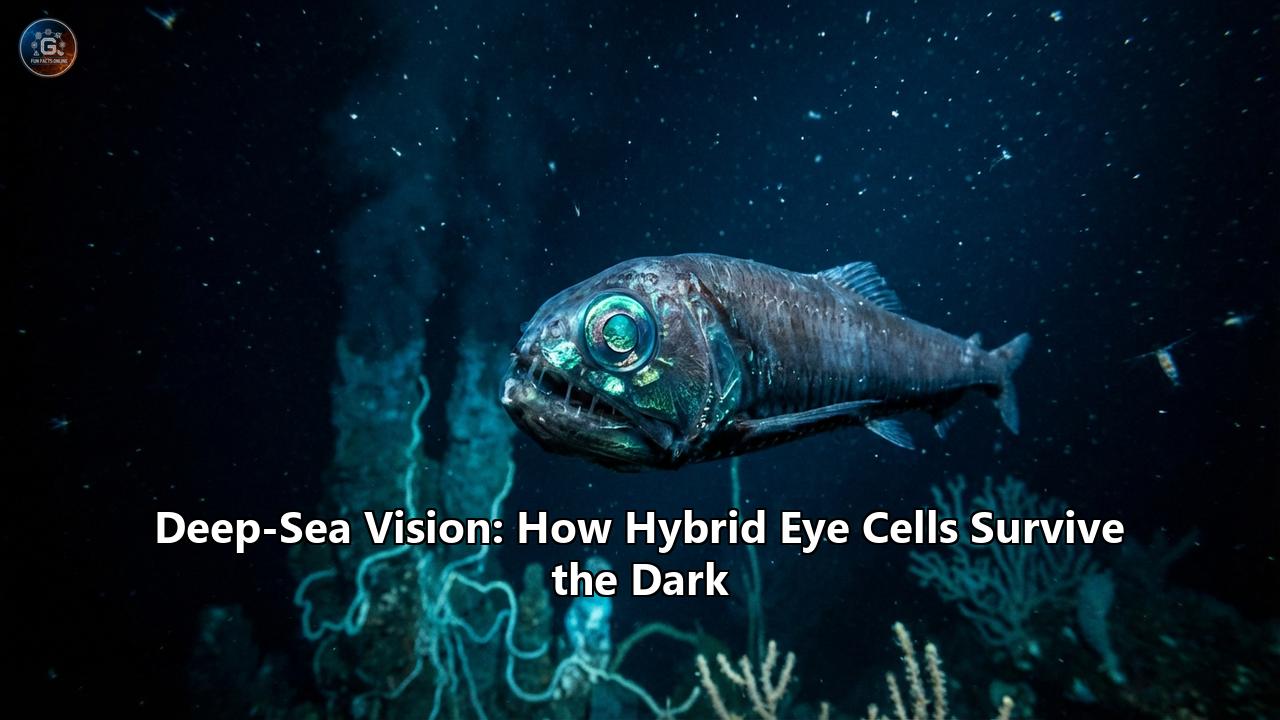
Imagine descending into the ocean, leaving the sunlit surface behind. As you plunge deeper, the vibrant blues and sparkling reflections fade into a heavy, monochrome blue-black. By the time you reach depths of 20 to 200 meters, you have entered the ocean’s "twilight zone"—the mesopelagic realm. Down here, sunlight is a scarce currency. Colors disappear, shadows soften into a perpetual, gloomy haze, and the ability to detect the faintest glimmer of light can mean the difference between finding a meal and becoming one.
For more than a century and a half, biology textbooks have painted a very specific, rigid picture of how animals—humans included—navigate light and dark. This 150-year-old rulebook dictated that vertebrate vision relies on a strict dichotomy of two cellular photoreceptors: rods and cones. Rods are the night-shift workers, highly sensitive cells designed to capture sparse photons in the dark, albeit in blurry black-and-white. Cones are the day-shift workers, demanding bright light to function but rewarding the brain with sharp, high-resolution color.
But the deep ocean has a habit of making a mockery of our terrestrial textbooks.
In a groundbreaking 2026 study published in Science Advances, an international team of researchers discovered that the deep sea is hiding a revolutionary visual secret. Dr. Lily Fogg, Dr. Fabio Cortesi, and their colleagues from institutions ranging from the University of Queensland to the University of Helsinki have uncovered a completely new type of light-sensing cell. By examining the microscopic eyes of larval deep-sea fish, they found a "hybrid" photoreceptor—a biological chimera that physically looks like a rod but operates using the genetic and molecular machinery of a cone.
This discovery doesn't just rewrite the rules of evolutionary biology; it opens thrilling new frontiers for human technology and medicine, promising everything from revolutionary night-vision cameras to novel treatments for glaucoma.
To truly understand the magnitude of this discovery, we must dive into the evolutionary pressure cooker of the deep sea, explore the microscopic architecture of the eye, and unravel the story of the tiny, glowing fish that are changing science forever.
The 150-Year-Old Rulebook: The Rod and Cone Dichotomy
To appreciate the sheer weirdness of a hybrid eye cell, we first need to understand the biological laws it breaks. The retina, the sensory membrane lining the back of the vertebrate eye, is an astonishing piece of biological engineering. Its primary job is to catch light particles (photons) and convert them into electrical signals that the brain can process into an image.
Since the mid-19th century, scientists have classified the photoreceptors tasked with catching these photons into two neat, distinct boxes based on their shape and function:
1. Rod Cells: The Low-Light SpecialistsRods are long, cylindrical cells packed with rhodopsin, a light-sensitive protein. Their elongated shape makes them excellent photon traps. They are so sensitive that a fully dark-adapted human rod cell can respond to a single photon of light. However, this extreme sensitivity comes with a trade-off. Rods are easily overwhelmed in bright conditions (which is why you are temporarily blinded when stepping out of a dark movie theater into the sunlight), and they do not process color. They also pool their signals together before sending them to the brain, which sacrifices visual sharpness for sensitivity.
2. Cone Cells: The High-Definition Color ProcessorsCones, true to their name, have a more tapered, conical shape. They require significantly more light to activate. However, they contain different types of photopigments (opsins) that react to different wavelengths of light, allowing for the perception of color. Furthermore, cones often have a one-to-one connection with the optic nerve pathways, providing sharp, high-resolution, dynamic vision.
For 150 years, this division of labor was considered a fundamental law of vertebrate biology. "The rods and cones slowly change position inside the retina when moving between dim and bright conditions, which is why our eyes take time to adjust when we flick on the light switch on our way to the restroom at night," explains Dr. Lily Fogg, a marine biology postdoctoral researcher who led the recent study.
But in the ocean's twilight zone, this neat dichotomy falls apart. The environment is neither bright enough for cones to function properly, nor dark enough for rods to be completely comfortable. It is a realm of perpetual, murky half-light. And nature abhors a vacuum of efficiency.
Enter the Twilight Zone: An Evolutionary Arms Race
The mesopelagic zone, spanning from about 200 to 1,000 meters deep, is the largest continuous habitat on Earth. But the fish in this recent study were examined in their larval stages, captured at depths between 20 and 200 meters in the Red Sea. This upper twilight region is a highly active biological corridor.
In this realm, the physics of light behaves strangely. Water rapidly absorbs the red, orange, and yellow wavelengths of sunlight. By the time you reach 50 meters, the world is bathed in a monochromatic blue-green hue. For the tiny larvae of deep-sea fish, this environment is a brutal obstacle course. They are only about half a centimeter long, with eyes smaller than a millimeter. They need to spot the microscopic zooplankton they feed on while simultaneously avoiding the looming silhouettes of predators swimming below them.
Furthermore, many creatures in this zone use a tactic called "counterillumination". Because the only light comes from the sun directly above, a fish swimming higher up casts a dark silhouette against the faint downwelling light. To hide this silhouette, deep-sea fish have evolved rows of photophores—tiny light-emitting organs on their bellies. By producing a faint blue-green bioluminescent glow that perfectly matches the intensity and color of the sunlight filtering down from above, they effectively render themselves invisible to predators lurking below.
To survive this game of optical hide-and-seek, visual systems had to adapt. Neither standard rods nor standard cones were up to the task. Standard rods would blur the fine details needed to spot the subtle break in a predator's counterillumination camouflage, while standard cones simply wouldn't activate in the gloom.
The solution? A biological mashup.
Meet the Mutants: Hatchetfish, Lightfish, and Lanternfish
During a series of marine exploration voyages in the Red Sea, the research team—including Dr. Fabio Cortesi from The University of Queensland, Dr. Lily Fogg, and Dr. Fanny de Busserolles—painstakingly collected larval specimens of three distinct deep-sea fish species.
- *The Hatchetfish (Maurolicus mucronatus): A bizarre-looking fish that, in adulthood, resembles a shiny, silver coin with a perpetually frowning face.
- The Lightfish (Vinciguerria mabahiss): A slender, elongated fish heavily decorated with bioluminescent photophores.
- The Lanternfish (Benthosema pterotum): One of the most abundant vertebrates on the planet, known for migrating up to the surface at night to feed and retreating to the depths by day.
These fish are tiny, measuring just 1 to 3 inches as adults, and their larvae are little more than translucent slivers of life. Studying them is an immense technical challenge. Because their eyes are smaller than a millimeter, traditional dissection and cellular analysis require immense precision. Using advanced genomic sequencing and high-resolution microscopy, the scientists peered into the retinas of these larvae and found something that shouldn't exist.
Anatomy of a Chimera: The "Rod-Like Cone"
What the researchers observed under the microscope was a cell that entirely defied categorization.
"We found that, as larvae, these deep-sea fish mostly use a mix-and-match type of hybrid photoreceptor," Dr. Fogg stated. "These cells look like rods – long, cylindrical and optimized to catch as many light particles – photons – as possible. But they use the molecular machinery of cones, switching on genes usually found only in cones".
Let’s break down the genius of this evolutionary design:
The Hardware (The Rod Structure):
To see in the twilight zone, you need a massive surface area to catch sparse photons. The hybrid cell borrows the physical architecture of a rod. It is elongated and cylindrical, packed end-to-end with membrane disks that act like a towering stack of solar panels. This ensures that even the faintest glimmer of downwelling sunlight or a flash of bioluminescence is captured.
The Software (The Cone Genetics):
While catching the light is important, processing it quickly and sharply is equally vital. Standard rods are slow to reset and pool their signals, creating a blurry image. But by utilizing the genetic code and molecular machinery of a cone, this hybrid cell can process the captured photons with the speed, efficiency, and potentially the sharpness of a daytime visual system.
"This hybrid cell has the best bits of both the bright light and dark light systems to be something new that’s really efficient for twilight vision," explained Dr. Cortesi.
This revelation challenges the long-standing dogma that rods and cones are fixed, clearly separated cellular identities. It suggests that the retina is far more malleable and adaptable than biologists ever gave it credit for. It proves that evolution operates more like a hacker, mixing and matching open-source code to survive, rather than adhering to strict, unbendable blueprints.
The Lifecycle of a Deep-Sea Mutant
The presence of these cells in the larval stage paints a fascinating picture of deep-sea life cycles. The researchers found that these hybrid rod-like cones form extremely early in the larvae's development. As larvae, these fish live closer to the surface (20 to 200 meters) where the intermediate light perfectly matches the capabilities of their hybrid eyes.
But what happens when they grow up?
As the lightfish and the lanternfish mature into adults, they undergo an "ontogenetic shift." They migrate deeper into the ocean, descending up to 1,000 meters into the bathypelagic zone, where the last vestiges of sunlight surrender to absolute, crushing darkness. In this pitch-black realm, intermediate vision is useless. Consequently, as these two species mature, their eyes transition, eventually adopting a traditional, rod-dominated visual system optimized purely for absolute darkness.
However, the hatchetfish (Maurolicus mucronatus*) is the exception to the rule. Because the hatchetfish tends to remain in the mesopelagic twilight zone throughout its life, it retains these remarkable hybrid cells into adulthood. The presence of these hybrid cells in the larvae of all three species suggests an evolutionary stepping-stone. The early appearance of these cells likely helps the larvae survive their vulnerable early weeks, and might even ease the biological and molecular transition into pure rods for the species that dive into the abyss later in life.
"It is a very cool finding that shows that biology does not fit neatly into boxes," noted Dr. Cortesi. "I wouldn't be surprised if we find these cells are much more common across all vertebrates, including terrestrial species". In fact, traces of similar hybrid cellular structures have been previously hinted at in a few terrestrial reptiles, like certain types of twilight-hunting lizards, but never with this level of genetic and molecular confirmation.
From the Deep Sea to Human Technology: Biomimicry and Beyond
The discovery of the hybrid eye cell is a triumph of pure biological science, but its implications stretch far beyond the realm of marine biology. We are currently living in an era of biomimicry—a field where engineers and technologists look to nature's 3.8 billion years of research and development to solve human problems. The deep-sea hybrid photoreceptor offers an incredibly lucrative blueprint for the tech industry.
Currently, human technology struggles with the same low-light limitations that plague standard vertebrate vision. Traditional night-vision goggles or low-light camera sensors operate similarly to rod cells. They amplify faint light, but the resulting image is often grainy, heavily artificially tinted (usually green), and lacks crisp, dynamic resolution. Conversely, high-definition digital cameras—our technological "cones"—require immense amounts of light or incredibly slow shutter speeds (which cause motion blur) to capture a clear image.
"This finding is fascinating because it builds on the little we know about the deep sea, but there are also practical applications for this knowledge," said Dr. Cortesi. "In technology, creating sensors based on this unique cell structure could lead to more efficient cameras or goggles for low-light situations without sacrificing image sharpness".
Imagine a new generation of digital sensors built on the "rod-like cone" architecture. A camera lens equipped with microscopic, cylindrical photon-traps that process data with the high-speed, high-resolution algorithms of a daylight sensor. This could revolutionize everything from deep-space astronomical imaging and deep-sea exploration drones to consumer smartphone cameras and autonomous vehicle navigation systems. Self-driving cars rely heavily on optical sensors to detect pedestrians and obstacles; a camera that can see with daytime clarity in twilight or heavy fog could save countless lives on the road.
Medical Miracles: Unlocking Glaucoma Treatments
Perhaps the most profound application of this deep-sea discovery lies in human medicine. The ocean is an environment of extremes. At a depth of just 1,000 meters, the hydrostatic pressure is roughly 100 times greater than at the surface—enough to crush a standard submarine. Yet, these tiny, fragile fish not only survive, but they seamlessly build and maintain highly complex cellular structures, like the retina, under these crushing conditions.
This extreme physiology has caught the attention of biomedical researchers, particularly those studying human eye diseases. Glaucoma is a devastating and incredibly common human eye condition, currently affecting millions worldwide. It is characterized by an abnormal build-up of intraocular pressure—fluid pressure inside the eye. Over time, this intense pressure damages the optic nerve and the delicate photoreceptor cells of the retina, leading to irreversible blindness.
By studying how deep-sea fish larvae construct and maintain their hybrid visual cells in the high-pressure environment of the ocean, scientists hope to uncover new biological resilience pathways. "In medicine, learning how these fish build this type of visual cell in the high-pressure environment of the deep ocean could unlock new biological pathways relevant to human eye conditions such as glaucoma," Dr. Cortesi emphasized.
If researchers can isolate the genetic mechanisms or structural proteins that protect the deep-sea fish's optic nerves and photoreceptors from the crushing weight of the ocean, it could pave the way for revolutionary gene therapies or neuroprotective drugs. Instead of merely lowering eye pressure in glaucoma patients—which is often insufficient to stop vision loss—doctors might eventually be able to fortify human retinal cells, making them resilient to pressure damage, much like the eyes of the lanternfish.
The Ocean as the Ultimate Laboratory
The discovery of hybrid eye cells in deep-sea fish larvae serves as a profound reminder of how little we truly know about our own planet. The deep ocean is the largest habitat on Earth, yet it remains less explored than the surface of the Moon or Mars. For 150 years, the smartest minds in biology believed that the fundamental building blocks of vertebrate vision were locked into a strict dichotomy. It took a half-centimeter fish swimming in the gloomy twilight of the Red Sea to prove us wrong.
These findings highlight the incredible elasticity of evolution. When faced with the seemingly impossible challenge of seeing in an environment that is neither dark nor light, nature didn't just give up. It didn't settle for the blurriness of rods or the blindness of cones. It hacked its own code, merging the hardware of one system with the software of another to create an elegant, hybrid solution.
As humanity looks to the future—seeking better cameras to document our world, more advanced sensors to guide our autonomous machines, and novel medical treatments to cure debilitating diseases like glaucoma—we don't necessarily need to invent these solutions from scratch. We simply need to look down.
The biological ingenuity fueling the open ocean is vast and largely untapped. The tiny hatchetfish, lightfish, and lanternfish, swimming in the perpetual twilight with their microscopic, rule-breaking eyes, are not just surviving the dark. They are shining a light on the boundless possibilities of biology, proving once and for all that nature's greatest innovations are often hiding in the shadows, just waiting to be seen.
Reference:
- https://scitechdaily.com/newly-discovered-hybrid-eye-cell-challenges-150-years-of-biology/
- https://www.finedayradio.com/news/tv-delmarva-channel-33/scientists-discover-fish-with-revolutionary-eye-cells-that-rewrite-biology-textbooks/
- https://www.scimex.org/newsfeed/twilight-fish-study-reveals-unique-hybrid-eye-cells
- https://www.tribuneindia.com/news/science-technology/deep-sea-fish-break-the-mold-with-novel-visual-system/
- https://www.technologynetworks.com/cell-science/news/twilight-fish-study-reveals-unique-hybrid-eye-cells-409578
- https://scienmag.com/study-of-twilight-fish-uncovers-unique-hybrid-eye-cells/
- https://www.devdiscourse.com/article/science-environment/3809258-unveiling-the-oceans-secret-hybrid-vision-in-deep-sea-fish
- https://www.optica-opn.org/home/newsroom/2026/february/twilight_vision_comes_into_sight/