
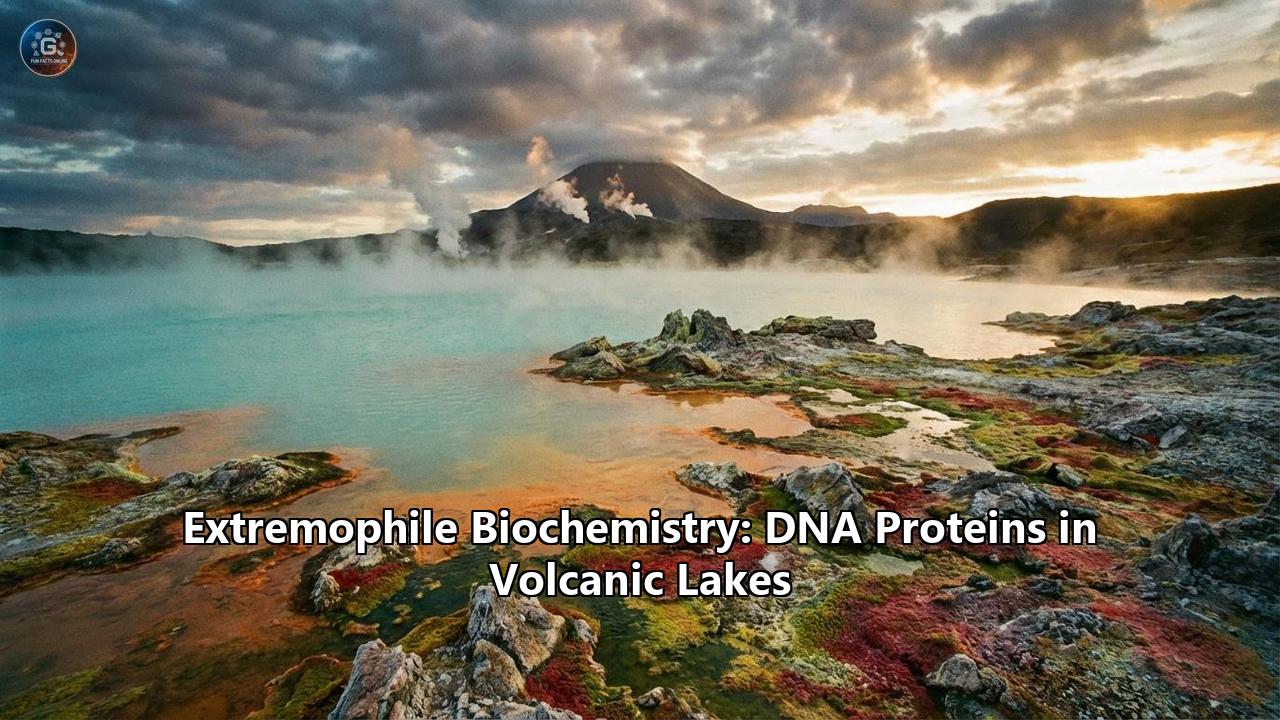
Imagine standing on the edge of a steaming crater. Below you, a roiling cauldron of ultra-acidic water, painted in alien shades of neon green and sulfurous yellow, violently releases plumes of toxic gas. The temperature hovers near the boiling point, and the liquid is less like water and more like a caustic brew of heavy metals, sulfuric acid, and dissolved rock. To a human, this is a lethal wasteland. To a microscopic polyextremophile, this is paradise.
Welcome to the world of volcanic crater lakes—some of the most hostile, dynamic, and extreme environments on planet Earth. In places like Laguna Caliente of the Poás Volcano in Costa Rica, the Dallol geothermal field in Ethiopia, or the boiling springs of Kamchatka, life does not merely survive; it thrives. But how? How do the fundamental building blocks of life—fragile strands of DNA and intricate protein machines—resist melting, dissolving, or denaturing in a boiling vat of acid?
The answer lies in extremophile biochemistry. Through billions of years of evolutionary pressure, the microorganisms inhabiting these geothermal cauldrons have completely re-engineered their molecular architecture. Their survival strategies offer not only profound insights into the origins of life on Earth but also a tantalizing glimpse into how life might survive on Mars or the moons of the outer solar system.
The Crucible: Understanding the Volcanic Lake Environment
To appreciate the biochemical miracles occurring within these organisms, we must first understand the gauntlet they run daily. Volcanic lakes are typically formed when a volcanic crater fills with meteoric water (rain or snowmelt) that interacts with shallow magma bodies and rising magmatic gases.
The resulting geochemical profile is staggering:
- Hyper-acidity: Many volcanic lakes have a pH hovering around 0 (and sometimes dropping into negative values). At this level, acid can rapidly dissolve metal and flesh alike.
- Extreme Temperatures: Water temperatures fluctuate wildly from ambient to actively boiling, often punctuated by "phreatic" (steam-driven) eruptions that blast rock and ash into the sky.
- Toxic Chemistry: The water is heavily saturated with sulfur compounds, iron, arsenic, and other heavy metals that would permanently poison conventional biological enzymes.
The organisms that call these lakes home are predominantly polyextremophiles—microbes that require more than one extreme condition to survive. Specifically, they are often thermoacidophiles: lovers of both blistering heat and flesh-melting acid. A prime example is the bacteria Acidiphilium, which dominates the ultra-acidic Laguna Caliente. Despite recurrent volcanic eruptions that essentially sterilize the lake, these acid-loving bacteria persist by taking refuge on the lake's fringes and utilizing a vast genetic repertoire to metabolize toxic elements.
But an organism is only as resilient as the molecules that build it. Let's delve into the biochemical armor that keeps their proteins from unraveling and their DNA from shredding.
Protein Adaptations: Forging Unbreakable Molecular Machines
Proteins are the workhorses of the cell, responsible for everything from metabolizing nutrients to repairing cellular damage. However, proteins are notoriously delicate. In mesophiles (organisms that live at normal temperatures, like humans), proteins rely on weak non-covalent forces to maintain their complex three-dimensional shapes. Introduce high heat, and these weak bonds break, causing the protein to unfold (denature). Introduce severe acid, and the electrostatic charges on the protein surface are neutralized, leading to rapid degradation.
Extremophiles in volcanic lakes have rewritten the rules of protein folding. Their "thermozymes" (heat-stable enzymes) and acid-stable proteins feature a masterclass in structural engineering:
1. The Impenetrable Hydrophobic Core
Proteins fold in a way that tucks their water-fearing (hydrophobic) amino acids into the center, away from the surrounding fluid. In hyperthermophiles, this hydrophobic core is packed much more tightly than in standard proteins. By minimizing the empty cavities within the protein's center, the structure becomes incredibly rigid, preventing hot water molecules from forcing their way inside and tearing the protein apart.
2. Molecular Spot Welds: Disulfide Bonds
To further stabilize their proteins, thermoacidophiles rely heavily on covalent bonds, which are much stronger than hydrogen bonds. Cysteine amino acids contain sulfur, and when two cysteines are brought together, they can form a disulfide bond. Extremophile proteins often feature a vastly increased number of these disulfide "spot welds," anchoring the protein's 3D structure in place so that neither boiling heat nor aggressive acidity can unravel it.
3. Ionic Networks and Salt Bridges
On the surface of the protein, extremophiles weave intricate networks of electrostatic interactions known as salt bridges. By strategically placing positively and negatively charged amino acids near each other, the protein is held together by a biological forcefield. In extremophiles, these salt bridges often form extensive, cooperative networks that require a massive amount of thermal energy to break.
4. Evolutionary Amino Acid Swaps
At high temperatures, certain amino acids are a liability. Glutamine and asparagine, for example, undergo a chemical reaction called deamidation when exposed to heat, which can destroy a protein's function. Thermoacidophiles have genetically purged these weak links from their sequences, replacing them with hardier amino acids like glutamate, charged residues, or rigid prolines. Proline is particularly valuable; its unique cyclic structure severely restricts the flexibility of the protein backbone, stiffening the molecule against the chaotic kinetic energy of boiling water.
5. Chaperonins: The Rescue Squad
Even with all this structural reinforcement, proteins occasionally denature. To combat this, volcanic lake extremophiles manufacture vast quantities of "chaperonins"—specialized heat-shock proteins shaped like hollow barrels. When a protein begins to unfold, it is captured inside the chaperonin barrel, which provides a safe, isolated microenvironment. Using cellular energy, the chaperonin actively forces the damaged protein to refold back into its correct, functional shape.
DNA Adaptations: The Architecture of Genetic Resilience
While protein stability is crucial, an organism's ultimate survival depends on protecting its instruction manual: DNA.
The DNA double helix is held together by hydrogen bonds between base pairs. As temperatures rise, the kinetic energy causes the two strands to separate—a process known as DNA "melting" or "breathing". Furthermore, high heat and low pH aggressively promote chemical damage to DNA, specifically depurination (the snapping off of adenine and guanine bases) and strand breakage.
If you drop human DNA into a volcanic lake, it will unzip and disintegrate in seconds. Yet, Archaea and bacteria in these environments maintain pristine genomes. How?
The Magic of Reverse Gyrase
The single most definitive hallmark of life at high temperatures is an enzyme called reverse gyrase. In fact, the gene for reverse gyrase is found in every single hyperthermophile known to science and is completely absent in organisms that live at moderate temperatures.
Normal DNA topoisomerases relax the tension in DNA strands. Reverse gyrase does the exact opposite. It is a unique molecular machine composed of a helicase domain and a topoisomerase domain. Using the energy of ATP, reverse gyrase actively twists the DNA double helix tighter and tighter, a state known as positive supercoiling.
Imagine taking a rubber band and twisting it until it knots in on itself. This over-wound, positively supercoiled DNA is dramatically more difficult to melt. The positive supercoils act as a physical spring, locking the genetic code tightly together so that the boiling environment cannot force the strands apart. Furthermore, reverse gyrase acts as a DNA "chaperone," physically coating the DNA to protect it from chemical degradation and rapidly homing in on sites of heat-induced damage to facilitate repairs.
Architectural Armor: Alba and Histone-like Proteins
In addition to supercoiling, extremophiles coat their DNA in protective armor. While human DNA is wrapped around proteins called histones, thermophilic Archaea (like Sulfolobus, which thrives in volcanic hot springs) utilize unique architectural proteins.
Proteins such as Alba and Sul7d bind directly to the minor groove of the DNA double helix. By carpeting the genome in these architectural proteins, the organism physically shields the DNA backbone from hydrolytic attack by the surrounding acidic soup. These proteins massively increase the melting temperature of the DNA, turning a fragile genetic thread into an indestructible biological cable.
The GC Content Myth
For decades, textbooks claimed that extremophiles survived by having a higher "GC content" in their DNA. Guanine (G) and Cytosine (C) are bound together by three hydrogen bonds, whereas Adenine (A) and Thymine (T) only have two. It seemed logical that more hydrogen bonds meant higher heat resistance.
However, modern biochemistry has largely debunked this as the primary mechanism for thermotolerance. While some thermophiles do have high GC content, many do not. Instead, it is the combination of positive supercoiling via reverse gyrase, architectural DNA-binding proteins, and an ultra-efficient suite of DNA repair enzymes that keeps the extremophile genome intact.
Metabolic Wizardry: Eating Rocks and Toxic Metals
Surviving the physical conditions of a volcanic lake is only half the battle; an organism still needs to eat. Volcanic crater lakes are severely depleted of organic carbon—there are no plants, no algae, and no easy sugars to consume.
Instead, the microorganisms living here are often chemolithoautotrophs—literal "rock eaters." They bypass the sun and the traditional food chain entirely. Instead, they power their biochemistry by oxidizing the toxic inorganic compounds vomited up by the volcano.
Through complex metabolic pathways, these microbes extract electrons from dissolved elemental sulfur, iron, and arsenic. They use these electrons to generate cellular energy, which they then use to fix carbon dioxide directly from the volcanic gases bubbling through the water. When volcanic eruptions temporarily alter the chemistry of the lake, or when rare rainfall events wash trace amounts of organic matter into the crater, highly adaptable microbes like Acidiphilium can instantly switch their metabolism, halting carbon fixation to gorge on sudden pulses of simple sugars.
Furthermore, to survive the hyper-acidity, these microbes must keep the acid outside their cell walls. The internal pH of an extremophile is typically kept near neutral (around pH 6.5) even if the outside environment is pH 0. They achieve this through an impenetrable, highly specialized lipid cell membrane and an army of highly active proton pumps. The moment a hydrogen ion (acid) leaks into the cell, these molecular pumps ruthlessly eject it back into the lake. They employ similar efflux pumps to purge their cytoplasm of toxic heavy metals, effectively bailing out a sinking ship faster than the water can rush in.
Biotechnological Marvels from the Abyss
The biochemistry of volcanic lake extremophiles is not just a scientific curiosity; it is a multi-billion-dollar cornerstone of modern biotechnology. Because extremophile proteins are naturally designed to withstand heat, acid, and chemical stress, they are the ultimate industrial tools.
The most famous example is Taq polymerase, an enzyme isolated from Thermus aquaticus, a bacterium found in the boiling springs of Yellowstone National Park. This heat-resistant DNA replicating enzyme is the engine behind PCR (Polymerase Chain Reaction)—the technology used in everything from DNA fingerprinting in forensics to COVID-19 testing. Without extremophile biochemistry, modern genetics would not exist.
Today, enzymes harvested from thermoacidophiles (thermozymes) are revolutionizing green industry. They are used in:
- Biomining: Using acid-loving bacteria to extract precious metals from raw ores without the need for environmentally devastating chemical smelting.
- Biofuels: Heat-stable enzymes break down tough plant cellulose into fermentable sugars for ethanol production at high industrial temperatures.
- Detergents and Food Processing: Enzymes that can function in hot water and extreme pH are utilized to break down starches, proteins, and lipids in industrial cleaning and food manufacturing.
- Bioplastics: In the face of extreme starvation and stress, crater lake bacteria synthesize bioplastic granules as energy reserves, providing a blueprint for the creation of sustainable, biodegradable plastics.
Astrobiology: Echoes of Mars and the Origins of Life
Perhaps the most profound implication of volcanic lake extremophiles lies not on Earth, but in the stars.
Billions of years ago, early Earth was a chaotic, violent place. The oceans were hot, acidic, and dominated by volcanic activity. Many scientists now believe that life did not originate in a tranquil, warm little pond, but rather in the deep-sea hydrothermal vents or boiling, acidic volcanic crater lakes that defined the primordial planet. By studying the reverse gyrases and heat-shock proteins of modern extremophiles, we are essentially looking back in time at the biochemical toolkits of our earliest ancestors.
Furthermore, environments like Laguna Caliente at the Poás Volcano are considered the most accurate terrestrial analogues for ancient Mars. The robotic rovers currently exploring the Red Planet, such as Perseverance and Curiosity, have discovered vast deposits of relict acid-sulfate hydrothermal systems. These Martian regions were once hot, sulfurous, acidic lakes—nearly identical to the volcanic craters of Earth.
The revelation that a simple, highly adaptable microbe can survive massive phreatic eruptions, toxic heavy metals, and boiling acid using a specific repertoire of protective genes proves a vital astrobiological point. It tells us that if microbial life ever sparked to existence on early Mars, the harsh volcanic conditions would not have been a death sentence. Life could have adapted. It could have engineered its proteins with disulfide bonds and supercoiled its DNA, persisting on the fringes of boiling craters just as it does on Earth today.
As we cast our gaze toward the ice-capped ocean worlds of Europa and Enceladus—where volcanic hydrothermal vents are believed to spew heat and chemicals into dark, alien oceans—the extremophiles of Earth's volcanic lakes provide a beacon of hope.
They teach us that biology is stubborn. They show us that life is not a fragile phenomenon easily snuffed out by extreme conditions, but a relentless, ingenious force capable of engineering its way out of the most hellish crucibles the universe has to offer.
Reference:
- https://science.nasa.gov/earth/earth-observatory/roiling-poas-volcano-154358/
- https://www.tandfonline.com/doi/full/10.1080/01490451.2025.2508731
- https://www.eurekalert.org/news-releases/941049
- https://www.sciencealert.com/a-toxic-volcanic-lake-could-show-us-how-life-may-have-survived-on-mars
- https://pmc.ncbi.nlm.nih.gov/articles/PMC6067093/
- https://www.frontiersin.org/news/2022/01/28/frontiers-astronomy-space-sciences-poas-volcano-extremophile-acidiphilium-bacteria
- https://www.frontiersin.org/journals/microbiology/articles/10.3389/fmicb.2025.1739143/full
- https://www.researchgate.net/publication/361532558_Molecular_mechanisms_behind_the_cold_and_hot_adaptation_in_extremozymes
- https://pmc.ncbi.nlm.nih.gov/articles/PMC9043155/
- https://digitalcommons.odu.edu/cgi/viewcontent.cgi?article=1059&context=chemistry_etds
- https://pmc.ncbi.nlm.nih.gov/articles/PMC2686386/
- https://academic.oup.com/nar/article/33/2/564/2549120
- https://www.mdpi.com/1422-0067/15/9/17162
- https://www.mdpi.com/2076-2607/13/8/1957
- https://www.fondriest.com/news/poas-volcano-gives-a-glimpse-of-life-on-mars.htm