
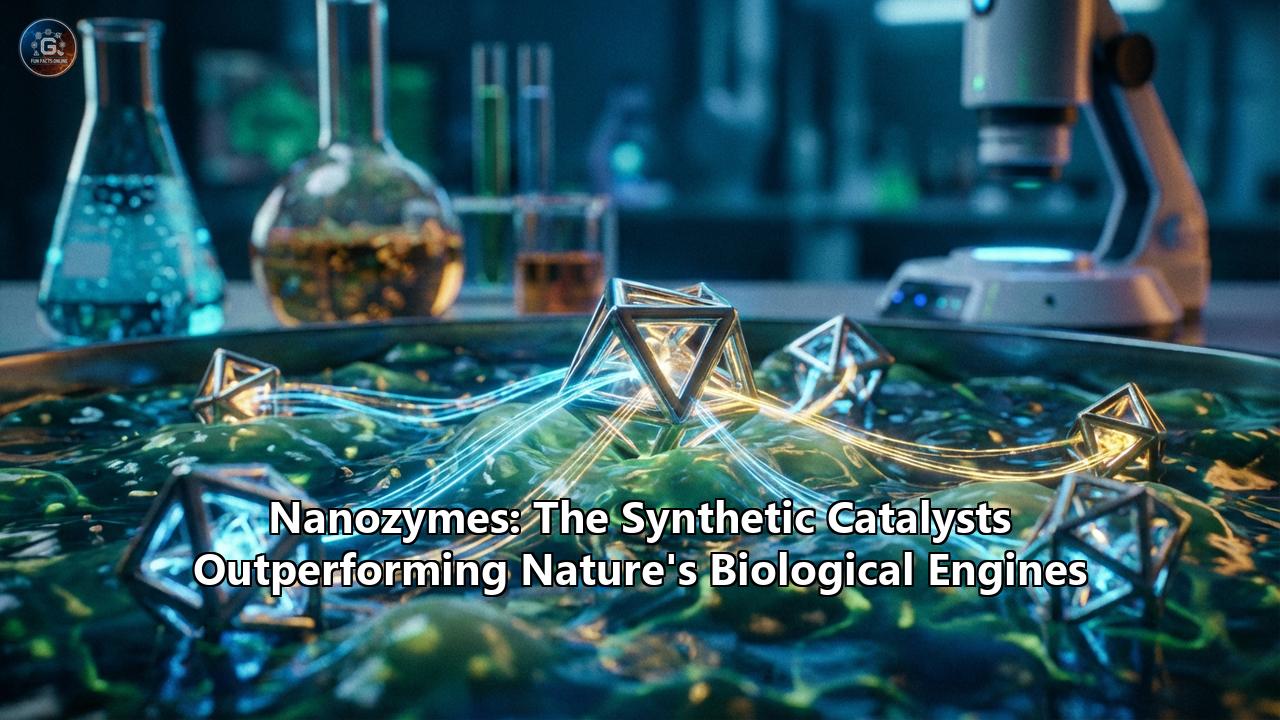
In the quiet, microscopic theaters of our cells, enzymes have reigned supreme for billions of years. These biological macromolecules, honed by eons of evolution, are the masters of efficiency, driving the chemical reactions that make life possible with breathtaking speed and specificity. For decades, scientists looked at these protein-based engines with envy, attempting to mimic their prowess in the lab. But natural enzymes are fragile divas—they denature in heat, unravel in varying pH levels, and are exorbitantly expensive to isolate and purify.
Enter the nanozyme.
Emerging from the convergence of nanotechnology and biology, nanozymes are nanomaterials that display intrinsic enzyme-like characteristics. They are the synthetic usurpers of the catalytic world—robust, low-cost, and highly tunable inorganic powerhouses that are beginning to outperform their biological counterparts in durability and stability. From fighting cancer with "smart" reactive oxygen species to detecting glucose levels with a simple color change, and even cleaning up industrial wastewater, nanozymes represent a paradigm shift in how we engineer chemical reactivity at the nanoscale.
1. The Genesis of a New Field
The story of nanozymes began not with a bang, but with a serendipitous observation. For years, nanomaterials were viewed primarily as inert carriers or imaging agents. Then, in 2007, a landmark study published in Nature Nanotechnology by researchers at the Chinese Academy of Sciences changed everything. They discovered that ferromagnetic nanoparticles ($Fe_3O_4$), widely used for magnetic resonance imaging (MRI), possessed an intrinsic enzyme-like activity. Specifically, they behaved like peroxidase, catalyzing the oxidation of substrates in the presence of hydrogen peroxide—just like the biological enzyme horseradish peroxidase (HRP).
This was a watershed moment. Before this, "artificial enzymes" were mostly organic molecules or polymer complexes that struggled with stability. The discovery that a simple, inorganic crystal could mimic the complex active site of a protein enzyme ignited a global race. Since then, hundreds of nanomaterials—including noble metals (Au, Pt, Pd), metal oxides ($CeO_2$, $MnO_2$, $Co_3O_4$), and carbon-based materials (graphene dots, carbon nanotubes)—have been identified as nanozymes.
2. Mechanisms of Action: How Inorganic Crystals Mimic Life
To understand why nanozymes are so revolutionary, one must look at them at the atomic level. Natural enzymes rely on a precise three-dimensional pocket of amino acids to bind a substrate and lower the activation energy of a reaction. Nanozymes achieve similar feats using surface atoms, crystal lattice defects, and electron transfer capabilities.
Peroxidase-like Activity: The Iron Oxide Standard
The $Fe_3O_4$ nanozyme mimics peroxidase through a mechanism remarkably similar to the Fenton reaction. The surface iron ions ($Fe^{2+}$ and $Fe^{3+}$) act as the active centers. When hydrogen peroxide ($H_2O_2$) interacts with the nanoparticle surface, the $Fe^{2+}$ transfers an electron to the peroxide, breaking the O-O bond and generating a highly reactive hydroxyl radical ($^\bullet OH$). This radical then oxidizes a substrate (like TMB or DAB), causing a color change. Unlike HRP, which can be denatured by the very radicals it produces, the iron oxide crystal is unflinching, enduring harsh conditions that would destroy a protein.
Oxidase-like Activity: Gold's Hidden Talent
Gold nanoparticles (AuNPs), often thought of as chemically inert, exhibit potent glucose oxidase-like activity. The mechanism here involves the adsorption of glucose and dissolved oxygen onto the gold surface. The gold atoms facilitate the transfer of electrons from glucose to oxygen, producing gluconic acid and hydrogen peroxide. This mimics the two-step mechanism of natural glucose oxidase (GOx) but without the need for a fragile protein cofactor like FAD. The catalytic efficiency depends heavily on the size and facet of the gold crystal; for instance, exposed (110) planes are often more active than (111) planes, proving that geometry dictates destiny at the nanoscale.
Superoxide Dismutase (SOD) Mimics: The Ceria Sponge
Cerium oxide ($CeO_2$) nanoparticles are the champions of antioxidant nanozymes. Their magic lies in their ability to switch reversibly between $Ce^{3+}$ and $Ce^{4+}$ oxidation states. This "redox switch" allows them to scavenge superoxide anions ($O_2^{\bullet-}$), a damaging free radical implicated in inflammation and aging. The oxygen vacancies in the crystal lattice act as sponges for these radicals, effectively mimicking the active site of the biological SOD enzyme. Crucially, ceria nanozymes are regenerative; after neutralizing a radical, they can reset their oxidation state, allowing them to work cyclically for extended periods—a feat of durability that natural enzymes struggle to match.
3. The Next Frontier: Single-Atom Nanozymes (SAzymes)
While traditional nanoparticle-based nanozymes are powerful, their active sites are often heterogeneous—only surface atoms participate, and their activities can vary. To bridge the gap between the specific "single active site" of a natural enzyme and the robustness of a nanomaterial, scientists developed Single-Atom Nanozymes (SAzymes).
SAzymes represent the pinnacle of atomic engineering. By anchoring individual metal atoms (like Fe, Co, or Zn) onto a support matrix (often nitrogen-doped carbon), researchers create a material where every metal atom is an active catalytic center. The structure of an Fe-N-C SAzyme, for example, looks strikingly similar to the heme group in hemoglobin or cytochrome c. This "atomic mimicry" delivers the best of both worlds: the near-perfect specificity and high activity of natural enzymes, combined with the thermal and chemical stability of inorganic materials. Recent studies have shown that Fe-N-C SAzymes can exhibit peroxidase activity nearly 100 times higher than traditional $Fe_3O_4$ nanoparticles, bringing synthetic catalysis dangerously close to—and sometimes surpassing—evolution's designs.
4. Applications: From Bench to Bedside to Beyond
The unique properties of nanozymes have catalyzed a surge of applications across medicine, industry, and environmental science.
Biomedical Revolution: Cancer Therapy and Diagnostics
- "Trojan Horse" Cancer Therapy: Tumors flourish in complex microenvironments often characterized by high levels of hydrogen peroxide and acidity. Nanozymes exploit this. "Smart" nanozymes can be injected into a tumor, where they catalyze the conversion of the tumor's own $H_2O_2$ into toxic hydroxyl radicals (via peroxidase activity) or oxygen (via catalase activity). The radicals kill cancer cells directly (Chemodynamic Therapy), while the oxygen generation overcomes tumor hypoxia, making the cancer more vulnerable to radiation and photodynamic therapy.
- Biosensing: The standard ELISA test, used for everything from HIV testing to pregnancy tests, relies on HRP. Replacing HRP with peroxidase-mimicking nanozymes makes these kits cheaper, more shelf-stable, and capable of operating in hotter climates without refrigeration. Paper-based strip tests using gold nanozymes are being developed for rapid detection of pathogens like E. coli or viruses like Influenza A, offering a lifeline for diagnostics in resource-limited settings.
Environmental Remediation
- Wastewater Treatment: The textile and dye industries release vast amounts of toxic phenolic compounds and organic dyes. Peroxidase-mimicking nanozymes can degrade these stubborn pollutants into harmless byproducts. Unlike biological enzymes, which would be poisoned by the sludge they are trying to clean, nanozymes remain active in the toxic soup, offering a sustainable solution for industrial cleanup.
- Pesticide Degradation: Organophosphate pesticides are notorious neurotoxins. Certain nanozymes (like hydrolase-mimics) can cleave the phosphoester bonds of these chemicals, neutralizing them in soil and water runoff before they reach the food chain.
Agriculture and Food Safety
- Stress Tolerance: In a warming world, crops face increasing oxidative stress from drought and heat. Ceria nanozymes, with their SOD-mimic capability, are being researched as "plant probiotics." When applied to crops, they scavenge the damaging ROS generated during stress, acting as an artificial immune system that boosts plant survival and yield.
- Freshness Indicators: Intelligent packaging incorporating oxidase-mimicking nanozymes can detect the biogenic amines released by spoiling meat, changing color to warn consumers long before the smell becomes apparent.
5. Future Perspectives: Intelligent and Programmable Catalysis
The future of nanozymes lies in intelligence. We are moving from passive catalysts to active, programmable machines.
- DNA-Scaffolded Nanozymes: By organizing nanozymes on DNA origami structures, scientists can control the spatial distance between different catalytic centers with nanometer precision. This allows for the construction of "enzyme cascades"—where the product of one nanozyme immediately becomes the substrate for the next, mimicking the efficient metabolic pathways of a cell.
- Nanozyme Logic Gates: Researchers are building boolean logic gates (AND, OR, XOR) using nanozymes. For example, a "smart" diagnostic agent might only trigger a signal (Output 1) if it detects both a cancer biomarker (Input A) AND high acidity (Input B). This binary computation at the molecular level promises diagnostics with near-zero false positives.
Conclusion
Nanozymes are no longer just a scientific curiosity; they are a maturing technology poised to disrupt multiple industries. They challenge the biological dogma that only proteins can be efficient enzymes, proving that inorganic matter, when sculpted with atomic precision, can emulate the breath of life. As we master the art of single-atom engineering and DNA-scaffolded assembly, nanozymes will likely become the workhorses of the 21st century—cleaning our water, curing our diseases, and perhaps one day, powering artificial life forms that blur the line between the born and the made.
Reference:
- https://www.biophysics-reports.org/article/doi/10.1007/s41048-020-00124-9
- https://pmc.ncbi.nlm.nih.gov/articles/PMC11344012/
- https://www.researchgate.net/publication/398645392_All_Nanozyme-Based_Cascade_Reactions_for_Biomedical_Applications_from_Self-Cascading_Nanozyme_to_Immobilized_Cascade_Nanozyme
- https://research-repository.griffith.edu.au/items/ce83e96b-e706-4777-83db-6c83681a8b18
- https://www.researchgate.net/figure/Scheme-A-and-truth-table-B-of-nanozyme-based-AND-gate-C-Absorbance-and-photograph-of_fig1_347092633