
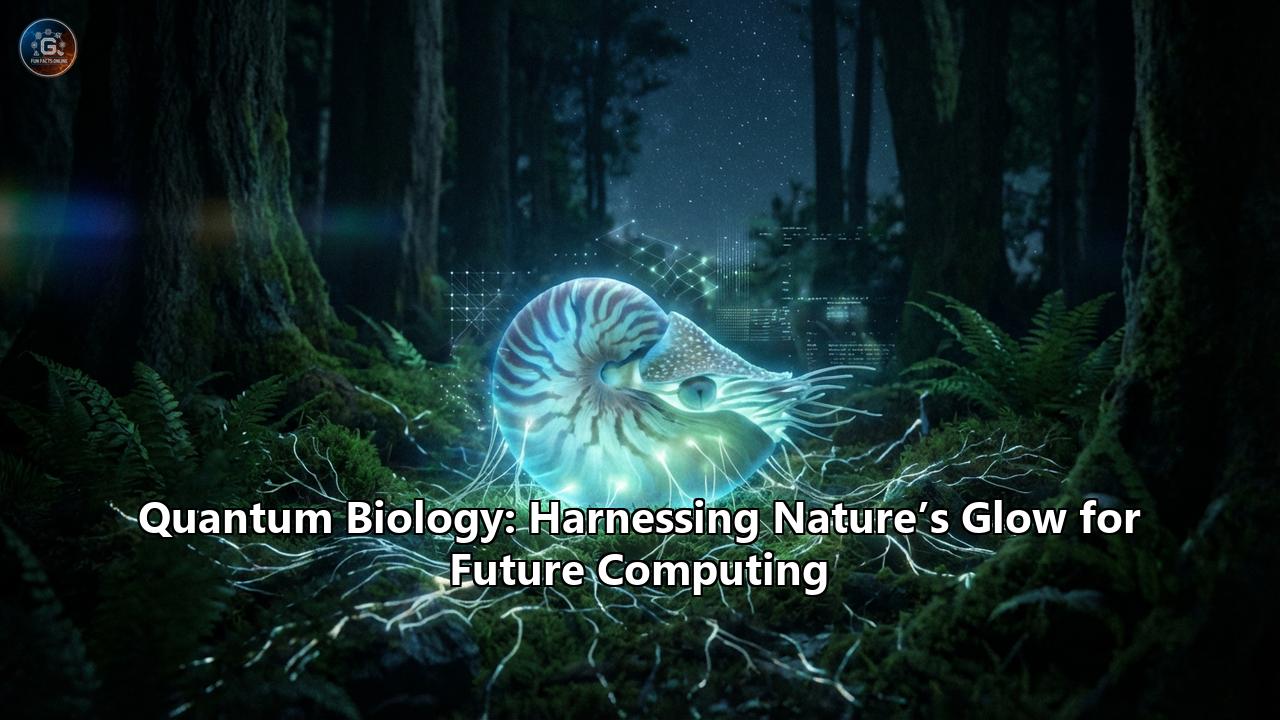
For decades, the holy grail of computing has been trapped behind a wall of absolute zero. To build a quantum computer—a machine capable of solving problems that would take conventional supercomputers millennia—we have believed that we must freeze atoms to near-absolute zero, shielding them in vacuums darker and emptier than deep space. We assumed that the "magic" of quantum mechanics, with its delicate superpositions and ghostly entanglements, could only survive in the most sterile, isolated environments imaginable.
We were wrong.
While we labored to build ice-box cathedrals for our fragile qubits, nature has been running quantum algorithms in the warm, wet, and messy chaos of life for billions of years. Every time a leaf captures a photon of sunlight, every time a European Robin finds its way south for the winter, and every time you smell the scent of rain, a quantum computer is at work.
This is the dawn of Quantum Biology, a revolutionary field that is overturning our understanding of life and promising a new era of computing. We are no longer just looking to silicon and cryogenics for the future of processing power; we are looking at the glowing proteins of jellyfish and the green engines of plants. We are learning to harness "Nature's Glow" to build computers that are not only powerful but alive.
The Impossible Efficiency of the Leaf
To understand the future of computing, we must first look at a spinach leaf. For years, biologists were puzzled by photosynthesis. When a photon hits a chlorophyll molecule, it creates an exciton—a packet of energy that must travel to a reaction center to be converted into chemical fuel. In the chaotic, vibrating world of a plant cell, that exciton should get lost, bumping into random atoms and dissipating as heat. It would be like trying to run through a crowded nightclub blindfolded to find the exit; you’d eventually get there, but you’d waste a lot of time and energy.
But plants don’t waste energy. The transfer of energy in photosynthesis is nearly 100% efficient. The exciton finds the reaction center almost instantly, every single time.
In 2007, a landmark study revealed the secret: the Fenna-Matthews-Olson (FMO) complex, a protein structure in bacteria, was acting as a quantum computer. The exciton wasn't taking one path; it was taking all possible paths simultaneously. Utilizing the quantum property of superposition, the energy wave "sampled" every route to the reaction center at once, instantly collapsed into the most efficient path, and arrived without loss.
This is exactly what a quantum computer does. It searches through databases or cracks codes by exploring all possibilities at once. Nature, however, does this at room temperature, in a "noisy" biological environment that should destroy quantum states.
The Computing Implication:This discovery has birthed the concept of "Hot Quantum Computing." By mimicking the rigid protein scaffolds that protect the quantum coherence in plants, engineers are designing organic solar cells and photonic processors that can function at room temperature. Imagine a quantum processor that doesn't need a building-sized refrigerator, but instead runs efficiently on your desktop, powered by the same principles that feed a forest.
Harnessing the Glow: The Biological Qubit
If plants are the hardware, then the Green Fluorescent Protein (GFP)—the molecule that makes jellyfish glow—is becoming the software.
In a stunning breakthrough that bridges the gap between biology and machines, researchers have recently begun transforming these glowing proteins into "Biological Qubits." In traditional quantum computers, qubits (quantum bits) are made of superconducting circuits or trapped ions. They are incredibly sensitive; a single stray atom or vibration can cause "decoherence," causing the qubit to crash and lose its data.
However, scientists at the University of Chicago recently demonstrated that fluorescent proteins can maintain quantum states even inside a living cell. By using lasers to put the electron spin of these proteins into superposition, they created a sensor that utilizes the "glow" of the protein to measure the quantum environment.
This is the literal "Nature's Glow" referenced in futuristic computing concepts. These biological qubits are naturally protected by their protein shells—nature's own Faraday cages.
The Future Application:This paves the way for Cellular Quantum Computing. Instead of silicon chips, the computers of the future might use arrays of engineered proteins suspended in a gel. These "wet" computers would be self-healing (since proteins can rebuild themselves) and massively parallel. We could see the rise of biosensors that don't just measure blood sugar but perform quantum calculations inside your bloodstream to detect cancer at the atomic level before a tumor ever forms.
The Quantum Compass: Navigation and Sensing
While plants master energy transport, birds master navigation. The European Robin migrates thousands of miles, navigating by the Earth's magnetic field, which is incredibly weak—far too weak to be detected by a standard biological compass.
The secret lies in the bird's eye, within a protein called cryptochrome. When light hits the bird's eye, it knocks an electron out of a molecule, creating a "radical pair" of electrons that are quantum entangled. These two electrons remain connected, dancing in unison even when separated. This entangled state is exquisitely sensitive to magnetic fields. As the bird flies, the Earth's magnetic field tugs on these entangled electrons, altering the chemical reactions in the bird's eye and essentially allowing the bird to "see" magnetic field lines as patterns of light and color.
The Computing Implication:This mechanism is the blueprint for Quantum Spintronics. Current electronic devices use the charge of electrons (moving them around like water). Spintronics uses the spin of electrons (quantum states), which is faster and produces almost no heat. By reverse-engineering the avian compass, we are developing ultra-sensitive quantum sensors that can detect underground oil deposits, map brain activity without MRI machines, or allow autonomous vehicles to navigate without GPS by locking onto magnetic anomalies in the crust.
The Smell of Calculation: Tunneling Through Data
Perhaps the most relatable quantum phenomenon happens right under your nose. The conventional theory of smell says that odor molecules fit into receptors in our nose like a key in a lock. But this "shape" theory fails to explain why molecules with different shapes can smell the same, or why similarly shaped molecules smell different.
The "Vibration Theory" of olfaction proposes that our nose is actually a scanning tunneling spectroscope. When an odor molecule enters a receptor, it acts as a bridge, allowing an electron to "tunnel" from one side of the receptor to the other. Quantum tunneling is the ability of a particle to pass through a solid barrier, like a ghost walking through a wall. This only happens if the molecule vibrates at the exact right frequency. Our nose isn't "feeling" the shape of the molecule; it is "listening" to its quantum vibrations.
The Computing Implication:This is nature's version of a neuromorphic chip. It recognizes complex patterns (scents) instantly via quantum tunneling speeds. Tech companies are now looking to build "electronic noses" based on this principle for safety and diagnostics, but the bigger prize is Tunneling Transistors. As silicon chips get smaller, electrons start leaking (tunneling) through barriers, causing errors. By mastering the biological control of tunneling, we can build processors that use this "leakage" as a feature, not a bug, allowing for switching speeds that are orders of magnitude faster than current chips.
The Convergence: The Rise of Organic Quantum Computing
We are standing on the precipice of a paradigm shift. The silicon age is reaching its physical limits; Moore's Law is slowing down. The next leap requires a fusion of the biological and the technological.
Imagine a Hybrid Bio-Quantum Computer:
- Chassis: A synthetic diamond lattice, inspired by the rigidity of protein scaffolds, operating at room temperature.
- Processor: Arrays of bioluminescent protein qubits that self-assemble and self-repair.
- Interconnects: Photonic channels mimicking the efficiency of the FMO photosynthesis complex, moving data with zero resistance.
- Logic: Algorithms based on the "quantum walk" of plants and the "entangled compass" of birds.
These machines wouldn't just be faster; they would be sustainable. Current data centers consume cities' worth of electricity to keep servers cool. A bio-inspired quantum computer would run on a fraction of the energy, operating efficiently in the warm disorder of the real world.
Conclusion: The Code of Life
For centuries, we viewed life as a machine made of levers and pumps. Then we viewed it as a computer made of code and chemistry. Now, we realize it is something far more profound: a quantum dance.
Nature has spent 3.8 billion years optimizing its quantum code. It has learned to maintain coherence in the chaos, to entangle particles in the warmth of a living eye, and to tunnel electrons through the barriers of enzymes. As we unlock these secrets, we aren't just building better computers; we are finally learning to speak the native language of the universe.
The future of computing isn't cold, dark, and metallic. It is warm, vibrating, and alive. It glows.