
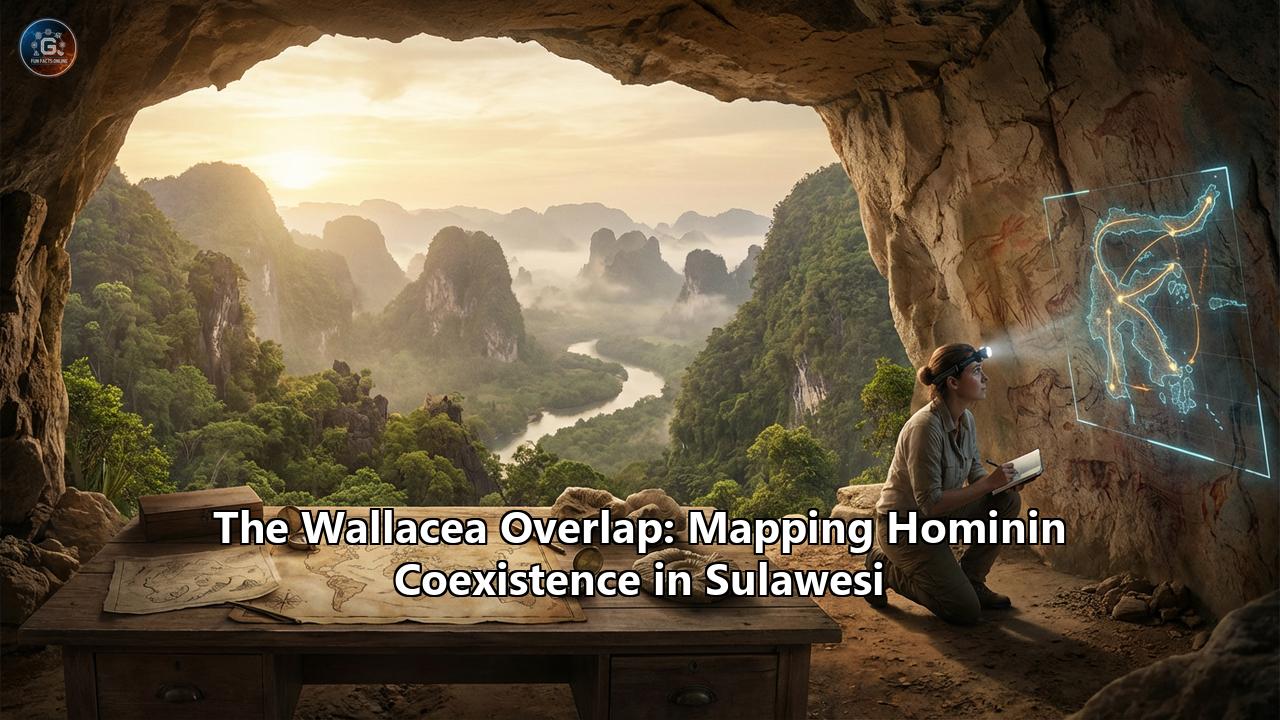
In the vast, fragmented archipelago of Indonesia, there lies an island shaped like a fractured orchid, its four spindly peninsulas reaching out into the surrounding seas as if trying to bridge the deep trenches that isolate it. This is Sulawesi. For distinct biological and geological reasons, it is a place of exceptions. It sits firmly within Wallacea—the biogeographical zone of transition between the continental shelves of Sunda (Asia) and Sahul (Australia). Here, the rules of migration and evolution are rewritten by deep-water channels that have never run dry, not even during the most severe ice ages of the Pleistocene.
For over a century, scientists regarded Sulawesi as a biological laboratory where isolation bred giants and dwarfs: elephants the size of ponies, pigs with tusks like antlers, and squirrels that lived on the ground. But in the last decade, a series of earth-shattering archaeological discoveries has transformed this island from a biological curiosity into one of the most important theatres in the story of human evolution.
We now know that Sulawesi was not merely a stepping stone for Homo sapiens on their way to Australia. It was a long-standing home to archaic human lineages—ghost species who navigated the open ocean hundreds of thousands of years before us. It was a canvas for the world’s oldest known narrative art, painted by early modern humans who possessed a sophisticated capacity for storytelling and spiritual belief. And, perhaps most intriguingly, it was a zone of overlap—a place where the timelines of different human species may have converged, intertwining their destinies in the humid karst forests.
This article maps the "Wallacea Overlap," exploring the deep history of hominin occupation in Sulawesi. We will journey through the geological epoch of the Pleistocene, walk among the extinct megafauna of the Walanae Basin, examine the controversial stone tools of Talepu and Calio, stand before the ancient ochre paintings of Maros-Pangkep, and decode the genome of "Bessé," a young woman whose bones hold the secrets of a lost human ancestry.
II. The Stage: Geography of the Wallacea GapTo understand the human story of Sulawesi, one must first understand the water. Unlike the islands of Java, Sumatra, and Borneo, which sit on the shallow Sunda Shelf and were periodically connected to mainland Asia by land bridges when sea levels fell, Sulawesi has always been an island. To its west lies the Makassar Strait, a formidable marine trench that plunges to depths of over 2,500 meters. Even during the Last Glacial Maximum (LGM), when global sea levels dropped by 120 meters, this strait remained a wide, deep blue barrier, approximately 40 kilometers across at its narrowest point.
This barrier is the physical manifestation of the Wallace Line, the faunal boundary identified by naturalist Alfred Russel Wallace in 1859. West of the line, tigers, rhinoceroses, and primates dominate; east of it, marsupials begin to appear. But Sulawesi, the largest island in the Wallacea zone, is a world unto itself. Its isolation acted as a filter, allowing only those species capable of swimming, flying, or rafting on debris to reach its shores.
For a hominin species to reach Sulawesi, they had to cross this line. They had to leave the certainty of the Asian continental shelf and commit to the open sea. For decades, the prevailing dogma in paleoanthropology was that only Homo sapiens, with our cognitive capacity for complex language and boat-building, could perform such a feat. Archaic humans like Homo erectus were viewed as land-bound, expanding only as far as their feet could carry them.
Sulawesi shatters this assumption. The island’s very existence as an occupied territory in the Early Pleistocene proves that the "crossing" happened nearly a million years before modern humans evolved. The geography of Wallacea did not just filter animals; it filtered human potential, selecting for resilience, adaptability, and perhaps, a desperate kind of ingenuity.
III. The First Wave: Archaic Pioneers of the WalanaeThe earliest chapter of Sulawesi’s human history is written not in bones, but in stone. In the scorched, grass-covered hills of the Walanae Basin in the island's southwest, archaeologists have unearthed evidence that rewrites the timeline of maritime migration.
The Talepu EnigmaIn 2016, a team led by Gerrit van den Bergh from the University of Wollongong and partners from the Indonesian National Research Centre for Archaeology published findings from a site called Talepu. Digging through layers of ancient river sediment, they found stone tools—simple, sharp-edged flakes made of chert and limestone. These tools were sealed beneath a layer of sediments that could be dated using diverse methods, including paleomagnetism and luminescence dating.
The results were stunning: the tools were at least 118,000 years old, and possibly as old as 194,000 years. This date firmly predates the arrival of Homo sapiens in the region by nearly 60,000 years or more.
Who were the toolmakers of Talepu? Without fossils, we are left to speculate based on the "usual suspects" of the region:
- Homo erectus: Known from Java as early as 1.5 million years ago, H. erectus is a strong candidate. If they crossed to Sulawesi, they may have undergone "insular dwarfism," a phenomenon seen in many island species where large bodies shrink due to limited resources.
- Homo floresiensis: The famous "Hobbits" of Flores, an island to the south of Sulawesi, date back to at least 190,000 years ago (ancestral forms). It is plausible that the Talepu toolmakers were a related lineage—perhaps even the ancestors of the Hobbits who drifted south from Sulawesi to Flores.
- Denisovans: The mysterious sister group to Neanderthals, known primarily from DNA and a few fossils in Siberia and Tibet. We know they were in Southeast Asia, and we know they interbred with the ancestors of modern Papuans and Australians. Could Sulawesi have been a Denisovan stronghold?
Just as the scientific community was digesting the Talepu findings, deeper excavations at a nearby site named Calio pushed the timeline back even further. In 2025, researchers confirmed the presence of stone artifacts in layers dating to 1.5 million years ago.
This discovery is monumental. It suggests that archaic hominins were island-hopping in Southeast Asia at a time when our own ancestors in Africa were barely mastering the Acheulean handaxe. The Calio tools imply that the crossing of the Makassar Strait was not a fluke or a one-time accident, but part of a persistent dispersal of archaic humans who were far more capable—or far more subject to the whims of tsunamis and currents—than previously believed.
IV. The Lost World: Megafauna of the PleistoceneTo visualize the lives of these first Sulawesi hominins, we must reconstruct their world. The Pleistocene environment of Sulawesi was a landscape of open savannas and gallery forests, quite different from the dense rainforests of today.
Living alongside the Calio and Talepu toolmakers was a menagerie of extinct giants, a fauna as unique as the hominins themselves:
- Stegodon sompoensis: A dwarf proboscidean, cousin to the elephant. Standing only about 1.5 meters tall at the shoulder, these creatures had massive, curved tusks closer together than modern elephants. They were likely excellent swimmers, which explains their presence on many Wallacean islands. For early hominins, a stranded or hunted juvenile Stegodon would have been a protein bonanza.
- Celebochoerus heekereni: The "Giant Sulawesi Pig." Unlike the modern warty pigs of the island, this beast had enormous tusks that flared outward and upward, not unlike a warthog but on a grander scale. They were ubiquitous in the Walanae Basin and likely a primary competitor—and prey—for archaic humans.
- Megalochelys: A giant land tortoise, rivalling the Galapagos tortoises in size. These slow-moving tanks would have been easy prey for hominins equipped with stone flakes and heavy rocks. Their disappearance from the fossil record coincides suspiciously with the arrival of tool-using humans, a pattern of "overkill" seen on islands globally.
The stone tools found at Talepu are often associated with the bones of these animals. At the site, researchers found the remains of Stegodon and Celebochoerus mixed with the stone flakes, painting a vivid picture of butchery sites on the banks of ancient rivers, where archaic humans processed meat while keeping a wary eye out for crocodiles and the Komodo dragon-like varanids that roamed the island.
V. The Arrival of the Artists: Homo Sapiens Enters WallaceaAround 50,000 to 60,000 years ago, a new player entered the game. A wave of anatomically modern humans (Homo sapiens), moving out of Africa and sweeping across Asia, reached the edge of the Sunda Shelf. They looked out across the water and did what their archaic predecessors had done—they crossed.
But these new arrivals brought with them a cognitive toolkit that was radically different. They didn't just survive; they created.
The Maros-Pangkep KarstIn the limestone hills of Maros-Pangkep, just north of the modern city of Makassar, these early humans found a landscape of towering karst towers, honeycombed with caves and rock shelters. It was here, in the safety of these shelters, that they left a record that would stun the 21st century.
Leang Bulu' Sipong 4: The Hunting SceneIn 2019, archaeologists unveiled a panel of rock art from the cave of Leang Bulu' Sipong 4. Uranium-series dating of the calcite crust overlying the pigment revealed a minimum age of 43,900 years, later revised to roughly 48,000 years.
The painting depicts a hunting scene. But it is not a simple representation of daily life. It shows tiny, human-like figures wielding spears or ropes, surrounding and attacking large animals—specifically, warty pigs and dwarf buffaloes (anoa).
The shock lies in the details of the hunters. They are therianthropes—hybrid figures with human bodies and animal features, such as bird heads or tails. This is the oldest known evidence of visual storytelling and supernatural belief in the world. It predates the famous cave art of Europe (like Chauvet and Lascaux) by thousands of years. It proves that the capacity for myth-making—the ability to imagine beings that do not exist in the physical world—was already fully formed when our species colonized the archipelago.
Leang Karampuang: The Oldest NarrativeIn 2024, the record was broken again. A new dating technique, using laser-ablation uranium-series imaging, was applied to a painting in Leang Karampuang cave. The result: 51,200 years old.
This painting shows three human-like figures interacting with a wild pig. One figure appears to be holding a stick or spear; another seems to be reaching out to the pig's face. The composition implies a narrative relationship—a story. This find cements Sulawesi's status as the cradle of cognitive modernity. It suggests that while Europe was still largely the domain of Neanderthals, humans in the tropics of Wallacea were already producing complex, narrative art.
VI. The Wallacea Overlap: Did They Meet?We have established two facts:
- Archaic hominins were in Sulawesi for over a million years, persisting at least until 118,000 years ago (Talepu) and potentially much later.
- Modern humans arrived by at least 51,200 years ago.
The burning question is: Did they overlap?
The site of Leang Bulu Bettue offers the most tantalizing clues. Excavated by a team from Griffith University and Indonesian archaeological institutes, this rock shelter contains a "deep sequence" of habitation.
- Upper Layers: Rich with evidence of modern human behavior—ochre processing, jewelry making (beads of babirusa tooth), and advanced stone tools.
- The Transition: Below the clearly modern layers, the archaeology changes. The tools become simpler, the symbolic artifacts disappear.
- Deep Layers: The excavations have reached depths where dating becomes difficult, pushing back towards the limits of radiocarbon dating (40,000–50,000 years).
While direct fossil evidence of coexistence (e.g., a Homo sapiens buried next to an archaic human) has not yet been found at Leang Bulu Bettue, the chronological overlap is highly probable.
In the nearby island of Flores, Homo floresiensis survived until at least 50,000 years ago—exactly the time modern humans arrived in the region. It is inconceivable that Sulawesi, a much larger and more resource-rich island, would have seen its archaic population vanish just before modern humans arrived.
The "Ghost" in the ForestImagine the encounter. The modern humans, dark-skinned, armed with compound projectile weapons, carrying the seeds of artistic culture. The archaic locals, perhaps smaller, stockier, using hand-held stone flakes, speaking a language—or using a communication system—unknown to the newcomers.
Did they fight? Did they trade? Or did they simply avoid each other in the dense, tropical vegetation? The genetic evidence suggests a third, more intimate possibility.
VII. The Genetic Fossil: Bessé and the DenisovansIn 2015, in a cave called Leang Panninge ("Bat Cave"), archaeologists found the burial of a young woman. She was 17 or 18 years old, buried in a fetal position, roughly 7,200 years ago. She belonged to the Toalean culture, a mysterious Holocene hunter-gatherer society known for creating beautiful, serrated stone arrowheads called "Maros points."
Her discoverers named her Bessé, a term of endearment for newborn princesses among the local Bugis people.
When scientists extracted DNA from Bessé’s petrous bone (the dense bone of the inner ear), the results were a revelation.
- Ancestral Link: Bessé shares about half her genetic makeup with present-day Indigenous Australians and Papuans. She is a descendant of the first wave of modern humans to reach Wallacea.
- Asian Influence: Surprisingly, she also carried a distinct ancient East Asian ancestry not found in Indigenous Australians, suggesting that Wallacea was a meeting point for different Homo sapiens migrations long before the Austronesian farmers arrived.
- The Denisovan Legacy: Most critically, Bessé’s genome contains a significant chunk of Denisovan DNA.
Indigenous Australians and Papuans have the highest percentage of Denisovan DNA of any people on earth (up to 5-6%). For years, scientists debated where this interbreeding happened. Was it in mainland Asia? Or was it in the islands?
Bessé provides the smoking gun. Her high proportion of Denisovan ancestry suggests that the admixture event—the mating between modern humans and Denisovans—likely occurred within Wallacea.
This implies that when Homo sapiens arrived in Sulawesi (or nearby islands), they didn't just find empty forests or "dumb" animals. They found Denisovans. And they didn't just kill them; they lived with them, mated with them, and absorbed them into our lineage. The "Wallacea Overlap" was not just a period of time; it was a biological fusion.
VIII. The Toalean Mystery and the End of an EraBessé belonged to the Toalean culture, which flourished in South Sulawesi from about 8,000 to 1,500 years ago. The Toaleans are an enigma in themselves. They were hunter-gatherers who seemingly never adopted agriculture, yet they produced technology (the Maros points) and art that rivalled the Neolithic farmers who would eventually replace them.
The Toalean culture vanished roughly 1,500 years ago. Today, the genetic signature of the modern people of Sulawesi (the Bugis and Makassarese) is overwhelmingly Austronesian—the result of a massive migration of farmers from Taiwan via the Philippines around 3,500 years ago. Bessé’s lineage—the direct descendants of the first artists and the carriers of the Denisovan ghost DNA—has been largely diluted or replaced.
However, in the remote interior of the island, and in the genomes of the people of Papua and Australia, the legacy of that first "Wallacea Overlap" endures.
IX. Conclusion: The Center of the WorldFor too long, the narrative of human evolution has been Eurocentric or Afrocentric. We look to the rift valleys of Africa for our origins and the caves of France for our culture. But Sulawesi demands a shift in perspective.
This island, shaped like a K, was a K-junction for humanity. It was here that the earliest seafarers made landfall. It was here that the oldest stories were painted on rock. It was here that we met our archaic cousins and made them part of us.
The excavations at Leang Bulu Bettue, Leang Karampuang, and Talepu are far from over. As archaeologists dig deeper into the limestone floor, they are likely to find the elusive fossils of the archaic toolmakers. We may yet look into the face of the Sulawesi Denisovan or the Talepu Hobbit.
Until then, the "Wallacea Overlap" remains a tantalizing ghost story—a tale of giants, dwarfs, artists, and lovers, played out on an isolated island that changed the course of human history.
Suggested Further Reading & Key Sites Mentioned:
- Leang Bulu' Sipong 4 (Earliest hunting scene, ~48ka)
- Leang Karampuang (Oldest narrative art, ~51.2ka)
- Talepu (Earliest stone tools, ~118ka)
- Calio (Older stone tools, ~1.5 Ma)
- Leang Panninge (Burial site of Bessé)
- Leang Bulu Bettue (Deep sequence cave showing potential overlap)
Reference:
- https://www.iagi.or.id/web/digital/5/2017_IAGI_Malang_The-Enigma-of-the-Existence.pdf
- https://www.youtube.com/watch?v=BFGIxPg8wlE
- https://www.researchgate.net/publication/351438374_Sulawesi
- https://en.wikipedia.org/wiki/Celebochoerus
- https://www.researchgate.net/publication/290452894_Earliest_hominin_occupation_of_Sulawesi_Indonesia
- https://iucn-tftsg.org/wp-content/uploads/file/Accounts/crm_5_000e_fossil_checklist_v1_2015.pdf
- https://www.kasekiken.jp/kaishi/kaishi_42(1)/kasekiken_42(1)_1-11.pdf/kasekiken_42(1)_1-11.pdf)
- https://www.researchgate.net/publication/275756638_The_first_Stegodon_fossils_from_Central_Sulawesi_and_a_new_advanced_Elephas_species_from_South_Sulawesi_Indonesia
- https://en.wikipedia.org/wiki/Wallace_Line
- https://en.wikipedia.org/wiki/Marine_isotope_stages
- https://cduebooks.pressbooks.pub/wallacea/chapter/sea-level/
- https://www.mpg.de/17386352/oldest-genome-from-wallacea-shows-previously-unknown-ancient-human-relations
- https://www.researchgate.net/publication/350299475_Widespread_Denisovan_ancestry_in_Island_Southeast_Asia_but_no_evidence_of_substantial_super-archaic_hominin_admixture