
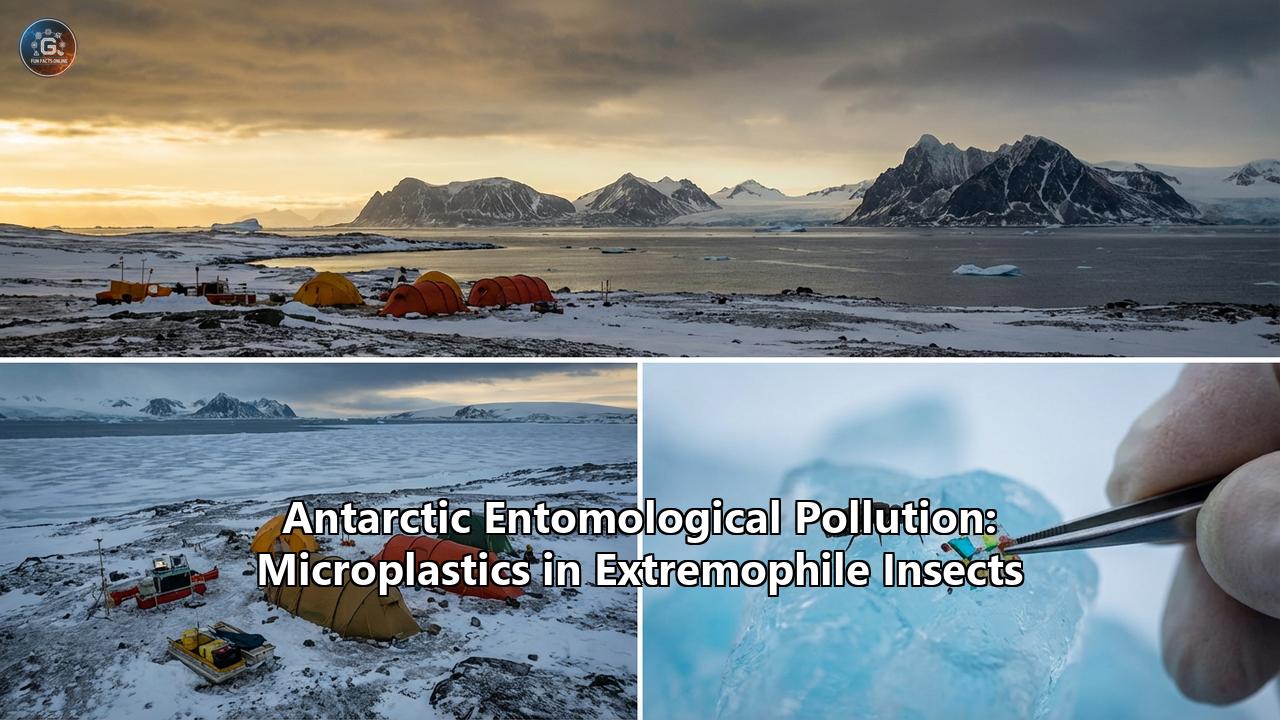
The wind howling across the Antarctic Peninsula carries with it a deceptive promise of purity. For centuries, the icy expanses at the bottom of the world have been viewed as the ultimate untouched frontier, a pristine wilderness shielded from the heavy hand of human industry by treacherous oceans and lethal temperatures. But peer closely at the mossy, moisture-rich fringes of the continent—where the ice gives way to sparse, rocky terrestrial ecosystems—and a different, more unsettling narrative emerges. Here, in the microscopic world of the soil, the footprint of the Anthropocene has arrived in the form of microplastics. And it has infiltrated the bellies of the most resilient, bizarre, and isolated extremophile insects on the planet.
To understand the gravity of this synthetic invasion, one must first meet the native rulers of the Antarctic soil. Antarctica hosts virtually no permanent terrestrial animals of significant size; there are no land mammals, no reptiles, and no amphibians. Instead, the true monarchs of the frozen dirt are arthropods. Chief among them is Belgica antarctica, a wingless, non-biting midge no larger than a grain of rice, which holds the prestigious title of the continent’s only native insect. Accompanying it in the damp moss beds is Cryptopygus antarcticus, a minuscule springtail, or collembolan, that serves as a central gear in the region's terrestrial food web.
These creatures are not merely survivors; they are biological marvels. Entomologists classify them as "poly-extremophiles," meaning they have evolved to withstand a barrage of lethal environmental stressors that would obliterate almost any other form of life. The larvae of Belgica antarctica—which remain in this juvenile stage for up to two years—can endure being frozen solid for months, survive severe dehydration that reduces their body water by up to 70%, and tolerate extreme swings in temperature, high soil salinity, and intense blasts of ultraviolet radiation. When the punishing Antarctic winter sets in, these insects rely on profound metabolic adaptations to enter a state of suspended animation, waiting out the darkness until the brief summer thaws the ice. However, this legendary toughness was forged over millions of years of natural selection. It never prepared them for the sudden, pervasive arrival of synthetic polymers.
How does plastic reach the ends of the Earth? The journey of microplastics—fragments smaller than five millimeters—is a testament to the inescapable interconnectivity of global ecosystems. They are shed by the degradation of synthetic clothing, the abrasion of rubber car tires, and the breakdown of plastic bags, bottles, and commercial fishing gear. Caught in powerful atmospheric currents or carried along vast oceanic conveyor belts, these microscopic invaders eventually precipitate out in snow, drift ashore in ocean foam, or are deposited by local human activity, including tourism and scientific research operations. Once in the Antarctic environment, they settle into the algae and moss beds—the exact foraging grounds of the continent's extremophile insects.
The first crack in the illusion of Antarctic terrestrial purity appeared in 2020. An Italian research team, led by ecologist Elisa Bergami and toxicologist Ilaria Corsi, made a sobering discovery along the shores of the Fildes Peninsula on King George Island. They found a large, stranded piece of expanded polystyrene (PS) foam, heavily colonized by microalgae, moss, and lichens. This floating debris had essentially become a toxic buffet for the local microfauna. Detecting plastics inside tiny, carbon-based organisms is notoriously difficult, but the team developed an innovative method using enzymatic digestion paired with advanced micro-Fourier Transform Infrared (µ-FTIR) spectroscopy at the Elettra Sincrotrone Trieste facility. This allowed them to unequivocally detect polystyrene fragments measuring less than 100 micrometers deep within the digestive tracts of the springtail Cryptopygus antarcticus. This watershed moment provided the first field-based evidence that microplastics had successfully entered the Antarctic terrestrial food web, shifting the global scientific focus from ocean pollution to the hidden contamination of polar soils.
Yet, the springtail was only the beginning of the story. In a groundbreaking study published in early 2026 in the journal Science of the Total Environment, a global research coalition revealed that Belgica antarctica, the continent's toughest native insect, was also actively consuming microplastics in the wild. The project was spearheaded by researchers from the University of Kentucky, including entomologist Nicholas Teets and lead author Jack Devlin—whose interest was initially sparked by a documentary on the global plastic crisis. Devlin posed a crucial, haunting question regarding these unique insects: "Does that toughness protect them from a new stress like microplastics, or does it make them vulnerable to something they've never seen before?".
To answer this, the team embarked on a comprehensive two-phased investigation. The field phase, conducted during a 2023 research cruise along the western Antarctic Peninsula, involved collecting wild midge larvae from 20 diverse locations spread across 13 islands. Working once again with microplastics specialist Elisa Bergami and imaging expert Giovanni Birarda, the team utilized infrared and Raman spectroscopy to peer inside the microscopic guts of the collected specimens. Out of 40 wild larvae analyzed, two were found to contain synthetic polymer fragments, including materials commonly associated with packaging, textiles, and fishing gear. A 5% ingestion rate may seem relatively low compared to heavily polluted urban ecosystems, but discovering any plastic within the only native insect of the world's most remote continent is an undeniable warning sign. As Devlin noted, "You work with this incredible little insect that lives where there are no trees, barely any plants, and you still find plastic in its gut. That really brings home how widespread the problem is.".
While the presence of microplastics in wild populations confirmed exposure, the researchers desperately needed to understand the biological consequences. In the laboratory phase, midge larvae were exposed to varying concentrations of microplastic beads for a 10-day period. Initially, the results seemed like a testament to the insect's legendary resilience. Even at high concentrations—levels that far exceed current natural contamination in Antarctica—the larvae did not die. Their basic metabolic rates remained remarkably steady, and on the surface, short-term exposure did not appear to disrupt their core physiological processes.
However, survival is not the same as thriving, and the researchers soon uncovered a hidden, insidious cost. Further analysis revealed that larvae exposed to high levels of plastic particles suffered a significant decrease in their fat reserves. In the unforgiving climate of Antarctica, fat is the ultimate currency of survival. Lipids are essential energy stores that sustain the midges through the long, dark months of the Antarctic winter when they are trapped in a frozen state. By filling their digestive tracts with nutritionally void plastic, the larvae may be experiencing a false sense of satiation, eating less organic food and expending extra energy attempting to process or pass the indigestible synthetic materials. This energetic drain could leave them critically unprepared for the deep freeze, potentially cascading into long-term population declines as pollution levels continue to steadily rise globally.
The implications of these findings extend far beyond the fate of a single extremophile species. The terrestrial ecosystems of the Antarctic Peninsula are exceptionally simple, characterized by low biodiversity and incredibly short food chains. In such environments, every species plays a load-bearing role. Belgica antarctica and Cryptopygus antarcticus are the primary drivers of nutrient cycling; they act as the biological recyclers of the ice, breaking down decaying algae, moss, and penguin guano, thereby returning vital nutrients to the sparse soil. Their populations can be astoundingly dense—reaching up to 40,000 midge larvae per square meter in optimal damp moss patches. If microplastic pollution compromises their lipid reserves, overall fitness, and reproductive success, the efficiency of soil nutrient recycling could plummet. While these insects have few natural terrestrial predators, a decline in their populations could still indirectly devastate the fragile flora and avian life that depend on a balanced, nutrient-rich soil ecosystem to survive.
Because of its relative ecological simplicity, Antarctica serves as an unparalleled natural laboratory. "Antarctica gives us a simpler ecosystem to ask very focused questions," Devlin explained. "If we pay attention now, we might learn lessons that apply far beyond the polar regions". This makes polar entomology a unique bellwether for the rest of the planet.
Ultimately, the discovery of entomological pollution in Antarctica destroys the enduring myth of the untouched sanctuary. It provides a sobering, microscopic lens through which to view the global environmental crisis. The fact that synthetic polymers manufactured in bustling metropolitan centers can navigate atmospheric currents and oceanic gyres to end up inside the microscopic gut of a two-millimeter midge at the South Pole is a profound testament to the reach of human influence. These tiny poly-extremophiles have survived ice ages, brutal solar radiation, and the harshest winters on Earth. Now, they are serving as the ultimate bio-monitors for a new epoch. The infiltration of microplastics into the Antarctic terrestrial food web is an early warning system—a plea from the bottom of the world indicating that when it comes to plastic pollution, there is no "away," and nowhere on this planet is truly out of reach.
Reference:
- https://www.areasciencepark.it/en/even-antarctica-toughest-insect-ingests-microplastics/
- https://www.preprints.org/manuscript/202310.0334
- https://www.onoff.gr/blog/en/science/microplastics-found-antarctic-insect/
- https://theclimatewatch.com/microplastics-found-in-antarctic-larvae-raises-alarm-over-global-pollution-spread/
- https://royalsocietypublishing.org/rsbl/article/16/6/20200093/62796/Plastics-everywhere-first-evidence-of-polystyrene
- https://spectrumbooks.in/news-views/english/environmental-ecology-biodiversity-and-climate-change/antarcticas-last-native-insect-faces-extinction-threat-from-microplastics
- https://scitechdaily.com/even-antarctica-isnt-safe-microplastics-found-inside-the-continents-only-insect/
- https://e360.yale.edu/digest/antarctic-midges-microplastics
- https://www.ceric-eric.eu/2020/06/24/press-release-ecosystems-at-risk-in-antarctica-due-to-microplastics/
- https://www.sciencedaily.com/releases/2026/02/260212234214.htm
- https://indiandefencereview.com/antarctica-last-native-insect-microplastic/
- https://gizmodo.com/antarcticas-only-bug-is-eating-something-it-really-shouldnt-2000697908
- https://news.ssbcrack.com/antarcticas-only-native-insect-found-consuming-microplastics/