
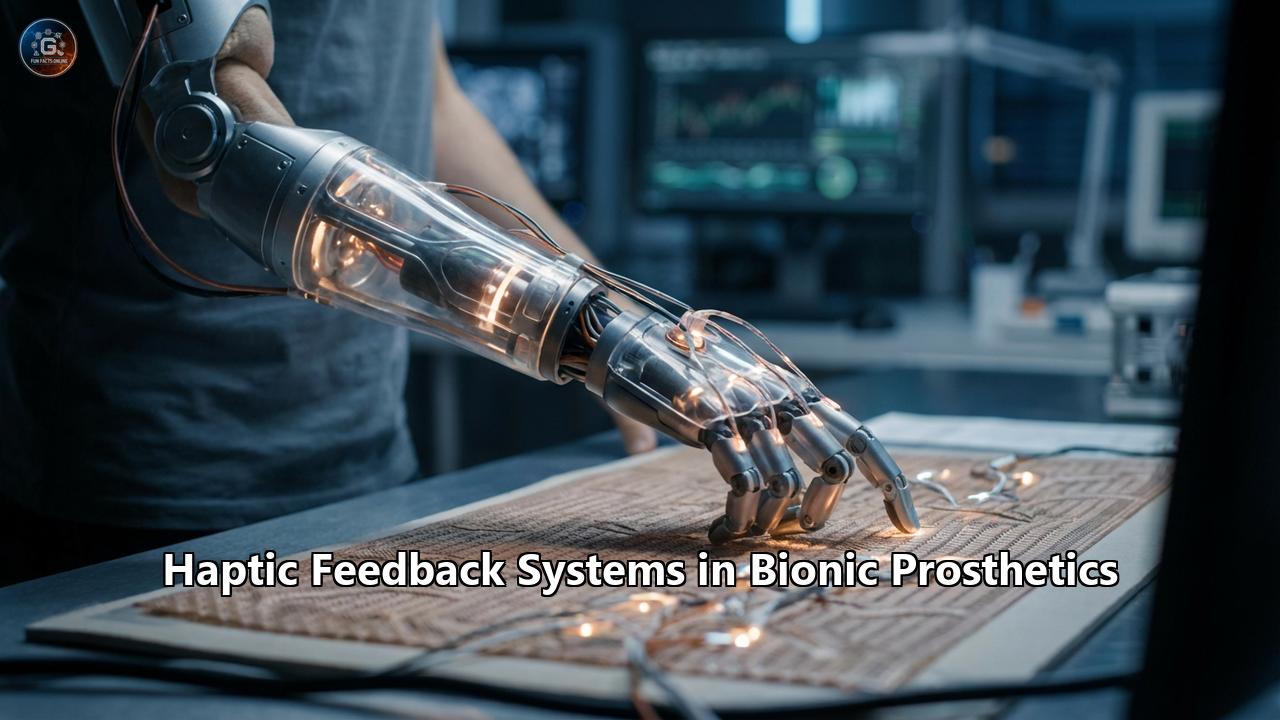
The wind on a face, the warmth of a morning coffee mug, the reassuring grip of a loved one’s hand—these are sensations that define the human experience. For the millions of individuals living with limb loss, however, the world has traditionally ended where their prosthetic begins. For decades, prosthetic limbs were marvels of mechanical engineering but failures of sensory integration. They were tools—sophisticated, articulated, and strong—but they were dead to the world they touched. A user could crush a paper cup or drop a fragile egg simply because they could not feel when they had made contact.
This disconnect is now ending. We are currently witnessing the dawn of the "Sensory Renaissance" in bionics. Through the convergence of soft robotics, neural engineering, artificial intelligence, and material science, researchers are giving prosthetics the one thing they have always lacked: a sense of touch.
This comprehensive guide explores the cutting-edge world of Haptic Feedback Systems in Bionic Prosthetics, tracing the journey from wooden pegs to cybernetic limbs that can feel, heal, and communicate directly with the human brain.
Part I: The Silent Epidemic and the Missing Loop
To understand the gravity of haptic feedback technology, one must first understand the deficit it seeks to cure. Imagine driving a high-performance sports car. It has a powerful engine, precision steering, and perfect aerodynamics. Now, imagine driving that car with a numb body. You cannot feel the vibration of the road through the seat, you cannot feel the resistance of the steering wheel, and you cannot feel the pedal under your foot. You would have to stare at your feet to know if you were braking; you would have to watch the wheel intensely to ensure you weren't drifting.
This is the daily reality for a traditional prosthetic user. It is a problem of "Open-Loop Control."
In a biological limb, the brain sends a motor command ("close hand"), the muscles execute it, and the nerves in the skin and muscles immediately send feedback ("hand is closing," "object contacted," "object is hot"). This is a Closed-Loop system. The brain adjusts the grip force milliseconds after contact, largely subconsciously.
In a traditional prosthetic, the brain sends the command (via electromyography or EMG sensors on the residual limb), and the hand closes. But no signal comes back. The loop is open. The user must rely entirely on visual feedback—watching the hand to see if it has grasped the object. This imposes a massive "cognitive load." The user cannot multitask; they cannot grab a water bottle while watching TV. The prosthetic requires their undivided attention, making it mentally exhausting to use.
This sensory void leads to a phenomenon known as "device abandonment." Studies have shown that up to 30% of upper-limb amputees eventually stop using their expensive myoelectric prosthetics, reverting to simpler body-powered hooks or no prosthesis at all. Why? Because a hook, connected via a cable and harness, offers "mechanotactile" feedback—the user feels the tension of the cable on their shoulders. A $50,000 bionic hand, despite its robotic beauty, often feels like a foreign object—a heavy, numb tool hanging off the body.
Haptic feedback is the key to closing the loop. It is the bridge that turns a tool into a limb.
Part II: The Biology of Touch – What We Are Trying to Mimic
To build an artificial sense of touch, engineers have had to reverse-engineer one of nature's most complex systems: the human skin. Skin is not merely a wrapping; it is a sprawling, intelligent data-collection surface.
The challenge of haptics is that "touch" is not a single sensation. It is a symphony of inputs processed by specialized biological sensors called mechanoreceptors. A truly realistic bionic limb must replicate the functions of at least four distinct types:
- Merkel Disks (Slow Adapting Type I): These are responsible for sensing sustained pressure and texture. When you hold a pen, Merkel disks tell your brain that the object is still there. They provide the "image" of touch.
- Meissner Corpuscles (Fast Adapting Type I): These are tuned to low-frequency vibrations and light touch. They are crucial for grip control, detecting the microscopic slip that happens just before you drop an object.
- Ruffini Endings (Slow Adapting Type II): These detect skin stretch and joint position (proprioception). They tell you the shape of your hand even when your eyes are closed.
- Pacinian Corpuscles (Fast Adapting Type II): Deep in the dermis, these sensors detect high-frequency vibrations. They allow you to feel the hum of a running engine or the texture of a rough wall through a tool you are holding.
Beyond these, the skin also houses thermoreceptors (for heat and cold) and nociceptors (for pain).
Early attempts at prosthetic feedback were crude because they treated touch as a binary signal: Contact or No Contact. Modern haptic systems, however, are "Biomimetic." They attempt to encode data into electrical signals that mimic the specific firing patterns of these biological receptors. The goal is to trick the brain into believing the signals are coming from a biological hand, not a silicon chip.
Part III: Non-Invasive Haptic Technologies
The most immediate and commercially viable solutions for sensory feedback are non-invasive. These systems do not require surgery; they sit on the surface of the residual limb (the "stump") and translate data from the bionic hand into sensations the skin can feel.
1. Vibrotactile Feedback
This is the most common form of haptics, similar to the vibration motor in a smartphone. Sensors in the prosthetic fingertips detect pressure. When the pressure increases, a small actuator on the user's residual limb vibrates.
- The Mapping Problem: A vibration on the forearm doesn't naturally feel like a touch on the finger. This is a "sensory substitution." The brain must learn that "buzz on forearm" equals "pressure on index finger."
- Advancements: Modern systems use "somatotopic mapping." By placing an array of vibrators in specific patterns, users can learn to distinguish which finger is touching an object. Advanced "tactors" can vary frequency and amplitude to simulate texture. A high-frequency buzz might mimic glass, while a low, rumbling throb mimics sandpaper.
2. Electrotactile Stimulation
Instead of vibration, this method uses small electrodes on the skin to deliver a mild, painless electrical current.
- Resolution: Electrotactile systems offer higher resolution than vibration. A small electrode array can transmit more detailed information—like the shape of an object—than a bulky vibration motor.
- The "Parethesia" Challenge: The sensation produced is often described as a "tingle" or "pins and needles" (paresthesia), which some users find unnatural or annoying. However, by modulating the pulse width and frequency, researchers can create sensations that feel more like pressure or tapping.
3. Mechanotactile (Force) Feedback
This is perhaps the most intuitive method. When the prosthetic hand grips an object, a motorized pusher presses into the soft tissue of the user's residual limb.
- Proprioception: Unlike vibration, which is abstract, pressure feels like pressure. This system helps significantly with "Grip Force Modulation." If the user squeezes a cup too hard, the pusher presses harder into their arm, warning them to back off.
- Skin Stretch: Newer devices use rockers to stretch the skin of the forearm, simulating the sensation of the fingers bending. This restores a degree of proprioception, allowing the user to know the hand's posture without looking at it.
4. Thermal Feedback
In 2023 and 2024, significant strides were made in thermal haptics. By using Peltier elements (thermo-electric coolers/heaters) on the residual limb, prosthetics can now transmit temperature.
- Functional Safety: This allows a user to know if a coffee is too hot to drink or if a surface is icy.
- Emotional Connection: Perhaps more importantly, thermal feedback restores human warmth. In trials, users reported that holding a loved one’s hand felt significantly more emotional and "real" when they could feel the body heat. This "affective touch" is crucial for psychological embodiment.
Part IV: The Invasive Revolution – Neural Interfaces
While non-invasive methods are safer, they are limited by the "bandwidth" of the skin on the residual limb. To achieve true, high-fidelity touch, scientists are bypassing the skin and going directly to the source: the nerves.
1. Peripheral Nerve Stimulation (PNS)
In this approach, surgeons implant cuff electrodes or micro-electrode arrays (like the USEA - Utah Slanted Electrode Array) directly into the median, ulnar, and radial nerves of the residual arm.
- Direct Inception: When the prosthetic sensors detect touch, the computer stimulates the specific nerve fibers that used to connect to the fingers. The result is profound. The user does not feel a vibration on their stump; they feel a sensation on their missing thumb. This is "referential sensation."
- Biomimetic Encoding: By using algorithms that mimic the firing spikes of natural mechanoreceptors (e.g., Neuromorphic encoding), researchers have enabled users to distinguish between hard and soft objects, and even textures like corduroy versus cotton.
2. Targeted Sensory Reinnervation (TSR)
TSR is a surgical technique that rewires the body to create a biological display.
- The Procedure: Surgeons take the sensory nerves that once went to the hand and surgically connect them to a patch of skin on the chest or upper arm.
- The Result: Over several months, the nerves grow into that patch of skin. When you touch that spot on the chest, the patient feels it as if you are touching their missing hand.
- The Haptic Loop: Engineers then place tactor arrays (vibrators or thermal pads) on this "reinnervated" skin map. When the prosthetic touches an object, the tactor pushes on the chest skin, and the brain perceives it as a touch on the phantom finger. This provides a completely naturalistic, non-invasive interface for an invasive surgical result.
3. Osseointegration and Osseoperception
Osseointegration involves anchoring the prosthetic directly to the bone using a titanium implant, eliminating the need for a socket.
- Osseoperception: Because the prosthetic is fused to the skeleton, vibrations travel through the device and into the user's bone. Users report a heightened sense of the environment—feeling the texture of the floor through a prosthetic leg or the crunch of an object in a prosthetic hand—mediated by the body’s natural vibration conduction.
Part V: Electronic Skin (E-Skin) – The New Frontier
The hardware on the prosthetic itself is undergoing a revolution. Rigid force sensors are being replaced by "E-Skin"—flexible, stretchable, sensor-laden materials that wrap around the prosthetic fingers.
The Stanford "Monolithic" Breakthrough:In recent years, researchers at Stanford University developed a soft integrated circuit that acts like a nervous system. This E-Skin can:
- Sense in High Resolution: It detects pressure, strain, and temperature simultaneously.
- Process Data Locally: unlike previous sensors that sent raw data to a central computer, this skin processes the signal on the limb, mimicking the peripheral nervous system's ability to filter noise.
- Self-Heal: The polymers used can re-bond if torn, similar to biological skin healing a scratch.
Developed by researchers at the National University of Singapore, ACES functions like a "nervous system on a chip." It is capable of detecting touch 1,000 times faster than the human sensory system. It uses a single wire to transmit data from thousands of sensors, making it robust against damage. If one sensor fails, the rest of the network survives—a crucial feature for prosthetics that face daily wear and tear.
These skins are moving us toward "Distributed Sensing." Instead of just feeling at the fingertips, future prosthetics will feel a bump on the wrist or a brush against the forearm, providing total spatial awareness.
Part VI: The Psychological Impact – Embodiment and Phantom Pain
The benefits of haptic feedback extend far beyond dexterity. They reach into the psyche of the user, altering how the brain maps the body.
1. Treating Phantom Limb Pain (PLP)
Phantom limb pain is a debilitating condition where the brain, starving for input from the missing limb, generates pain signals. It is a "cortical reorganization" error.
- The Cure: Haptic feedback provides the brain with the input it craves. By restoring the flow of information, the brain "calms down." Studies involving peripheral nerve stimulation have shown dramatic, long-term reductions in PLP for users who had suffered for years. The feedback reassures the brain that the limb is "healthy" and present.
2. The Sense of Embodiment
Embodiment is the feeling that the prosthetic is part of you, not just attached to you. This is measured by the "Rubber Hand Illusion."
- Closing the Gap: When visual feedback (seeing the hand touch) matches sensory feedback (feeling the touch) with less than 100 milliseconds of latency, the brain accepts the device.
- Agency and Ownership: Users with haptic feedback report a higher "Sense of Agency" (I caused that action) and "Sense of Ownership" (That hand is mine). This leads to better care of the device, more confident social interaction, and a reduction in the cognitive effort required to move.
Part VII: Case Studies in the Lab
To illustrate the power of these systems, we look at the standard tests used to validate them.
The Cherry Stem Test:In a landmark study, a user equipped with a sensory-feedback hand was tasked with plucking the stem off a cherry while blindfolded. Without feedback, the user either crushed the cherry or failed to grip the stem. With haptic feedback enabled, the user could feel the delicate compliance of the fruit and the resistance of the stem, successfully completing the task. This level of finesse is impossible with visual feedback alone.
The Box and Blocks Test:This test measures manual dexterity by having a user move blocks over a partition. Users with haptic feedback consistently move more blocks per minute than those without, approaching the speed of able-bodied individuals. The feedback allows them to grab the block without hesitation, knowing instantly when they have a secure grip.
The "Walgamott" Trials:Keven Walgamott, a participant in a University of Utah study using the "LUKE Arm" with the Utah Slanted Electrode Array, provided one of the most moving testimonials in the field. When he first held his wife's hand with the sensory-enabled prosthetic, he wept. "It felt like I was holding her hand," he said. He could feel her fingers interlaced with his robotic ones. This moment highlighted that the ultimate goal of bionics is not just function, but connection.
Part VIII: Challenges and the Road Ahead
Despite the miracles occurring in labs, hurdles remain for widespread adoption.
- Surgical Stability: Implanted electrodes can degrade over time. The body attacks foreign objects, creating scar tissue (encapsulation) that insulates the electrode and blocks the signal. Developing bio-compatible, long-lasting interfaces is the "Holy Grail" of neural engineering.
- Power Consumption: Processing complex haptic data requires energy. Prosthetic batteries are already taxed by motors; adding high-speed sensory processing reduces battery life. Neuromorphic chips, which process data only when changes occur (like the human brain), are being developed to solve this.
- Cost: A bionic hand can cost $30,000 to $100,000. Adding custom haptic arrays and neural surgery pushes this into the stratosphere. Democratizing this technology through 3D printing and open-source software is a critical movement within the industry (e.g., the Open Bionics initiative).
- Signal Complexity: We still do not fully understand the "language" of touch. While we can stimulate nerves, we are often shouting static rather than whispering poetry. We need better algorithms to translate digital sensor data into the nuanced, fluid language of neural spikes.
Conclusion: The Symbiotic Future
We are standing at the threshold of a new era in human evolution. The distinction between "biological" and "artificial" is blurring. Haptic feedback systems are not just accessories for prosthetics; they are the wiring of a new nervous system.
In the near future, we will see "Bionic Integration" where amputation is no longer a disability but an alteration of interface. We will see AI-driven prosthetics that predict the user's intent and confirm it with a reassuring squeeze. We will see electronic skins that are more sensitive than biological ones, giving users "super-human" sensitivity—the ability to feel heat at a distance or detect microscopic vibrations.
The journey of the amputee has effectively shifted from "rehabilitation" to "augmentation." By closing the loop, by giving the machine the power to feel, we are finally returning the lost sense of wholeness to the human body. The prosthetic of the future will not just be a hand that moves; it will be a hand that holds, feels, and loves.
Reference:
- https://www.youtube.com/watch?v=17Ia-z2b3Pg
- https://www.independent.co.uk/tech/electronic-skin-amputee-prosthetics-robotics-stanford-b2341451.html
- https://research.chalmers.se/publication/534397/file/534397_Fulltext.pdf
- https://www.proquest.com/openview/a53c3e0c57615580ea008f1dd5f0f004/1?pq-origsite=gscholar&cbl=2041930
- https://livingwithamplitude.com/article/haptic-feedback-new-direction-for-prosthetics/
- https://www.futurity.org/electronic-skin-robots-prosthetics-2121462-2/
- https://www.medrxiv.org/content/10.1101/2022.03.13.22272179v2.full
- https://pmc.ncbi.nlm.nih.gov/articles/PMC12467846/