
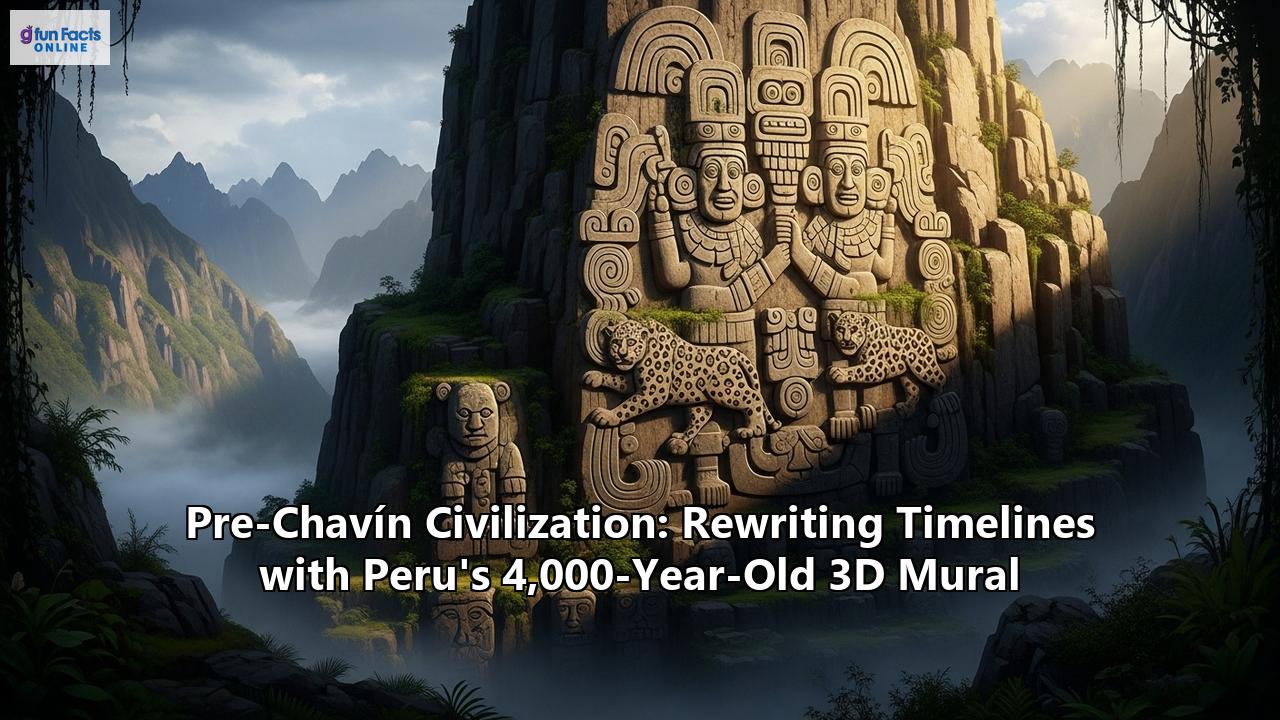
Before Chavín: How a 4,000-Year-Old 3D Mural Is Forcing a Rethink of Ancient Peru
Deep within the coastal valleys of northern Peru, a stunning discovery is peeling back the layers of time, revealing an artistic and cultural sophistication that predates one of ancient America's most influential civilizations. For decades, the Chavín culture, which emerged around 900 BCE, was considered a foundational source of artistic and religious ideology in the Andes. However, the recent unearthing of a vibrant, three-dimensional mural, estimated to be between 3,000 and 4,000 years old, at the Huaca Yolanda archaeological site is challenging long-held assumptions and rewriting the timeline of cultural development in the region. This remarkable find, along with other significant discoveries at sites like Vichama, paints a vivid picture of complex pre-Chavín societies grappling with climate change, expressing a unique cosmology, and creating art of a caliber previously thought to have emerged much later.
A Wall That Speaks Volumes: The Huaca Yolanda Mural
In the La Libertad region of Peru, a team of archaeologists led by Ana Cecilia Mauricio from the Pontifical Catholic University of Peru has uncovered an artifact that can only be described as unprecedented in Peruvian archaeology. Discovered in July 2025 within what is believed to have been a ceremonial temple, the polychrome mural at Huaca Yolanda is a breathtaking example of pre-ceramic artistry. Spanning nearly 20 feet in length and over 9 feet in height, the mural immediately stands out for its three-dimensional relief, vibrant colors, and intricate, double-sided design.
What makes this discovery so revolutionary is its age and complexity. Dated to the Formative Period (roughly 2000-1000 BCE), the mural was created by a little-known coastal culture thousands of years before the Inca Empire rose to prominence. The artwork was intentionally buried to make way for later construction, a common practice in ancient Peru that, fortunately, preserved its astonishing details for millennia. The mural features a rich tapestry of symbols painted in shades of blue, yellow, red, and black. On one face, a large bird, possibly an eagle or falcon, is depicted with outstretched wings. The other side is a stunning composition of stars, marine plants, figures resembling shamans, and mythological beings. Central to the artwork are depictions of fish and, most remarkably, a fish figure whose body is rendered as a three-dimensional fishing net.
This complex iconography suggests a deep spiritual connection to the sea, the sky, and the natural cycles that governed life for these coastal people. "The use of cool colors like the blue, in addition to the three-dimensional forms, suggests a ritual relationship with the sea and natural cycles," explained archaeologist Ana Cecilia Mauricio. The double-sided nature of the wall indicates it was a central feature within a sacred space, likely used for rituals related to water and fertility. The very existence of such a sophisticated mural, with its unique 3D artistry and symbolic depth, demonstrates that the artistic and religious foundations of Andean civilization are far older and more diverse than previously understood. It stands as a testament to a distinct coastal artistic tradition that flourished independently, long before the Chavín culture's own unique iconography of jaguars and predatory reptiles spread from the highlands.
A Tale of Drought and Resilience: The Murals of Vichama
Further south, in the Huaura Valley near Lima, another set of pre-Chavín murals tells a different, yet equally compelling, story. The archaeological site of Vichama, an agricultural and fishing settlement that was part of the ancient Caral civilization, has yielded a series of dramatic reliefs that are approximately 3,800 years old. These artworks provide a stunning narrative of a society grappling with the devastating effects of climate change.
Excavations led by renowned archaeologist Dr. Ruth Shady Solís have uncovered murals depicting emaciated, skeletal human figures with empty stomachs, stark representations of a period of prolonged drought and famine that afflicted the region around 1900 BCE. These powerful images of suffering stand in stark contrast to other reliefs found at the site, which celebrate the return of life-giving resources.
One of the most significant discoveries at Vichama is a mural depicting a humanized toad with outstretched arms, found near a carving of an anthropomorphic head with closed eyes. In Andean cosmology, the toad is intrinsically linked to water and rain. Archaeologists interpret this scene as representing "the return of water" after the drought. Dr. Shady explains that these findings align with evidence of extreme climate shifts that affected not only the Caral civilization but also ancient societies in Egypt and Mesopotamia during the same period.
Another striking mural found at the entrance to a ceremonial hall shows four human heads with their eyes closed, flanked by two snakes. The serpents' heads point towards a humanoid seed symbol digging into the soil, a powerful metaphor for the fertilization of the earth by a water deity. These reliefs, created by the inhabitants of a civilization on the brink, showcase their resilience and their use of art to document their struggles, hopes, and enduring spiritual connection to the natural world. Vichama was a farming and fishing town that emerged in the last stages of the Caral civilization, and its art provides a unique window into the daily life and symbolic world of its people.
Rewriting the Pre-Chavín Timeline
The discoveries at Huaca Yolanda and Vichama are crucial because they dismantle the long-held notion of the Chavín culture as the singular "mother culture" of the Andes. Instead, they reveal a rich mosaic of complex societies that were developing sophisticated artistic traditions and belief systems concurrently and even before the rise of Chavín de Huántar.
Artistic Innovation Before Chavín: The Huaca Yolanda mural, in particular, with its unprecedented 3D design and polychrome palette, demonstrates an artistic sophistication previously unknown for the Formative Period. This pushes back the timeline for such advanced artistic techniques by centuries, proving that innovation was not confined to a single cultural source. While later cultures like the Moche and Chimú were known for their decorated adobe walls, Vichama and Huaca Yolanda show this was a much older tradition. Diverse Cosmologies: The iconography at these sites highlights the existence of distinct, regionally-focused belief systems. Huaca Yolanda's art is steeped in a coastal cosmology of marine life and celestial bodies, celebrating the abundance of the Pacific. In contrast, Vichama's murals narrate a specific historical trauma—a climate crisis—and the community's relationship with deities of water and earth. This diversity contrasts with the more homogenized religious iconography of the later Chavín horizon, which focused on powerful feline, avian, and serpentine figures. The Enduring Legacy of the Caral Civilization: Vichama's murals are a direct link to the final phases of the Caral-Supe civilization, the oldest in the Americas, which flourished between approximately 3500 and 1800 BCE. The decline of this powerful civilization is believed to have been hastened by natural events, including earthquakes and the El Niño phenomenon, leading to the abandonment of major centers like the sacred city of Caral itself. Vichama, a settlement that developed as Caral was waning, captures the memory of this crisis in its art, providing a tangible link between environmental change and cultural expression over 3,800 years ago.A Fragile Heritage at Risk
Despite their immense historical value, these irreplaceable windows into the past are under constant threat. The Huaca Yolanda site, which spans over 20 hectares, faces immediate danger from illegal agricultural expansion, with heavy machinery encroaching on the protected archaeological zone. Looting is another persistent problem that risks the destruction of priceless artifacts before they can be studied. Archaeologist Ana Cecilia Mauricio has made urgent appeals to Peruvian authorities to implement protective measures, including perimeter fencing and specialized security, to safeguard this fragile heritage.
The murals of Huaca Yolanda and Vichama are more than just ancient art; they are historical documents carved in clay and earth. They offer profound insights into the ingenuity, resilience, and spiritual depth of pre-Chavín peoples. As archaeologists continue to uncover these hidden narratives, our understanding of the roots of Andean civilization becomes richer and more complex, proving that long before the famous empires rose and fell, a vibrant and diverse world of artistic and cultural innovation was already thriving along the coast of ancient Peru.
Reference:
- https://www.jpost.com/archaeology/article-865961
- https://www.livescience.com/archaeology/a-truly-unprecedented-discovery-3-000-year-old-multicolored-mural-with-fish-stars-and-gods-discovered-in-peru
- https://puntoedu.pucp.edu.pe/coyuntura/huaca-yolanda-conoce-el-hallazgo-de-una-pieza-milenaria-clave-de-las-civilizaciones-de-la-costa-norte/
- https://allthatsinteresting.com/huaca-yolanda-peru-ancient-mural
- https://www.smithsonianmag.com/smart-news/this-colorful-mural-of-stars-and-fish-is-the-first-of-its-kind-found-on-the-coast-of-northern-peru-180987144/
- https://www.ancient-origins.net/news-history-archaeology/polychrome-mural-peru-0022320
- https://news.ssbcrack.com/massive-3d-mural-discovered-on-perus-northwest-coast-dating-back-3000-years/
- https://news.artnet.com/art-world/3000-year-old-polychrome-mural-peru-2675399
- https://www.infobae.com/peru/2025/07/09/descubren-mural-policromo-de-3-mil-anos-en-huaca-yolanda-una-obra-unica-del-arte-preceramico-en-el-norte-peruano/
- https://indiandefencereview.com/mysterious-3000-year-old-mural-in-peru/
- https://colombiaone.com/2025/07/25/rare-pre-columbian-mural-peru/
- https://www.britannica.com/topic/Chavin
- https://www.youtube.com/watch?v=L9-TKOIoK40
- https://rpp.pe/peru/la-libertad/huaca-yolanda-muro-milenario-en-sitio-arqueologico-de-la-libertad-en-riesgo-por-expansion-agricola-noticia-1645247