
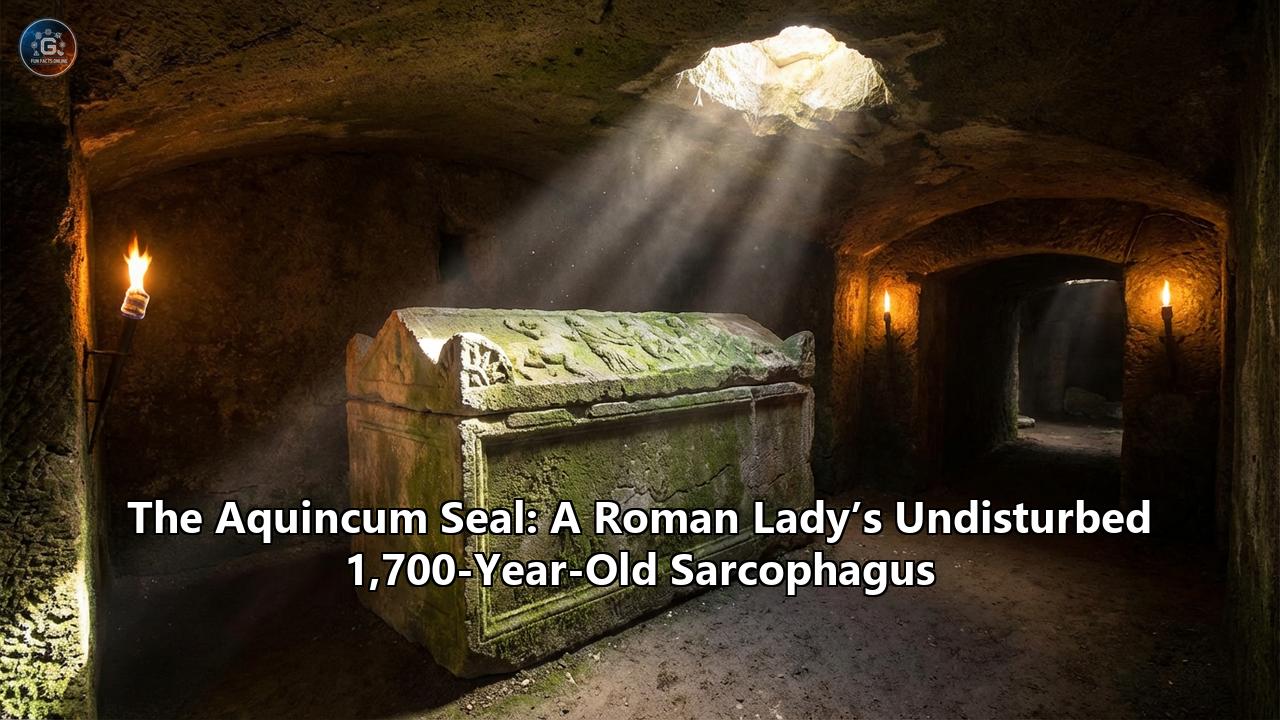
The air in the Óbuda district of Budapest is usually thick with the sounds of the modern city—trams screeching, construction drills humming, and the murmur of a European capital at work. But recently, beneath the foundation of a seemingly ordinary site, a hush fell over a team of archaeologists from the Budapest History Museum. They stood before a limestone block that had refused to yield its secrets for nearly two millennia. This was not merely a stone box; it was a time capsule, its lid clamped shut with iron and sealed with molten lead, a Roman “do not disturb” sign that had miraculously commanded respect for 1,700 years.
When the heavy stone lid was finally hoisted by machinery, the grinding noise gave way to a collective gasp. Inside, unaffected by the centuries of wars, migrations, and urban sprawl that had churned the earth above, lay the complete skeleton of a young woman. She was not alone. Surrounding her was a trove of artifacts so pristine they looked as if they had been placed there only yesterday: shimmering glass vessels, bronze statues, and a scattering of coins that once served as currency in an empire that spanned the known world.
This is the story of the "Aquincum Seal"—a discovery that has electrified the archaeological community, offering an unprecedented, high-definition glimpse into the life and death of a high-status woman on the rugged frontier of the Roman Empire.
The Discovery: A Miracle of Preservation
The find occurred during a large-scale rescue excavation in Óbuda, a northern neighborhood of Budapest that sits atop the ruins of Aquincum, once the bustling capital of the Roman province of Pannonia Inferior. Rescue excavations are often races against time, conducted before new construction projects obliterate potential history. But this time, the earth offered up something that stopped the clock entirely.
The team, led by archaeologist Gabriella Fényes, uncovered the limestone sarcophagus in a sector of the ancient city that had a complex history. The area had been a residential quarter in the 2nd century AD, filled with the homes of Roman citizens, merchants, and soldiers. However, by the 3rd and 4th centuries, as the empire’s grip began to loosen and the frontier became more dangerous, these houses were abandoned. In a practice common to the late Roman period, the ruins of the living were repurposed as the homes of the dead.
While excavators found a Roman aqueduct and eight simpler, earth-cut graves nearby, the sarcophagus stood apart. It was a "hermetically sealed" vessel, a term archaeologists rarely get to use without qualification. The ancients had poured molten lead into the seams where the lid met the coffer, creating a physical and chemical barrier against moisture, air, and grave robbers.
“The peculiarity of the finding is that it was a hermetically sealed sarcophagus. It was not disturbed previously, so it was intact,” Fényes noted, her voice reflecting the emotional weight of the moment. In the 4th century, stone sarcophagi were valuable commodities; they were frequently looted, emptied, and reused for new burials. To find one that was “made specifically for the deceased” and never reopened is a statistical anomaly—a stroke of luck that bridges a 1,700-year chasm.
The Occupant: The Lady of Aquincum
Lying in the center of the stone box was the skeleton of a young woman. While detailed osteological analysis—including carbon dating, DNA sequencing, and stable isotope analysis—is still underway, the initial visual inspection tells a poignant story.
The size of the bones suggests she was young, perhaps in her late teens or early twenties. Her skeleton was complete and articulated, meaning she had not been jostled or crushed by the collapse of the grave over time. She lay in a position of repose, arranged with care and tenderness by those who buried her.
Who was she? The sheer opacity of history prevents us from knowing her name—unless a hidden inscription emerges from the cleaning process—but the context screams of status. In a frontier town like Aquincum, where life could be harsh and resources were often directed toward the military machine, a burial of this magnitude was reserved for the elite. She was likely the daughter or wife of a high-ranking official, a wealthy merchant, or a military commander stationed at the nearby legionary fortress.
The lead seal that protected her also preserved the emotional footprint of her mourners. “The deceased was buried very carefully by her relatives. They must have really loved who they buried here,” Fényes observed. This was not a hasty disposal of a body; it was a curated selection of her most prized possessions, intended to comfort her or signal her rank in the afterlife.
The Treasury of the Tomb: A Catalog of Roman Life
The artifacts found surrounding the young woman are not just grave goods; they are a cross-section of the economic and cultural life of Roman Pannonia.
1. The Glass Vessels
Two completely intact glass vessels were found near the skeleton. In the Roman world, glass was a marker of sophistication. By the 3rd and 4th centuries, the Rhineland and areas of Pannonia had developed their own glassblowing workshops, producing wares that rivaled those of Italy and the Levant.
These vessels likely held perfumed oils or wine—offerings to the deceased or essentials for her grooming in the afterlife. Finding them unbroken is extraordinary; usually, the weight of settling earth shatters such delicate items. Their survival is a testament to the structural integrity of the stone sarcophagus. The glass is likely of a greenish hue, typical of the iron-rich sands used in provincial glassmaking, perhaps even produced in local workshops that archaeologists know existed in the region.
2. The Coins
Scattered around her were 140 coins. This is a staggering number. In Greek and Roman mythology, the dead required a single coin—a Charon’s obol—placed in the mouth to pay the ferryman for passage across the River Styx. Finding a single coin is standard; finding 140 is a statement.
This hoard suggests several possibilities. It could be a display of immense disposable wealth, a "bribe" to ensure VIP treatment in the underworld, or perhaps a purse she wore in life that was buried with her. These coins are also the archaeologist's best friend; once cleaned and identified, the emperors' profiles stamped on them will provide a precise terminus post quem—the earliest possible date for the burial. If the latest coin dates to the reign of Constantine or one of his successors, we will be able to pinpoint the year of her death with remarkable accuracy.
3. The Gold-Threaded Fabric
Perhaps the most evocative find is the trace of gold threads. Organic materials like wool, linen, and silk rot away, leaving only dust. But gold is immortal. The presence of gold threads implies that she was buried in a garment woven with or embroidered by gold—a tunica or shroud of immense value.
In the late Roman Empire, laws often tried to regulate the display of luxury, but the wealthy frequently ignored them. A garment woven with gold thread would have shimmered in the torchlight of the funeral procession, a final, defiant spark of light before the lid was lowered. This confirms her high social standing; such textiles were the haute couture of antiquity, often imported or made by highly specialized craftspeople.
4. Amber Jewelry
A piece of amber jewelry was also recovered. This is a geographically significant find. Aquincum sat squarely on the "Amber Road," an ancient trade route that funneled the "gold of the north" from the Baltic Sea down to the Adriatic and into the heart of the Empire.
Amber was not just decorative; it was believed to have protective, magical properties, often worn by women to ward off sickness or aid in fertility. For a young woman, this amulet might have been a cherished personal item, a connection to the trade networks that made cities like Aquincum rich.
5. The Bone Hairpin and Bronze Figurines
A bone hairpin found near the skull suggests her hair was styled elaborately for the burial, a final act of grooming. The bronze figurines are more mysterious. Were they toys? Votive offerings? Statuettes of deities like Venus or Minerva meant to guide her? Bronze was valuable, and leaving such items in a grave removed them from circulation, further emphasizing the family's willingness to sacrifice wealth for her memory.
The Historical Context: Aquincum on the Edge
To understand why this find is so significant, one must understand Aquincum. Today, it is a district of Budapest; 1,700 years ago, it was the shield of the Empire.
Situated on the Danube River, Aquincum was the capital of Pannonia Inferior. It was a "double city"—a massive military fortress (castrum) housed 6,000 legionaries (the Legio II Adiutrix was stationed here for centuries), while a separate civilian town (canabae) thrived nearby with amphitheaters, floor-heated villas, and public baths.
The 3rd and 4th centuries were tumultuous. The "Crisis of the Third Century" saw the empire nearly fracture under civil wars, plague, and economic collapse. By the time this young woman died, Aquincum was a city in transition. The large, opulent houses of the 2nd century were being abandoned or subdivided as the population shrank or moved closer to the protection of the military walls.
The location of the sarcophagus—in the ruins of an abandoned house—speaks to this urban transformation. The living city was contracting, and the spaces of the dead were encroaching on the spaces of the living. Yet, even in this era of decline and uncertainty, her family commanded enough resources to source a fresh limestone sarcophagus, tons of lead, and a king's ransom in grave goods. It is a powerful reminder that even as empires crumble, the human desire to honor the dead remains constant.
The Mud and the Future
The sarcophagus was hermetically sealed, but it was not a vacuum. Over 1,700 years, a thin layer of mud, about 4 centimeters thick, accumulated at the bottom—likely from groundwater seepage or condensation that mingled with dust.
This mud is now the frontier of the investigation. Archaeologists are sifting through it with microscopic precision. “I suspect we could find jewelry. We haven’t found any earrings or other jewelry belonging to the woman, so I hope that these small items will turn up during the sifting of the mud,” Fényes said. It is highly probable that small gold earrings or rings slipped from the skeleton as the body decomposed and are now hiding in this sediment.
The skeleton itself will undergo a battery of tests.
- Isotope Analysis: By analyzing the chemical signatures of strontium and oxygen in her teeth, scientists can tell if she was a local girl, born and raised in Aquincum, or if she traveled from Rome, Syria, or Gaul.
- Paleopathology: Her bones will reveal if she suffered from diseases, malnutrition, or trauma. Did she die of the plague? Childbirth? Or a chronic illness?
- DNA: If viable DNA can be extracted, it could reveal her ancestry, eye color, and hair color, bringing us face-to-face with a Roman citizen.
A Bridge Across Time
The discovery of the Aquincum Seal is more than just a data point for historians; it is an emotional anchor. When Gabriella Fényes admits she “shuddered” to think of the pain of the family burying this young woman, she voices a universal sentiment.
Seventeen centuries ago, a family stood by a hole in the ground in what is now Budapest. They wept. They placed a bone pin in her hair, draped her in gold-woven cloth, and filled her stone bed with coins and glass. They watched the molten lead hiss as it sealed her away, hoping she would remain undisturbed for eternity.
They could not have imagined the world of 2025—the heavy machinery, the cameras, the laboratory tests. But in a way, their wish was granted. She was not looted. She was not destroyed. She waited, in the dark and the silence, until she could tell her story to a world that had forgotten her name, but can still feel her presence.
As the analysis continues, the "Lady of Aquincum" will surely have more to say, teaching us that while civilizations rise and fall, the rituals of love and loss are the true constants of the human experience.
Reference:
- https://www.youtube.com/watch?v=Bbv8YszyzvQ
- https://www.ancient-origins.net/news-history-archaeology/roman-sarcophagus-aquincum-00102325
- https://www.arabnews.com/node/2623422/offbeat
- https://www.latimes.com/science/story/2025-11-24/archaeologists-lift-lid-on-1-700-year-old-roman-sarcophagus-hidden-beneath-budapest
- https://www.youtube.com/watch?v=l2l_mLfbT60
- https://www.express.co.uk/news/world/2138126/roman-tomb-found-budapest-hungary
- https://www.youtube.com/watch?v=sE7KgwosQZQ
- https://www.youtube.com/watch?v=CHY8YSM6Gas
- https://en.wikipedia.org/wiki/Charon%27s_obol
- https://www.grandrapidscoins.com/charon-s-obol-and-coins-for-the-dead/
- https://traj.openlibhums.org/article/3877/galley/5522/download/
- https://www.reddit.com/r/papertowns/comments/b1ubcr/the_civilian_and_military_towns_of_aquincum_a/
- https://www.heritagedaily.com/2020/06/aquincum-roman-budapest/133682