
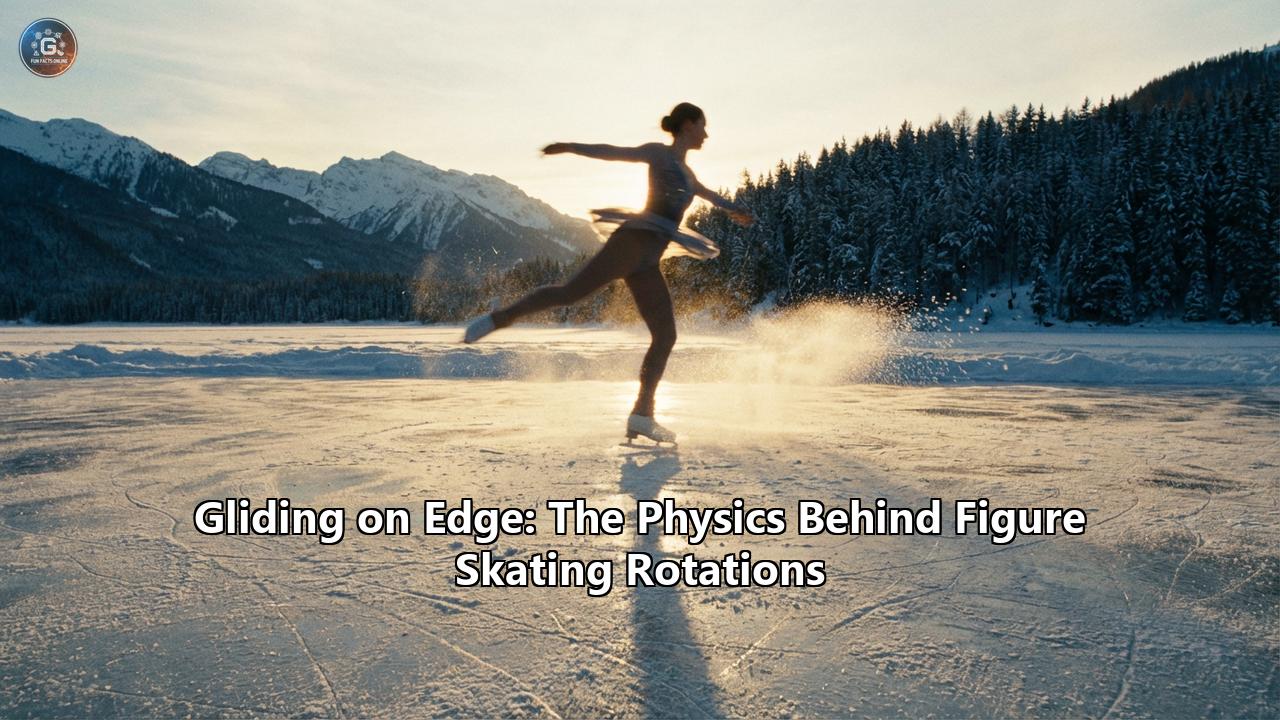
When the blade of a skate strikes the ice, it isn't just a metal edge meeting a frozen surface; it is a collision of biomechanics, material science, and Newtonian physics. To the casual observer, figure skating is an art form—a display of grace, costumes, and music. But underneath the sequins and choreography lies a brutal and exacting science. A quadruple jump, one of the most difficult feats in modern sports, requires a skater to generate enough vertical force to overcome gravity, enough torque to initiate a blur of rotation, and the precise body control to land on a blade no thicker than a few millimeters, all while traveling at 20 miles per hour.
This interplay of forces turns the human body into a projectile, a gyroscope, and a friction-reducing machine all at once. To understand how a skater glides on an edge or rotates four times in the blink of an eye, we must look at the physics that makes it all possible.
The Stage: The Paradox of Ice
The physics of skating begins with the ice itself, a surface that presents a unique paradox: it must be slippery enough to glide but grippy enough to push against. If ice were perfectly frictionless, a skater would stand in place, unable to generate the traction needed to move. If it were too rough, the friction would sap their momentum immediately.
The magic lies in a microscopic layer of water on top of the ice. For decades, textbooks taught that this layer was created by "pressure melting"—the idea that the skater’s weight on the thin blade lowered the melting point of the ice. While this contributes, it is not the primary factor. If it were, skating would be impossible in extremely cold temperatures where human weight isn't enough to melt the ice. The primary driver is actually frictional heating. As the blade slides across the ice, the friction generates heat, melting a microscopic film of water that acts as a lubricant. This is why ice feels "slower" or "grittier" at extremely low temperatures (below -20°C); the friction isn't sufficient to create that lubricating layer instantly.
Figure skating ice is typically kept warmer than hockey ice—around 24°F to 26°F (-4°C to -3°C), compared to hockey’s harder 17°F (-8°C). This "soft" ice allows the blades to bite deeper for sharp turns and landings, providing the traction necessary to convert horizontal speed into vertical lift.
The Tool: The Geometry of the Blade
A figure skating blade is not a flat knife; it is a complex piece of engineering defined by two curves: the rocker and the hollow.
The rocker (or radius) is the longitudinal curve of the blade from toe to heel. Imagine the blade is a segment of a giant circle; the radius of that circle determines how much of the blade touches the ice at once. A flatter blade (larger radius) offers more speed but less agility. Figure skating blades typically have a "dual radius"—a flatter section towards the heel for gliding and stability, and a sharper curve towards the toe (the "spinning rocker") that allows the skater to rock forward and reduce the contact point to a single spot, minimizing friction for spins.
The hollow is the curve across the width of the blade. If you look at a blade head-on, it isn't flat; it’s concave, creating two distinct edges: the inside edge (facing the other foot) and the outside edge (facing away). The depth of this groove is the "Radius of Hollow" (ROH). A deeper hollow creates sharper, taller edges that bite aggressively into the ice, allowing for extreme lean angles without slipping. However, deeper hollows increase drag. Elite skaters must find a "Goldilocks" hollow—deep enough to grip for a triple Lutz takeoff, but shallow enough to maintain speed into the jump.
The Engine: Torque and Angular Momentum
Once the skater is moving, the goal is often rotation. This is where the conservation of angular momentum becomes the governing law of the rink.
Angular momentum ($L$) is the product of a skater’s moment of inertia ($I$) and their angular velocity ($\omega$):
$$L = I \times \omega$$
The moment of inertia ($I$) is a measure of how spread out the skater's mass is from their axis of rotation. When a skater enters a spin with arms and a leg extended, their mass is distributed far from the center, creating a large moment of inertia. Because angular momentum is conserved (it stays constant once the skater leaves the ice or establishes a spin), the only way to speed up the rotation ($\omega$) is to decrease the moment of inertia.
This is the "swivel chair effect" seen in every science classroom, but at an Olympic level. As the skater pulls their arms and free leg tightly across their chest (the "scratch spin" position), they drastically reduce their radius. To compensate, their rotational speed skyrockets. Elite skaters can reach rotational speeds of over 6 revolutions per second—faster than a helicopter rotor.
The initiation of this rotation—the torque—comes from the interaction with the ice. For edge jumps like the Loop or Salchow, the skater carves a curve on the ice. This curve creates a centripetal force. When the skater stomps down or extends their leg to jump, that linear momentum along the curve is converted into rotational momentum. For toe jumps like the Lutz or Flip, the toe pick acts as a pivot point. The skater jams the serrated teeth into the ice, vaulting over it while simultaneously swinging their free side around, generating the torque needed to snap into a rotation.
The Flight: Projectile Motion and the Quad Revolution
The Holy Grail of modern figure skating is the quadruple jump—four full revolutions in the air. To achieve this, skaters are fighting a strict time limit imposed by gravity.
Once a skater leaves the ice, they are a projectile. Their center of mass follows a parabolic arc determined entirely by their vertical velocity at takeoff. No amount of flailing arms can keep them in the air longer.
- Time in Air: A typical elite male skater stays in the air for about 0.65 to 0.70 seconds.
- Rotation Requirement: To complete a quad, the skater needs to rotate four times in that 0.7-second window. This requires an average rotational speed of about 340-350 revolutions per minute (RPM), with peak speeds often exceeding 400 RPM.
This math reveals why quads are so difficult. To get more air time, a skater needs more vertical power (strength). But more muscle mass can add weight, which might slow down the rotation. Therefore, the key to the quad revolution hasn't just been jumping higher; it has been rotating faster. Skaters today are thinner and tighter in the air than in previous decades. They have optimized the "snap"—the speed at which they can go from an open takeoff position to a tightly crossed rotating position. This transition must happen in less than 0.1 seconds.
The Manoeuvres: A Physics Breakdown
Different jumps utilize these principles in distinct ways, leading to different levels of difficulty.
The Axel: The Forward Takeoff
The Axel is the only jump with a forward takeoff. Invented by Axel Paulsen in 1882, it is the hardest jump of its respective rotation class (e.g., a triple Axel is harder than a triple Loop) because it requires an extra half-rotation. A triple Axel is actually $3.5$ revolutions.
- Physics: The skater enters on a forward outside edge. As they step up, they must transfer their forward momentum into vertical lift, almost like a pole vaulter planting their pole. The braking action of the skid on the takeoff foot converts forward kinetic energy into rotational and vertical energy.
The Lutz vs. The "Flutz"
The Lutz is a toe jump that enters from a backward outside edge. This is biomechanically counter-intuitive. The skater is gliding on a curve to the left (left outside edge), but they must rotate to the left (counter-clockwise). This means they are jumping "against" the curve of the entry edge.
- Physics: The counter-rotation builds massive tension in the torso, like a coiled spring. When the toe pick strikes, this tension releases, snapping the skater into the air.
- The Flutz: Because holding an outside edge while winding up to spin the opposite way is so difficult, many skaters accidentally let their ankle roll inward to an inside edge just before takeoff. This changes the physics completely, turning the difficult Lutz into the easier Flip jump. This error, known as a "flutz" (fake Lutz), is a failure to maintain the torque-generating tension of the outside edge.
The Brain: Conquering Dizziness
With rotation speeds reaching 6 revolutions per second, why don't skaters vomit after every spin? Dancers use "spotting"—keeping their eyes fixed on one point—to reduce dizziness. Figure skaters spin too fast for this; spotting would cause whiplash.
Instead, skaters rely on vestibular adaptation. The vestibular system in the inner ear contains fluid-filled canals that detect rotation. When you spin, the fluid moves; when you stop, the fluid keeps moving due to inertia, telling your brain you are still spinning. This sensory conflict causes dizziness.
Neuroscientific studies on figure skaters show that they have trained their brains to suppress these signals. Their cerebellum (the part of the brain controlling balance) processes the vestibular input differently than a normal person. Essentially, the skater's brain learns to ignore the "error message" coming from the inner ear, allowing them to stop a blur of a spin and immediately step into a graceful landing sequence.
The Limit
As we watch skaters push for quintuple jumps, we are approaching the limits of human physiology. To add a fifth rotation, a skater would need to either jump significantly higher (requiring inhuman power-to-weight ratios) or rotate faster (risking injury to the spine and joints from the centrifugal force). The current technique involves pre-rotating on the ice (starting the turn before leaving the ground), essentially "borrowing" degrees of rotation from the takeoff.
Figure skating is often viewed through the lens of artistry, but every gold medal is a victory of physics. It is the mastery of friction, the manipulation of momentum, and the conquest of gravity, all performed on a thin steel edge.
Reference:
- https://icoachskating.com/figure-skating-jumps-minimum-air-times-trevor-laak/
- https://skatewithaimee.com/blog/f/figure-skating-blades-radius-of-hollow-maintenance---part-3
- http://bladesbytodd.com/rockers-explained/
- https://www.goldenskate.com/forum/threads/how-different-radius-of-hollow-affect-skating.81787/
- https://www.goldenskate.com/forum/threads/why-do-skaters-flutz-and-or-what-makes-edge-jumps-so-difficult.50664/
- https://www.reddit.com/r/FigureSkating/comments/1xob6k/hello_figure_skaters_could_someone_explain_the/
- https://www.reddit.com/r/FigureSkating/comments/1ewut9q/how_come_even_elite_skaters_do_flutz/
- https://www.youtube.com/watch?v=i9uqsll3ZxA
- https://www.youtube.com/shorts/-x8bbn3ICPc
- https://www.youtube.com/watch?v=KSEsPUsevvw
- https://icoachskating.com/nick-perna-how-to-fix-a-flutz-part-1/
- https://en.wikipedia.org/wiki/Figure_skating_jumps