
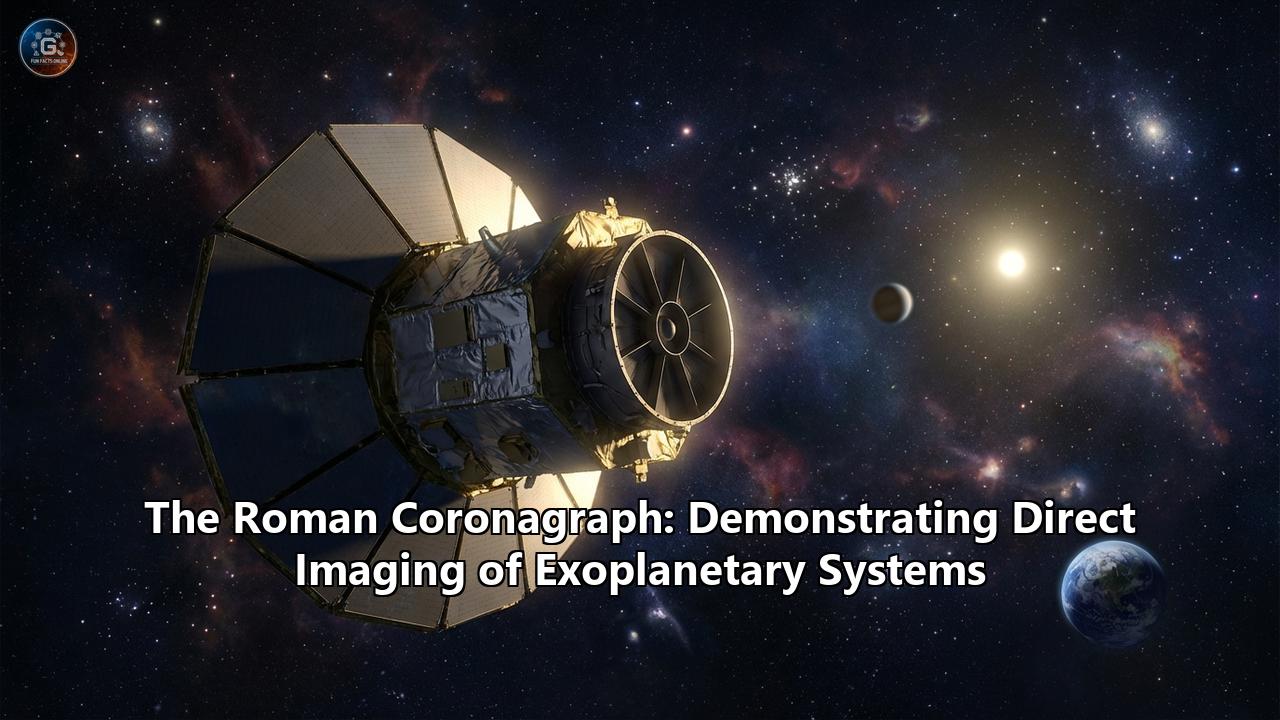
The search for life beyond Earth is perhaps the most profound scientific endeavor of our time. For centuries, we have gazed at the stars and wondered if other worlds orbit them, and if those worlds might host living beings. In the last three decades, the field of exoplanet astronomy has exploded, moving from mere speculation to the confirmation of over 5,000 planets outside our solar system. Yet, for all this success, a frustrating barrier remains: we rarely see these planets. We detect them indirectly—by the wobble they induce in their host star or the tiny dip in brightness as they transit across its face. To truly understand these worlds—to read their atmospheres for signs of water, oxygen, and life—we must capture their light directly. We must take their picture.
This is the challenge that the Roman Coronagraph Instrument (CGI), aboard NASA’s upcoming Nancy Grace Roman Space Telescope, is designed to meet. It is not just another instrument; it is a technological bridge to the future, a pathfinder that will demonstrate the capability to suppress the blinding glare of stars and reveal the faint, planetary jewels hidden within. It is the most advanced coronagraph ever sent into space, a complex symphony of mirrors, masks, and detectors that will "dig a dark hole" in the fabric of starlight, allowing us to see what has been hidden for so long.
Part I: The Glare of the Host
To understand the magnitude of the Roman Coronagraph’s task, one must first grasp the tyranny of starlight. Stars are billions of times brighter than the planets that orbit them. In visible light, our Sun is ten billion times ($10^{10}$) brighter than Earth. Trying to image an Earth-like planet next to a sun-like star is often compared to trying to spot a firefly hovering next to a stadium floodlight—from a distance of several thousand miles.
The problem is not just brightness; it is the nature of light itself. Light behaves as a wave, and when it passes through the aperture of a telescope, it diffracts. It spreads out, creating a pattern of bright rings and scattered light known as the Point Spread Function (PSF). This diffraction pattern acts like a luminous fog, washing out the faint signal of any nearby planet. For decades, astronomers have battled this diffraction limit, pushing optics to their breaking point.
The traditional solution is a coronagraph, a device invented nearly a century ago to study our own Sun. But the Roman Coronagraph is no traditional device. It represents a quantum leap in optical engineering, moving from the "passive" starlight suppression of the past to "active" wavefront control—a dynamic, living optical system that adapts in real-time to the harsh environment of space.
Part II: The Legacy of Bernard Lyot
The story of the coronagraph begins in the French Pyrenees in the 1930s. French astronomer Bernard Lyot was frustrated. To study the solar corona—the faint, wispy outer atmosphere of the Sun—astronomers had to wait for the fleeting moments of a total solar eclipse, when the moon naturally blocked the solar disk. Lyot realized that if he could create an artificial eclipse inside a telescope, he could study the corona at will.
He invented the coronagraph, a device that placed an opaque metal disk (an occulting mask) at the focal plane of a telescope to block the sun's image. But Lyot quickly discovered that blocking the sun wasn't enough. Light diffracted around the edges of his mask, and imperfections in his telescope lenses scattered light, recreating the glare he was trying to remove. He introduced a "Lyot stop," a secondary aperture that trimmed the diffracted light, and he rigorously polished his lenses to reduce scattering. His invention worked, revolutionizing solar physics.
For decades, coronagraphs were strictly solar instruments. It wasn't until the launch of the Hubble Space Telescope that stellar coronagraphy became a serious pursuit. Hubble’s instruments allowed astronomers to block the light of distant stars to look for debris disks—rings of dust and gas where planets are born. But Hubble’s coronagraphs were "passive." They relied on the static precision of the optics. If the telescope’s mirror expanded slightly due to heat, or if the optics had microscopic manufacturing errors (like the famous spherical aberration of Hubble’s primary mirror, though corrected), the starlight would leak through.
Hubble could suppress starlight by a factor of about 100,000 ($10^5$). To see a Jupiter-like planet, we need a suppression of 100 million ($10^8$). To see an Earth, we need 10 billion ($10^{10}$). The gap between Hubble’s capability and the requirement for Earth-imaging is vast. The Roman Coronagraph is the machine designed to bridge that gap.
Part III: The Anatomy of the Roman Coronagraph
The Roman Coronagraph Instrument is often described as being the size of a baby grand piano, nestled within the larger structure of the Roman Space Telescope. But inside this piano is a mechanism of Swiss-watch complexity, operating at the scale of nanometers.
The instrument is a "Technology Demonstrator." This is a specific NASA classification (Class C) meaning its primary goal is not necessarily to churn out scientific papers (though it surely will), but to prove that the hardware works. It is a dress rehearsal for the future "Habitable Worlds Observatory," a proposed flagship mission that will hunt for Earth 2.0.
The Roman Coronagraph achieves its magic through a series of cascaded optical subsystems, each attacking the problem of starlight from a different angle.
1. The Active Wavefront Control System
The heart of the Roman Coronagraph is its active wavefront control. In space, a telescope is subjected to a dynamic environment. As the spacecraft slews from one star to another, the thermal load from the Sun changes, causing the structure to expand or contract by tiny amounts. Vibrations from reaction wheels (which turn the spacecraft) can jitter the optics.
In a passive coronagraph, these tiny shifts effectively destroy the contrast. A shift of a few nanometers—the width of a few DNA strands—can cause enough starlight to leak around the mask to hide a planet.
Roman solves this with Deformable Mirrors (DMs).
The instrument contains two high-precision DMs. These are not static glass surfaces; they are flexible membranes purely polished to angstrom-level smoothness, resting on a bed of thousands of piezoelectric actuators. These actuators can push or pull the mirror surface, creating microscopic hills and valleys.
- DM1 (The Pupil Mirror): Corrects for amplitude errors (variations in reflectivity) and phase errors (aberrations) in the telescope's primary mirror.
- DM2 (The Field Mirror): Works in concert with DM1 to create a "dark hole"—a specific region in the field of view where starlight is destructively interfered with to near-zero intensity.
This system forms a closed feedback loop. The instrument constantly measures the incoming wavefront of starlight, calculates the errors, and sends commands to the DMs to flex and compensate. It is similar to the Adaptive Optics (AO) used on ground-based telescopes to correct for atmospheric turbulence, but while ground AO corrects for the fast, chaotic blurring of the atmosphere, Roman’s active control corrects for the slow, insidious "breathing" of the telescope optics and the static manufacturing errors.
2. The Masks: Hybrid Lyot vs. Shaped Pupil
The Roman Coronagraph is not a "one size fits all" machine. It employs two distinct types of starlight suppression masks, allowing astronomers to choose the right tool for the job.
The Hybrid Lyot Coronagraph (HLC):This is the instrument's sniper rifle. It is designed for high-contrast imaging at very close separations from the star (small "Inner Working Angles").
- How it works: The HLC uses a complex focal plane mask that combines a metal occulter (to block the light) with a dielectric layer that shifts the phase of the light. This phase shift guides the diffracted starlight in a specific way so that it can be rejected by the Lyot stop downstream.
- The "Hybrid" nature: It combines amplitude (blocking) and phase (shifting) manipulation.
- Strength: It offers a 360-degree field of view around the star (an annulus) and can see planets very close to their host, making it ideal for detection—finding new planets that hug their stars.
This is the shotgun. Instead of blocking the light at the focal plane first, the SPC starts by reshaping the telescope's pupil.
- How it works: A mask at the pupil plane (before the light comes to a focus) blocks parts of the aperture, creating a binary pattern of openings. This shape is mathematically calculated to force the diffracted light into specific "lobes" in the final image, leaving other areas completely dark.
- Trade-off: It doesn't provide a 360-degree view. Instead, it creates two "bow-tie" shaped dark zones on either side of the star.
- Strength: The SPC is incredibly robust. It is less sensitive to "jitter" (telescope vibration) than the HLC. It is the preferred mode for spectroscopy (analyzing the light) and for observing debris disks, where a wider field of view is needed.
3. The Eyes: Electron Multiplying CCDs (EMCCDs)
Once the starlight has been suppressed by the masks and the wavefront has been cleaned by the deformable mirrors, the remaining photons must be caught. The signal from an exoplanet is incredibly faint—often just a few photons hitting the detector every second.
Standard CCDs (like in your phone or DSLR) have "read noise." Every time you read the data from the chip, a little bit of electronic static is added. If your planet only sends you 5 photons and your read noise is 10 photons, the planet is lost in the static.
Roman uses EMCCDs (Electron Multiplying Charge-Coupled Devices). These detectors operate in a "photon counting" mode.
- Avalanche Gain: When a photon hits the silicon and frees an electron, that electron is passed through a high-voltage register that accelerates it. As it crashes into other atoms, it frees more electrons—an avalanche effect. One electron becomes a thousand.
- Zero Read Noise: By amplifying the signal before it is read out, the read noise becomes negligible compared to the massive signal.
- Result: The Roman Coronagraph can detect individual photons. It can literally count the particles of light arriving from a distant world. This sensitivity is crucial for achieving the $10^{-9}$ contrast ratios needed for the mission.
Part IV: Digging the Dark Hole
The most evocative phrase in the Roman Coronagraph lexicon is "Digging the Dark Hole." This is not a reference to black holes, but to the zone of extreme darkness created around the star.
When the instrument turns on, the image of the star is a messy blob of speckles—scattered light caused by tiny imperfections in the mirrors. These speckles look exactly like planets. To distinguish a planet from a speckle, the instrument performs an iterative process:
- Probing: The DMs induce a known pattern of ripples on the wavefront.
- Sensing: The detector measures how the speckles interfere with this probe pattern. This allows the computer to map the electric field of the stray light.
- Nulling: The computer calculates the exact shape the DMs must take to create destructive interference—anti-speckles—that cancel out the stray light.
- Digging: This correction is applied. The background light level drops. The process repeats.
With each iteration, the background gets darker. The "hole" gets deeper. Eventually, the starlight in the target region is suppressed by a factor of 100 million. In the center of this artificially created void, if a planet is present, its steady light will shine through, unblinkingly distinct from the suppressed chaotic background.
Recent ground testing in thermal vacuum chambers at JPL—the "static" tests—have successfully demonstrated this capability, proving that the physics holds up. The Roman Coronagraph has already "dug the hole" on Earth; soon, it will do so in the vacuum of deep space.
Part V: The Observation Modes and Strategy
The Roman Coronagraph is a swiss-army knife of starlight suppression. It operates in several "Bands," each corresponding to different wavelengths of visible light and optimized for different science cases.
- Band 1 (Visible, 575nm): This is the primary "Tech Demo" mode using the Hybrid Lyot Coronagraph. It is a narrow band (10% bandwidth) yellow-green light. This is the mode that must work to satisfy the mission requirements. It is optimized for detecting the reflection of gas giants.
- Band 2 & 3 (Red/Orange): These bands use the Shaped Pupil Coronagraph and are designed for wider fields of view. Band 3 includes a spectroscopy mode.
- Band 4 (Near-Infrared, 825nm): This band pushes into the infrared, where older, cooler planets might be brighter.
Spectroscopy: The Holy Grail
Taking a picture is one thing; understanding what you are seeing is another. The Roman Coronagraph includes a prism assembly that can disperse the light of the planet into a spectrum.
This is the key to characterization. By spreading the light out, astronomers can look for absorption lines—fingerprints of chemical elements. In the reflection spectrum of a gas giant, they might see the signature of methane clouds or ammonia ice. While Roman likely won't image Earth-twins, demonstrating the ability to take a spectrum of a dot $10^{-8}$ times fainter than its star is the exact technological hurdle that must be cleared to one day detect oxygen or chlorophyll on a habitable world.
The Battle of Algorithms: RDI vs. ADI
Even with the best hardware, some starlight will leak through. The final step in the chain is software processing, relying on two main strategies:
- ADI (Angular Differential Imaging): The telescope rolls around the line of sight to the star. The optics (and the speckles caused by them) stay fixed relative to the instrument. The planet, however, is fixed on the sky, so it appears to rotate in the image. By subtracting the images from different roll angles, the static speckles disappear, and the moving planet pops out.
- RDI (Reference Differential Imaging): The telescope slews to a bright, nearby "reference star" that has no planets. It digs a dark hole and takes a picture of the "naked" starlight speckle pattern. It then moves back to the target star. The reference image is subtracted from the target image. This is crucial for Roman because some speckles are "quasi-static"—they change slowly over time. Frequent hops to a reference star (like the bright star Zeta Puppis) allow the instrument to recalibrate its dark hole.
Part VI: The Targets and The Science
Who are the actors on this stage? The Roman Coronagraph is not a survey instrument like its big brother, the Wide Field Instrument. It is a sniper. It will stare at specific, pre-selected targets.
The "Tech Demo" Phase
For the first 18 months (approximate timeframe for the demo phase), the targets will be carefully chosen to be "easy" (relatively speaking).
- Bright Stars: The wavefront sensing system needs photons to work. The brighter the host star, the faster the DMs can update their shape to correct for jitter. Targets will likely be naked-eye visible stars (magnitude 2 to 5).
- Known Quantities: Roman will likely target systems where we already know something exists—either a massive planet detected by radial velocity or a debris disk imaged by Hubble. The goal is to confirm the instrument sees what it should.
- 47 Ursae Majoris: Often cited in simulations, this yellow dwarf star hosts known gas giant planets. It is a prime candidate for Roman to attempt a direct image of a mature, Jupiter-class planet.
The Science Potential
While primarily a tech demo, the scientific potential is real.
- Mature Jupiters: Current ground-based telescopes can only image "young" Jupiters—planets that are freshly formed and still glowing hot from the heat of creation (emitting infrared light). They cannot see "cold," mature Jupiters like our own, which only shine by reflected starlight. Roman will be the first instrument capable of seeing these cold giants in visible light. This completes the family album of exoplanets.
- Zodiacal Dust: Our solar system is filled with dust from comets and asteroid collisions (the Zodiacal cloud). We suspect other stars have this too ("Exozodi"). This dust is the background noise for future Earth-hunters. If a system is choked with dust, we can't see an Earth through it. Roman will measure the "Exozodi" levels of nearby stars, helping us curate a "clean" target list for the future Habitable Worlds Observatory.
- Protoplanetary Disks: Roman’s polarization mode allows it to see the scattering of light off dust grains in debris disks. By measuring the polarization, astronomers can infer the size, shape, and composition of the dust grains—are they icy? Rocky? Fluffy? This tells us about the building blocks of planets in that system.
Part VII: The Human Element – The Community Participation Program
NASA recognizes that the Roman Coronagraph is too complex and too important to be left to a small closed team. To maximize the return, they have established the Community Participation Program (CPP).
This program invites teams from universities and research institutes around the world to propose observation strategies and targets. It effectively democratizes the "Tech Demo."
- Pre-launch: Teams are currently building complex simulation tools, creating "Data Challenges" where they try to find fake planets hidden in synthetic data, and refining the target lists.
- Post-launch: These teams will be the boots on the ground (or eyes on the screen), analyzing the data as it comes down, tweaking the algorithms, and helping decide which "Best Effort" modes (like the difficult spectroscopy bands) should be attempted.
The CPP ensures that a new generation of astronomers is trained in the dark arts of high-contrast imaging. These are the doctoral students and postdocs who will be the principal investigators of the Habitable Worlds Observatory in the 2040s. Roman is building the workforce, not just the hardware.
Part VIII: The Bridge to the Habitable Worlds Observatory
It is impossible to talk about the Roman Coronagraph without talking about the Habitable Worlds Observatory (HWO).
The 2020 Decadal Survey in Astronomy and Astrophysics—the blueprint for NASA’s future—recommended that the next great flagship mission after Roman should be a telescope capable of finding life on Earth-like planets.
To do that, we need a telescope larger than Hubble, with a coronagraph 100 to 1,000 times better than Roman's.
This seems daunting, but Roman is the crucial stepping stone.
- Validation: If Roman’s active wavefront control works in space, we know the physics is sound. We just need to scale it up (more actuators on the DMs, faster control loops).
- Model Verification: Currently, our models of how coronagraphs behave in space are theoretical. Roman provides the "Ground Truth." If Roman sees a specific type of speckle pattern that we didn't predict, we can fix our models before we build the HWO.
- Risk Reduction: Space missions are expensive. Risk is the enemy. By flying the active DMs and EMCCDs on Roman (a Class C instrument), NASA retires the risk. If they fail, it’s a failed demo, not a failed flagship. If they succeed, the HWO can be built with confidence.
Roman is the prototype. It is the Mercury to HWO's Apollo.
Conclusion: The View from the Dark Hole
When the Nancy Grace Roman Space Telescope launches, arguably its most exciting images will be the ones that look like almost nothing.
To the untrained eye, a Roman Coronagraph image will look like a black square with a few noisy pixels in the center. But to an astronomer, that blackness is beautiful. It represents the conquest of diffraction. It represents a "Dark Hole" where the blinding light of a star has been tamed, and where, for the first time, the faint, reflected photons of a mature planetary system are allowed to shine.
The Roman Coronagraph is more than a camera; it is a declaration of intent. It is humanity saying that we are no longer content to infer the existence of other worlds from wobbles and shadows. We are ready to look them in the eye. We are ready to take their picture. And in that dark hole, dug by piezoelectric mirrors and mathematical masks, lies the future of astronomy—the path that leads, eventually, to a pale blue dot around another star, and the answer to the question: "Are we alone?"
Reference:
- https://arxiv.org/pdf/2202.05923
- https://roman.gsfc.nasa.gov/science/docs/FINAL_CGI_fact_sheet_12212023.pdf
- https://www.ebsco.com/research-starters/history/lyots-coronagraph-allows-observation-suns-outer-atmosphere
- https://arxiv.org/html/2409.11062v1
- https://roman.ipac.caltech.edu/docs/Coronagraph_Technical_Information.updated.pdf
- https://roman.gsfc.nasa.gov/science/RRI/Roman-CGI-Reference-Info-January2023.pdf
- https://www.spiedigitallibrary.org/conference-proceedings-of-spie/13092/1309255/The-Roman-coronagraph-community-participation-program-observation-planning/10.1117/12.3020205.full
- https://www.spiedigitallibrary.org/journals/Journal-of-Astronomical-Telescopes-Instruments-and-Systems/volume-11/issue-02/021413/Roman-coronagraph-instrument-optical-design-description/10.1117/1.JATIS.11.2.021413.full
- https://spie.org/news/photonics-focus/mayjune-2023/digging-the-dark-hole-to-find-exoplanets
- https://www.researchgate.net/figure/Specifications-of-the-CCD201-20-EMCCD-from-e2v_tbl2_287110477
- https://roman.ipac.caltech.edu/docs/sims/20210110_Roman_CGI_post_processing_report_URS_corrected_typo.pdf
- https://www.livemint.com/news/trends/nasa-images-from-jupiter-s-moon-to-andromeda-galaxy-these-5-photos-from-outer-space-will-leave-you-spellbound-11723019268315.html
- https://roman.gsfc.nasa.gov/science/Roman_teamlist_cpp.html
- https://www.stsci.edu/files/live/sites/www/files/home/roman/_documents/WFIRST-STScI-TR1605.pdf
- https://arxiv.org/html/2512.03308v1