
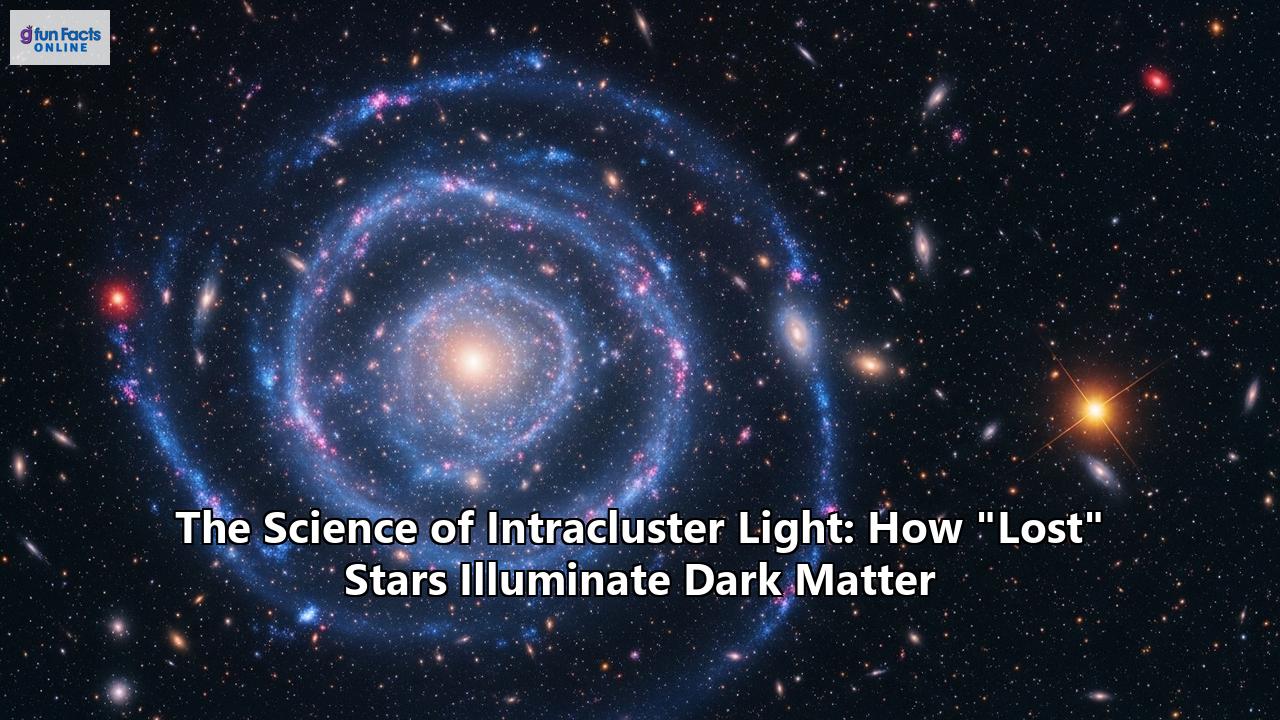
The Unseen Glow: How "Lost" Stars in Intracluster Light Illuminate the Universe's Darkest Secrets
In the immense cosmic tapestry, galaxy clusters represent the most massive gravitationally bound structures known to humanity. These sprawling metropolises of galaxies, each containing hundreds or even thousands of stellar systems, are bound together by an immense gravitational pull. Yet, the visible galaxies, as dazzling as they are, account for only a tiny fraction of a cluster's total mass. The vast majority lurks in the form of dark matter, an enigmatic substance that remains one of the greatest unsolved mysteries in modern cosmology. But astronomers have found an unlikely tool to map this invisible scaffolding: a faint, ethereal glow known as intracluster light (ICL). This "lost" light, emanating from stars ripped from their galactic homes, is providing a new way to "see" the unseeable, tracing the distribution of dark matter with remarkable precision.
The Ghostly Glow Between Galaxies
First theorized by Swiss astronomer Fritz Zwicky in 1951, intracluster light is the faint, diffuse luminescence that permeates the space between galaxies within a cluster. It is composed of billions of stars that are not gravitationally bound to any single galaxy but rather to the overall gravitational potential of the cluster itself. These stellar orphans, adrift in the vast intergalactic medium, create a soft, ghostly haze that is incredibly difficult to observe, often a hundred to a thousand times fainter than the darkest night sky on Earth.
The existence of this light is a direct consequence of the violent and dynamic environment within a galaxy cluster. Over billions of years, the immense gravitational forces at play orchestrate a chaotic cosmic dance. Galaxies pull and tear at one another, and in these interactions, stars are stripped away from their parent galaxies and cast out into intergalactic space. This process, known as tidal stripping, is one of the primary mechanisms responsible for the formation of intracluster light.
Other significant formation pathways include the complete disruption of smaller, dwarf galaxies as they fall into the cluster's gravitational well, and a process called violent relaxation that occurs during major mergers between large galaxies. A smaller fraction of these stars may also form in situ, born from cooling gas in the intracluster medium, though this is considered a minor contribution.
The stellar population of the ICL tells a story of its tumultuous origins. Studies have shown that these stars are typically older and have a lower metallicity (a measure of elements heavier than hydrogen and helium) than the stars in the central regions of the bright, massive galaxies. This suggests that the ICL is largely built up from the tidal stripping of the outer regions of large, spiral-like galaxies and the shredding of smaller, less-evolved satellite galaxies over long periods. The formation of the ICL is a late-forming process in the universe, with most of it accumulating since a redshift of about 1, which corresponds to the last 6 billion years of cosmic history.
A Luminous Tracer for Dark Matter
The true significance of intracluster light lies in its profound connection to dark matter. Because both the "lost" stars of the ICL and the elusive dark matter particles are essentially free-floating within the cluster, they are both subject to the same overall gravitational potential. As a result, the distribution of the intracluster light should exquisitely trace the distribution of the dark matter halo that envelops the entire cluster. Where the ICL is brighter, the dark matter is denser.
This provides astronomers with a powerful new tool to map the invisible. Traditionally, dark matter has been mapped through the laborious process of gravitational lensing, where the immense gravity of the cluster bends and distorts the light from more distant background galaxies. While effective, this method can be complex. Another method involves observing the X-ray emission from the hot gas of the intracluster medium; however, this gas can be influenced by non-gravitational forces, making it a less precise tracer of the underlying dark matter distribution.
Intracluster light offers a more direct and potentially more accurate visual proxy for the dark matter's structure. By simply observing the faint, diffuse light with powerful telescopes, astronomers can create a map of where the dark matter should be. Studies utilizing data from the Hubble Space Telescope's Frontier Fields program have shown an excellent agreement between the distribution of the ICL and the mass maps derived from gravitational lensing, with a remarkable similarity in their shapes and contours.
However, the relationship is not without its complexities. Some recent studies, comparing observational data with sophisticated computer simulations, suggest that the ICL might be a "biased" tracer of dark matter. These simulations indicate that the stars in the ICL may have different orbital energies and a more centrally concentrated density profile than the dark matter. While the overall shape may be similar, these subtle differences must be understood to refine the use of ICL as a precise cosmological probe.
Observing the Unobservable: A Technological Challenge
The study of intracluster light pushes the boundaries of modern observational astronomy. Its extremely low surface brightness makes it a challenging target, requiring long exposure times with some of the world's most sensitive instruments. The Dark Energy Camera (DECam) on the Víctor M. Blanco 4-meter Telescope in Chile has been instrumental in making some of the most radially extended measurements of ICL to date.
In a landmark observation, a total of 28 hours of DECam exposure time was used to capture the delicate intracluster light of the galaxy cluster Abell 3667, revealing a glowing bridge of stars that connects the cores of two smaller galaxy clusters in the process of merging. This provided stunning visual evidence of the ongoing formation of the ICL.
The Hubble Space Telescope has also been a crucial tool, with its high resolution allowing for detailed studies of the ICL in distant clusters. More recently, the James Webb Space Telescope (JWST) has opened a new era for ICL studies, its unprecedented sensitivity enabling the exploration of this diffuse light at even greater distances and in greater detail than ever before. Early observations of the cluster SMACS-J0723.3-7327 with JWST have allowed astronomers to study the ICL out to a distance of approximately 400 kiloparsecs, revealing a rich tapestry of formation processes.
The Future is Bright for Faint Light
The study of intracluster light is poised for a revolution with the advent of the Vera C. Rubin Observatory. Scheduled to begin its Legacy Survey of Space and Time (LSST), Rubin will image the entire southern sky every few nights for a decade with an enormous 3.2-gigapixel camera. The vast and deep dataset produced will allow astronomers to stack images to create ultra-long exposures of countless galaxy clusters, revealing their intracluster light with unparalleled clarity across a significant range of cosmic time. This will not only provide a comprehensive survey of the ICL's properties across different cluster masses and evolutionary stages but also create an invaluable resource for mapping dark matter on a grand scale.
By studying the whispers of these "lost" stars, astronomers are piecing together the violent histories of galaxy clusters, understanding how these massive structures are assembled over cosmic time. And in doing so, they are illuminating the invisible, using the faint glow of wayward stars to map the dark matter scaffolding that underpins the very structure of our universe. The ghostly light between galaxies, once a mere curiosity, has become a beacon, guiding us toward a deeper understanding of the cosmos's most profound mysteries.
Reference:
- https://astron.snu.ac.kr/10169/
- https://www.sci.news/astronomy/intracluster-light-11544.html
- https://www.mdpi.com/2075-4434/9/3/60
- https://www.sci.news/astronomy/decam-intracluster-light-galaxy-cluster-abell-3667-14118.html
- https://news.fnal.gov/2021/01/precision-measurements-of-intracluster-light-suggest-possible-link-to-dark-matter/
- https://science.nasa.gov/missions/hubble/faint-glow-within-galaxy-cluster-illuminates-dark-matter/
- https://sites.google.com/view/lsstgsc/working-groups/low-surface-brightness-science/intra-cluster-light
- https://academic.oup.com/mnras/article/448/2/1162/1051011
- https://academic.oup.com/mnras/article/437/4/3787/1009785
- https://arxiv.org/abs/2405.13503
- https://iac.es/en/outreach/news/intracluster-light-luminous-tracer-dark-matter-clusters-galaxies
- https://academic.oup.com/mnras/advance-article/doi/10.1093/mnras/staf615/8113287?searchresult=1
- https://arxiv.org/abs/2504.03518
- https://www.newswise.com/articles/decam-s-deep-view-of-abell-3667-illuminates-the-past-of-a-galaxy-cluster-and-the-future-of-astronomical-imaging
- https://arxiv.org/abs/2209.00043
- https://www.sciencedaily.com/releases/2025/08/250806094122.htm