
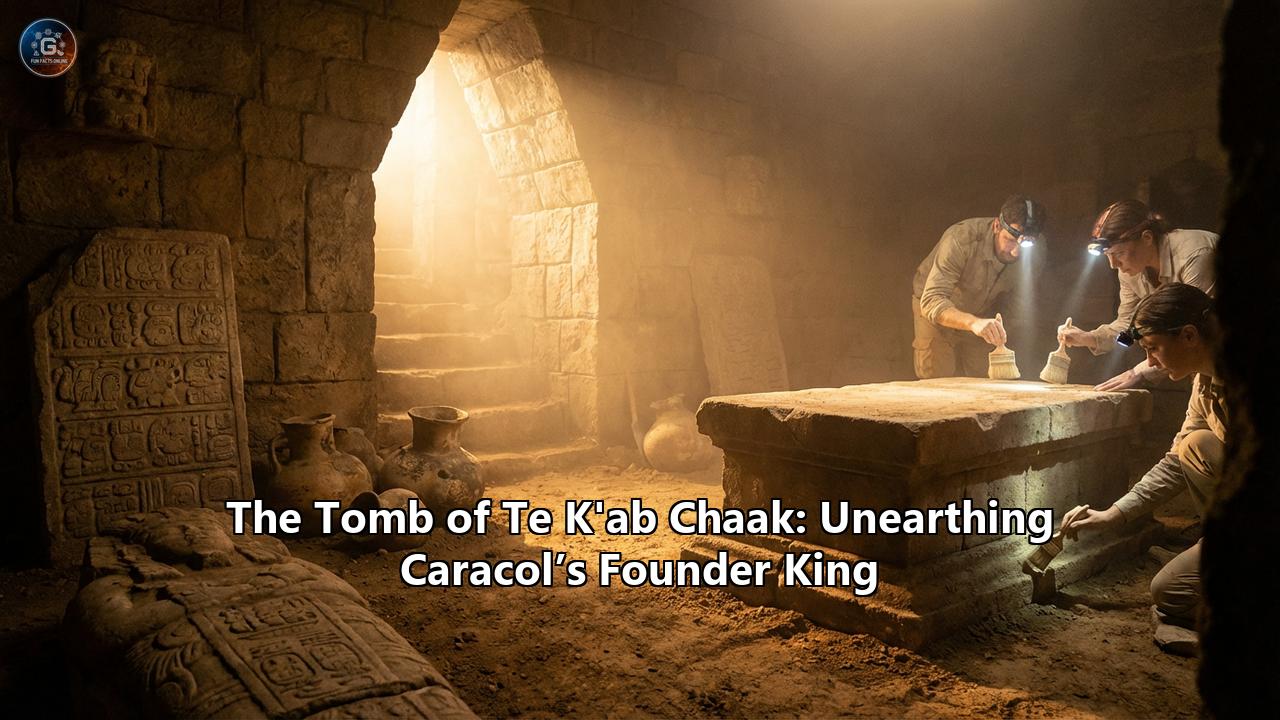
For over a millennium, the jungle of the Vaca Plateau in western Belize held a secret wrapped in red. Beneath the roots of mahogany and ceiba trees, under the weight of tons of limestone debris, a chamber lay in absolute darkness. It was sealed in the year 350 AD, a time when the Roman Empire was fracturing and the Gupta Empire was rising in India. Inside, the air was still, heavy with the metallic scent of cinnabar—the "blood of the mountains"—dusting every surface in a vibrant, toxic crimson.
In the center of this crimson void lay a man who had once commanded the rains. He was Te K’ab Chaak, the "Tree Branch Rain God," the first king of Caracol. For 1,600 years, his name was known only from eroded glyphs on crumbling stone stelae, a ghostly ancestor invoked by later kings to justify their wars and their power. He was a myth, a line of text, a shadow.
Until now.
The discovery of Te K’ab Chaak’s tomb by the Caracol Archaeological Project, led by Doctors Arlen and Diane Chase, is not merely an archaeological find; it is a resurrection. It is the physical manifestation of a history that was previously only whispered in stone. This unearthing challenges our timeline of Mesoamerican history, rewrites the story of the mysterious "arrival of strangers" from Teotihuacan, and illuminates the origins of a city that would grow to rival the greatest powers of the ancient Americas.
This is the story of that king, his city, and the team that found him.
Part I: The Void Beneath the Shrine
The discovery of a royal tomb is rarely a moment of cinematic drama. There are no booby traps, no rolling boulders. Instead, there is the slow, methodical scraping of trowels against dirt, the humidity of the Belizean jungle, and the constant buzzing of insects. But in the 2025 field season, the rhythm of excavation at Caracol’s Northeast Acropolis was broken by a sudden anomaly.
The team was revisiting a location near Structure B19, a spot that had been probed decades earlier in 1993. The Northeast Acropolis is an elite residential complex, a place where the city's nobility lived, conducted rituals, and buried their dead. The archaeologists were looking to clarify architectural sequences, to understand how the city’s layout had evolved over centuries.
As they dug through the floor of a known Late Classic tomb, they hit a layer of fill that felt different—looser, less compacted. Arlen Chase, a veteran of forty years of excavation at Caracol, pushed a measuring stick into the dirt. It didn’t hit rock. It didn’t hit fill. It slid down, disappearing into a void.
"There was a eureka-type moment," Arlen later recalled. "We knew there had to be something there."
The "something" was a sealed chultun-like chamber, a large rectangular vault carved directly into the bedrock. As the team carefully breached the seal, they were greeted by a sight that signals the highest status in the Maya world: the color red.
The entire chamber was coated in cinnabar, a mercury sulfide mineral imported from the volcanic highlands hundreds of miles away. To the ancient Maya, cinnabar was not just a pigment; it was a conduit for ch’ulel, the soul-force that resided in blood. Coating a tomb in cinnabar was an attempt to animate the dead, to keep the soul warm and vibrant in the cold underworld of Xibalba.
Lying amidst this sea of red was the skeleton of an adult male. He was approximately 5 feet 7 inches tall—a commanding height for a Maya of that era. His bones told the story of a long life; he had lost all his teeth before he died, a sign of advanced age that suggests he was cared for and revered until his final breath.
But it was the artifacts surrounding him that confirmed his identity. This was not just a noble. This was the K’uhul Ajaw—the Holy Lord.
Part II: The King Who Started It All
To understand the magnitude of this discovery, we must step back to the year 331 AD.
The Maya Lowlands were a patchwork of city-states, a collection of fiefdoms and nascent kingdoms vying for resources and prestige. Tikal, to the north in present-day Guatemala, was already an established power. But in the foothills of the Maya Mountains, Caracol was just beginning its ascent.
On a date recorded in the Maya Long Count as 8.14.13.10.4 (corresponding to the year 331 AD), Te K’ab Chaak ascended the throne. His name is a potent combination of symbols. Chaak is the erratic and powerful rain god, the wielder of the lightning axe. Te K’ab translates to "Tree Branch" or "Tree Arm." Thus, the founder king was the "Tree-Armed Rain God," a name that evokes fertility, growth, and the destructive power of the storm.
Before this discovery, historians debated whether Te K’ab Chaak was a real historical figure or a legendary ancestor invented by later kings to lengthen their pedigree. Maya rulers were notorious for fabricating connections to the past to legitimize their rule. But the tomb offers physical proof: The Founder was real.
The Burden of FoundationWhat does it mean to found a dynasty? It means Te K’ab Chaak was the architect of a new political order. He likely coalesced the disparate farming communities of the Vaca Plateau into a centralized state. He would have commissioned the first monumental architecture in the epicenter, organizing the labor of thousands to level plazas and raise pyramids.
He was not just a politician; he was the high priest. In the Maya worldview, the king was the axis mundi, the World Tree that connected the heavens, the earth, and the underworld. When the rains failed, it was Te K’ab Chaak who had to bleed onto paper bark and burn it to communicate with the ancestors. When trade routes were threatened, it was he who had to marshal the warriors.
The tomb reveals that he was successful. The richness of his grave goods indicates that even in this early period, Caracol was wealthy. He was not a petty chieftain; he was a monarch with access to luxury goods from across the Mesoamerican world.
Part III: Treasures of the Underworld
The artifacts found within the tomb of Te K’ab Chaak are not merely "treasure" in the monetary sense; they are a text, a language of symbols that tells us what the Maya believed and who they knew.
The Jadeite Mosaic MaskResting near the skull was the piece de resistance of the discovery: a mosaic death mask made of jadeite.
Jade was the most precious substance in the Maya universe. It was the color of maize, of water, of life itself. A jade mask was more than a covering; it was a new face for the king. In death, the king’s human face would rot away, but the jade face was eternal. It transformed him into the Maize God, the deity who dies, is buried, and is reborn every season.
The mask found in the tomb is a masterpiece of Early Classic craftsmanship. Unlike the single-piece masks of the Olmecs, this is a mosaic, composed of dozens of interlocking jade tesserae. This style suggests a specific artistic tradition, possibly influenced by the mosaic masks of Teotihuacan, yet distinctly Maya in its execution. The eyes, likely made of shell and obsidian, would have stared up into the darkness, forever watching for the path to the sky.
The Messenger of the MerchantsAmong the eleven pottery vessels found in the tomb, one stands out for its unique iconography. It depicts Ek Chuah, the "Black Star" or the "Merchant God."
Ek Chuah is often shown with a black face, a drooping lower lip, and a pack of merchandise on his back. He is the patron of cacao (chocolate), the currency of the Maya world. Finding an image of Ek Chuah in a royal tomb from 350 AD is significant. It tells us that Te K’ab Chaak was not just a warrior-king but a merchant-king.
The Vaca Plateau where Caracol sits is devoid of natural water sources, but it is rich in resources like timber and copal incense. Te K’ab Chaak likely built his power by controlling the trade routes that moved these goods to the lowlands. The presence of the Merchant God suggests that Caracol was already a hub of commerce, a market city where traders from the coast and the highlands met to exchange jade, obsidian, salt, and feathers.
The Coatimundi LidsTwo of the ceramic vessels featured lids with handles modeled in the shape of coatimundi heads. The coatimundi, or pisote (known as tz’uutz’ in Maya), is a long-snouted, raccoon-like animal common in the Belizean jungle.
While cute to the modern eye, to the Maya, animals were spirit companions (wayob). The coatimundi is a forager, a digger, a creature of the earth. Interestingly, the word tz’uutz’ appears in the names of later Caracol rulers, suggesting that this animal was a totem or a lineage symbol for the dynasty Te K’ab Chaak founded. These lids are a tangible link to the family crest of the Caracol royalty.
The Spondylus ShellsScattered around the body were thorny oyster shells (Spondylus princeps). These shells are native only to the Pacific Ocean, hundreds of miles away across treacherous mountain ranges.
To find Pacific shells in a tomb in Belize (which borders the Caribbean/Atlantic) is a testament to the incredible reach of ancient Maya trade networks. These shells were red—like cinnabar, like blood—and were associated with the underwater realm. Their presence proves that Te K’ab Chaak’s influence extended from sea to shining sea.
Part IV: The Teotihuacan Enigma
The most explosive implication of Te K’ab Chaak’s tomb lies in its date: roughly 350 AD.
For decades, Maya archaeology has been dominated by the theory of the "Entrada" (The Arrival). Inscriptions at Tikal record that on January 16, 378 AD, a stranger named Siyaj K’ak’ ("Fire is Born") arrived from the west. On the same day, the king of Tikal died. Siyaj K’ak’ is widely believed to have been a general or diplomat from Teotihuacan, the massive imperial city in central Mexico (near modern-day Mexico City).
The standard narrative was that Teotihuacan "invaded" or intervened in the Maya world in 378 AD, installing new rulers and bringing a new style of warfare and iconography (including goggle-eyed rain gods and green obsidian).
But Te K’ab Chaak’s tomb complicates this story.
The 350 AD ConnectionThe tomb dates to before the 378 AD Entrada. Yet, nearby excavations in the same Northeast Acropolis plaza revealed a cremation from the same year (350 AD) containing undeniable Teotihuacan artifacts: green obsidian (found only at the Pachuca source near Teotihuacan) and projectile points typical of central Mexican warriors.
If Te K’ab Chaak was buried in 350 AD with high-status goods, and Teotihuacan-style artifacts were already present in Caracol at the same time, it suggests that the relationship between the Maya and Mexico was older and more complex than a single invasion event.
Was Te K’ab Chaak a local Maya lord who adopted foreign styles to look cosmopolitan? Was he a diplomat who had visited the great city of Teotihuacan? Or was Caracol actually an early outpost for Mexican traders, a "forward operating base" established decades before the takeover of Tikal?
Diane Chase notes, "The Caracol archaeological data suggests that the situation was far more complicated." It wasn't just a one-way conquest. It was a dialogue. The Maya and Teotihuacan were aware of each other, trading and exchanging ideas long before the armies marched. Te K’ab Chaak stands at this crossroads, a ruler who was fully Maya but whose city was already looking westward toward the great metropolis of the highlands.
Part V: The Garden City
To understand the king, we must understand his kingdom. Caracol is unlike any other Maya city.
Most Maya cities, like Tikal or Calakmul, are clustered around water sources. They are dense urban cores surrounded by rural hinterlands. Caracol is different. It is a "Garden City," a sprawling low-density metropolis where the farm and the city were one and the same.
The Master of WaterTe K’ab Chaak’s name—"Rain God"—is ironic because Caracol has no natural surface water. The limestone bedrock is like a sieve; rain sinks immediately into underground caves.
To survive, the founders of Caracol had to be master engineers. They constructed thousands of reservoirs, lining them with clay to make them watertight. They captured every drop of rain that fell on their plazas and pyramid tops, funneling it into these tanks.
The Terraced LandscapeThe most stunning feature of Caracol, revealed in recent years by LiDAR (Light Detection and Ranging) technology, is its agricultural terracing. The Chases’ research has shown that over 80% of the landscape around Caracol was terraced.
Te K’ab Chaak’s people moved millions of tons of stone to build walls across the hillsides. These terraces stopped soil erosion and retained moisture, allowing them to farm the same plots of land intensively year after year. This agricultural engine allowed the population to explode. By the Late Classic period, the dynasty Te K’ab Chaak founded would rule over 100,000 people—a population density comparable to modern-day suburbs.
When Te K’ab Chaak was buried in 350 AD, this system was in its infancy. He would have looked out from his palace not over a dense jungle, but over a mosaic of manicured fields, white plaster plazas, and thatch-roofed houses stretching to the horizon.
Part VI: The Legacy of the Dynasty
Te K’ab Chaak died, but his lineage survived for 460 years. The dynasty he founded would go on to become the scourge of the Maya world.
The Rise of the Snake's AllyIn the centuries after the founder’s death, Caracol found itself sandwiched between two superpowers: Tikal and Naranjo. Initially, Caracol was a vassal or ally of Tikal. But in the 6th century, the geopolitical winds shifted.
Under the reign of King Yajaw Te’ K’inich II (Lord Water), a descendant of Te K’ab Chaak, Caracol switched sides. In 562 AD, allied with the Snake Kingdom (Kaanul) of Calakmul, Caracol launched a "Star War" against Tikal. They crushed their former overlord. Tikal went silent for over a century, erecting no new monuments—a period known as the Tikal Hiatus.
The Golden AgeThis victory ushered in Caracol’s Golden Age. The wealth of Tikal flowed into the Vaca Plateau. The successors of Te K’ab Chaak embarked on a building spree. They expanded the colossal pyramid known as Caana ("Sky Place"), which remains the tallest man-made structure in Belize to this day (standing 141 feet tall).
They also democratized wealth. Archaeological digs in humble residential mounds at Caracol have found jade, polychrome pottery, and obsidian. It seems the "Caracol Model" involved sharing the spoils of war and the bounty of the terraces with the common people, creating a stable and loyal middle class that sustained the dynasty for centuries.
All of this—the wars, the wealth, the sky-high temples—can be traced back to the foundation laid by Te K’ab Chaak in 331 AD. He was the root of the tree.
Part VII: The Detectives of Time
The discovery of the tomb is the crown jewel in the career of Arlen and Diane Chase. Since 1985, this husband-and-wife team from the University of Houston has dedicated their lives to Caracol.
Maya archaeology is a test of endurance. It involves battling 100-degree heat, venomous fer-de-lance snakes, and the logistical nightmare of supplying a camp deep in the jungle. For decades, the Chases worked with trowels and transits, mapping the city one stone at a time.
In 2009, they changed archaeology forever. They were the first to use airborne LiDAR to map a Maya site. A plane flew over the canopy, shooting laser pulses that penetrated the leaves and bounced off the ground. When the data was processed, the jungle was digitally stripped away.
The result was shocking. Caracol was not just a cluster of temples in the forest; it was a continuous urban sprawl covering 200 square kilometers. The LiDAR map revealed the terraces, the causeways (roads), and the hidden house mounds. It proved that the Maya were capable of urban planning on a scale previously unimagined.
The discovery of Te K’ab Chaak’s tomb was a return to traditional, dirty-fingernails archaeology. It required intuition. It required the knowledge of 40 years of stratigraphy to know that a "soft spot" in the floor was not just dirt, but a door to the past.
"This discovery is both a story of how quickly things can happen, but also how much patience you need to have," Diane Chase said. "On one hand, it was more than a thousand years in the making, but for us, it was at least forty years."
Part VIII: Visiting the King’s City
Today, Caracol is a destination for the adventurous traveler. Located in the Chiquibul Forest Reserve, it is a bumpy two-hour drive from the town of San Ignacio. The isolation is part of the allure. Unlike the crowded ruins of Chichén Itzá, you can often stand atop Caana and hear nothing but the roar of howler monkeys and the call of the keel-billed toucan.
Visitors can walk the Plaza A, where the stelae of Te K’ab Chaak’s descendants still stand. They can climb the massive Caana and look out over the jungle canopy, imagining the deforested, terraced city of the 7th century.
And now, they can look toward the Northeast Acropolis with new reverence. They can know that beneath those stones lies the empty chamber of the man who started it all. The cinnabar dust has settled, the jade mask has been moved to a museum, but the spirit of the Founder still permeates the limestone.
Conclusion: The Enduring Mystery
The unearthing of Te K’ab Chaak is a reminder that history is never settled. A single shovel thrust can upend our understanding of centuries.
We now know the face of Caracol’s founder. We know he lived in a time of international intrigue, balancing the local traditions of the Maya with the exotic allure of distant Teotihuacan. We know he laid the groundwork for a city that would survive the collapse of empires.
But mysteries remain. How did he die? Was he a victim of the violent politics of his time? What is the exact translation of the hieroglyphs on his pottery? And what other secrets lie hidden in the thousands of unexcavated mounds that dot the Vaca Plateau?
As the jungle reclaims the excavation trench, sealing the Northeast Acropolis once more, we are left with the image of the jade mask staring into the dark. It is a face of endurance, a face of power, the face of a king who waited 1,600 years to tell his story. The Founder has returned, and Caracol will never be the same.
Reference:
- https://www.forbes.com/sites/davidanderson/2019/06/28/interactions-between-the-ancient-maya-and-the-city-of-teotihuacan-revealed-by-new-excavations/
- https://www.greaterbelize.com/royal-maya-tomb-found-in-belize-makes-top-10-discoveries-of-2025/
- https://archaeology.org/issues/january-february-2026/collection/return-of-the-king/top-10-discoveries-of-2025/
- https://en.wikipedia.org/wiki/Maya_monarchs
- https://www.sci.news/archaeology/ancient-maya-mercury-11226.html
- https://en.wikipedia.org/wiki/Caracol
- https://symbolikon.com/downloads/ek-chuah/
- https://www.ancient-origins.net/news-history-archaeology/maya-kings-tomb-0022259
- https://sciences.ucf.edu/biology/games/wp-content/uploads/sites/13/2012/09/ChaseWeishampel2016.pdf
- https://www.ucf.edu/news/mapping-ancient-civilization-in-a-matter-of-days/