
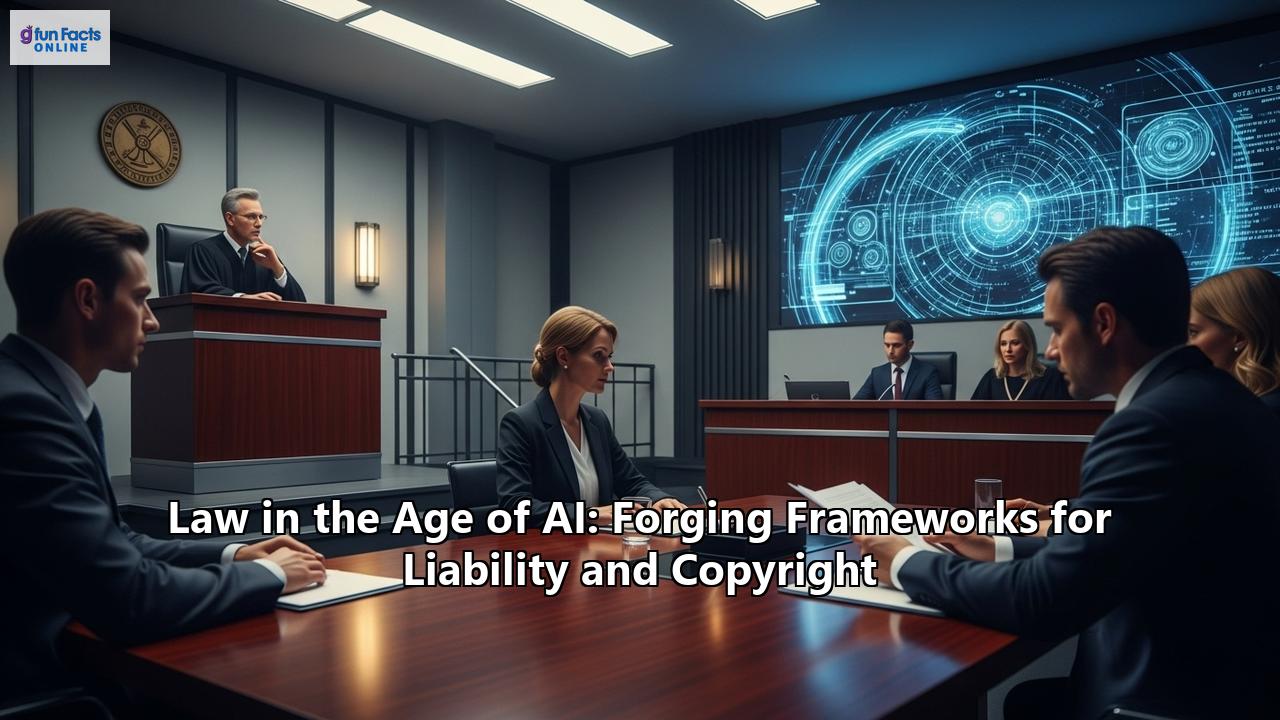
Navigating the Uncharted Waters of AI: Forging Legal Frameworks for Liability and Copyright
Artificial intelligence is no longer the stuff of science fiction; it's a transformative force reshaping industries and our daily lives. As AI systems become increasingly sophisticated and autonomous, they raise profound legal questions that challenge the very foundations of our established legal frameworks. Two of the most pressing battlegrounds are determining who is responsible when an AI system causes harm (liability) and who owns the creative works generated by AI (copyright). This article delves into the intricate legal landscapes of AI liability and copyright, exploring the current state of the law, the emerging challenges, and the ongoing efforts to forge a new legal paradigm for the age of AI.
The Labyrinth of Liability: Who Pays When AI Fails?
When a self-driving car is involved in an accident, a medical AI misdiagnoses a patient, or a hiring algorithm exhibits discriminatory bias, the question of legal responsibility becomes paramount. Traditional legal principles, designed for a world of human actors, are being stretched to their limits by the complexities of artificial intelligence.
The Tangled Web of Responsibility in the AI Supply Chain
One of the foremost challenges in assigning liability for AI-related harm is the intricate and often fragmented nature of the AI supply chain. An AI system is rarely the product of a single entity. Its creation and deployment can involve:
- Developers: The entities that design and build the core AI models, such as the large language models (LLMs) that power many generative AI applications.
- Data Providers: Those who supply the vast datasets used to train the AI.
- Fine-tuners and Customizers: Companies that take a general-purpose AI model and adapt it for a specific task or industry.
- Deployers and End-users: The individuals or organizations that ultimately use the AI system.
This multi-layered process makes it incredibly difficult to pinpoint where a fault originated. Was it a flaw in the initial design, biased training data, improper customization, or misuse by the end-user? The "black box" nature of some advanced AI systems, where even their creators cannot fully explain the reasoning behind a specific output, further complicates the task of assigning blame.
Adapting Traditional Legal Frameworks to a New Reality
In the absence of specific AI-centric legislation, courts and legal experts are turning to established principles of tort law to address harms caused by AI. The primary legal theories being applied are negligence and product liability.
Negligence: A negligence claim typically requires a plaintiff to prove that the defendant owed them a duty of care, breached that duty, and that this breach caused the plaintiff's injury. In the context of AI, this could mean arguing that a developer failed to exercise reasonable care in designing a safe system or that a deployer was negligent in how they implemented it. However, establishing the standard of "reasonable care" for a rapidly evolving technology like AI is a significant hurdle. Courts may look to industry standards and customs to determine what constitutes appropriate safety measures. Product Liability: This area of law holds manufacturers and sellers responsible for injuries caused by defective products. If an AI system is deemed a "product," its creators could be held liable for design defects, manufacturing defects, or a failure to provide adequate warnings about potential risks. The concept of "consumer expectations" plays a crucial role here; if an AI system doesn't perform as a reasonable user would expect, it could be considered defective. Strict Liability: In some instances, particularly with high-risk AI applications, a theory of strict liability might be applied. This would hold the creators or operators of the AI system responsible for any harm it causes, regardless of their intent or level of care. The rationale behind this is to incentivize the utmost caution when developing and deploying potentially dangerous technologies.The Global Pursuit of AI Liability Rules
Recognizing the limitations of existing laws, governments and international bodies are actively working to establish clearer rules for AI liability.
The European Union's Pioneering Approach: The EU has been at the forefront of this effort. The AI Act, which came into force in the summer of 2024, is the world's first comprehensive legal framework for AI. It takes a risk-based approach, imposing stricter obligations on "high-risk" AI systems, such as those used in critical infrastructure, medical devices, and employment. While the AI Act focuses on safety and fundamental rights, it was intended to be complemented by the AI Liability Directive (AILD). The AILD aimed to ease the burden of proof for victims of AI-related harm by introducing measures like a "presumption of causality" and empowering courts to order the disclosure of evidence about high-risk AI systems. However, due to a lack of agreement among stakeholders, the European Commission withdrew the AILD proposal in February 2025. Despite this setback, the EU is still revising its Product Liability Directive to explicitly include software and AI systems, which will provide another avenue for compensation for those harmed by AI. Developments in the United States and Beyond: In the U.S., the legal landscape for AI liability is being shaped by court cases and legislative proposals at both the federal and state levels. For example, California's proposed SB 1047 aims to create a comprehensive regulatory framework for AI, including provisions to protect consumers. Australia is also grappling with these issues, exploring mandatory guardrails for high-risk AI and considering how its consumer protection laws apply to AI-related errors.The overarching challenge for lawmakers worldwide is to strike a delicate balance: creating effective recourse for those harmed by AI without stifling innovation.
The Copyright Conundrum: Creativity in the Age of Machine-Generated Content
The rise of generative AI, capable of producing text, images, music, and code that is often indistinguishable from human-created work, has thrown copyright law into a state of flux. The central questions are twofold: can AI-generated content be copyrighted, and is it legal to use existing copyrighted works to train AI models?
The Human Authorship Requirement: A Bedrock Principle Under Strain
Copyright law has traditionally been grounded in the principle of human authorship. To be eligible for copyright protection, a work must be the product of human creativity and originality. This "bedrock requirement" is being put to the test by generative AI.
The Stance of the U.S. Copyright Office: The U.S. Copyright Office has taken a firm stance on this issue, repeatedly affirming that works generated solely by AI without any creative human input are not copyrightable. This position has been supported by federal court rulings.The Copyright Office has issued guidance clarifying its position on works that incorporate AI-generated material. The key takeaways from this guidance are:
- AI as a Tool: If a human uses AI as a tool to assist in their creative process, the resulting work may be copyrightable. The level of human control and creative contribution is the determining factor. For example, using AI to edit a photograph or generate ideas that are then developed by a human author would likely not preclude copyright protection for the human-authored elements.
- Prompts are Not Enough: Simply writing a text prompt to an AI system, even a detailed one, is not considered sufficient creative input to grant the user copyright ownership of the resulting output. The AI, in this case, is seen as the one making the expressive choices.
- Disclosure is Required: When applying for copyright registration for a work that contains more than a minimal amount of AI-generated content, the applicant must disclose this fact and disclaim the AI-generated portions.
This nuanced approach means that while a graphic novel with human-authored text and AI-generated images can be copyrighted as a whole, the individual AI-generated images themselves are not protected.
International Perspectives on AI and Copyright: Other countries are also navigating this complex issue. In Canada, the intellectual property office has permitted a copyright registration that listed an AI system as a co-author alongside a human. This contrasts with the U.S. approach. China, in a landmark 2023 case, granted copyright protection to an AI-generated image, emphasizing that it reflected a human's intellectual effort. The EU is also actively developing its copyright framework in relation to AI.The Fair Use Firestorm: Training AI on Copyrighted Data
Perhaps the most contentious issue at the intersection of AI and copyright is the use of vast amounts of copyrighted material to train AI models. AI developers argue that this practice is essential for creating powerful and effective systems and should be considered "fair use" under copyright law.
The Fair Use Doctrine Explained: Fair use is a legal doctrine that permits the limited use of copyrighted material without permission from the copyright holder. Courts in the U.S. typically consider four factors when determining if a use is fair:- The purpose and character of the use, including whether it is transformative.
- The nature of the copyrighted work.
- The amount and substantiality of the portion used.
- The effect of the use upon the potential market for or value of the copyrighted work.
On the other side, creators and copyright holders argue that the unauthorized ingestion of their works to train commercial AI models constitutes massive copyright infringement. They point out that this practice can harm the market for their work, especially if the AI-generated outputs compete with the original creations. A number of high-profile lawsuits have been filed by authors, artists, and news organizations against major AI companies, putting this issue squarely before the courts.
The Evolving Legal and Regulatory Landscape: The U.S. Copyright Office has stated that there will not be a single answer to whether training AI models on copyrighted material is fair use and that it will depend on a case-by-case analysis. It has also suggested that a voluntary licensing market could develop to address this issue.The EU's Copyright in the Digital Single Market Directive includes exceptions for text and data mining (TDM), which is the process used to train AI. However, these exceptions are subject to certain conditions, and rights holders can opt out of having their works used for commercial TDM. The EU's AI Act also includes provisions requiring providers of general-purpose AI models to respect these opt-outs and to provide summaries of the copyrighted content used for training.
The Path Forward: Forging a New Legal Frontier
The legal and ethical questions surrounding AI are complex and far-reaching. As this technology continues to evolve at a breakneck pace, our legal systems are in a constant race to keep up. The frameworks for liability and copyright that are being forged today will have a profound impact on the future of innovation, creativity, and accountability in the age of AI.
The path forward will likely involve a combination of adapting existing laws, creating new legislation, and fostering international cooperation. Finding the right balance will be key: a balance that protects individuals and society from the potential harms of AI, fairly compensates creators for their work, and allows for the continued development of this transformative technology for the benefit of all. The journey to a comprehensive legal framework for AI is still in its early stages, and the debates and legal battles of today will shape the digital world of tomorrow.
Reference:
- https://www.rand.org/pubs/research_reports/RRA3243-4.html
- https://www.taylorwessing.com/en/insights-and-events/insights/2025/01/ai-liability-who-is-accountable-when-artificial-intelligence-malfunctions
- https://www.wottonkearney.com/professionals-and-ai-navigating-liability-and-emerging-risks/
- https://www.dailyjournal.com/mcle/1525-legal-liability-concerns-in-artificial-intelligence-what-you-need-to-know
- https://www.nortonrosefulbright.com/en-be/knowledge/publications/7052eff6/artificial-intelligence-and-liability
- https://schoenherr.eu/content/liability-for-damages-the-missing-piece-of-the-ai-act-puzzle
- https://www.nortonrosefulbright.com/en/knowledge/publications/7052eff6/artificial-intelligence-and-liability
- https://www.europarl.europa.eu/RegData/etudes/BRIE/2023/739342/EPRS_BRI(2023)739342_EN.pdf739342_EN.pdf)
- https://commission.europa.eu/business-economy-euro/doing-business-eu/contract-rules/digital-contracts/liability-rules-artificial-intelligence_en
- https://www.twobirds.com/en/insights/2025/proposed-eu-ai-liability-rules-withdrawn
- https://www.ai-liability-directive.com/
- https://www.researchgate.net/publication/387015813_Liability_Issues_in_the_Context_of_Artificial_Intelligence_Legal_Challenges_and_Solutions_for_AI-Supported_Decisions
- https://thebarristergroup.co.uk/blog/ai-generated-content-and-copyright-evolving-legal-boundaries-in-english-law
- https://intellectual-property-helpdesk.ec.europa.eu/news-events/news/artificial-intelligence-and-copyright-use-generative-ai-tools-develop-new-content-2024-07-16-0_en
- https://www.rand.org/pubs/perspectives/PEA3243-1.html
- https://builtin.com/artificial-intelligence/ai-copyright
- https://unblock.federalregister.gov
- https://www.techtarget.com/searchcontentmanagement/answer/Is-AI-generated-content-copyrighted
- https://www.wiley.law/alert-Generative-AI-in-Focus-Copyright-Offices-Latest-Report
- https://www.congress.gov/crs-product/LSB10922
- https://sites.usc.edu/iptls/2025/02/04/ai-copyright-and-the-law-the-ongoing-battle-over-intellectual-property-rights/
- https://www.artlawgallery.com/2025/02/articles/artificial-intelligence/the-copyright-offices-latest-guidance-on-ai-and-copyrightability/
- https://www.skadden.com/insights/publications/2025/02/copyright-office-publishes-report
- https://www.millerthomson.com/en/insights/publications/copyright-challenges-in-the-age-of-ai/
- https://www.dentons.com/en/insights/articles/2025/june/11/can-copyrighted-material-be-used-to-train-ai-systems
- https://www.arl.org/blog/training-generative-ai-models-on-copyrighted-works-is-fair-use/
- https://originality.ai/blog/fair-use-and-ai
- https://trademarklawyermagazine.com/ai-training-data-might-not-be-protected-by-fair-use/
- https://www.lowenstein.com/news-insights/videos-listing/when-does-ai-violate-copyright-law-recent-cases-and-new-causes-of-action-1
- https://www.skadden.com/insights/publications/2025/05/copyright-office-report
- https://copyrightblog.kluweriplaw.com/2024/11/28/copyright-the-ai-act-and-extraterritoriality/
- https://www.heavybit.com/library/article/regulation-copyrights-for-ai-and-open-source