
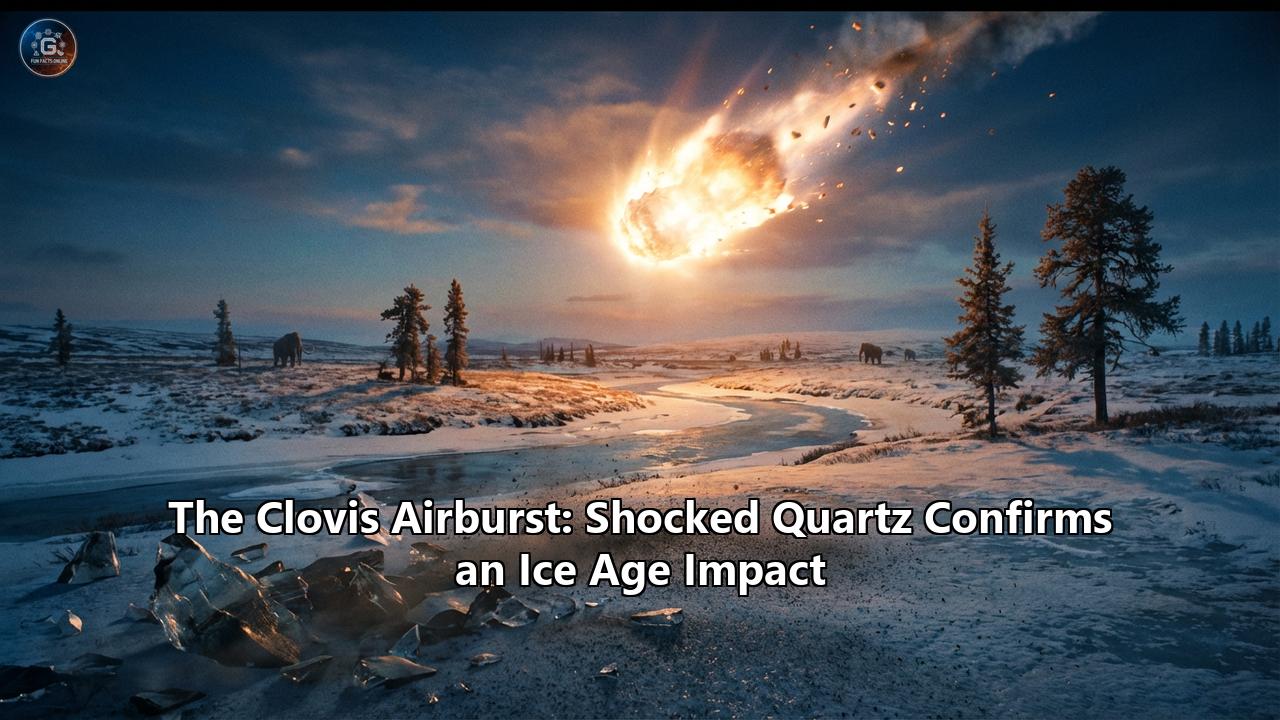
The wind howled across the North American steppe 12,800 years ago, chilling the bones of the great beasts that roamed the grasslands. For the Clovis people, masters of the stone spear and the first great culture of the continent, the world was a place of abundance. Mammoths, mastodons, and camels thundered across the plains. The ice sheets of the great north were retreating, and the world was warming. It was a time of plenty.
And then, in a heartbeat, the sky caught fire.
For decades, the sudden end of this epoch—the abrupt return to ice-age temperatures, the vanishing of the megafauna, and the ghostly disappearance of the Clovis culture—has been geology’s greatest cold case. It is a mystery wrapped in a layer of black biological mat, a dark scar in the earth known as the Younger Dryas Boundary.
For years, a contentious group of scientists has argued that a cosmic impact—a fragmented comet detonating in Earth’s atmosphere—was the culprit. They were met with derision, skepticism, and a demand for the "gold standard" of proof: an impact crater and shocked quartz.
In 2025, they found both.
The Invisible Killer: The Younger Dryas Impact Hypothesis
To understand the magnitude of the recent discoveries, one must understand the ferocity of the debate that preceded them. The Younger Dryas Impact Hypothesis (YDIH), first popularized in 2007, posited that Earth collided with debris from a disintegrating giant comet. The theory proposed that this event didn't just leave a dent; it set the world on fire, blocked out the sun with soot, and poured freshwater into the oceans, shutting down the Atlantic circulation and plunging the planet back into a deep freeze for 1,200 years.
Critics, often dubbed the "Impact Mafia" by frustrated proponents, demanded hard evidence. Where was the crater? Where was the shocked quartz—that unique form of mineral that only forms under the pressures of a nuclear blast or a cosmic collision?
For nearly two decades, proponents pointed to "proxies": microscopic diamonds (nanodiamonds), magnetic spherules, and spikes in platinum found in the soil layer dating to 12,800 years ago. While compelling, these were dismissed by mainstream geology as products of natural earthly processes or misinterpretations.
The hypothesis seemed to be on the ropes. The discovery of a massive impact crater beneath the Hiawatha Glacier in Greenland in 2018 briefly rallied hope, only for it to be dashed in 2022 when radiometric dating confirmed that impact occurred 58 million years ago—far too old to be the Younger Dryas assassin.
But the Comet Research Group kept digging. And in the soil of three of the most famous archaeological sites in America, and a humble farm in Louisiana, they finally struck the geological jackpot.
The Smoking Gun: Shocked Quartz in the Clovis Heartland
In late 2024 and throughout 2025, a series of landmark papers published in PLOS ONE and Airbursts and Cratering Impacts fundamentally shifted the battlefield. Led by UC Santa Barbara emeritus professor James Kennett, the team returned to the "scene of the crime": the classic Clovis sites where the culture was first defined.
They excavated at Murray Springs, Arizona; Blackwater Draw, New Mexico; and Arlington Canyon, California. These are hallowed grounds for archaeologists, the very places where Clovis spear points lie alongside the bones of the mammoths they hunted.
There, right at the boundary layer where the Clovis artifacts disappear forever, they found it: Shocked Quartz.
Quartz is one of the most common minerals on Earth, durable and ubiquitous. But "shocked" quartz is different. It contains microscopic features called planar deformation features (PDFs)—sets of parallel lines that can only be created when a shockwave travels through the crystal at pressures exceeding hundreds of thousands of atmospheres. It is the fingerprint of a cosmic hammer blow.
But the quartz Kennett’s team found was even more specific. It contained glass-filled fractures. The shock of the event hadn't just cracked the crystals; it had melted the silica within the cracks instantly. This indicated temperatures exceeding 2,000 degrees Celsius (3,632°F)—hotter than any volcano, hotter than any forest fire.
"This is the crème de la crème of cosmic impact evidence," Kennett stated. The presence of these grains at three widely separated sites across North America proved that this was not a local anomaly. It was a continental catastrophe.
The Missing Crater: The Perkins Plume
While the shocked quartz provided the forensic fingerprint, the critics’ loudest question remained: Where is the crater? If a comet hit Earth, where is the hole?
The answer, it turns out, was hiding in a Louisiana backyard.
For generations, the Fitzenreiter family in Pointe Coupee Parish, Louisiana, had puzzled over a strange depression on their land. It was a 300-meter-long dip, a "seasonal lake" that didn't quite fit the flat bayou landscape. Robert Fitzenreiter, inheriting the land, suspected it was more than just a swampy low spot. He spent years trying to get scientists to look at it.
In June 2025, his persistence paid off. A study published by the Comet Research Group confirmed that the "Perkins Depression" was no ordinary swamp. It was a touchdown airburst crater.
Unlike the asteroid that killed the dinosaurs, which slammed into the crust like a solid bullet, the Younger Dryas impactor likely consisted of a swarm of cometary fragments. These were "rubble piles" of ice and rock that detonated in the atmosphere.
The Perkins site represents a "plasma plume" event. Imagine a nuclear explosion occurring just above the ground. The projectile doesn't dig a deep bowl; instead, a column of superheated, ionized gas (plasma) slams into the earth. It scours the surface, melting the ground instantly without excavating a deep crater.
The evidence at the Fitzenreiter farm was overwhelming:
- Tons of Meltglass: The team recovered massive quantities of melted earth, formed at temperatures hot enough to boil iron.
- Microspherules: Billions of tiny iron and silica balls, condensed from vaporized rock rain, were found in the soil.
- Shocked Quartz: The same tell-tale crystals found at the Clovis sites were present here in abundance.
The dating was precise: 12,800 years ago. The Perkins Plume was the first confirmed physical scar of the event that changed the world.
The Physics of Armageddon: Touchdown Airbursts
How does a comet hit Earth without leaving a classic crater? The new research utilized "hydrocode modeling"—advanced computer simulations used to model nuclear blasts—to explain the physics.
The study showed that a porous, icy comet fragment, perhaps 100 meters wide, entering the atmosphere at 40,000 miles per hour, would act less like a rock and more like a bomb. The atmosphere would compress it until it detonated with the force of megatons of TNT.
If this explosion happens high up (like the Tunguska event of 1908), it flattens trees but leaves no crater. But if it happens low enough—a "touchdown"—the shockwave hits the ground like a hammer. The air itself turns into a blowtorch.
The pressure from this wave is what created the shocked quartz. The heat is what created the meltglass. And the resulting firestorm would have been unimaginable.
The Day the World Burned
The picture painted by these new discoveries is apocalyptic.
12,800 years ago, the sky would have lit up with thousands of streaks as the comet swarm encountered Earth. The "touchdown" at the Perkins site in Louisiana was likely just one of hundreds or thousands of similar blasts across the hemisphere.
- The Fire: The heat from the airbursts would have ignited biomass instantly. Evidence suggests that up to 10% of the Earth's biomass burned in a matter of days. A layer of soot found globally at this boundary layer confirms a world engulfed in flames.
- The Impact Winter: The smoke, dust, and soot rose into the stratosphere, blocking out the sun. The warming Earth was suddenly plunged into darkness and cold.
- The Extinction: For the megafauna—the woolly mammoths, the saber-toothed cats, the giant ground sloths—there was no escape. Their food sources burned, the temperatures plummeted, and their habitats were destroyed.
- The Human Toll: The Clovis people, who had thrived for centuries, vanished. Their distinctive fluted spear points disappear from the archaeological record exactly at this layer. While humans survived, their culture was shattered, forcing them to adapt to a harsher, colder world.
Some researchers even suggest that this catastrophe forced humanity's hand. In Abu Hureyra, Syria, another site where shocked quartz has been found, the destruction of the hunter-gatherer village coincides with the very first evidence of agriculture. When the wild world died, humans were forced to start farming to survive.
The Debate Rages On
Despite the "crème de la crème" evidence, the scientific community is not a monolith. The "Impact Mafia" has not surrendered. A July 2025 article in the Skeptical Inquirer titled "The Younger Dryas Impact: A Failed Hypothesis" highlights the entrenched resistance.
Critics argue that the shocked quartz could be misidentified tectonic features, or that the dates are not as synchronous as proponents claim. They point to the " reproducibility crisis," claiming that other labs have struggled to find the same proxies.
However, the 2025 findings address the biggest hurdles. The detailed electron microscopy of the quartz is difficult to refute, and the Perkins Plume offers a physical location that critics can visit and sample themselves. The shift in the "Overton Window" of geology is palpable. What was once dismissed as fringe pseudoscience is now supported by hard, crystalline evidence published in major peer-reviewed journals.
A Warning from the Past
The confirmation of the Clovis Airburst is more than just a solution to a geological puzzle. It is a sobering reminder of our place in the cosmos.
We often look for the "big one"—the dinosaur-killing asteroid that leaves a 100-mile-wide crater. But the Younger Dryas event teaches us that the danger is more subtle and perhaps more frequent. A comet doesn't need to hit the ground to destroy a civilization; it just needs to scream through the atmosphere and detonate.
The scorched earth of the Fitzenreiter farm and the fractured crystals of the Clovis hunters tell a story of a day when the sun vanished and the ice returned. It is a story written in stone, confirming that the sky effectively fell, changing the course of life on Earth forever.
As we stare up at the night sky, we are no longer just looking at stars. We are looking at the authors of our history, and the potential architects of our future. The ghosts of the mammoths, and the lost Clovis tribes, now have a witness—grains of sand, shocked into silence, testifying to the fire that fell from above.
Reference:
- https://cosmictusk.com/shocked-quartz-at-the-boundary-and-a-plasma-plume-in-the-backyard/
- https://pocketmags.com/ca/skeptical-inquirer-magazine/julyaugust-2025/articles/the-younger-dryas-impact-a-failed-hypothesis
- https://www.jpost.com/science/article-867796
- https://researchnow.flinders.edu.au/en/publications/evidence-of-a-12800-year-old-shallow-airburst-depression-in-louis/
- https://journals.plos.org/plosone/article?id=10.1371/journal.pone.0319840
- https://www.researchgate.net/publication/392399441_Evidence_of_a_12800-year-old_Shallow_Airburst_Depression_in_Louisiana_with_Large_Deposits_of_Shocked_Quartz_and_Melted_Materials
- https://cosmictusk.com/%F0%9F%9A%A8-major-younger-dryas-impact-evidence-discovered-in-louisiana-shallow-airburst-crater-identified/
- https://pmc.ncbi.nlm.nih.gov/articles/PMC12422476/
- https://www.scienceopen.com/hosted-document?doi=10.14293/ACI.2025.0004
- https://www.sciencenews.org/article/hiawatha-crater-greenland-age-younger-dryas
- https://en.wikipedia.org/wiki/Hiawatha_impact_structure
- https://www.forbes.com/sites/davidbressan/2022/03/09/hiawatha-crater-dated-to-a-few-million-years-after-dinosaurs-extinction-impact/
- https://www.youtube.com/watch?v=wr_cwFwS0RE
- https://www.sciencedaily.com/releases/2025/12/251225080736.htm
- https://www.researchgate.net/publication/374397743_Microstructures_in_shocked_quartz_linking_nuclear_airbursts_and_meteorite_impacts