
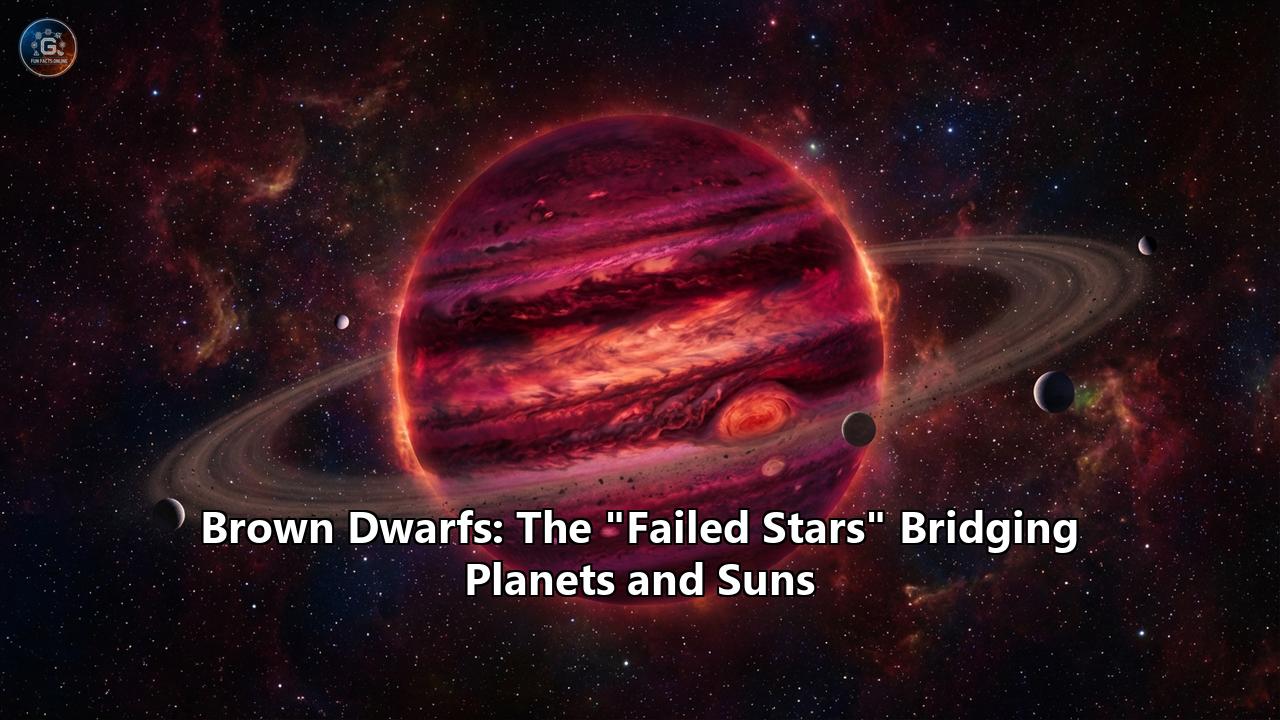
The universe is not binary; it does not deal merely in the blazing brilliance of stars and the rocky silence of planets. Between these two familiar archetypes lies a vast, shadowed, and mysterious population of objects that defy simple categorization. They are the Brown Dwarfs—the cosmic "middle children," the "failed stars," and the missing links that hold the secrets to star formation and planetary atmospheres alike.
For decades, they were theoretical ghosts—mathematical inevitabilities that refused to show themselves in our telescopes. Today, we know they number in the billions, drifting silently through the dark, possessing storms of molten iron, glowing with a magenta hue, and harboring mini-solar systems of their own.
Here is the comprehensive story of Brown Dwarfs.
Part I: The Cosmic Middle Child
1.1 The Definition Paradox
To understand a brown dwarf, one must first discard the rigid dichotomy of "star" vs. "planet." In the standard model of stellar astronomy, a star is defined by its ability to sustain nuclear fusion. A cloud of gas collapses, heats up, and if it is massive enough—at least 80 times the mass of Jupiter ($M_J$)—the pressure and temperature in its core ignite hydrogen into helium. This reaction releases the energy that powers the star for billions of years.
A planet, conversely, forms from the leftovers. It accretes from a disk of dust and gas around a star, never gaining enough mass to ignite.
But nature loves a gradient. What happens to an object that forms like a star—collapsing directly from a gas cloud—but stops growing at 40 $M_J$? Or 20 $M_J$? It is too heavy to be a planet, yet too light to be a star.
This is the Brown Dwarf.
Astronomers generally define them as objects with masses between 13 and 80 Jupiter masses.
- Below 13 $M_J$: Gravity is too weak to fuse anything. These are planets (or "sub-brown dwarfs" if they float freely).
- Above 80 $M_J$: Gravity is strong enough to fuse hydrogen. These are Red Dwarf stars.
- Between 13-80 $M_J$: The core pressure is intense enough to fuse deuterium (a heavy isotope of hydrogen) and, in the heavier ones (>65 $M_J$), lithium. This fusion provides a brief spark of "stardom" before the fuel runs out and the object begins a slow, eternal fade into darkness.
1.2 "Failed Stars" or "Super Planets"?
The term "failed star" is evocative but perhaps unfair. It implies an intent to become a sun that went awry. In reality, brown dwarfs are successful at being exactly what they are: stabilized celestial bodies governed by quantum mechanics.
Unlike Sun-like stars, which are supported against gravity by thermal pressure (the heat of fusion pushing outward), brown dwarfs are supported by Electron Degeneracy Pressure. As gravity crushes the core, electrons are packed so tightly that the Pauli Exclusion Principle kicks in—no two electrons can occupy the same quantum state. They resist further compression, creating a rigid structure that halts the collapse.
This leads to a bizarre physical characteristic: Brown dwarfs are all roughly the same physical size as Jupiter.
A brown dwarf with 70 times the mass of Jupiter is only about 10-15% larger in diameter than Jupiter itself. It is simply incredibly dense. If you were to add more mass to a brown dwarf, it wouldn't get bigger; it would actually get smaller as the gravity compresses the degenerate core even further.
Part II: The Anatomy of the Invisible
2.1 Formation: A Star is Born (Almost)
Brown dwarfs form in the same violent nurseries as stars. Deep inside molecular clouds (like the Orion Nebula), knots of turbulent gas lose their battle against gravity and collapse.
For a true star, the infalling gas continues until the core temperature hits 10 million Kelvin. For a brown dwarf, the cloud fragment is smaller—a "runt" of the litter. It collapses, heats up, and spins, likely forming an accretion disk just like a young protostar.
This formation mechanism is the primary way astronomers distinguish brown dwarfs from massive planets.
- Stars & Brown Dwarfs: Form via gravitational collapse of a gas cloud.
- Planets: Form via core accretion inside a disk around a host.
However, this line is blurring. We have found 12 $M_J$ objects free-floating (likely collapsed clouds) and 25 $M_J$ objects orbiting stars (likely formed in disks). The universe, it seems, has multiple recipes for making the same cake.
2.2 The Deuterium Spark
The "life" of a brown dwarf begins with a whimper, not a bang. For the first few million years, they shine relatively brightly (in infrared) due to the heat of formation. When the core temperature reaches roughly 1 million Kelvin, Deuterium fusion ignites.
$$ ^2H + ^1H \rightarrow ^3He + \gamma $$
Deuterium is easier to fuse than regular hydrogen because the nucleus already contains a neutron, reducing the electrostatic repulsion between protons. This burning phase acts as a thermostat, keeping the brown dwarf's interior warm and its radius stable.
But deuterium is rare. The supply is exhausted quickly—in as little as 10 million years for lighter dwarfs, or up to 100 million years for the massive ones. Once the deuterium is gone, the "star" goes out. The brown dwarf is now dead, thermodynamically speaking. It has no new source of energy. It will spend the rest of eternity radiating away its trapped heat, cooling, dimming, and shrinking slightly.
2.3 The Lithium Test
One of the cleverest detective tools in astronomy involves Lithium.
Stars destroy lithium. The convection currents in a young star drag surface lithium down into the hot core, where it is obliterated by protons at roughly 2.5 million Kelvin.
Brown dwarfs below 65 $M_J$, however, never get hot enough to destroy lithium.
Therefore, if you look at a dim, red object and see the spectral signature of lithium, you know it must be a brown dwarf. If it were a true star, that lithium would be long gone. This "Lithium Test" confirmed the first brown dwarf candidates in the 1990s.
Part III: The Spectral Zoo (L, T, and Y)
Because brown dwarfs cool over time, their appearance changes drastically as they age. Astronomers had to extend the traditional stellar classification system (O, B, A, F, G, K, M) to include three new spectral types: L, T, and Y.
3.1 L Dwarfs: The Red-Hot Irons
- Temperature: 1,300 K – 2,000 K
- Appearance: Deep red / Magenta
- Key Feature: Dust clouds
L dwarfs are the hottest and youngest of the bunch. To the human eye, they would glow a dull, deep red, similar to a heating element on a stove. Their atmospheres are chemically fascinating. They are hot enough that exotic molecules like metal hydrides (FeH, CrH) exist in gas form.
Most notably, L dwarfs are cloudy. But these aren't water clouds. They are clouds of hot dust—tiny grains of enstatite (rock) and liquid iron. If you could fly a spaceship into an L dwarf, your windshield would be pelted by a rain of molten sand and metal.
3.2 T Dwarfs: The Methane Worlds
- Temperature: 700 K – 1,300 K
- Appearance: Magenta / Black (in visible), Bright Blue (in Infrared)
- Key Feature: Methane
As the dwarf cools, it crosses a critical threshold. The silicate and iron clouds rain out, disappearing from the upper atmosphere. The sky clears. At these lower temperatures, carbon monoxide transforms into Methane (CH₄).
Methane is a powerful absorber of red light. This gives T dwarfs a very distinct spectral fingerprint. In infrared images, they can actually appear "blue" because the methane absorbs so much of the longer red wavelengths. These objects look less like stars and more like Jupiter, though still much hotter.
3.3 Y Dwarfs: The Coldest Frontier
- Temperature: < 600 K (Some as cold as 300 K - Room Temperature!)
- Appearance: Black (Visible), Faint Purple/Dark (Infrared)
- Key Feature: Ammonia, Water Clouds
The Y dwarfs are the ghostly whispers of the galaxy. Discovered only recently (notably by the WISE spacecraft), these objects are incredibly faint. Some, like WISE 0855, are frozen worlds with temperatures around -10°F (-23°C).
At this stage, they are indistinguishable from rogue planets. They have water ice clouds, ammonia, and complex atmospheric chemistry. They emit almost zero visible light; they can only be seen by the faint heat signature of their formation billions of years ago.
Part IV: Atmospheres from Hell
The weather on a brown dwarf makes a Category 5 hurricane on Earth look like a gentle breeze.
4.1 The Great Cloud Breakup (The L-T Transition)
One of the most dramatic events in the life of a brown dwarf is the L-T Transition.
An L dwarf is blanketed in thick silicate clouds. A T dwarf is clear. How does an object get from one to the other?
It doesn't happen gradually. It happens violently.
As the dwarf cools to about 1,200 K, the cloud deck begins to fracture. Holes open up in the global cloud layer, allowing heat from the deep interior to blast out. This results in massive variability in brightness—up to 50% changes in a few hours.
Imagine a world where half the hemisphere is covered in thick, hot, sandy smog, and the other half is clear, exposing the blindingly hot furnace below. As the dwarf rotates, astronomers see it blink: bright, dim, bright, dim. This "patchy cloud" model explains the erratic behavior of dwarfs in this transition phase.
4.2 Iron Rain
In the cooler L-dwarfs, the atmosphere gets cold enough for gaseous iron to condense. It forms droplets. Gravity on a brown dwarf is intense—often 50 to 100 times stronger than Earth's. This pulls the iron rain down rapidly into the deeper, hotter layers, where it evaporates again, returning to the upper atmosphere via convection.
It is a cycle of heavy metal rain: clouds of hot sand (silicates) and rain of molten iron, driven by winds clocking in at hundreds of miles per hour.
4.3 The Auroras
Brown dwarfs are also magnetic powerhouses. They spin incredibly fast, often completing a rotation in 2 to 4 hours. This dynamo effect generates magnetic fields thousands of times stronger than Earth's.
Recent radio telescope observations have detected auroras on brown dwarfs. Unlike Earth's auroras, which are powered by solar wind, brown dwarf auroras are powered by their own rotation and perhaps the interaction with nearby moons. These auroras are millions of times brighter than the Northern Lights and emit powerful pulses of radio waves. A brown dwarf might look dark to the eye, but to a radio telescope, it is a pulsing lighthouse.
Part V: Discovery History & Famous Dwarfs
5.1 The Wilderness Years
In the 1960s, astronomer Shiv Kumar theorized that these objects must exist. He called them "black dwarfs" (a term later repurposed for dead white dwarfs). For 30 years, they were the "Holy Grail" of astronomy. The technology simply wasn't there; brown dwarfs are dim in visible light and bright in infrared, but infrared detectors were primitive.
5.2 The Breakthrough: Teide 1 and Gliese 229B
The dam broke in 1995 (a miracle year for astronomy, which also saw the first exoplanet discovery).
- Teide 1: Discovered in the Pleiades cluster by Rafael Rebolo and team. It passed the Lithium Test. It was the first "free-floating" brown dwarf.
- Gliese 229B: Discovered orbiting a red dwarf star. The smoking gun was Methane. Its spectrum showed heavy methane absorption, impossible for a star. It was the first T-dwarf.
5.3 Luhman 16: The Neighbors
In 2013, Kevin Luhman discovered a pair of brown dwarfs only 6.5 light-years away. Named Luhman 16A and 16B, they are the third closest system to the Sun (after Alpha Centauri and Barnard's Star).
Luhman 16B is fascinating because it is in the volatile L-T transition. We have actually made weather maps of its surface, detecting dark and light patches of clouds rotating in and out of view.
5.4 "The Accident" (WISE 1534–1043)
Discovered by a citizen scientist Dan Caselden, this object is an oddity. It moved fast but looked faint. JWST analysis revealed it is ancient—perhaps 10 to 13 billion years old. It is metal-poor (formed before the universe was rich in heavy elements) and challenges our understanding of how cold and old these objects can get.
Part VI: Mini Solar Systems
If brown dwarfs form like stars, can they have planets?
Yes. And they might be the most common planetary systems in the galaxy.
6.1 Disks and Planets
We have observed protoplanetary disks around young brown dwarfs (like OTS 44). These disks contain enough mass to form Earth-sized planets, though probably not Jupiter-sized ones.
- 2M1207b: In 2004, the first-ever direct image of an exoplanet was taken. It wasn't orbiting a Sun-like star; it was orbiting a brown dwarf. 2M1207b is a gas giant (about 4 $M_J$) orbiting a 25 $M_J$ brown dwarf.
6.2 The Pebble Problem
There is a theoretical hurdle. In a low-mass disk around a brown dwarf, gas drag is strong. Small pebbles should spiral into the dwarf before they can clump into planets. Yet, we see planets.
This suggests our theories of planet formation (core accretion vs. pebble accretion) need tweaking. It is possible that brown dwarf planets form very quickly, or that they form closer to the "star" and migrate outward.
6.3 Moons of Habitability?
Could life exist here?
The brown dwarf itself is likely hostile (radiation, high gravity, violent weather). But what about a rocky planet or moon orbiting it?
- The Goldilocks Zone: Since brown dwarfs are cool, the habitable zone is very close—often within 1% of the distance from Earth to the Sun.
- Tidal Locking: A planet this close would be tidally locked (one side facing the dwarf). The "day" side would be blasted by infrared heat; the "night" side would be frozen. Life would be restricted to the "terminator line" (twilight zone).
- The Tides: The tidal forces from a massive brown dwarf would be immense, likely causing extreme volcanism on the planet (like Io around Jupiter). This could keep the planet warm even as the dwarf cools.
While less likely than Earth-analogs, a "Pandora-like" moon orbiting a brown dwarf remains a staple of astrobiological theory.
Part VII: The Brown Dwarf Desert & Galactic Context
7.1 The Desert
When we look for companions around Sun-like stars, we find plenty of other stars (binaries) and plenty of planets. But we rarely find brown dwarfs in close orbits (< 5 AU). This scarcity is called the Brown Dwarf Desert.
It tells us something profound about formation:
- Planets form in disks (bottom-up).
- Stars form from cloud fragmentation (top-down).
The "Desert" suggests that it is very hard for the "top-down" process to make a small object right next to a big one, and very hard for the "bottom-up" process to make an object as heavy as 40 $M_J$.
7.2 Galactic Archaeologists
Because brown dwarfs never burn their hydrogen, they are pristine time capsules. A star changes its chemistry over time through fusion. A brown dwarf retains the chemical composition of the gas cloud from which it formed 10 billion years ago. By studying ancient brown dwarfs (like "The Accident"), we can sample the chemistry of the early Milky Way.
Part VIII: The Future
We are entering the Golden Age of brown dwarf science.
- James Webb Space Telescope (JWST): Its infrared vision is perfectly tuned for brown dwarfs. It is currently analyzing their atmospheres, finding molecules like silane and detecting the "chemical disequilibrium" caused by vertical winds.
- Nancy Grace Roman Space Telescope (2027): This mission will use microlensing—watching for stars to brighten as a massive object passes in front of them—to detect thousands of rogue brown dwarfs that are too faint to see directly. It will finally tell us how many of these "ghosts" are truly out there.
- Rubin Observatory (LSST): Will map the entire southern sky every few nights, catching the "flicker" of rotating brown dwarfs and helping us understand their stormy weather patterns over long periods.
Conclusion
Brown dwarfs are not failures. They are the bridge. They connect the physics of the very large (stars) to the physics of the very small (planets). They challenge our definitions and force us to accept that nature is a continuum.
They are worlds of iron rain, diamond dust, and purple skies. They are the silent majority of the galaxy, drifting in the dark, waiting for us to turn our infrared eyes upon them and read the history of the universe written in their cooling embers.
As we peer deeper into the "Y Dwarf" spectral types, we may soon find the link that connects us—a Solar System of planets—to the rest of the stellar graveyard. The brown dwarf is no longer a footnote; it is the Rosetta Stone of galactic evolution.
Reference:
- https://astrophysicsspectator.org/topics/degeneracy/BrownDwarfStructure.html
- https://en.wikipedia.org/wiki/Brown_dwarf
- https://www.space.com/2576-wild-weather-iron-rain-failed-stars.html
- https://science.nasa.gov/universe/exoplanets/scientists-improve-brown-dwarf-weather-forecasts/
- https://www.space.com/24192-stormy-weather-brown-dwarfs-aas223.html
- https://www.astronomy.com/science/telescopes-see-weather-patterns-in-brown-dwarf/
- https://arxiv.org/abs/astro-ph/9602051
- https://www.universetoday.com/articles/mini-solar-system-around-a-brown-dwarf
- https://nasaspacenews.com/2025/12/webb-captures-dwarf-stars/