
The wind doesn’t always blow, and the sun doesn’t always shine. It is the oldest cliché in renewable energy, yet it remains the single most expensive problem in the transition to a carbon-zero future. We have conquered the cost of generation—solar panels and wind turbines are now the cheapest sources of electricity in history—but we have failed to conquer time. We cannot effectively store that cheap energy for the calm, dark hours of the "Dunkelflaute," the dark wind lull.
For decades, the lithium-ion battery has been the reigning monarch of energy storage. It powers our phones, our cars, and increasingly, our grid. But lithium is a sprinter, not a marathon runner. It is brilliant for quick bursts of power, but try to stretch it over 12, 24, or 100 hours, and the economics collapse. The materials are too scarce, the degradation too fast, and the fire risk too high.
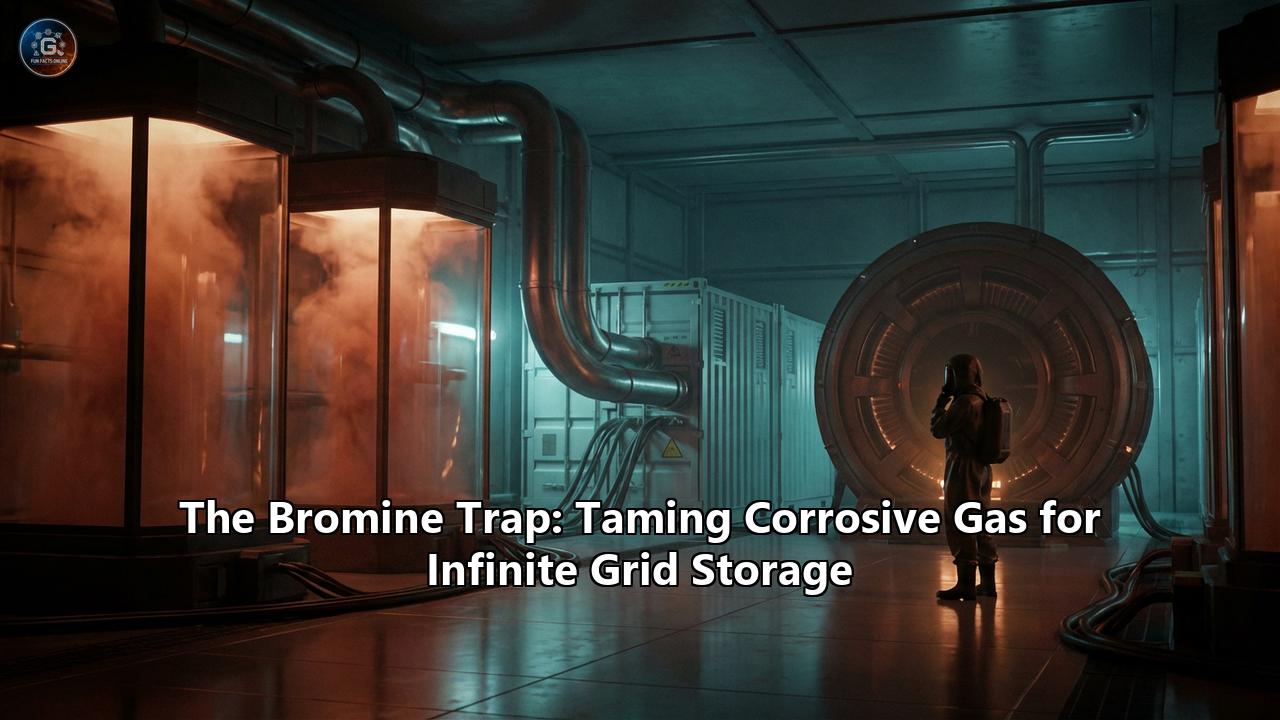
Enter the Hydrogen-Bromine (H2-Br2) flow battery. It promises the holy grail: infinite cycle life, dirt-cheap active materials, and the ability to decouple power from energy. But for fifty years, this technology has been held back by a single, terrifying flaw. Bromine is a beast. It is a fuming, reddish-brown gas that eats through steel, dissolves plastic, and poisons humans. It is difficult to catch and harder to hold.
This is the story of "The Bromine Trap"—the scientific quest to tame one of the most corrosive elements on the periodic table to unlock infinite grid storage. It is a story that spans from the molecular cages designed in labs at MIT and KAIST to the vast brine pools of the Dead Sea, and to the cutting-edge materials science at institutions like Rice University that are rewriting the rules of what batteries can be.
Part I: The Storage Paradox
To understand why scientists are obsessed with a toxic halogen like bromine, we must first understand the "Storage Paradox."
The modern electrical grid is built on a "just-in-time" delivery model. Electricity must be consumed the exact millisecond it is generated. This was fine when we burned coal or gas, which could be ramped up or down at will. But in a renewable grid, supply is dictated by the weather. To bridge the gap, we need storage.
Lithium-ion batteries store energy in solid electrodes. To double the storage duration, you must double the entire battery—cathode, anode, casing, and all. This makes long-duration storage prohibitively expensive.
Flow batteries are different. They store energy in liquid tanks. The hardware (the stack) determines the power (how fast you can discharge), while the tank size determines the energy (how long you can discharge). To double the duration, you just build a bigger plastic tank and fill it with more fluid. It is the cheapest way to store massive amounts of energy.
But not all fluids are created equal. The leading flow battery technology, Vanadium, relies on a metal that is expensive, volatile in price, and mined in limited locations. We need a chemistry that is dirt cheap and abundant.
We need Hydrogen and Bromine.
The Chemistry of the Future
The H2-Br2 battery is elegant in its simplicity. On one side, you have hydrogen gas, the most abundant element in the universe. On the other, you have bromine, easily extracted from seawater or brine pools.
When the battery discharges, hydrogen gas splits into protons and electrons. The protons cross a membrane, while the electrons travel through the wire to power your house. On the other side, they meet bromine, forming hydrobromic acid (HBr). The reaction is exceptionally fast and reversible. Unlike other batteries that rely on sluggish metal ions shuffling through solids, H2-Br2 kinetics are lightning quick. This means high power density and high efficiency.
But the devil is in the discharge. When you charge the battery back up, you convert that safe HBr acid back into hydrogen and... elemental bromine ($Br_2$).
Elemental bromine is a nightmare. It is a dense, volatile liquid that readily vaporizes into a choking gas. It permeates membranes, ruining the battery's efficiency (a phenomenon called "crossover"). It corrodes standard pumps and seals. If a tank were to rupture, it would release a cloud of toxic gas heavier than air that hugs the ground.
For decades, this "Bromine Trap"—the inability to safely and efficiently contain the active bromine—killed the technology in the cradle.
Part II: The Cage and the Sponge
The breakthrough that revived this technology didn't come from better pumps or stronger steel. It came from supramolecular chemistry: the art of building traps for molecules.
The goal was simple: keep the bromine available for reaction, but stop it from vaporizing or crossing the membrane. Scientists needed a "molecular jail."
The Complexing Agent
The first line of defense, developed in the late 20th century and refined recently, involves "Bromine Complexing Agents" (BCAs). These are typically quaternary ammonium salts—bulky organic molecules that bind to bromine.
Imagine bromine as a hyperactive child. The BCA is a heavy backpack. When bromine forms, it immediately grabs onto the BCA to form a "polybromide" complex (like $QBr_3$ or $QBr_5$). This complex is a heavy, oily liquid that sinks to the bottom of the tank. It doesn't vaporize. It doesn't cross the membrane easily. It stays put until it is needed.
This phase separation was a clever trick, but it introduced new problems. The thick, oily "sludge" was hard to pump and slowed down the reaction. The battery became safe, but sluggish.
The Porous Organic Cage (POC)
This is where the cutting edge of materials science enters the fray. Researchers at institutions like KAIST in South Korea, in collaboration with MIT, began designing "Porous Organic Cages" (POCs).
Think of these not as a backpack, but as a literal cage. These are individual molecules shaped like hollow polyhedrons. They are designed with windows exactly the right size to let a bromine molecule slip inside, but the chemical environment inside creates a strong attraction—a "trap."
In a landmark study, researchers synthesized nitrogen-rich cages that could capture bromine vapor with terrifying efficiency. The interaction was so specific that the bromine would essentially "hibernate" inside the cage, stabilizing the volatile gas into a manageable solid or liquid form even at room temperature.
This "Bromine Trap" technology allows the battery to operate with almost zero free bromine vapor. It eliminates the corrosion risk and the safety hazard, while keeping the bromine chemically active enough to deliver high power when called upon.
The Rice University Connection: The Carbon Revolution
While KAIST and MIT were building cages, Rice University in Houston, Texas, was revolutionizing the materials that house these reactions. Under the leadership of visionaries like Professor James Tour and Haotian Wang, Rice became the epicenter of "Flash Joule Heating" and advanced porous carbons.
Batteries are not just chemistry; they are architecture. You need a scaffold to hold these reactions. Rice researchers developed methods to turn ordinary materials—asphalt, plastic waste, even banana peels—into high-value porous graphene and carbon scaffolds.
For a bromine battery, the electrode surface is critical. It must be conductive, cheap, and porous enough to host the bromine/polybromide reaction without getting clogged. The "Flash Joule" technique allows for the creation of turbostratic graphene with immense surface area in milliseconds.
Furthermore, Rice’s recent work on lithium extraction membranes creates a symbiotic relationship with the bromine story. Bromine is often a byproduct of lithium mining from brine. The same brine pools in Arkansas or the Salton Sea that Rice’s membranes are filtering for lithium are rich in bromide. The waste product of the lithium revolution is the fuel for the bromine revolution.
III. The Two-Electron Miracle
Solving the safety issue was step one. Step two was making the battery a titan of energy density.
In a traditional H2-Br2 battery, for every bromine atom you use, you transfer one electron. It’s a 1:1 ratio.
$$2Br^- \rightarrow Br_2 + 2e^-$$
But in 2024 and 2025, researchers at the Dalian Institute of Chemical Physics (DICP) unveiled a mind-bending innovation. They didn't just trap the bromine; they changed how it reacts.
By introducing specific amine compounds that act as both a trap and a participant, they unlocked a two-electron transfer process. Instead of stopping at elemental bromine ($Br_2$), the reaction could proceed further to form brominated amine compounds.
This effectively doubled the capacity of the battery without increasing the tank size. It was like downloading a software update to your car and suddenly having a gas tank twice as big.
This "High-Energy Bromine Trap" did two things:
- Ultra-low Corrosion: The concentration of free bromine dropped to almost zero (7 millimolar). You could essentially stick your hand in the tank (though we don't recommend it) without immediate chemical burns. This meant cheaper membranes and plastic pipes could be used.
- Massive Energy Density: The battery could now store enough energy to rival lithium-ion in footprint, but at a fraction of the cost.
IV. The Geopolitical Trap
Science had tamed the gas. But it couldn't tame the world.
Just as the technology was maturing, a new trap emerged. Not molecular, but geopolitical.
Bromine is abundant, yes. It is in every gallon of seawater. But extracting it from the open ocean is energy-intensive. The economic supply comes from high-concentration brine pools. The world’s primary source is the Dead Sea, shared by Israel and Jordan. The second is the Smackover Formation in Arkansas, USA.
In 2024 and 2025, as global tensions rose, the supply chain for critical minerals began to fracture. The reliability of shipments from the Middle East came into question. The price of bromine, usually stable, began to flicker.
The Elestor Pivot
Elestor, a Dutch company and the undisputed commercial leader in H2-Br2 batteries, dropped a bombshell in 2025. After years of piloting successful bromine systems, they announced a pivot to Hydrogen-Iron flow batteries.
Their CEO, Hylke van Bennekom, was blunt: "Geopolitical turbulence."
The risk wasn't that the battery didn't work. It worked beautifully. The risk was that building a global grid storage infrastructure on a chemical sourced from a potential conflict zone was repeating the mistakes of the oil era.
This creates a fascinating schism in the future of the "Bromine Trap."
- Path A: The Iron Age. Companies like Elestor move to iron, which is everywhere. It is heavier and has lower voltage than bromine, but it is geopolitically boring. "Boring" is a feature, not a bug, for grid security.
- Path B: The Domestic Bromine Boom. In the United States, the "Bromine Trap" is becoming a gold rush. The Smackover Formation in Arkansas is already being tapped for lithium (using technologies like those from Rice). The bromine byproduct is massive. For the US market, H2-Br2 remains a prime contender because the source is domestic and secure.
V. The Infinite Grid
So, where does this leave us?
The "Bromine Trap" has evolved from a technical failure mode into a sophisticated technological triumph. We have the cages, the complexing agents, and the carbon scaffolds to handle this corrosive beast safely.
We are standing on the precipice of the Long Duration Energy Storage (LDES) era. The grid of the 2030s will require batteries that can discharge for 100 hours straight to survive a winter storm or a cloudy week. Lithium cannot do this. Hydrogen-Bromine (and its cousin Hydrogen-Iron) can.
Imagine a facility in the Texas panhandle. It looks like a small chemical plant. Rows of large tanks hold the electrolyte. When the West Texas wind howls at night and electricity prices turn negative, this plant sucks in gigawatts of power, splitting HBr into hydrogen and trapping bromine in porous cages.
Three days later, the wind dies. The sun is blocked by clouds. The grid is starving. The plant reverses flow. The hydrogen recombines with the trapped bromine. Gigawatts of power flow back into the grid, hour after hour, day after day. The bromine never leaves the loop. It is never consumed. It is a closed cycle of infinite rechargeability.
The "Bromine Trap" is no longer a cage for a dangerous gas. It is a vault for sunlight and wind, holding them safe until we need them most.
The Verdict
The race is now between the chemistry of perfection (Bromine: high voltage, fast kinetics, but toxic/geopolitically complex) and the chemistry of pragmatism (Iron: lower performance, but safe and ubiquitous).
Thanks to the work at Rice, KAIST, MIT, and DICP, the technical barriers for bromine are gone. The trap works. Now, the market must decide if it is brave enough to open the cage.
Key Takeaways
- The Problem: Grid storage needs to be cheap and long-lasting. Lithium-ion is too expensive for long durations.
- The Contender: Hydrogen-Bromine flow batteries offer low cost and fast kinetics but suffer from the toxicity and corrosivity of bromine gas ($Br_2$).
- The "Trap": Innovations in Porous Organic Cages (POCs) and Complexing Agents now allow us to chemically "cage" bromine, preventing leaks and corrosion while keeping it active.
- The Breakthrough: New "two-electron transfer" chemistry has doubled the energy density, making these batteries smaller and more powerful.
- The Twist: Geopolitical risks regarding bromine supply (Dead Sea instability) have caused some European manufacturers to pivot to Iron, while the US looks to domestic brine sources.
- The Future: H2-Br2 remains one of the most promising technologies for infinite, grid-scale storage, provided supply chains can be secured.
Reference:
- https://www.marketreportanalytics.com/reports/hydrogen-bromine-flow-battery-235709
- https://www.ess-news.com/2025/05/07/geopolitical-clouds-prompt-switch-from-bromine-to-iron-flow-batteries-at-european-manufacturer/
- https://www.miragenews.com/new-high-energy-bromine-flow-battery-system-1593944/
- https://www.innovationnewsnetwork.com/permissibility-key-to-elestors-switch-to-hydrogen-iron-flow-battery/58508/