
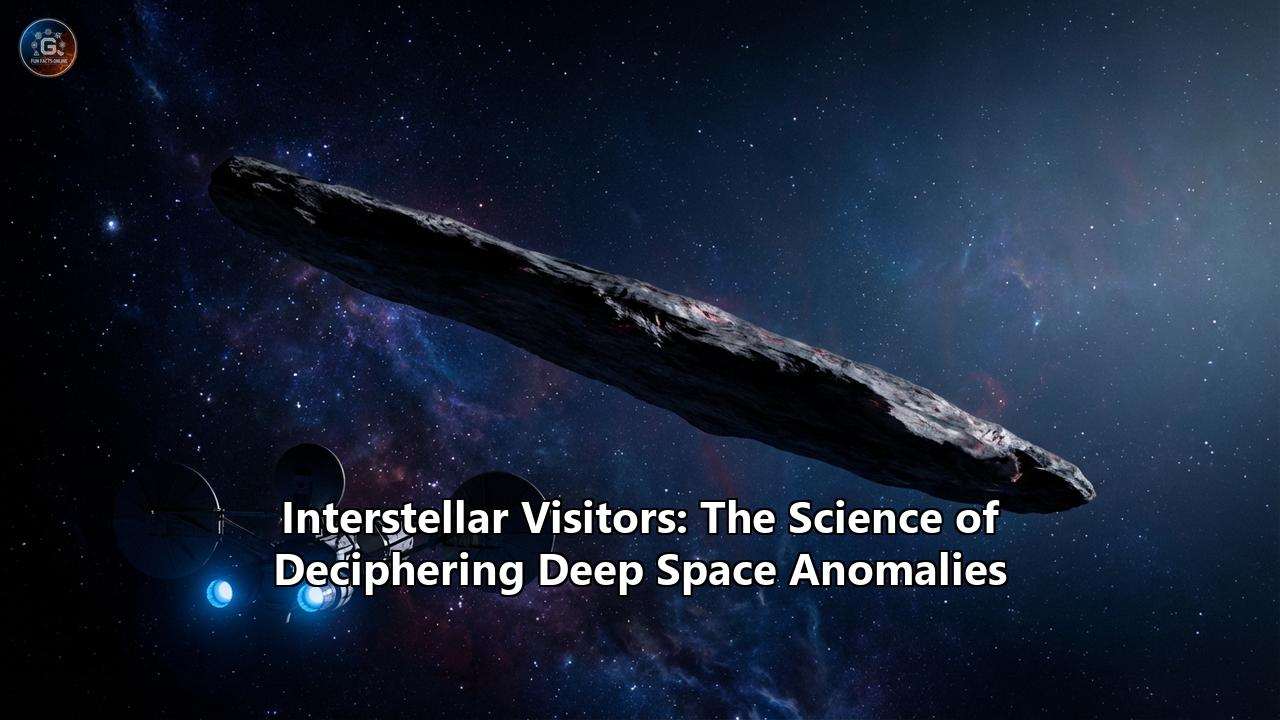
For millennia, humanity viewed our solar system as a closed ecosystem, an isolated island floating in the vast, empty ocean of the Milky Way. We believed that the planets, asteroids, and comets bound to our Sun were the only cast of characters in our local cosmic drama. But on a quiet night in October 2017, the celestial rules were rewritten. A phantom slipped through our cosmic backyard—an object moving so fast, and on such a strange trajectory, that astronomers quickly realized it could not be from around here. It was a piece of interstellar shrapnel, a wanderer from another star system.
Since that momentous discovery, the science of deep space anomalies has exploded into one of the most fiercely debated, heavily funded, and profoundly fascinating fields in modern astrophysics. We are no longer just looking at our own celestial neighborhood; we are intercepting packages from the deepest reaches of the galaxy. In recent years, our early warning systems and deep-space observatories have confirmed that our solar system is not a walled garden, but rather a bustling galactic highway.
From the cigar-shaped enigma of 1I/’Oumuamua to the ancient, geometry-defying comet 3I/ATLAS discovered in 2025, these interstellar visitors (ISOs) are literal fragments of alien solar systems dropped at our doorstep. They bring with them the chemical blueprints of distant exoplanets, ancient histories that predate the Earth, and, occasionally, uncomfortable questions that challenge our understanding of what is natural and what could potentially be engineered.
This is the comprehensive story of the science, the controversies, the upcoming billion-dollar missions, and the profound existential implications of deciphering deep space anomalies.
The Physics of an Intruder: How We Know They Aren't Ours
Before delving into the specific visitors that have graced our skies, it is essential to understand the mechanics of how astronomers instantly recognize an object as "alien." The secret lies in a single, stubborn mathematical value: orbital eccentricity.
In orbital mechanics, eccentricity determines the shape of an object's path around the Sun. An eccentricity of zero is a perfect circle. An eccentricity between zero and one is an ellipse—the shape of the orbits of all the planets, asteroids, and periodic comets in our solar system. If an object has an eccentricity of exactly one, its path is a parabola; it has just enough energy to escape the Sun's gravity, but no more.
But when an object arrives with an eccentricity greater than one, alarm bells ring in observatories around the world. An eccentricity greater than 1.0 denotes a hyperbolic trajectory. It means the object possesses too much kinetic energy to be captured by the Sun's gravitational pull. It is moving too fast. It falls toward the Sun, swings around it in a gravitational slingshot, and is flung back out into the interstellar void, never to return.
Furthermore, these objects often come from entirely wrong directions. Most native objects in our solar system orbit within the ecliptic—a relatively flat disk extending outward from the Sun's equator. Interstellar objects, however, often plunge into our system at steep, chaotic angles, slicing through the ecliptic plane like a needle passing through a piece of fabric.
By analyzing the incoming velocity, the hyperbolic trajectory, and the angle of approach, scientists can rewind the clock, tracing the object's path back into the interstellar medium to determine roughly where in the galaxy it originated.
The First Scout: 1I/’Oumuamua
On October 19, 2017, the Pan-STARRS1 telescope in Hawaii detected a faint point of light moving rapidly against the background stars. Initially assumed to be a standard asteroid or a comet, follow-up observations quickly revealed an eccentricity of 1.20. It was the first confirmed interstellar object, officially designated 1I/’Oumuamua—a Hawaiian name roughly translating to "a messenger from afar arriving first".
’Oumuamua was a profoundly confusing object. First, there was its shape. By measuring the way sunlight reflected off it as it tumbled through space, astronomers deduced that it was highly elongated. Some models suggested it was shaped like a cigar—perhaps ten times as long as it was wide, extending roughly 400 meters—while other models interpreted the light curve as a flat, pancake-like disc. Neither shape is common among the asteroids or comets in our solar system.
But the most baffling anomaly was its movement. As ’Oumuamua sped away from the Sun, it accelerated. Comets natively exhibit "non-gravitational acceleration" due to outgassing; as the Sun heats their icy surfaces, they vent gas and dust, acting like tiny thrusters that push the comet along. However, ’Oumuamua showed absolutely no signs of a cometary coma or dust tail. Deep observations by the Spitzer Space Telescope found no traces of carbon-based gases or water vapor.
If it wasn't outgassing, what was pushing it?
The scientific community scrambled for natural explanations. Some theorized it was a loosely bound aggregate of dust—a "fractal" object 10,000 times more porous than aerogel. Others suggested it was a shard of pure hydrogen ice or a chunk of nitrogen ice chipped off an exo-Pluto, which would allow it to outgas invisibly.
And then came the extraterrestrial hypothesis. Dr. Avi Loeb, the former chair of Harvard’s astronomy department, proposed that ’Oumuamua’s flat shape and anomalous acceleration could be perfectly explained if the object was a lightsail—an artificial, millimeter-thin sheet of highly reflective material designed by an alien civilization to harness the radiation pressure of starlight for propulsion. While the vast majority of the scientific community heavily disputed this, favoring natural—albeit highly exotic—explanations, Loeb’s hypothesis ignited a global conversation about our readiness to identify extraterrestrial technosignatures.
’Oumuamua is now far beyond the orbit of Neptune, racing toward the constellation Pegasus. It is too faint to be seen by any telescope on Earth, taking its ultimate secrets with it into the dark.
The Familiar Stranger: 2I/Borisov
If ’Oumuamua was a bizarre, geometry-defying ghost, the second interstellar visitor offered a comforting sense of familiarity. On August 29, 2019, Gennadiy Borisov, a Crimean amateur astronomer using a self-built 0.65-meter telescope, spotted a fuzzy dot moving through the pre-dawn sky.
Given the designation 2I/Borisov, this object left no room for doubt: it was a comet. It possessed a glowing coma and a distinct tail, and it arrived on a highly hyperbolic trajectory with an eccentricity of 3.3—the most extreme ever recorded.
Because it behaved like a traditional comet, astronomers could use spectroscopy to analyze the light passing through its glowing gas cloud, allowing them to determine its chemical makeup. What they found was both familiar and distinctly alien. 2I/Borisov contained water vapor, diatomic carbon, and oxygen, much like the comets in our own Oort cloud. However, it possessed an unusually high concentration of carbon monoxide (CO).
Carbon monoxide is highly volatile and freezes only at incredibly low temperatures. The abundance of CO suggested that 2I/Borisov formed in the frigid outer reaches of a distant star system, perhaps one centered around a cool red dwarf, before being violently ejected into interstellar space by a gravitational interaction with a giant exoplanet.
The discovery of 2I/Borisov was a monumental relief to astronomers. It confirmed that ’Oumuamua was not a fluke. The galaxy was teeming with ejected material, and our solar system was routinely flying through this invisible cosmic rain.
The Ancient One: 3I/ATLAS and the 2025 Culture War
For six years, the skies remained relatively quiet on the interstellar front. But that changed dramatically in the summer of 2025.
On July 1, 2025, the Asteroid Terrestrial-impact Last Alert System (ATLAS) in Río Hurtado, Chile, flagged an object moving inbound from the direction of the constellation Sagittarius. Originally dubbed A11pl3Z and quickly officially confirmed as 3I/ATLAS (C/2025 N1), this object shattered previous records and expectations.
Traveling at a blistering 37 miles per second (60 km/s) relative to the Sun, 3I/ATLAS arrived on a steep trajectory. But it was the tracing of this trajectory that dropped jaws across the astronomical community. Most stars in the Milky Way, including our Sun, orbit within the "thin disk" of the galaxy. 3I/ATLAS, however, was plunging in from the Milky Way's "thick disk"—a diffuse population of ancient stars orbiting far above and below the galactic plane.
Because objects in the thick disk are relics of the early galaxy, astronomers calculated that 3I/ATLAS could be over 7 billion years old. It is not just an interstellar visitor; it is a time capsule from the universe's deep past, predating the formation of our own Earth and Sun by billions of years. It is, statistically, the oldest comet humanity has ever observed.
As 3I/ATLAS approached, it displayed tentative signs of cometary activity, generating a marginal coma and a short tail. But as it grew closer, the data became increasingly strange. Astronomers detected an immense X-ray glow emanating from the comet, extending 250,000 miles into space.
Then came the visual anomalies. Captured by the Hubble Space Telescope and the passing JUICE Jupiter probe, high-resolution imagery of the comet’s nucleus revealed bizarre, unsettling structures. Some frames showed parallel grooves running alongside each other like machined tracks, interspersed with raised, near-regular "studs" that cast sharp shadows.
The internet exploded. The images immediately became a lightning rod for the extraterrestrial hypothesis. Proponents of the artificiality theory argued that the geometric patterns were evidence of alien engineering—perhaps a derelict probe or a piece of ancient megastructure. Avi Loeb’s previous theories regarding ’Oumuamua were continuously cited by the public as justification for viewing 3I/ATLAS as a manufactured object.
Mainstream scientists, however, quickly provided natural, albeit complex, explanations. In the vacuum of space, under microgravity, directional sunlight can cause exotic ices to sublimate (turn directly from solid to gas) in highly specific ways. Fracturing along internal crystal planes can produce sheer cliffs, straight ridges, and pits that appear unnervingly geometric in 2D photographs. Despite the online outrage cycle and the subsequent culture war between "believers" and "defenders of orthodoxy," space agencies maintained that 3I/ATLAS was a natural, highly eroded, 7-billion-year-old chunk of galactic ice.
Dredging the Ocean: IM1 and the Galileo Project
While telescopes scan the skies for massive interstellar objects, other scientists believe that interstellar visitors have already touched down on Earth.
In 2014, a meteor designated IM1 burned through the atmosphere and crashed into the Pacific Ocean off the coast of Papua New Guinea. Decades later, data declassified by the U.S. Space Command confirmed that the meteor's entry velocity and trajectory indicated an interstellar origin—predating ’Oumuamua by three years.
Furthermore, data from government sensors indicated that IM1 exhibited the highest material strength of any meteorite in the NASA CNEOS catalog. It didn't explode high in the atmosphere like a typical stony or iron asteroid; it survived deep into the lower atmosphere before detonating, suggesting an anomalously tough composition.
Driven by the possibility that IM1 could be a piece of extraterrestrial technology or a rare interstellar alloy, Dr. Avi Loeb and his Galileo Project organized a marine expedition. In June 2023, the team dragged a magnetic sled across the ocean floor at the calculated impact site.
Astoundingly, they recovered 850 microscopic, metallic spherules. Analysis revealed that a tenth of these submillimeter droplets possessed a unique chemical signature never before seen in solar system materials. They were incredibly rich in Beryllium, Lanthanum, and Uranium—a composition now known as "BeLaU".
The Galileo Project posits that these spherules are the melted remnants of the interstellar meteor. The scientific community remains divided; some geochemists argue the spherules could be the result of terrestrial volcanic activity or industrial run-off. Yet, the Galileo Project continues to build custom observatories equipped with infrared, optical, radio, and audio sensors, heavily relying on artificial intelligence to sift through millions of near-Earth objects to find the next anomalous outlier.
The Science of Detection: Upgrading Our Eyes
Why did we only find our first interstellar object in 2017? Were they avoiding us?
The answer is a matter of mathematics and technology. It is estimated that there are over 10 septillion (a 10 followed by 24 zeros) interstellar objects drifting through the Milky Way. At any given moment, there are likely thousands of small ISOs within the orbit of Neptune.
However, space is unfathomably large, and these objects are incredibly dark, fast, and relatively small. Telescopes must point at exactly the right patch of sky, at exactly the right time, to catch a faint reflection of sunlight moving against the star field. Historically, our telescopes simply did not have the wide-field vision combined with the rapid imaging capability to catch them.
That changed with the advent of automated sky surveys like Pan-STARRS and ATLAS, which map large swaths of the sky multiple times a week. But the true revolution is looming just over the horizon.
High in the Chilean Andes, the Vera C. Rubin Observatory is preparing to power on. Its primary feature is the Legacy Survey of Space and Time (LSST), an astronomical undertaking of unprecedented scale. Equipped with an 8.4-meter primary mirror and the largest digital camera ever constructed (3.2 gigapixels), the Rubin Observatory will image the entire visible southern sky every few nights, beginning around 2025/2026.
The observatory's light-gathering power will allow it to see much fainter, much more distant objects. Astronomers anticipate that the Rubin Observatory will discover a staggering number of interstellar visitors. Estimates range from 1 to 2 new ISOs per year, up to as many as 50 over the observatory's first decade of operation.
This influx of data will transition the study of interstellar objects from a novelty to a robust statistical science. We will be able to map the chemical diversity of exoplanetary systems across the galaxy without ever leaving Earth.
Chasing the Ghosts: The Ultimate Interception
Observing these objects through telescopes is invaluable, but the holy grail of interstellar astronomy is up-close exploration. We want to touch them. We want to fly a spacecraft through an interstellar comet's tail and sniff the alien gas.
But intercepting an ISO is a nightmare of orbital mechanics. Because we cannot predict when or from where an ISO will arrive, we only spot them when they are already deep within the solar system, moving at terrifying speeds. By the time engineers could design, build, and launch a bespoke spacecraft, the object would be gone.
To solve this, the European Space Agency (ESA), in collaboration with the Japanese Space Agency (JAXA), has devised a brilliant and audacious plan: the "ambush" strategy.
Approved for launch in 2029, the Comet Interceptor mission represents a radical departure from traditional space exploration. The F-class (Fast) mission consists of a mothership and two smaller probe satellites. It will launch as a co-passenger alongside the Ariel exoplanet telescope.
Once in space, Comet Interceptor will not head toward a specific target. Instead, it will travel to Lagrange Point 2 (L2), a gravitationally stable zone 1.5 million kilometers behind Earth. There, shielded from the Sun's glare, it will simply park. And wait.
It is a "lurking" probe. It will idle in the cold of space for up to three years, waiting for the ground-based Vera Rubin Observatory to flag a suitable target. The primary goal is to intercept a pristine, long-period comet entering the inner solar system from the Oort cloud for the very first time. But if the stars align and an interstellar object is detected on an accessible trajectory, Comet Interceptor will fire its engines and give chase.
Upon nearing the target, the spacecraft will split into three separate modules. These modules will perform a high-speed, multi-point flyby, surrounding the object to capture a comprehensive 3D profile of its nucleus, dust, gas, and plasma environment.
However, catching an ISO requires immense amounts of energy. The metric for spacecraft maneuverability is "Delta-V" (change in velocity). A study analyzing hypothetical missions to catch the recent 3I/ATLAS comet showed that a launch from Earth would require an initial Delta-V of 24 kilometers per second just to match its path—an incredibly difficult feat for current propulsion technology. Flyby speeds could easily exceed 60 kilometers per second. For context, NASA's New Horizons probe flew past Pluto at a mere 14 kilometers per second. Capturing images and data while screaming past a tumbling alien rock at 60 km/s will push autonomous AI targeting systems to their absolute limits.
Other ambitious proposals exist, such as Project Lyra, which explored the theoretical feasibility of sending a hyper-fast probe to catch up to the fleeing ’Oumuamua, though the technical challenges of reaching an object already beyond Neptune are staggering. Another concept, proposed in a JPL Planetary Science Summer Seminar, suggests using a hard kinetic impactor—essentially firing a bullet into the ISO as the probe flies past, excavating fresh, unweathered exoplanetary material from beneath the surface for spectroscopic analysis.
The Cosmic Shrapnel: What Do They Teach Us?
Why dedicate billions of dollars and decades of careers to chasing down what amounts to cosmic debris? Because interstellar objects are the missing puzzle pieces to the grand narrative of the universe.
For decades, we have used the Kepler and James Webb space telescopes to look at exoplanets. But those observations rely on measuring shadows and light dips. Interstellar objects represent the first known macroscopic samples of exoplanetary material available in our neighborhood.
They are the byproducts of cosmic violence. When a new star system forms, it is a chaotic billiard table of colliding protoplanets and migrating gas giants. Giant planets like Jupiter act as gravitational bulldozers, violently ejecting trillions of icy comets and rocky planetesimals out of their native systems and into the interstellar void.
By studying these nomads, we learn about the chemical factories of alien stars. If we find an ISO loaded with water ice and organic molecules, it strengthens the theory of "Panspermia"—the idea that the building blocks of life (or perhaps even dormant microbial life itself) can be distributed across the galaxy via comet impacts. It forces us to ask: did the water in Earth's oceans, and the carbon in our DNA, originate in our own solar system, or was it delivered billions of years ago by an ancient interloper like 3I/ATLAS?
The Extraterrestrial Hypothesis: A Mirror for Humanity
Inevitably, the study of deep space anomalies forces us to confront the deepest, most unsettling question of all: Are we alone?
Every time an interstellar object behaves strangely—whether it's ’Oumuamua's non-gravitational acceleration or 3I/ATLAS's geometric surface anomalies—a portion of the public, and a brave fraction of the scientific community, points toward artificiality.
Mainstream astronomy relies on a strict application of Occam's Razor. The fundamental methodology is to rule out the wild, artificial explanations first. Scientists relentlessly test the brightness curves, outgassing behaviors, and non-gravitational accelerations, assuming natural cosmic mechanisms. It is a rigorous defense against cosmic overreaction. They assume nature first, and test until the data breaks their assumptions.
But as we discover more of these objects, the "alien technology" hypothesis refuses to die. Projects like Galileo seek to pull the search for extraterrestrial technological artifacts out of the realm of fringe internet forums and into transparent, systematic, mainstream scientific research. They argue that dismissing anomalies out of hand is as unscientific as blindly accepting them. If we were to find a defunct alien probe drifting dead through our solar system, it wouldn't broadcast a radio signal; it would look exactly like a dark, highly eroded, oddly shaped rock.
The debate over these deep space anomalies reveals as much about human psychology as it does about astrophysics. When we look at the cold, indifferent, jagged shapes of a 7-billion-year-old comet, we desperately search for meaning. We look for the hand of a creator, even if that creator is a distant, technologically advanced civilization.
A New Era of Interstellar Astronomy
The era of the closed solar system is officially over. We are sitting on the edge of a galactic highway, and the traffic is heavy.
As we move toward the late 2020s and into the 2030s, the Vera Rubin Observatory will light up the dark, revealing dozens, perhaps hundreds, of deep space anomalies streaking through our skies. In orbit, the Comet Interceptor will silently wait at L2, a robotic predator ready to pounce on an alien rock. Back on Earth, scientists will continue to sift through ocean floor mud and telescope data, looking for the tiny inconsistencies that might crack the universe wide open.
Whether these interstellar visitors turn out to be nothing more than exotic ice and ancient rock, or whether one of them eventually proves to be a package from a distant neighbor, their presence fundamentally alters our perspective. We are no longer isolated. The galaxy is touching us. And for the first time in human history, we have the tools, the technology, and the audacity to reach back.
Reference:
- https://www.livescience.com/space/comets/nasa-confirms-that-mysterious-object-shooting-through-the-solar-system-is-an-interstellar-visitor-and-it-has-a-new-name
- https://www.charlesyoungcentre.org.uk/24-166071-uncomfortable-doubts-about-what-is-really-passing-through-our-solar-system-raised-by-comet-3i-atlas-interstellar-object/
- https://beaconwales.org/22-164012-unsettling-new-close-ups-of-interstellar-comet-3i-atlas-expose-bizarre-structures-that-some-call-evidence-of-alien-engineering-while-others-denounce-as-hysterical-pseudoscience/
- https://www.theguardian.com/science/2025/jul/03/nasa-interstellar-comet-solar-system-a11pl3z-3i-atlas
- https://www.rand.org/pubs/commentary/2025/04/mysterious-objects-from-other-stars-are-passing-through.html
- https://knowablemagazine.org/content/article/physical-world/2024/detect-interstellar-objects-oumuamua-borisov-clues-to-exoplanets
- https://avi-loeb.medium.com/join-the-search-for-unidentified-anomalous-phenomena-within-the-galileo-project-273add935ca9
- https://www.skeptic.com/article/interstellar-interlopers-anomalous-natural-objects-or-extraterrestrial-technologies/
- https://nasa-techshowcase.seti.org/wp-content/uploads/2022/10/Interstellar-Object-Interceptor-.pdf
- https://ras.ac.uk/news-and-press/research-highlights/newly-discovered-interstellar-object-may-be-oldest-comet-ever
- https://www.space.com/esa-comet-interceptor-mission-2029-launch
- https://www.cometinterceptor.space/
- https://www.esa.int/Science_Exploration/Space_Science/Comet_Interceptor/ESA_s_new_mission_to_intercept_a_comet
- https://www.universetoday.com/articles/could-we-launch-a-mission-to-chase-down-interstellar-comet-3iatlas