
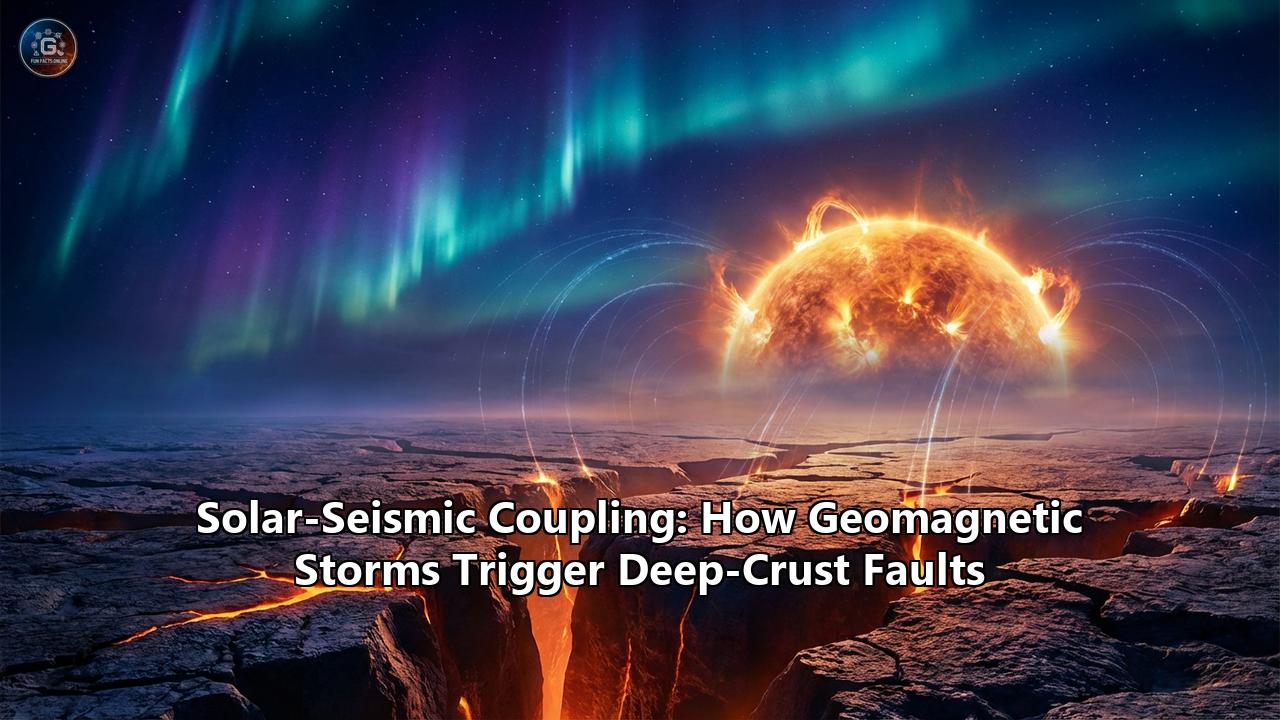
For centuries, science has neatly divided the natural world into distinct, manageable disciplines. Astronomers looked up to study the fiery mechanics of the stars, while geologists looked down to understand the slow, grinding tectonic engine of the Earth. The heavens and the deep earth were treated as isolated realms, separated by miles of atmosphere and an assumption that events in space had little to do with the solid ground beneath our feet.
But what if the Earth is not a closed geological system? What if the intense, invisible storms raging on the surface of the Sun can reach down through the vacuum of space, pierce our magnetic shield, and act as the final trigger for catastrophic earthquakes deep within the planet's crust?
Welcome to the emerging, fiercely debated, and deeply fascinating science of Solar-Seismic Coupling.
In recent years, a wave of groundbreaking data and new theoretical models has begun to challenge the orthodox view of seismology. Scientists are uncovering compelling evidence that space weather—specifically solar flares, coronal mass ejections (CMEs), and geomagnetic storms—interacts with the Earth’s subterranean environment in profound ways. By generating massive underground electrical currents, altering the electrostatic balance of deep-crust faults, and even physically deforming underground quartz crystals, the Sun may be playing a subtle but decisive role in the timing of our planet's most devastating tremors.
This is the story of how space weather whispers to the deep earth, and how the invisible forces of the cosmos might hold the key to the holy grail of geophysics: predicting earthquakes before they strike.
The Cosmic Engine: Space Weather and the Earth’s Shield
To understand how a star 93 million miles away can fracture solid rock, we first have to understand the sheer scale of the energy being thrown at us.
The Sun is a hyperactive sphere of superheated plasma, constantly governed by twisting, snapping magnetic fields. When these magnetic fields tangle and break, they release monumental amounts of energy in the form of solar flares. Often accompanying these flares are Coronal Mass Ejections (CMEs)—billion-ton clouds of magnetized plasma hurled into the solar system at millions of miles per hour.
When one of these CMEs is aimed at Earth, it doesn't crash into the ground. Instead, it slams into the magnetosphere, the invisible magnetic bubble generated by Earth's spinning iron core. This collision sparks a geomagnetic storm. To the naked eye, the most obvious symptom of a geomagnetic storm is the aurora borealis, or Northern Lights—a beautiful, shimmering display of atmospheric gases energized by solar particles.
But beneath the beauty, a violent electromagnetic disturbance is taking place. As the Earth's magnetic field is battered and compressed by the solar wind, it sets off a chain reaction that filters down through the atmosphere, into the oceans, and straight into the rocky crust of the planet.
The Electric Earth: Telluric Currents and Lorentz Forces
We rarely think of the ground we walk on as being electrically charged, but the Earth's crust is humming with power.
When a geomagnetic storm distorts the Earth's magnetic field, the basic laws of electromagnetism dictate that this changing magnetic field will induce an electrical current in any nearby conductor. The Earth's crust, filled with groundwater, metallic ores, and salty oceans, is an excellent conductor. As a result, geomagnetic storms trigger massive, invisible rivers of electricity known as telluric currents that flow through the crust and mantle.
These currents are not localized; they traverse vast areas near the Earth's surface, constantly flowing to attain equilibrium between regions of differing electric potentials. During a severe geomagnetic storm, the strength of these telluric currents can spike dramatically.
This is where the first mechanism of solar-seismic coupling comes into play: Lorentz forces. When massive telluric currents flow through the Earth's conductive lithosphere in the presence of the Earth's main magnetic field, they generate Lorentz forces—actual, physical mechanical forces that act upon the rock layers. While tectonic plates are primarily driven by the slow convection of magma in the mantle, the sudden introduction of Lorentz forces from a solar storm can superimpose an additional, rapid stress field onto the tectonic plates. For a fault line that is already snagged, locked, and loaded with centuries of tension, this sudden electromagnetic shove might be all it takes to snap.
The Quartz Conundrum: The Reverse Piezoelectric Effect
The idea that electromagnetic forces could trigger earthquakes took a massive leap forward following a landmark 2020 study utilizing two decades of data from the NASA-ESA Solar and Heliospheric Observatory (SOHO) satellite.
For years, scientists had observed bizarre electromagnetic anomalies prior to major earthquakes, such as mysterious "earthquake lightning" or spikes in radio waves. The traditional geological explanation was the piezoelectric effect. Quartz is one of the most abundant minerals in the Earth's continental crust and is heavily concentrated in fault zones. When quartz crystals are subjected to immense physical pressure—such as the grinding of two tectonic plates—they generate an electrical charge. Thus, geologists believed that the electromagnetic anomalies were simply a byproduct of the rocks being squeezed right before an earthquake.
The 2020 SOHO researchers, however, combed through a global catalog of strong earthquakes and compared it to solar proton fluxes. They found a startling correlation: when positively charged protons streaming from the Sun peaked, there was a significant spike in massive earthquakes (magnitude 5.6 and above) occurring globally over the next 24 hours.
To explain this, the researchers flipped the traditional cause-and-effect model on its head. What if the electrical anomalies weren't the result of the earthquake, but the cause?
They proposed a mechanism known as the Reverse Piezoelectric Effect. Just as squeezing quartz generates an electrical pulse, applying an electrical pulse to quartz causes it to physically deform, expand, and vibrate. When a geomagnetic storm sends surging telluric currents through the Earth's crust, these electrical pulses pass through the quartz-rich rock of fault lines. The quartz crystals rapidly deform and jitter, destabilizing the intense friction that is holding the locked tectonic plates together. The rocks slip, the fault ruptures, and the ground shakes.
The Giant Capacitor: The 2026 Kyoto University Breakthrough
While the reverse piezoelectric effect provided a brilliant mechanical explanation, science rarely settles on just one answer. In February 2026, researchers at Kyoto University, led by applied mathematician Ken Umeno, proposed a bold, brand-new model that views the Earth not just as a mechanical system, but as a colossal, planet-wide electrical circuit.
The Kyoto model introduces the concept of Ionospheric-Electrostatic Coupling. Between the vacuum of space and the breathable atmosphere lies the ionosphere, a shell of electrons and electrically charged atoms. When a powerful solar flare erupts, the intense radiation dramatically increases the electron density in the lower ionosphere, pushing charged particles downward.
Deep underground, massive fault zones contain water subjected to such extreme temperatures and pressures that it enters a "supercritical" state. Electrically speaking, these supercritical, fluid-filled fracture zones act like giant capacitors—devices that store electrical energy.
According to Umeno's theoretical model, these underground fault capacitors are electrostatically coupled to the Earth's surface and the lower ionosphere. It is a massive, invisible circuit linking the heavens to the underworld. When a solar storm creates a sudden surge of negative charge in the lower ionosphere, it drastically disrupts the electrostatic balance deep within the crust. The sudden shift in charge applies extra electrostatic pressure directly inside the fragile fracture zones.
"Let me be clear—we are not claiming that solar flares generate tectonic stress," Umeno explained in the wake of the study's release. "Our argument is about timing, not energy. When a fault is already close to failure, even a small perturbation may shift when rupture occurs".
The researchers pointed to devastating recent events, such as the 2024 Noto Peninsula earthquake in Japan, which occurred back-to-back with a period of intense solar flare activity. While they are careful to state this does not definitively prove direct causation in every instance, the model provides a highly viable physical mechanism for how space weather serves as the ultimate cosmic trigger for a fault already on the absolute brink of snapping.
Solar Heat and Fluid Dynamics: The Tsukuba Studies
Electromagnetism isn't the only weapon in the Sun's arsenal. In 2025, another Japanese research team from the University of Tsukuba, led by computer scientist Matheus Henrique Junqueira Saldanha, brought a completely different mechanism to light: Solar Heat Transfer.
Junqueira Saldanha and his team had previously identified a strong mathematical correlation between the number of sunspots (a key indicator of solar activity) and seismic events on Earth. Sunspot activity waxes and wanes on a roughly 11-year cycle, tied to the reversal of the Sun's magnetic field. But the underlying mechanism driving the earthquake correlation remained a mystery.
By applying advanced mathematical modeling to global temperature records and solar data, the Tsukuba team found that the missing link was atmospheric and surface temperature.
"Solar heat drives atmospheric temperature changes, which in turn can affect factors like rock properties and underground water movement," Junqueira Saldanha noted.
This mechanism is less about sudden, violent shocks and more about slow, insidious changes in pressure. Fluctuations in solar heat can alter snowmelt rates, rainfall patterns, and surface water loads. Because water is incredibly heavy, shifting massive amounts of it across the Earth's surface alters the hydrostatic pressure on shallow tectonic plate boundaries. Furthermore, variations in underground water movement can act as a lubricant, making rocks more brittle and prone to fracturing.
When the Tsukuba team factored solar-induced temperature shifts into their computational models, they found that the accuracy of their earthquake forecasts improved significantly—particularly for shallow seismic events originating in the Earth's upper crust. While solar heat transfer may have a relatively small overall impact compared to deep mantle convection, it remains a critical variable in the highly complex equation of seismic triggers.
The Statistical Hunt: Coincidence or Correlation?
Despite these breakthrough theories, Solar-Seismic Coupling remains one of the most hotly debated topics in modern geophysics. Proving that an event 93 million miles away caused a specific earthquake is an incredibly steep hill to climb.
The hunt for a statistical link is actually over a century old. In 1853, a Swiss astronomer named Rudolf Wolf became the first scientist to formally attempt to connect sunspot activity with earthquakes. For decades, the results were frustratingly inconclusive. A major 2013 paper published in Geophysical Review Letters examined 100 years of sunspot and geomagnetic data and concluded there was absolutely no evidence of a connection.
Traditional geological organizations, such as the United States Geological Survey (USGS), have long maintained a stance of skepticism. The USGS explicitly states that "it has never been demonstrated that there is a causal relationship between space weather and earthquakes". Their argument is grounded in the observation that earthquakes are fundamentally driven by interior terrestrial processes and occur at consistent rates regardless of the Sun's 11-year variable cycle. To a classical geophysicist, comparing a solar flare to an earthquake is like comparing apples to bowling balls.
However, as data collection has become exponentially more sophisticated, the statistical anomalies have become impossible to ignore.
Recent studies by researchers like Sobolev (2021) analyzed global earthquakes with a magnitude of 6.5 or higher and compared them against the strongest magnetic storms (where the planetary Kp index exceeded 7). The analysis found that within two days after the onset of these massive geomagnetic storms, strong earthquakes occurred at a rate that mathematically defied random chance, boasting a statistical significance of over 95%. Similarly, researchers analyzing thousands of data points of Kp (geomagnetic) fluctuations found distinct patterns of synchronization between geomagnetic surges and seismicity, noting that during and immediately after magnetic storms, the probability of a strong earthquake essentially doubles.
Critics, such as University of Maryland seismologist Nicholas Schmerr, often argue that highlighting events like the 2023 solar flares and the subsequent Japanese earthquakes is mere coincidence. But proponents of complex systems science push back hard against this dismissal. As Victor Novikov of the Russian Academy of Sciences points out, labeling the relationship as a sheer coincidence assumes that "earthquake systems are dynamically isolated from space weather". In the realm of chaos theory and complex systems, "cross-scale interactions are common near instabilities".
This brings us back to Ken Umeno's crucial caveat: Timing, not energy.
A geomagnetic storm does not pack enough localized energy to crack a pristine, solid tectonic plate. The energy required to do that is almost unfathomable. But that is not what Solar-Seismic Coupling suggests. The theory proposes that tectonic drift does 99.9% of the work over centuries, locking the fault, bending the rock, and building the strain to the absolute breaking point. The fault enters a state of critical instability. At that exact moment, a surge of solar protons hits the Earth, telluric currents flood the crust, the quartz heavily deforms, and electrostatic pressure spikes in the subterranean fluids.
The Sun is the feather that breaks the bedrock.
A New Era of Seismology: Predicting the Unpredictable
If the Solar-Seismic Coupling theories continue to be validated, the implications for human civilization are staggering.
Currently, earthquake "prediction" is essentially a game of historical probability. Seismologists look at geological records, monitor fault strain, study aftershock patterns, and provide broad risk assessments. We know that the San Andreas fault is "due" for a major rupture, but "due" in geological time could mean tomorrow, or it could mean in 150 years. There is currently no widely accepted method to predict the exact day or week an earthquake will strike.
But space weather is entirely observable. We have a fleet of satellites—like SOHO, the Parker Solar Probe, and the Solar Dynamics Observatory—staring at the Sun 24/7. We can see a solar flare erupt. We can track a Coronal Mass Ejection as it hurtles across the solar system, giving us a lead time of 1 to 3 days before it impacts Earth.
If we can definitively map the relationship between incoming geomagnetic storms and the critical stress points of the Earth's crust, we could integrate space weather forecasts into seismic warning systems.
Imagine a future where a weather report doesn't just warn of incoming rain or snow, but issues a "Seismic Watch" based on a recent X-class solar flare. By monitoring real-time ionospheric charge, measuring telluric current surges via global magnetotelluric surveys, and combining that data with underground strain gauges, authorities could evacuate vulnerable cities hours or even days before the ground actually breaks.
As researchers from Kyoto University to the University of Tsukuba scale up their analyses, the boundary between astronomy and geology is dissolving. We are being forced to view the Earth not as a solitary, isolated rock floating in an empty void, but as a deeply connected component of a vast, interactive solar system.
The mechanics of our world are entangled with the mood of our star. The next time you find yourself looking up at the majestic, dancing ribbons of the aurora borealis, take a moment to look down at the ground beneath your feet. The exact same invisible cosmic forces that are lighting up the night sky just might be whispering to the ancient, stressed faults of the deep earth, deciding when it is finally time to let go.
Reference:
- https://www.usgs.gov/faqs/do-solar-flares-or-magnetic-storms-space-weather-cause-earthquakes
- https://www.britannica.com/science/telluric-current
- https://en.wikipedia.org/wiki/Telluric_current
- http://www.ltpaobserverproject.com/uploads/3/0/2/0/3020041/earthquake_activity_controlled_by_the_regular_induced_telluric_currents.pdf
- https://www.astronomy.com/science/powerful-eruptions-on-the-sun-might-trigger-earthquakes/
- https://www.sciencedaily.com/releases/2026/02/260224023209.htm
- https://gizmodo.com/wild-study-proposes-possible-link-between-solar-flares-and-earthquakes-2000724708
- https://www.discovermagazine.com/solar-heat-may-impact-earths-seismic-activity-making-earthquake-predictions-47207
- https://www.sciencealert.com/the-suns-activity-can-trigger-earthquakes-and-now-we-know-how
- https://www.mdpi.com/2073-4433/13/7/1131
- https://www.researchgate.net/publication/356824637_On_the_Correlation_of_Earthquakes_with_Geomagnetic_Storms