
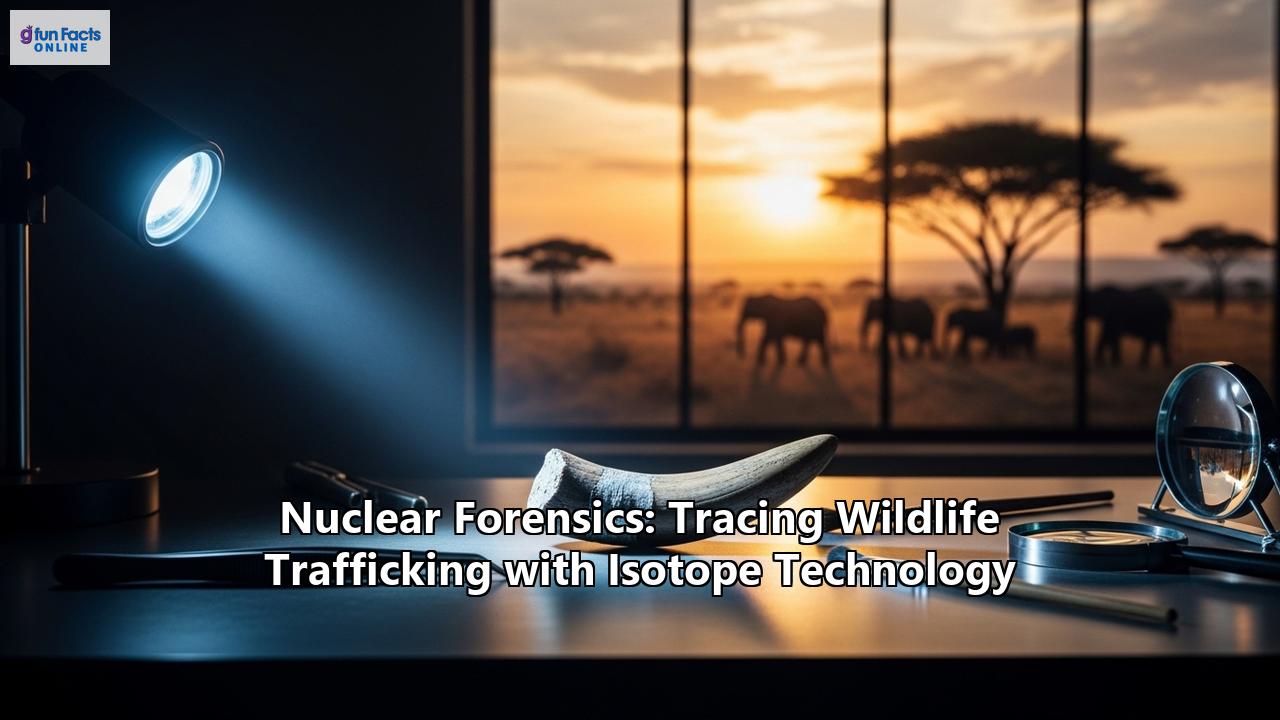
The Unseen Battle: How Nuclear Science is Becoming a Formidable Weapon Against Wildlife Trafficking
The fight against the multi-billion dollar illegal wildlife trade, a dark enterprise that pushes countless species towards extinction and fuels organized crime, has a powerful and unexpected new ally: nuclear science. Far from the realms of power plants and weaponry, a specialized field known as nuclear forensics is providing investigators with an unprecedented ability to trace the origins of trafficked wildlife products, shining a light on the shadowy networks that plunder our planet's biodiversity. This groundbreaking approach, which utilizes the stable and radioactive signatures embedded in animal tissues, is transforming how we combat these devastating environmental crimes.
At the heart of this revolution lies the analysis of isotopes—variants of chemical elements that have the same number of protons but different numbers of neutrons. The adage "you are what you eat" is the fundamental principle at play here. The isotopic composition of an animal's environment, influenced by factors like geology, climate, and diet, is systematically recorded in its body. By carefully measuring these isotopic "fingerprints" in confiscated items like ivory, rhino horn, timber, and pangolin scales, scientists can create a geographical passport, revealing where an animal lived and, in some cases, even what it ate. This information is a game-changer for law enforcement, providing crucial intelligence to dismantle trafficking networks, identify poaching hotspots, and build robust legal cases against perpetrators.
This article delves into the fascinating world of nuclear forensics and its application in the fight to protect our planet's most vulnerable species. We will explore the intricate science behind isotope analysis, examine compelling case studies where this technology has been instrumental, and discuss the challenges and limitations that still need to be overcome. Furthermore, we will shed light on the critical role of international cooperation and the pioneering efforts of organizations like the International Atomic Energy Agency (IAEA) in harnessing the power of the atom for conservation. As we will see, the silent, invisible markers within these trafficked goods are now speaking volumes, offering a new frontier of hope in the global effort to end the illegal wildlife trade.
The Science Behind the Trace: Unlocking Nature's Isotopic Code
To comprehend how a sliver of ivory or a fragment of a rhino horn can betray the secrets of its origin, we must first journey into the realm of atoms and isotopes. Every element on the periodic table exists in various forms known as isotopes. While all isotopes of an element share the same number of protons, they differ in the number of neutrons in their nucleus, which gives them slightly different masses. These isotopes can be broadly categorized into two types: stable isotopes and radioactive isotopes.
Stable Isotopes: Nature's Geographic RecordersStable isotopes, as their name suggests, do not decay over time. The "bio-elements" – hydrogen (H), carbon (C), nitrogen (N), oxygen (O), and sulfur (S) – are the workhorses of this forensic science. The ratios of their heavier and lighter isotopes in the environment are not uniform across the globe. For instance, the isotopic composition of water (and therefore the hydrogen and oxygen within it) varies predictably with geography, latitude, and altitude. This variation is primarily driven by meteorological processes like precipitation patterns.
When an animal drinks this water and consumes plants that have absorbed it, these unique isotopic signatures are incorporated into its tissues, such as bones, teeth, hair, claws, and horns. Similarly, the isotopic ratios of carbon in plants are influenced by the type of photosynthesis they perform, and this signature is passed up the food chain. Nitrogen isotopes, on the other hand, can reveal an animal's trophic level, or its position in the food web.
These naturally occurring isotopic variations create what scientists call "isoscapes"—isotopic landscapes. These are essentially maps that predict the geographic patterns of isotopic ratios. By analyzing the stable isotope ratios in a confiscated wildlife product and comparing them to these isoscape maps, scientists can pinpoint the likely geographic origin of the animal.
Radioactive Isotopes: A Ticking Clock and a Blaring AlarmRadioactive isotopes, or radioisotopes, are unstable and decay over time, emitting radiation in the process. While some naturally occurring radioisotopes can be used for dating purposes, a more recent and innovative application in wildlife forensics involves the deliberate introduction of radioisotopes into wildlife products to deter trafficking.
The most prominent example of this is the Rhisotope Project, a pioneering initiative in South Africa aimed at protecting rhinoceroses from poaching. In this project, a small, harmless amount of a specific radioisotope is inserted into a rhino's horn. This does not harm the animal but serves two crucial purposes. Firstly, it devalues the horn in the eyes of consumers, who would be understandably wary of a product that is radioactive. Secondly, and perhaps more importantly, it makes the horns easily detectable by the thousands of radiation monitors already installed at international borders, ports, and airports to prevent nuclear terrorism. This transforms a passive security infrastructure into an active tool against wildlife crime, dramatically increasing the risk of detection for traffickers.
The Analytical Powerhouse: Isotope Ratio Mass Spectrometry (IRMS)The key to unlocking these isotopic secrets lies in a highly sensitive analytical technique called Isotope Ratio Mass Spectrometry (IRMS). In simple terms, IRMS instruments are designed to precisely measure the minute differences in mass between the isotopes of an element.
The process begins with the careful preparation of the sample. A small piece of the wildlife product is cleaned and then converted into a gas. This gas is then introduced into the mass spectrometer, where it is ionized—meaning the atoms are given an electrical charge. These charged atoms are then accelerated through a magnetic field, which deflects them according to their mass-to-charge ratio. Lighter isotopes are deflected more than their heavier counterparts. Detectors positioned at different points then count the number of atoms of each isotope, allowing for the precise calculation of their ratio.
There are different types of IRMS techniques, such as Continuous Flow IRMS (CF-IRMS), which is often coupled with other analytical instruments like gas chromatographs or elemental analyzers for more complex analyses. Thermal Ionization Mass Spectrometry (TIMS) and Multicollector Inductively Coupled Plasma Mass Spectrometry (MC-ICP-MS) are other powerful techniques used for analyzing certain isotopes, particularly those of heavier elements.
The data generated by these sophisticated instruments, when combined with the knowledge of isoscapes and a deep understanding of animal physiology and ecology, provides law enforcement with a powerful new weapon in the fight against wildlife trafficking.
From the African Savanna to the Amazon Rainforest: Isotope Technology in Action
The true power of nuclear forensics is best illustrated through its application in real-world scenarios, where it has provided crucial evidence to combat the illegal trade in some of the world's most iconic and endangered species.
The Ivory Trade: Unmasking the Kingpins
The illegal ivory trade has decimated elephant populations across Africa. A major challenge for law enforcement has been to link large seizures of ivory to specific poaching hotspots and to the criminal syndicates behind them. Stable isotope analysis has emerged as a critical tool in this effort.
Early studies in the late 1980s demonstrated that isotopic "fingerprinting" of African elephant ivory using elements like nitrogen and strontium could differentiate between elephant populations from different regions. More recent advancements have focused on a multi-isotope approach, analyzing carbon, nitrogen, hydrogen, oxygen, and even heavier elements to create more detailed geographic signatures.
In one notable study, scientists analyzed the isotopic composition of 487 ivory samples from 28 African elephant range states. By comparing the results to reference samples from 208 sites, they were able to assign 50% of the samples to within 381 kilometers of their origin and 75% to within 1,154 kilometers. While this may seem like a large area, it is often precise enough to narrow down the origin to a specific country or protected area, providing invaluable intelligence for law enforcement to focus their resources.
The Rhisotope Project: A Radioactive Deterrent
As previously mentioned, the Rhisotope Project in South Africa is a groundbreaking initiative that uses radioisotopes to combat rhino poaching. South Africa is home to the world's largest rhino population and has been at the epicenter of the poaching crisis, losing over 10,000 rhinos in the past decade. Traditional anti-poaching methods, such as dehorning, have had limited success.
The Rhisotope Project, initiated in 2021, takes a novel approach by inserting a small, harmless dose of a radioisotope into the rhino's horn. This is achieved by drilling a small hole in the horn and inserting two tiny radioactive chips. The radioactive material is designed to last for five years, making it a more cost-effective solution than dehorning, which needs to be repeated every 18 months.
The project has a dual objective: to deter poachers by making the horns undesirable to consumers and to increase the likelihood of detection at international borders. The presence of radioactive material makes the horn essentially poisonous for human consumption, a significant deterrent given its use in traditional medicine. Furthermore, the horns can trigger the thousands of radiation portal monitors already in place worldwide, which are designed to detect nuclear and other radioactive materials. This means that people caught with a treated horn could face more severe charges under anti-terrorism laws, in addition to wildlife trafficking offenses.
Combating Illegal Logging: Tracing Timber to its Roots
The illegal timber trade is another massive global criminal enterprise, with devastating consequences for biodiversity, climate change, and local communities. Verifying the origin of timber has been a major challenge, but stable isotope analysis is providing a solution.
The isotopic composition of wood, like that of animal tissues, reflects the environment in which the tree grew. Factors such as the isotopic ratios in precipitation, temperature, humidity, and altitude all leave their mark. By analyzing the stable isotopes of elements like oxygen and hydrogen in timber, scientists can create "timber isoscapes" to trace the wood back to its source.
The International Atomic Energy Agency (IAEA) is actively involved in promoting this technology and is working to create a global database of timber stable isotope data. This database will serve as a foundation for developing statistical models that can predict timber origins in different regions worldwide. This will empower authorities to verify the declared origin of timber products and enforce regulations aimed at preventing illegal logging.
Beyond Ivory and Timber: A Versatile Forensic Tool
The applications of isotope analysis in wildlife forensics are not limited to elephants, rhinos, and trees. The technique is being increasingly used to combat the trafficking of a wide range of species.
- Pangolins: Pangolins are the most trafficked mammals in the world, and their scales are often seized in large, mixed quantities, making it difficult to identify the species and origin. Stable isotope analysis of pangolin scales is being explored as a way to address this challenge. Research is underway to determine if isotopic signatures can be used to differentiate between pangolin species and pinpoint their geographic provenance.
- Turtles: The illegal pet trade is a major threat to many turtle species, with traffickers often falsely claiming that confiscated animals are captive-bred to avoid prosecution. A study on wood turtles in the United States successfully used stable isotope analysis of their claw clippings to distinguish between wild and captive individuals with 97.2% accuracy. This was possible because the diets of wild and captive turtles are vastly different, leading to distinct isotopic signatures in their tissues. This provides law enforcement with a powerful tool to combat the laundering of wild-caught turtles.
- Polar Bears: In the Canadian Arctic, where there are strict quotas for the harvesting of polar bears, isotope analysis has been used to determine the origin of pelts. By analyzing the stable isotopes in the bears' hair, scientists can assign a pelt to a specific management zone, helping to ensure that hunting quotas are not exceeded.
These examples demonstrate the remarkable versatility of isotope analysis as a forensic tool. As the technology continues to develop and become more accessible, its application is likely to expand to an even wider range of species and wildlife products, providing a much-needed boost to global conservation efforts.
The High-Tech Hurdles: Navigating the Challenges of Isotope Forensics
While nuclear forensics offers immense promise in the fight against wildlife trafficking, it is not without its challenges. The successful application of this high-tech tool requires overcoming a series of scientific, logistical, and legal hurdles.
The Quest for Comprehensive Databases: The Isoscape Challenge
One of the biggest challenges in isotope forensics is the need for comprehensive and robust reference databases. To accurately determine the origin of a sample, scientists need to compare its isotopic signature to a detailed map of isotopic variations—an isoscape—for the species and region in question. Creating these isoscapes is a monumental task that requires collecting and analyzing a large number of reference samples from known locations.
The collection of these samples can be expensive and logistically complex, especially in remote or politically unstable areas where much of the world's biodiversity is found. Furthermore, the isotopic composition of the environment can vary not only geographically but also over time, meaning that these databases need to be continuously updated.
To address this challenge, international efforts are underway to create centralized, open-access databases for isotopic data. One such initiative is IsoBank, which aims to be an aggregator and repository of isotopic data from a wide range of scientific fields. By consolidating data from various studies, IsoBank will help scientists to verify, replicate, and integrate data, ultimately leading to more accurate and reliable isoscapes. The IAEA is also playing a crucial role in this area by supporting the development of global databases for specific products like timber.
The Price of Precision: Cost and Technical Expertise
The sophisticated equipment required for isotope analysis, such as isotope ratio mass spectrometers, is expensive to purchase and maintain. Moreover, the analysis itself requires highly trained technicians and scientists with expertise in both analytical chemistry and ecology. This can be a significant barrier for many countries, particularly those with limited resources but high levels of wildlife crime.
International collaboration and capacity building are essential to overcome this challenge. Organizations like the IAEA and the United Nations Office on Drugs and Crime (UNODC) are actively involved in providing technical assistance, training, and equipment to countries to help them establish and strengthen their own forensic capabilities. This support is crucial for ensuring that this powerful technology is accessible to those on the front lines of the fight against wildlife trafficking.
From the Lab to the Courtroom: The Legal Labyrinth
For isotopic evidence to be a truly effective tool, it must not only be scientifically sound but also legally admissible in court. The standards for the admissibility of scientific evidence vary between legal systems, but they generally require that the technique be reliable and widely accepted within the scientific community.
In the United States, for example, two main standards have been used: the Frye standard, which focuses on "general acceptance" in the relevant scientific field, and the Daubert standard, which gives judges a more active role in evaluating the reliability of the evidence based on a set of criteria, including whether the technique has been tested, peer-reviewed, and has a known error rate.
Meeting these legal standards can be a challenge for a relatively new and complex field like isotope forensics. It requires clear and standardized protocols for sample collection, analysis, and data interpretation. It also requires scientists to be able to effectively communicate the complexities of the science and the statistical uncertainties of their findings to judges, lawyers, and juries who may not have a scientific background.
The Intricacies of Nature: Scientific Limitations
Finally, it is important to acknowledge the inherent limitations of the science itself. Isotope analysis is a powerful tool, but it is not a silver bullet. The isotopic signatures in an animal's tissues can be influenced by a variety of factors, including its age, sex, diet, and health, which can sometimes complicate the interpretation of the data.
Furthermore, the accuracy of origin assignment depends on the degree of isotopic variation across the landscape. In regions with relatively uniform isotopic compositions, it can be more difficult to pinpoint the origin of a sample with a high degree of precision.
Despite these challenges, the field of isotope forensics is rapidly evolving. Ongoing research is focused on developing new analytical techniques, refining statistical models, and expanding our understanding of the factors that influence isotopic variation in nature. As the science continues to advance, so too will its power to combat the devastating scourge of wildlife trafficking.
A Global Alliance Against Wildlife Crime: The Power of International Cooperation
The fight against wildlife trafficking is a global one, and it requires a global response. The transboundary nature of this illicit trade, with wildlife products often sourced in one country, trafficked through several others, and sold in yet another, necessitates a high degree of international cooperation. Nuclear forensics, with its ability to trace the origins of these products, is a powerful tool for fostering this collaboration.
The Role of the International Atomic Energy Agency (IAEA)
The IAEA, often associated with nuclear energy and non-proliferation, is a key player in promoting the peaceful use of nuclear technology, and this includes its application in wildlife forensics. The agency provides a wide range of support to its member states to help them build their capacity in this field. This includes:
- Technical Assistance: The IAEA offers technical assistance to countries to help them establish and strengthen their own forensic laboratories. This can include providing equipment, training scientists and technicians, and helping to develop standard operating procedures for sample analysis.
- Coordinated Research Projects: The agency initiates and supports coordinated research projects that bring together scientists from around the world to collaborate on specific challenges in isotope forensics. These projects help to advance the science, develop new methodologies, and build a global network of experts.
- Database Development: As mentioned earlier, the IAEA is actively involved in the development of global databases for isotopic data, which are essential for accurate origin assignment.
- Legal and Regulatory Support: The IAEA also works with countries to help them develop the necessary legal and regulatory frameworks to support the use of nuclear forensics in criminal investigations.
The United Nations Office on Drugs and Crime (UNODC)
The UNODC is the lead United Nations entity for addressing transnational organized crime, including wildlife and forest crime. The office works to support countries in their efforts to combat this illicit trade through a variety of means, including strengthening law enforcement and criminal justice responses. The UNODC recognizes the importance of forensic science in these efforts and works to promote its use.
The UNODC and the IAEA have joined forces to promote the use of nuclear science and technology to counter criminal activities. This collaboration aims to ensure that the development of new forensic tools and techniques is aligned with the needs of law enforcement and the criminal justice system.
A Network of Partners
Beyond the IAEA and the UNODC, a wide range of other international and national organizations are involved in the fight against wildlife trafficking. The Convention on International Trade in Endangered Species of Wild Fauna and Flora (CITES) provides the international legal framework for regulating the trade in endangered species. The International Consortium on Combating Wildlife Crime (ICCWC) is a collaborative effort between five inter-governmental organizations—CITES, INTERPOL, the UNODC, the World Bank, and the World Customs Organization—to bring a coordinated global response to wildlife crime.
The effective application of nuclear forensics requires close collaboration between all of these partners, as well as with national law enforcement agencies, forensic laboratories, and conservation organizations. By working together, these organizations can share information, expertise, and resources to ensure that this powerful technology is used to its full potential to protect our planet's biodiversity.
The Future of the Fight: Forging New Frontiers in Forensic Science
The use of nuclear forensics to combat wildlife trafficking is a rapidly evolving field, with new technologies and methodologies constantly emerging. The future of this fight lies in the synergy of different forensic disciplines, the development of more powerful analytical tools, and a continued commitment to international collaboration.
A Powerful Partnership: Isotope and DNA Analysis
While isotope analysis is a powerful tool for determining the geographic origin of a wildlife product, DNA analysis excels at identifying the species and even the individual animal from which it came. The combination of these two techniques creates a formidable forensic toolkit.
For example, in a large seizure of ivory, DNA analysis can be used to determine the number of individual elephants represented in the seizure and to link different seizures to the same criminal network. Isotope analysis can then be used to pinpoint the geographic origin of the ivory, providing crucial intelligence for law enforcement to target poaching hotspots. This integrated approach provides a much more complete picture of the crime, from the individual animal to the trafficking route to the criminal organization behind it.
Emerging Technologies and Methodologies
The field of isotope forensics is constantly being pushed forward by new innovations. Scientists are exploring the use of a wider range of isotopes, including those of heavier elements, to provide even more detailed geographic information. The development of new analytical techniques, such as compound-specific isotope analysis (CSIA), which allows for the analysis of individual compounds within a sample, is also opening up new avenues of research.
Furthermore, advances in data analysis and modeling are making it easier to interpret the complex data generated by isotope analysis. The use of machine learning and other advanced statistical techniques is helping to improve the accuracy of origin assignment and to better quantify the uncertainties associated with these predictions.
A Call to Action
The fight against wildlife trafficking is a complex and multifaceted challenge, and there is no single solution. However, the innovative application of nuclear science offers a powerful new weapon in our arsenal. By providing a way to trace the origins of trafficked wildlife products, isotope technology is helping to shine a light on the dark corners of this illicit trade, making it harder for criminals to operate with impunity.
To fully realize the potential of this technology, we need a concerted global effort. We need to invest in the research and development of new forensic techniques, build the capacity of countries to use these tools, and strengthen the legal frameworks that allow this evidence to be used in court. Most importantly, we need to foster a spirit of international cooperation, bringing together scientists, law enforcement officers, policymakers, and conservationists to work towards a common goal: the protection of our planet's precious biodiversity. The silent isotopes in a poached tusk or a piece of illegal timber are now speaking out against the crimes committed against nature. It is our responsibility to listen, and to act.
Reference:
- https://www.iaea.org/projects/crp/f22089
- https://ouci.dntb.gov.ua/en/works/lxEpYXP9/
- https://academic.oup.com/nsr/article/11/9/nwae286/7738377
- https://www.wwf.de/fileadmin/fm-wwf/Publikationen-PDF/Wald/Forensic-methods-used-to-verify-the-declared-species-and-origin-of-wood-WWF-Germany.pdf
- https://pmc.ncbi.nlm.nih.gov/articles/PMC12120388/
- https://www.numberanalytics.com/blog/science-of-wildlife-forensics
- https://pmc.ncbi.nlm.nih.gov/articles/PMC6427615/
- [https://www.biosch.hku.hk/event/20230829a_[EB]_Tracey-LeighPrigge.pdf](https://www.biosch.hku.hk/event/20230829a_[EB]_Tracey-LeighPrigge.pdf)
- https://www.frontiersin.org/journals/forests-and-global-change/articles/10.3389/ffgc.2021.650257/full
- https://www.researchgate.net/publication/304615165_Tackling_Illegal_Wildlife_Trade_by_Improving_Traceability_A_Case_Study_of_the_Potential_for_Stable_Isotope_Analysis
- https://pmc.ncbi.nlm.nih.gov/articles/PMC9775157/
- https://www.youtube.com/watch?v=CUljBtitdME&pp=0gcJCfwAo7VqN5tD
- https://www.openaccessgovernment.org/article/isotopic-applications-assit-in-forensic-tracking-of-illegally-traded-wildlife-parts/166900/
- https://pmc.ncbi.nlm.nih.gov/articles/PMC5815615/
- https://forumias.com/blog/rhisotope-project/
- https://www.insightsonindia.com/2024/06/29/rhisotope-project/
- https://www.wildlifeforensicacademy.com/projects/blog-post-title-two-jlwcm
- https://stories.tamu.edu/news/2024/07/29/radioactive-rhinoceros-horns-may-deter-poaching/
- https://www.labcompare.com/617-News/592505-Stable-Isotope-Analysis-Method-Shows-Promise-for-Detecting-Wildlife-Trafficking/
- https://www.researchgate.net/publication/387465390_Wildlife_trade_investigations_benefit_from_multivariate_stable_isotope_analyses
- https://www.nuclearasia.com/feature/questions-being-studied-by-the-rhisotope-project-for-rhino-protection/4203/
- https://pmc.ncbi.nlm.nih.gov/articles/PMC11747954/
- https://www.mdpi.com/2079-7737/11/12/1728
- https://pubmed.ncbi.nlm.nih.gov/39727255/
- https://pmc.ncbi.nlm.nih.gov/articles/PMC6606046/
- https://www.iaea.org/newscenter/news/iaea-and-unodc-join-forces-in-promoting-the-legal-framework-for-nuclear-security
- http://ecophys.utah.edu/uploads/3/1/8/3/31835701/419.pdf
- https://sites.chemistry.unt.edu/~tgolden/courses/Vol%20III%20Chapter%201%20Legal%20Standards%20for%20the%20Admissibility%20of%20Novel%20Scientific%20Evidence.pdf
- https://scholarship.law.marquette.edu/cgi/viewcontent.cgi?article=1855&context=mulr
- https://ncji.org/wp-content/uploads/2024/01/Evidence-Standards-by-State-7.12.23.pdf
- https://library.fiveable.me/isotope-geochemistry/unit-10/forensic-applications-isotopes/study-guide/amWhFJkKXVVq0KIl
- https://www.unodc.org/unodc/en/frontpage/2021/December/unodc-and-iaea-join-forces-to-promote-key-international-legal-instruments-against-nuclear-terrorism.html
- https://www.tracenetwork.org/wp-content/uploads/2012/08/Ogden-et-al-ESR-Wildlife-Forensics-review-2009.pdf