
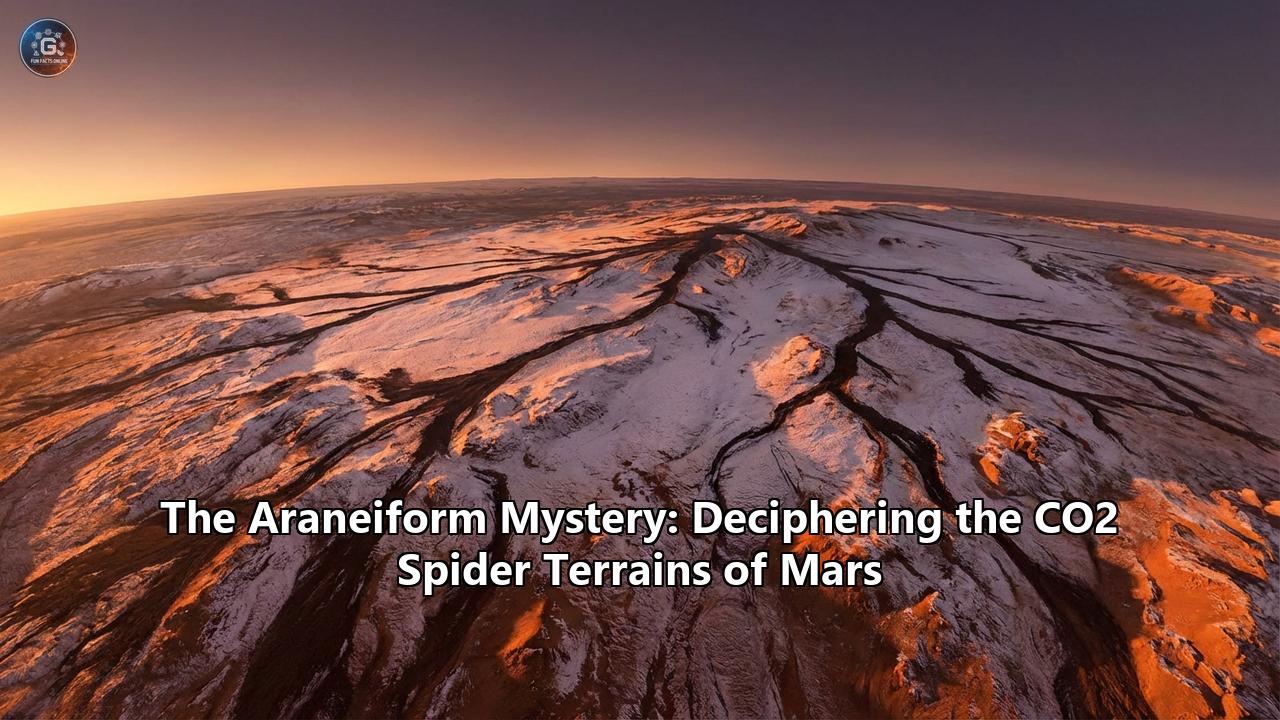
For decades, planetary scientists staring at satellite imagery of the Martian south pole were baffled by a geological phenomenon with no equal on Earth: sprawling, dendritic, black channels that looked remarkably like biological spiders scurrying across the ice. Officially termed "araneiforms," these features became one of the Red Planet's most tantalizing riddles. Are they cracks? Are they fluid channels? Are they, somehow, signs of life? It took the convergence of advanced orbital imaging, theoretical physics, and daring laboratory simulations on Earth to finally decipher the mechanism behind these alien sculptures. The answer revealed a planetary process as violent as it is exotic: the explosive sublimation of dry ice, driven by a solid-state greenhouse effect that turns the Martian surface into a landscape of geysers and gas jets. This article explores the history, the physics, and the implications of the "Mars Spiders," detailing the scientific journey that transformed a visual oddity into proof that Mars is still a dynamic, active world.
Part I: The Arachnid Anomaly
The Discovery of the Cryptic TerrainThe story of the Martian spiders begins not with a rover on the ground, but with the eyes in the sky. In the late 1990s and early 2000s, NASA’s Mars Global Surveyor (MGS) began beaming back high-resolution images of the Martian surface. While the northern polar cap of Mars is visually distinct—rich in water ice and relatively stable—the southern polar cap proved to be a chaotic, shifting landscape that defied easy categorization.
As the mission's cameras scanned the high southern latitudes (specifically around 70°S to 87°S), they encountered a region that did not behave like the rest of the ice cap. In the depth of the southern winter, this area was shrouded in darkness and covered in a thick blanket of carbon dioxide frost. But as spring broke and the sun rose, the region didn't just melt; it transformed.
Scientists dubbed this the "Cryptic Region" or "Cryptic Terrain" because of its unexplainable low albedo (reflectivity) in thermal measurements. It remained cold, like CO2 ice, yet appeared dark, like bare soil. Within this paradoxical zone, images revealed bizarre, fractal-like shapes etched into the surface. They consisted of a central pit radiating dozens of branching, sinuous troughs that tapered as they extended outward. They looked like river tributaries, or lightning strikes frozen in stone. But mostly, they looked like spiders.
These "araneiforms" (from the Latin aranea, meaning spider) ranged in size from tens of meters to a full kilometer across. They appeared in swarms, huddled together by the thousands, creating a texture that made the skin of Mars look wrinkled and diseased. Unlike impact craters or lava tubes, which have clear analogs on Earth, the spiders were unique. No geological process on our home planet creates such perfect, radially branching negative topography in a repetitive swarm pattern.
The Early HypothesesThe scientific community loves a vacuum, but it hates a mystery. As soon as the images were public, theories proliferated.
- Fluid Erosion: The dendritic (tree-like) branching suggested fluid flow. On Earth, water carves similar channels. Could there be liquid water beneath the south pole? This was quickly dismissed; the temperatures were far too low (-130°C or lower), and the atmospheric pressure too thin for liquid water to exist in stable flows on the surface.
- Volcanic Fracturing: Some proposed that the spider legs were tension cracks formed by upwelling magma or tectonic stresses. However, the radial symmetry was too perfect, and the features were restricted only to the cryptic region of the south pole. Tectonic features usually don't care about latitude or seasons.
- Biological Misinterpretations: In the fringes of the internet and tabloid media, the "Mars Spiders" became fuel for conspiracy theories. Much like the "Face on Mars" from the Viking era, the spiders were claimed to be fossilized giant organisms or even vegetation that bloomed in the Martian spring. While scientifically unfounded, these wild ideas highlighted the desperate need for a geological explanation that made sense.
The breakthrough would not come from looking for Earth-like processes, but by accepting that Mars is an alien world with alien chemistry. The key ingredient was Carbon Dioxide.
Part II: The Physics of the Alien Spring
The CO2 CycleTo understand the spiders, one must understand the atmosphere of Mars. Unlike Earth, where the atmosphere is nitrogen and oxygen, Mars is 95% carbon dioxide. During the harsh Martian winter, temperatures at the poles drop so low that the atmosphere itself freezes. About 30% of the entire planetary atmosphere deposits onto the polar caps as a layer of dry ice (solid CO2) roughly one meter thick.
This creates a seasonal ice cap that is not made of snow or water ice, but of translucent, slab-like carbon dioxide. This slab is the canvas upon which the spiders are painted.
The Kieffer ModelIn the early 2000s, geophysicist Hugh Kieffer proposed a radical hypothesis. He suggested that the spiders were not formed by liquid, but by gas. His theory, known as the "Kieffer Model," described a solid-state greenhouse effect—a mechanism that has no natural occurrence on Earth.
Here is the step-by-step physics of the Kieffer Model:
- The Translucent Slab: As winter settles, CO2 gas condenses into a slab of ice. Crucially, this ice is relatively transparent to visible sunlight but opaque to thermal infrared radiation. It acts like a glass pane.
- Solar Heating: When spring arrives, the sun penetrates the translucent ice slab and strikes the dark Martian regolith (soil) underneath.
- The Greenhouse Trap: The dark soil absorbs the sunlight and heats up. It re-radiates this energy as heat (infrared), but the CO2 ice blocks this heat from escaping. The energy is trapped at the base of the ice layer.
- Sublimation at the Interface: The trapped heat causes the CO2 ice at the very bottom of the slab to sublimate (turn directly from solid to gas). This creates a pocket of high-pressure gas trapped between the heavy ice slab above and the soil below.
- The Jet Eruption: As the pressure builds, the ice slab eventually cracks at its weakest point. The pressurized gas from the entire surrounding area rushes toward this vent at speeds reaching 160 kilometers per hour (100 mph).
- Carving the Spider: As the gas rushes beneath the ice toward the vent, it scours the loose soil, carving deep radial channels. These channels become the "legs" of the spider. The gas then erupts out of the central crack like a geyser, carrying dust and sand high into the Martian air.
- The Fan and Spot: The dust falls back downwind, creating dark fan-shaped deposits on top of the bright ice. These "fans" were the smoking gun that connected the spiders to the seasonal venting.
The Kieffer Model was elegant, but it needed observational proof. The Mars Reconnaissance Orbiter (MRO), launched in 2005, provided it. Its HiRISE camera could resolve features as small as a desk.
HiRISE monitoring campaigns observed the cryptic terrain over several Martian years. They watched the spiders "wake up." In early spring, the spiders were invisible, covered by the winter ice slab. Then, seemingly overnight, dark spots would appear. As spring progressed, these spots would grow into fans, oriented in the direction of the prevailing wind.
Crucially, the spiders themselves—the etched troughs—were permanent geological scars. But the activity—the jetting gas and the dark fans—was seasonal. The spiders were the plumbing system; the fans were the exhaust.
Part III: The Struggle to Simulate
Why Earth is a Bad AnalogGeologists usually rely on "comparative planetology." To understand a dune on Mars, they study a dune in the Sahara. To understand a volcano on Venus, they look at Hawaii. But there is no place on Earth where CO2 freezes into translucent slabs and explodes.
Attempting to prove the Kieffer Model required recreating Mars in a lab. This posed immense engineering challenges:
- Temperature: You need to reach -140°C or lower.
- Pressure: You need a near-vacuum (about 6 millibars, or less than 1% of Earth's sea-level pressure).
- Gravity: Mars has 1/3 Earth's gravity, affecting how soil is lifted (a variable hard to fix in a lab).
- The Material: You need pure CO2 ice and a soil simulant that mimics the fineness of Martian dust.
For years, experiments failed. Some couldn't get the pressure right; others couldn't get the ice to form as a translucent slab (it often formed as snowy hoarfrost, which scatters light and breaks the greenhouse effect).
The Open University BreakthroughThe turning point came around 2020-2021, driven by researchers like Dr. Lauren Mc Keown at the Open University (UK) and later Trinity College Dublin. They utilized the "Mars Simulation Chamber," a specialized rig capable of holding the vacuum and thermal conditions necessary.
Instead of trying to grow the ice from scratch (which is notoriously difficult to keep clear), they took a pragmatic approach: they drilled holes in blocks of dry ice and suspended them over beds of granular sediment. They then lowered the pressure to Martian levels and heated the substrate.
The results were spectacular. The dry ice sublimated vigorously upon contact with the warm grains. The gas rushed through the pre-drilled vents (simulating the cracked ice). When they lifted the ice blocks, the sediment underneath had been scoured into perfect, dendritic spider patterns.
It was the first empirical evidence that the Kieffer Model wasn't just good math—it was physical reality. The gas flow naturally self-organized into fractal channels, mimicking the exact morphology seen on Mars.
The JPL "DUSTIE" ExperimentsThe confirmation journey didn't stop there. In 2024, NASA’s Jet Propulsion Laboratory (JPL) took the simulation a step further using their "Dirty Under-vacuum Simulation Testbed for Icy Environments" (DUSTIE).
Researchers at JPL wanted to see if they could get the ice to crack naturally, rather than drilling a hole. They cooled a simulant soil, flooded the chamber with CO2 gas, and condensed it into a solid ice slab. Then they turned on a heater beneath the soil to simulate the solar warming.
The experiment yielded a surprise. The ice didn't just form on top of the soil; it formed within the pore spaces of the soil. When the sublimation began, it wasn't just gas rushing under the ice; the soil itself exploded from within. The pressure buildup caused the ice-soil mixture to fracture, shooting plumes of gas and debris into the chamber.
This modification to the Kieffer Model—where the "spider" is carved not just by surface scouring but by the explosive fragmentation of frozen soil—helped explain some of the deeper, more rugged araneiforms that looked too substantial to be carved by gas wind alone.
Part IV: The "Kieffer Zoo"
The success of the spider model unlocked a new understanding of an entire menagerie of features found in the Martian polar regions. Planetary scientists began to see the fingerprint of CO2 sublimation everywhere. They call this collection of features the "Kieffer Zoo."
1. Fried EggsThese are features consisting of a central broken terrain surrounded by a ring of lighter material. They are thought to be "protospiders" or areas where the gas venting was less violent, lifting the ice slightly to deposit a halo of dust before settling back down.
2. Lace TerrainIn areas where the spiders are so dense they overlap, the ground takes on a textured, woven appearance known as lace terrain. This represents a landscape that has been "completely worked" by the sublimation process over thousands of years.
3. Dalmatian SpotsBefore the fans appear, the first sign of spring is often "Dalmatian spots"—dark blotches on the ice. These are the sites of the vertical jets. The gas blasts straight up, carrying dark sand. When the jet stops or the wind is low, the sand falls straight back down, creating a round spot.
4. Swiss Cheese TerrainWhile spiders are constructive/erosional features in the soil, the "Swiss Cheese Terrain" (found in the permanent CO2 cap) consists of bizarre, flat-floored pits in the ice itself. These are caused by the sublimation of the ice cap year after year, where the sun burns holes into the CO2 layers, creating steep-walled depressions that grow and merge.
Part V: The Changing Face of Mars
The confirmation of the spider formation mechanism fundamentally changed our view of Mars. For a long time, Mars was viewed as a "dead" planet—a place where geology happened billions of years ago (volcanoes, river valleys) and finished.
The spiders prove that Mars is currently geologically active. It is not active with lava or tectonic plates, but with "cryo-venting." Every year, millions of tons of soil are moved, channels are deepened, and the landscape is reshaped. The south pole of Mars is a dynamic, shifting surface that is constantly being re-sculpted by the sun.
Erosion Rates and Climate HistoryThis active erosion presents a puzzle. If spiders are carved every year, why aren't they miles deep? Why do they seem to preserve a specific size?
The answer likely lies in the Martian dust cycle. While the spring vents scour the channels, the global dust storms of summer and autumn fill them back up. The spiders exist in a delicate equilibrium between being carved by gas and being buried by dust. This makes them excellent markers for climate stability. If the spiders are visible, it means the current climate regime (the seasonal CO2 cycle) has been stable for long enough to maintain them.
Planetary Protection and Future LandersUnderstanding araneiforms is critical for future missions. A lander touching down in the cryptic region during early spring might find itself sitting on top of a geological time bomb. If a spacecraft's heat source warmed the ground beneath a CO2 slab, it could theoretically trigger an artificial jet, blasting the lander with high-velocity debris.
Furthermore, the geyser-like plumes are sampling the subsurface. Instead of drilling, a future rover could potentially drive up to a fresh "fan" deposit and analyze the material that was just ejected from meters underground. It is nature’s way of doing the excavation for us.
Part VI: Beyond Mars
The solution to the Araneiform Mystery has opened the door to "Comparative Cryomorphology." If CO2 jets can carve spiders on Mars, what about other icy worlds?
Triton and Nitrogen GeysersWhen Voyager 2 flew past Neptune's moon Triton in 1989, it saw dark plumes erupting 8 kilometers into the sky. These are likely nitrogen geysers driven by a similar solid-state greenhouse effect. The sunlight warms the nitrogen ice (which is translucent like CO2), creating pressurized jets.
Europa's Chaos TerrainJupiter's moon Europa has "chaos terrain" where the ice shell seems disrupted. While likely driven by liquid water from below, understanding how sublimation and phase changes fracture ice sheets on Mars helps refine the physics models used for Europa.
Pluto's Bladed TerrainNew Horizons revealed massive blades of ice on Pluto. These are likely formed by sublimation, though the mechanism differs. The study of Martian spiders provides a baseline for how gases shape surfaces in the outer solar system.
Part VII: Conclusion
The Martian Spiders are a testament to the power of scientific persistence. What started as a visual anomaly that evoked biological fears has transformed into a triumph of planetary physics. We now know that the "Spiders from Mars" are the footprints of the sun, etched into the ground by the violent phase change of carbon dioxide.
They remind us that the universe is not limited to the geological playbook of Earth. On a world where the air freezes and the ground explodes, the landscape takes on forms that are truly alien, yet perfectly understandable through the universal laws of physics. As we continue to gaze at the Red Planet, the spiders stand as a warning and an invitation: expect the unexpected, for Mars is still alive in its own frozen, dusty way.
Reference:
- https://universitytimes.ie/2021/03/trinity-researchers-discover-process-behind-martian-spiders/
- https://www.youtube.com/watch?v=mBaXrUoiR1s
- https://www.indy100.com/science-tech/mars-spiders-nasa-science-earth
- https://www.techexplorist.com/nasa-scientists-recreated-mars-spiders-lab/89945/
- https://www.steamnews.org/articles/science/the-mystery-of-the-mars-spider
- https://www.livescience.com/space/mars/spiders-on-mars-fully-awakened-on-earth-for-1st-time-and-scientists-are-shrieking-with-joy
- https://thedebrief.org/martian-cryptic-terrain-revealed-by-receding-frost-on-the-red-planets-south-pole/
- https://www.researchgate.net/publication/6873114_CO2_jets_formed_by_sublimation_beneath_translucent_slab_ice_in_Mars'_South_Seasonal_Polar_Ice_Cap
- https://planetarygeomorphology.wordpress.com/2021/06/01/martian-spiders-recreated-in-the-laboratory/
- https://www.earth.com/news/mars-spiders-recreated-in-nasa-lab-for-the-first-time/
- https://www.jpl.nasa.gov/images/pia26406-cracks-forming-in-frozen-martian-soil-simulant/
- https://www.sciencealert.com/nasa-can-finally-explain-why-creepy-spiders-on-mars-keep-appearing
- https://waxvisuals.com/martian-araneiforms-2
- https://www.tcd.ie/news_events/articles/trinity-researchers-tackle-the-spiders-from-mars/
- https://www.planetary.org/planetary-radio/2024-mars-spiders
- https://www.nasa.gov/solar-system/planets/mars/nasa-scientists-re-create-mars-spiders-in-a-lab-for-first-time/
- https://www.space.com/2745-roaring-jets-carbon-dioxide-solve-mars-mystery.html
- https://www.space.com/34481-mars-spiders-citizen-scientists-investigation.html
- https://www.space.com/nasa-recreates-mars-spiders-on-earth
- https://imewg.org/international-mars-missions/
- https://en.wikipedia.org/wiki/Exploration_of_Mars