
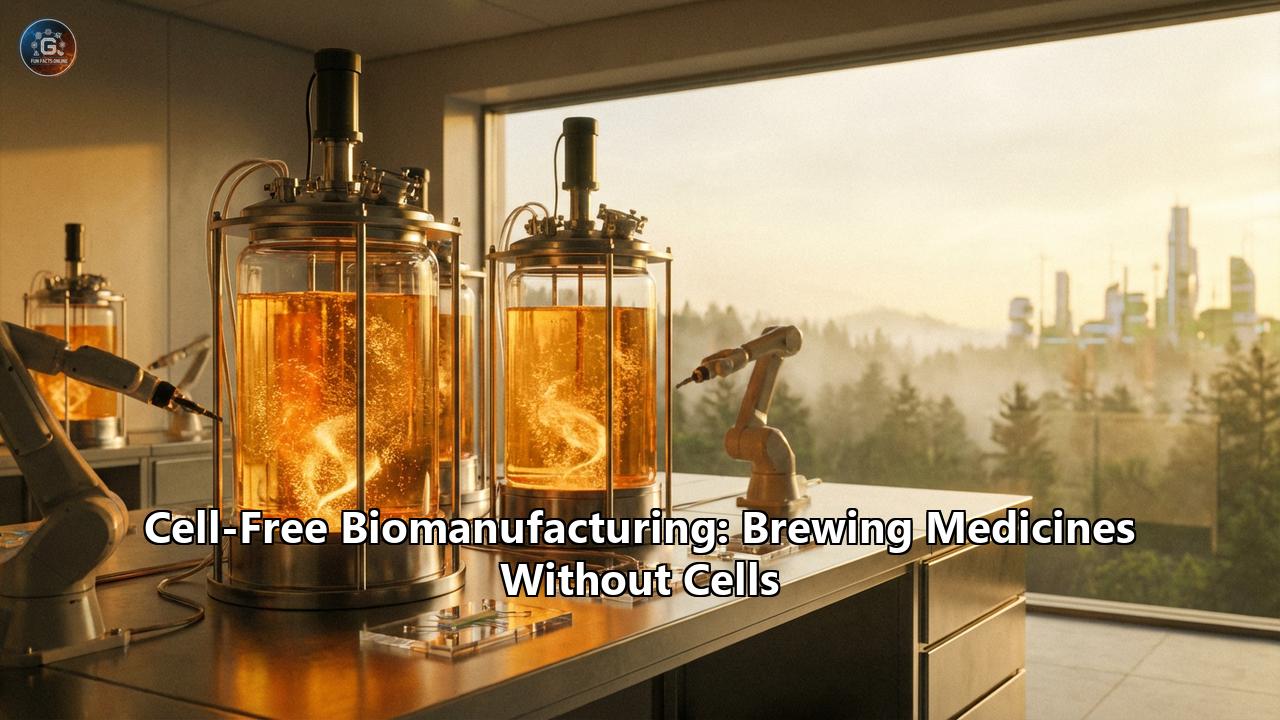
In the quiet hum of a traditional biomanufacturing facility, the air is thick with the scent of yeast or the sterile tang of media. Giant steel fermenters, rising like monoliths, hold thousands of liters of living slurry—trillions of microscopic factories working in unison. For decades, this has been the gold standard of biotechnology: harnessing the living cell to brew our medicines, from insulin to monoclonal antibodies. But the cell is a fickle partner. It has its own agenda—survival, reproduction, homeostasis—that often conflicts with the engineer’s desire to produce a specific molecule. The cell is a black box, a fortress of membranes and regulatory networks that resists tampering.
But what if we didn't need the cell?
What if we could strip away the walls, discard the survival instincts, and keep only the machinery? What if we could liberate the ribosomes, the enzymes, and the DNA, placing them in a simple test tube or a microfluidic chip to do our bidding without the biological noise?
This is the dawn of Cell-Free Biomanufacturing (CFB). It is not merely an alternative method; it is a fundamental uncoupling of biology from the constraints of life. It is the transition from farming organisms to engineering pure biological machines. As we stand in 2026, looking back at a decade of explosive growth in this field, we are witnessing a transformation as profound as the shift from steam to electricity. We are no longer just growing medicines; we are brewing them, molecule by molecule, in a soup of pure potential.
Part I: The Liberated Machine
To understand the magnitude of this shift, we must first dismantle our understanding of traditional biotechnology. For the last half-century, "biomanufacturing" was synonymous with "fermentation." You genetically modified a host organism—usually Escherichia coli, Saccharomyces cerevisiae (yeast), or Chinese Hamster Ovary (CHO) cells—to carry a plasmid containing the gene for your product. You fed these cells sugar and oxygen, carefully monitored the pH and temperature, and waited.
The cell would take in the nutrients, grow, divide, and, as a side hustle, produce your protein. But the cell is selfish. It uses the majority of its energy for its own maintenance: building cell walls, replicating its genome, and fighting off stress. The energy diverted to your product was a "metabolic tax" the cell paid reluctantly. Furthermore, if your product was toxic to the cell, the cell would die or stop producing. If the product required complex folding that the cell’s internal environment couldn't support, the product would emerge as useless junk.
Cell-free biomanufacturing changes the rules of engagement by removing the "life" from the equation. The process begins with the harvesting of the cellular machinery. Cells are grown to a high density and then lysed—ripped open. The cell walls and genomic DNA are removed, leaving behind a rich "lysate" or extract. This extract contains the essential workers: RNA polymerases to read DNA, ribosomes to build proteins, chaperones to fold them, and enzymes to generate energy.
Into this "soup," engineers add a source of energy (like ATP or creatine phosphate), amino acids, nucleotides, and the specific DNA template for the desired product. The result is an open, accessible reaction. There is no cell wall to cross. There is no gene regulation to overcome. If you want to add a non-natural amino acid to make a super-stable drug? You just pour it in. If you want to monitor the reaction in real-time? You just look.
This is biology without the black box. It is the ultimate reductionist dream turned into an industrial reality.
The Historical Echo: From Buchner to Nirenberg
While cell-free systems feel futuristic, their roots are deeply embedded in the history of biochemistry. In 1897, Eduard Buchner ground up yeast cells with sand and filtered the juice. He showed that this dead "juice" could still ferment sugar into alcohol, proving that vital biological processes were chemical in nature and could occur outside the living entity. This discovery earned him the Nobel Prize and laid the foundation for enzymology.
Fast forward to 1961. Marshall Nirenberg and Heinrich Matthaei at the National Institutes of Health used a cell-free system derived from E. coli to decipher the genetic code. They added synthetic RNA made entirely of uracil (poly-U) to the extract and watched as the ribosomes churned out a protein made entirely of phenylalanine. It was the Rosetta Stone of biology, and it was only possible because they had stripped away the confusing complexity of the living cell to focus on the pure mechanics of translation.
For decades, however, these systems were mere curiosities—tools for basic research, too inefficient and expensive for making actual products. They ran out of energy quickly, the proteins degraded, and the yields were microscopic. It wasn't until the early 2000s, with the pioneering work of James Swartz at Stanford and subsequently Michael Jewett at Northwestern, that cell-free systems began to evolve from laboratory toys into industrial engines. They cracked the code on energy regeneration, figuring out how to mimic the cell's own metabolism (like oxidative phosphorylation) in the test tube to keep the reaction running for hours, or even days.
Part I: The Taxonomy of the Cell-Free World
Not all cell-free systems are created equal. Just as a mechanic chooses a different engine for a race car versus a tractor, bioengineers choose different "chassis" for their cell-free reactions.
*1. The Workhorse: E. coli Lysates
The most common system is derived from E. coli. It is cheap, robust, and incredibly efficient. Modern E. coli systems can produce grams of protein per liter of reaction in just a few hours—yields that rival high-density fermentation. Because bacteria are simple, their machinery is streamlined. This system is the go-to for producing simple therapeutic proteins, industrial enzymes, and novel materials. However, E. coli lacks the sophisticated machinery to add complex sugar chains (glycosylation) to proteins, which is essential for many human antibodies.
2. The Specialist: Wheat Germ Extract (WGE)Derived from the embryos of wheat seeds, this eukaryotic system is prized for its ability to fold complex proteins that would clump together in bacterial systems. Wheat germ has a unique advantage: it is remarkably free of endogenous genetic information that could interfere with the process, resulting in very clean product. It is often used for high-throughput screening of human proteins in drug discovery.
3. The Mammalian Mimics: CHO and HeLa LysatesFor high-value human therapeutics, we often need the machinery of a mammal. Extracts from Chinese Hamster Ovary (CHO) cells or human cell lines (like HeLa) contain the endoplasmic reticulum remnants needed to perform complex folding and post-translational modifications. Historically, these were low-yielding and expensive. However, recent breakthroughs by companies like LenioBio (with their plant-based ALiCE system) and others utilizing CHO lysates have boosted yields significantly. These systems are crucial for making "biologics"—the complex antibodies and fusion proteins that dominate modern medicine.
4. The Minimalist: The PURE SystemAt the extreme end of the spectrum lies the PURE (Protein synthesis Using Recombinant Elements) system. Instead of using a crude soup of smashed cells, the PURE system is built from scratch. Scientists purify every single component individually—the 20 tRNA synthetases, the ribosomes, the initiation factors—and mix them in precise ratios. It is the ultimate known biology. Because it contains nothing unnecessary, it is perfect for "clean" applications where absolutely no contamination from native cellular proteins can be tolerated. It is also the playground for "synthetic cells," where researchers try to build a living cell from the bottom up.
Part III: The Advantages of Being Dead
Why go to the trouble of extracting the machinery? Why not just let the cells do the work? The answer lies in the limitations of life itself.
1. Speed: The Velocity of ChemistryIn traditional fermentation, the "Design-Build-Test" cycle is slow. You design a DNA plasmid, transform it into a cell, wait days for the colony to grow, induce expression, harvest, and purify. If it fails, you start over. It takes weeks.
In cell-free systems, you can use linear DNA (PCR products) directly. You don't need to clone a plasmid or transform a cell. You simply print your DNA, throw it in the mix, and have protein in 4 hours. This accelerates the cycle of innovation from months to days. During the COVID-19 pandemic and subsequent outbreaks, this speed allowed researchers to screen thousands of viral antigens for vaccine candidates in the time it took traditional labs to grow a single starter culture.
2. The "Open" EnvironmentA living cell is a fortress. It carefully controls what enters and exits. If you want to introduce a non-natural chemical to modify your protein, the cell membrane might block it, or an efflux pump might spit it out. In a cell-free reaction, the environment is open. You have direct access to the "cytoplasm." You can adjust the pH, the redox potential, or the salt concentration in real-time. You can add non-canonical amino acids (nAAs) that don't exist in nature, allowing for the creation of "bio-better" drugs with enhanced stability or novel functions (like "click chemistry" handles for attaching toxins to cancer-killing antibodies).
3. Tolerance to ToxicityThis is perhaps the killer app for industrial chemistry. Many valuable molecules—potent antibiotics, membrane proteins, or viral components—are toxic to the cells that make them. Producing a toxin inside a living cell is like building a bomb inside a factory; eventually, the factory blows up. Cell-free systems are "dead." They don't care if the product is toxic. They will happily churn out potent cytotoxins for cancer therapy or antimicrobial peptides that would instantly kill a living host strain.
4. Distributed Manufacturing: The Pharmacy in a BackpackLiving cells require a "cold chain." They need to be kept frozen, then carefully thawed and cultured in sterile environments. You cannot easily ship a fermenter to a battlefield or a remote village.
Cell-free systems, however, can be lyophilized (freeze-dried). The extract, the energy source, and the DNA can be dried into a powder or a pellet. This powder is stable at room temperature for months or even years. To activate it, you simply add water. This capability has birthed the concept of "just-in-time" manufacturing. Imagine a doctor in a disaster zone carrying a kit of freeze-dried pellets. She diagnoses a patient, adds water to the specific pellet for that disease, and three hours later, she has a dose of a sterile, therapeutic protein. No cold chain, no giant factory—just biology on demand.
Part IV: Transforming Medicine
The most immediate impact of CFB is in the pharmaceutical industry, where the pressure to reduce costs and increase speed is immense.
Antibody-Drug Conjugates (ADCs): The Sniper Rifles of OncologyADCs are powerful cancer treatments where a toxic chemical is attached to an antibody that targets a tumor. The antibody guides the toxin to the cancer cell, sparing healthy tissue. Making these in living cells is a nightmare. You have to purify the antibody and then chemically attach the toxin in a messy, inefficient process that often results in a heterogeneous mix—some antibodies have zero toxins, some have eight.
Sutro Biopharma, a pioneer in this space, uses a cell-free system to revolutionize ADCs. Because the system is open, they can use non-natural amino acids to create specific "docking sites" on the antibody. The toxin snaps into these sites with Lego-like precision. The result is a homogeneous, safer, and more effective drug. Their facility in California looks less like a brewery and more like a chemical plant, with precise control over every reaction parameter.
Vaccines: The Speed of ResponseWhen a new pathogen emerges, speed is everything. In traditional vaccine manufacturing (like for the flu), we grow viruses in chicken eggs—a process that takes months and is vulnerable to supply shocks. Even modern mammalian cell culture takes weeks to spin up.
Cell-free systems enable "distributed vaccine manufacturing." In a theoretical pandemic response scenario, central labs could email the DNA sequence of a new viral antigen to distributed manufacturing hubs around the world. These hubs, equipped with stockpiles of freeze-dried cell-free extract, could print the DNA and start brewing vaccines immediately. Companies like Vaxcyte have utilized cell-free technology to produce complex conjugate vaccines (like those for Pneumococcal disease) that are notoriously difficult to make in cells because the necessary enzymatic pathways interfere with cell wall synthesis. In the cell-free pot, those pathways run unhindered.
Personalized Medicine: The N=1 CureThe holy grail of oncology is the "neoantigen vaccine." Every tumor has unique mutations. Ideally, we would sequence a patient’s tumor, identify the unique mutant proteins, and manufacture a vaccine that trains the immune system to attack those specific targets. This is the ultimate personalized medicine.
Traditional manufacturing cannot scale to produce a unique drug for every single patient—it’s too slow and expensive. CFB is uniquely suited for this. Because the scale can be miniaturized to a few microliters, a single automated machine could run hundreds of different reactions in parallel, producing a personalized vaccine dose for hundreds of patients simultaneously. The "template" is just DNA; changing the product is as simple as changing the code.
Part V: Beyond Medicine—The Industrial Renaissance
While high-value drugs grab the headlines, the volume game is in industrial chemicals. We are transitioning to a "bio-economy," trying to replace petroleum-derived plastics and fuels with bio-based alternatives.
Metabolic Engineering UnchainedIn living cells, metabolic flux is tightly regulated. If you try to force a cell to turn all its glucose into a biofuel like isobutanol, the cell fights back. It senses the imbalance and shuts down the pathway to preserve resources for growth.
Cell-free Metabolic Engineering (CFME) eliminates this tug-of-war. Scientists can mix and match enzymes from different organisms—bacteria, fungi, plants—into a single pot to create "super-pathways" that don't exist in nature. They can drive the reaction to 100% conversion because there is no biomass to build.
For example, researchers have developed cell-free systems that convert glucose to 2,3-butanediol (a precursor for rubber) with near-theoretical yields. Others are working on systems that use enzymes to capture carbon dioxide directly from the air and convert it into bioplastics, powered by electricity or hydrogen, completely bypassing the inefficiency of photosynthesis.
The Bio-Bits Revolution: Democratizing ScienceOne of the most charming applications of CFB is in education. Synthetic biology has historically been inaccessible to high schools because it requires biosafety cabinets, incubators, and sterile technique.
Enter "BioBits," developed by researchers at MIT and Northwestern. These are freeze-dried cell-free pellets that glow fluorescent green or red when water and a DNA trigger are added. They are safe, shelf-stable, and require no special equipment. A student can hold a tube in their hand, add water, and watch the "central dogma" of biology (DNA -> RNA -> Protein) happen before their eyes as the tube lights up. This is demystifying biomanufacturing for the next generation, turning it from a hazardous lab procedure into a kitchen-table activity.
Diagnostics: The Paper LabDuring the Zika and Ebola outbreaks, the need for rapid, low-cost diagnostics became painfully clear. PCR machines are expensive and require power.
Cell-free systems provided a solution: paper-based diagnostics. Researchers freeze-dried cell-free extracts onto small slips of paper. These extracts contained a gene circuit designed to detect the viral RNA. If the virus was present in a patient's saliva, it would trigger the circuit, causing the paper to change color (often using the enzyme LacZ to turn it blue).
This technology, further boosted by CRISPR-based detection (like Sherlock Biosciences), allows for "lab-quality" molecular diagnostics at a price point of roughly $1 per strip. It brings sophisticated molecular biology to the most remote corners of the world.
Part VI: The Challenges of Scale and Cost
If cell-free is so perfect, why do we still use cells? The answer, historically, has been cost and scale.
The ATP ProblemLiving cells are incredibly efficient at regenerating ATP (energy) using glucose and oxygen. Early cell-free systems required the addition of expensive high-energy substrates like phosphoenolpyruvate (PEP) or creatine phosphate. This made the "cost per gram" of protein astronomical—fine for a high-value cancer drug, but prohibitive for a biofuel.
However, the "Davos of cell-free" has been the development of energized extracts. By carefully harvesting the cells, researchers preserve the native inverted membrane vesicles containing the electron transport chain. This allows the cell-free reaction to perform oxidative phosphorylation—using oxygen to regenerate ATP just like a living mitochondrion. This has slashed costs by orders of magnitude, bringing CFB within striking distance of traditional fermentation for mid-value products.
The Scale-Up ParadoxFermentation engineers know how to build 200,000-liter tanks. We understand how to stir them and aerate them. Scaling up a cell-free reaction is different. Because the reaction is so fast and intense, it generates massive amounts of heat and requires rapid oxygen transfer. In a giant tank, the center would suffocate.
Therefore, scale-up in CFB often looks more like "scale-out." Instead of one giant tank, you might use continuous flow reactors—long, thin tubes where reagents flow in one end and product flows out the other. This allows for precise control of the environment. Sutro Biopharma has successfully demonstrated this at industrial scales (hundreds of liters), proving that the technology is not just a lab bench curiosity.
Protein Folding and GlycosylationWhile we can make proteins, making them perfect* is hard. Human proteins are often decorated with specific sugar patterns (glycans) that determine their stability and efficacy. Bacteria don't do this. Mammalian cell-free systems do, but they are more expensive to prepare.
The frontier of research is now "glyco-engineering" cell-free systems. Scientists are adding specific glycosyltransferases to bacterial extracts, effectively teaching a bacterial soup how to paint sugars onto proteins like a human cell. This "bottom-up" construction of glycosylation pathways offers more control than even mammalian cell culture, where the glycan profile can vary wildly from batch to batch.
Part VII: The Future—Synthetic Cells and Space Pharma
As we look toward the 2030s, the line between "cell-free" and "synthetic life" will blur.
The Artificial CellThe ultimate goal for many in the field is to build a cell from scratch. Using the PURE system as a base, researchers are encapsulating these reactions inside lipid vesicles (soap bubbles) to mimic a cell membrane. They are adding gene circuits that allow these bubbles to "communicate" with each other, sensing chemical signals and releasing drugs in response.
Imagine an artificial cell injected into the bloodstream. It is not alive; it cannot mutate or cause infection. But it acts like a white blood cell, sensing a tumor marker and synthesizing a toxin right at the site of the cancer. This is the realm of "programmable therapeutics," where the drug is not a static molecule, but a nanobot made of biology.
Manufacturing on MarsSpace travel imposes the ultimate supply chain constraint. You cannot ship insulin to Mars; the radiation would destroy it during the trip, and the cost of lifting it out of Earth's gravity is prohibitive.
NASA and private space agencies are looking to CFB as the solution. Astronauts would carry tubes of lyophilized extract (lightweight and stable). On Mars, they would have a digital library of DNA sequences. If an astronaut gets an infection, they download the sequence for the appropriate antibiotic, print the DNA (using a portable synthesizer), add it to the extract with some water (recycled, of course), and brew the medicine on the spot. This "astro-pharmacy" is essential for long-duration deep space missions.
Part VIII: The Economic and Environmental Argument
We must also consider the sustainability of this shift. Traditional pharma is surprisingly dirty. It uses massive amounts of water for cleaning and sterilization (WFI - Water for Injection), and the single-use plastics involved in bioreactors create tons of waste.
CFB offers a path to "green" manufacturing. Because the reactions are cleaner and faster, the footprint of a factory is smaller. There is less biomass waste (you aren't growing tons of yeast cell bodies that you just throw away).
Furthermore, the ability to decentralize manufacturing changes the economics of global health. Currently, many developing nations import their biologics, leaving them vulnerable to currency fluctuations and supply chain disruptions. CFB could enable "micro-factories" in developing regions. A small facility in Nigeria or Brazil could produce monoclonal antibodies for local needs using imported, stable extracts, bypassing the need for massive capital investment in traditional fermentation infrastructure.
Conclusion: The Unbottling of Biology
For three billion years, the machinery of life was locked inside the cell, evolving solely for the propagation of the species. It was a masterpiece of survival, but a nightmare for engineering.
Cell-free biomanufacturing is the moment we picked the lock. It is the moment we stopped being farmers of cells and became engineers of biology.
By stripping away the complexity of life, we have gained control. We have gained speed. We have gained the ability to design molecules that nature never dared to imagine. From the personalized cancer vaccine brewed in a hospital basement to the biosensor detecting a pandemic virus on a paper strip, to the potential of brewing medicines on the Red Plain of Mars, cell-free systems are rewriting the definition of manufacturing.
The factories of the future will not be giant steel vats of churning slurry. They will be silent, small, and incredibly precise. They will not be limited by what a cell can survive, but only by what a human mind can design. We are no longer brewing with cells; we are brewing with the very essence of life itself, refined, purified, and ready to work.
Reference:
- https://www.osti.gov/servlets/purl/1852564
- https://en.wikipedia.org/wiki/Cell-free_protein_synthesis
- https://www.mdpi.com/2227-9717/8/6/675
- https://www.creative-biolabs.com/vaccine/cell-free-expression-system-for-vaccine-production.htm
- https://pmc.ncbi.nlm.nih.gov/articles/PMC4314355/
- https://www.leniobio.com/wp-content/uploads/2024/07/W_ALiCE_V1_0423.pdf
- https://www.researchgate.net/publication/266380827_Overview_of_Cell-Free_Protein_Synthesis_Historic_Landmarks_Commercial_Systems_and_Expanding_Applications
- https://synapse.patsnap.com/article/what-is-the-difference-between-cell-free-and-cell-based-expression-systems
- https://resilience.com/blog/developing-new-medicines-through-artificial-intelligence
- https://www.technologynetworks.com/cancer-research/blog/unlocking-mrna-therapeutics-cell-free-dna-synthesis-is-powering-the-ai-era-of-genetic-medicines-407524