
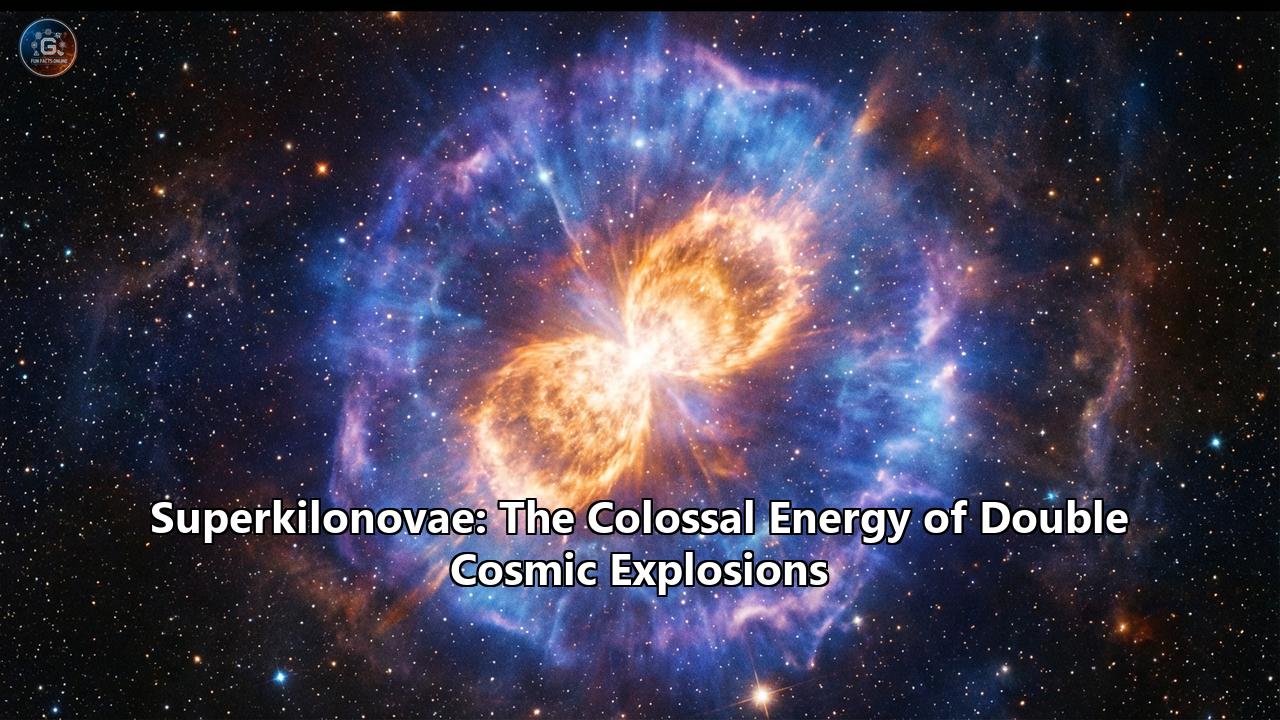
The Day the Sky Exploded Twice: Unlocking the Secrets of the Superkilonova
In the vast, silent theater of the cosmos, stars usually die alone. A massive star runs out of fuel, its core collapses, and it detonates in a supernova—a singular, blinding flash that outshines entire galaxies. Or, in a different corner of the dark, two ancient, city-sized neutron stars spiral together and collide, ripping through the fabric of spacetime in a kilonova. These were the two distinct endings astronomers had written for the lives of the heavy and the dense. They were separate chapters in the textbooks of astrophysics.
Until August 18, 2025.
On that day, the universe rewrote the book. Sensors buried deep within the Earth and telescopes perched on high mountain peaks detected a signal that shouldn’t have existed. It was a tremor in gravity and a flash of light that told a story of impossible violence: a star that didn’t just die, but tore itself apart to build its own executioners. It was a supernova that birthed a kilonova immediately within its own heart.
Astronomers are calling it the "Superkilonova." It is a double cosmic explosion of colossal energy, a celestial matryoshka doll of destruction that has solved a decade-old mystery about the origins of the heaviest elements in our universe. This is the story of AT2025ulz, the event that changed everything we thought we knew about stellar death.
Part I: The Impossible Signal
The Chirp That Broke the Rules
The morning of August 18 began like any other for the scientists at the Laser Interferometer Gravitational-Wave Observatory (LIGO). The facility, a massive L-shaped tunnel system designed to detect ripples in spacetime, had been quiet. But at 09:42 UTC, the automated alert system screamed.
A gravitational wave signal, cataloged as GW250818, swept through the detectors in Hanford, Washington, and Livingston, Louisiana, before hitting the Virgo detector in Italy. The "chirp"—the rising frequency of sound that indicates two massive objects spiraling into each other—was loud and clear. It was unmistakably a merger of two compact objects.
But as the computers crunched the numbers to estimate the masses of the colliding bodies, the control room fell silent.
Standard physics dictates that neutron stars—the crushed cores left behind by supernovae—must have a mass between roughly 1.1 and 2.3 times that of our Sun. Anything lighter, and gravity isn't strong enough to crush protons and electrons into neutrons; it remains a white dwarf. Anything heavier, and it collapses into a black hole. This "Chandrasekhar Limit" and the "Tolman-Oppenheimer-Volkoff limit" are the guardrails of stellar evolution.
The signal from GW250818 shattered these guardrails. One of the objects in the merger weighed in at just 0.7 solar masses.
"It was like finding a fully grown elephant that weighed as little as a golden retriever," says Dr. Elena Rossi, a theoretical astrophysicist at the Institute for Advanced Study. "It physically shouldn't exist. We thought it was a glitch in the software or terrestrial noise—a truck driving by, a minor earthquake. But the signal was clean. It was real."
The Red Flash
While the gravitational wave community scrambled to make sense of the "impossible" neutron star, the optical astronomers were already hunting. The LIGO alert had narrowed the source to a patch of sky in the constellation Eridanus, about 1.3 billion light-years away.
Within hours, the Zwicky Transient Facility (ZTF) at the Palomar Observatory in California spotted a new point of light. Named AT2025ulz, it wasn't behaving like a supernova. A supernova typically starts blue and hot, fading slowly over months. This object was red—deep, angry red—and it was fading fast.
"It looked exactly like a kilonova," recalls Dr. Mansi Kasliwal, Principal Investigator at Palomar. "The red color comes from the heavy elements—lanthanides and actinides like gold and uranium—blocking the blue light. It was a textbook neutron star merger. We thought we had another GW170817, the famous merger from 2017."
But the universe had a twist in store. Three days later, just as the "kilonova" should have faded into blackness, the object stopped dimming. It began to brighten again. The spectrum shifted from the heavy-metal red to a scorching, hydrogen-rich blue.
The dead star was exploding again.
"We were watching a movie where the credits had already rolled, and suddenly the main character stands up and starts a whole new plot," says Dr. Rossi. "First we saw the merger of two neutron stars. Then we saw the explosion of a massive star. The timeline was backwards. You can't merge two neutron stars until the star that made them has died. But here, they seemed to be happening on top of each other."
The combination of a sub-solar mass object and a "kilonova-inside-a-supernova" signature pointed to only one theoretical, never-before-seen possibility: a Superkilonova.
Part II: Anatomy of a Cataclysm
To understand the colossal energy of a superkilonova, we must first understand the "standard" models it violates.
The Standard Model: Lonely Deaths
In the standard picture of stellar evolution, a massive star (say, 20 times the mass of the Sun) burns through its fuel until it has an iron core. Iron absorbs energy rather than releasing it, so the fusion fire goes out. Gravity wins. The core collapses in a fraction of a second, rebounding off the dense nuclear matter to trigger a shockwave that blows the star apart. This is a Core-Collapse Supernova. It leaves behind a single neutron star.
To get a kilonova, you usually need two massive stars born in a binary system. They orbit each other for millions of years. One explodes, leaving a neutron star. Later, the other explodes, leaving a second neutron star. Then, over billions of years, these two remnants slowly spiral together, leaking energy as gravitational waves, until they finally merge.
The process is slow, inefficient, and rare.
The Superkilonova Mechanism: Core Fission
The event of August 2025 was different because it was fast. It didn't take billions of years; it took seconds.
The progenitor of AT2025ulz was likely a "Wolf-Rayet" star—a massive, hot star that had already blown off its outer layers—spinning at a breakneck speed.
"Imagine a figure skater spinning so fast that her arms don't just pull out—they rip off," explains Dr. Cole Miller, a professor of astronomy at the University of Maryland. "When the core of this rapidly spinning star collapsed, it didn't crunch down into a single ball. The centrifugal force was so intense that the core stretched into a bar shape, then snapped in two."
This process is called Rotational Fission.
Instead of one standard neutron star (1.4 solar masses), the collapsing core split into two smaller "baby" neutron stars, each weighing perhaps 0.7 to 0.9 solar masses. These two objects were born in a frantic, screaming orbit around each other, separated by mere kilometers.
"They are born trapped in a death spiral," says Miller. "Because they are so close, they emit gravitational waves of incredible intensity. They lose orbital energy instantly. We believe they merged less than a few minutes after being born."
The Double Explosion
The sequence of events for AT2025ulz would have been terrifying to behold:
- The Collapse: The iron core of the giant star collapses.
- The Fission: The core splits into two sub-solar mass proto-neutron stars.
- The Merger (Kilonova): Before the outer layers of the star even know the core has collapsed, the two baby neutron stars crash into each other. This releases a burst of neutrons and gamma rays—a "kilonova" engine igniting inside the belly of the beast.
- The Detonation (Supernova): The energy from the merger, combined with the standard shockwave of the core collapse, blasts outward. It slams into the falling layers of the star. The kilonova "boosts" the supernova, injecting it with r-process heavy elements and extra kinetic energy.
This explains the strange signals. The gravitational waves (GW250818) came from the merger of the two baby cores. The initial red flash was the kilonova breaking through the thin outer layers. The subsequent blue brightening was the main bulk of the supernova finally lighting up.
It was a two-for-one cosmic deal: a kilonova wrapped in a supernova shell.
Part III: The Cosmic Gold Rush
Why does this matter to anyone other than astrophysicists? Because of the gold ring on your finger.
The R-Process Crisis
For decades, scientists struggled to explain where the heaviest elements in the periodic table came from. The Big Bang gave us hydrogen and helium. Normal stars fuse lighter elements like carbon and oxygen. Supernovae can make iron and nickel. But for the "heavyweights"—gold, platinum, uranium, plutonium—you need something more extreme. You need the R-Process (Rapid Neutron Capture Process).
The r-process requires a literal flood of neutrons to jam themselves into atomic nuclei faster than the nuclei can decay. For a long time, we thought standard supernovae were responsible. But computer models showed they weren't neutron-rich enough.
Then came the discovery of kilonovae (like GW170817). These neutron star mergers are perfect factories for gold. We breathed a sigh of relief; the mystery seemed solved.
But there was a problem: math.
"Standard neutron star mergers are too rare," says Dr. Jennifer Barnes, a theorist at the Kavli Institute for Theoretical Physics. "When we count the amount of gold and uranium in our galaxy and divide it by the age of the Milky Way, standard kilonovae can't account for all of it. We were missing a source. We were missing a factory."
Superkilonovae: The Missing Factory
The Superkilonova discovery changes the equation. If a single massive star can undergo core fission and produce a merger by itself, without needing a binary companion, these events could be far more common than standard mergers.
"A Superkilonova is an r-process bomb," Barnes explains. "Because the merger happens inside the exploding star, the neutron-rich debris doesn't just fly off into empty space. It gets mixed into the supernova shell. This might actually help seed the galaxy more efficiently than a 'naked' kilonova."
The spectrum of AT2025ulz showed distinct absorption lines of strontium, tellurium, and—shockingly—indications of californium. This suggests that superkilonovae might be capable of forging even heavier, unstable elements that standard mergers cannot, due to the immense pressure of the surrounding stellar envelope holding the reaction "cooker" closed for a fraction of a second longer.
It is possible that the majority of the precious metals in Earth's crust were not born from the lonely wandering of binary stars, but from these violent, solitary suicides of rotating giants.
Part IV: The Hunt for the "Impossible" Stars
The most controversial aspect of the Superkilonova is the "sub-solar mass" neutron star.
Breaking the Limit
"We are taught in grad school that a 0.7 solar mass neutron star is impossible," says Dr. Rossi. "The nuclear matter should decompress and explode, or it shouldn't form at all."
However, the "Superkilonova" scenario offers a loophole. These objects are not stable, cold neutron stars. They are hot, rotating proto-neutron stars. They are rich in leptons (electrons and neutrinos) trapped inside them. This trapped heat and neutrino pressure can support a lighter mass against gravity, at least temporarily.
"They don't have to live long," Rossi notes. "They only have to survive for the few minutes it takes to spiral in and merge. They are ephemeral ghosts. They exist just long enough to scream out a gravitational wave and then die."
This realization has forced nuclear physicists to re-examine the Equation of State (EoS) for dense matter. The existence of GW250818 suggests that nuclear matter is "softer" or more compressible at high temperatures than previously thought.
The Role of LIGO Voyager
The detection of GW250818 was a stroke of luck, pushing the current LIGO A+ detectors to their sensitivity limits. But it has fueled the fire for the next generation of detectors, such as the LIGO Voyager and the European Einstein Telescope.
"Now that we know these things exist, we are going to look for them everywhere," says Kasliwal. "We suspect that many 'weird' supernovae we've seen in the past—the ones that were too bright, or faded too fast, or had strange chemical signatures—were actually superkilonovae in disguise. We just didn't have the gravitational wave hearing aids to hear the merger inside the explosion."
Astronomers are currently re-analyzing data from the last ten years, looking for "orphan" optical transients that match the profile of AT2025ulz.
Part V: A New Class of Monsters
The Superkilonova is not just a curiosity; it connects several other mysterious phenomena in the universe.
Gamma-Ray Bursts (GRBs)
Long-duration Gamma-Ray Bursts (lasting more than 2 seconds) are usually associated with collapsing massive stars (collapsars). Short-duration bursts (less than 2 seconds) are associated with neutron star mergers.
Superkilonovae might explain "hybrid" bursts—GRBs that are long but show the chemical signature of a merger. If the central engine is a merger happening inside a collapsing star, it could sustain a jet of energy for longer than a simple merger, punching a hole through the stellar envelope.
Magnetars
What is left behind after a Superkilonova? When the two sub-solar neutron stars merge, their combined mass is roughly 1.4 to 1.8 solar masses. This is actually quite light—lighter than many single neutron stars.
"This is the beautiful irony," says Miller. "You start with a massive star, you split the core, you merge it back together, and you might end up with a very stable, extremely rapidly spinning neutron star with a terrifying magnetic field."
This remnant is likely a Magnetar.
Magnetars are neutron stars with magnetic fields a trillion times stronger than Earth's. They are known to emit Fast Radio Bursts (FRBs). The Superkilonova model provides a direct pathway to creating these magnetic monsters. The violent mixing during the merger amplifies the magnetic field to ungodly levels (the "dynamo effect"), leaving behind a magnetar that spins at hundreds of times per second.
It is very likely that AT2025ulz has left a newborn magnetar in its wake, which will soon begin barking out radio signals across the cosmos. Radio telescopes like the Square Kilometre Array (SKA) are already pointing at the site, waiting for the first chirps of the baby monster.
Part VI: The Future of the Field
As we move through 2026, the astrophysical community is in a state of feverish excitement. The discovery of the Superkilonova is comparable to the discovery of the first black hole or the first planet outside our solar system. It adds a new "animal" to the cosmic zoo.
The "Goldilocks" Explosions
Scientists are now asking: What conditions are required to make a Superkilonova?
- High Mass: The star must be massive enough to collapse.
- Low Metallicity: The star needs to be almost pure hydrogen and helium (low metal content). Metals in a star causing "wind," which slows down its rotation. A pristine, metal-poor star retains its spin.
- Extreme Rotation: The star must be spinning near its breakup speed.
These conditions suggest that Superkilonovae were much more common in the early universe, when stars were pristine and massive. They may have been the primary architects of the early periodic table, seeding the infant galaxies with the heavy elements needed to eventually form rocky planets—and life.
Philosophical Implications
There is a poetic symmetry to the Superkilonova. It is a death that mimics birth. The core divides (fission) like a biological cell, only to reunite in an act of fusion-like destruction.
"It reminds us that the universe is messy," reflects Dr. Barnes. "We like to put things in boxes: Box A is a Supernova, Box B is a Kilonova. Nature doesn't care about our boxes. Nature smashes the boxes together and sets them on fire. AT2025ulz showed us that the line between these events is blurred."
Conclusion: The Echo of the Big Bang
The energy released by the AT2025ulz event was colossal—estimated at 10^52 ergs, significantly higher than a standard supernova. But its true power lies not in the raw heat or light, but in the information it carried.
It told us that stars can lead secret double lives. It told us that the heavy atoms in our bodies—the iodine in our thyroids, the gold in our electronics—might have been forged in a rare, violent dance of twin cores inside a dying giant.
As you read this, the shockwave from that explosion 1.3 billion light-years away is still expanding, sweeping up interstellar gas, creating a nebula that will one day form new stars. And perhaps, around one of those future stars, a planet will form, rich in gold and platinum, unaware that its wealth came from the day the sky exploded twice.
For now, astronomers keep their eyes on the screen, waiting for the next chirp. Because if there’s one thing the Superkilonova has taught us, it’s that the universe is still full of surprises, waiting to be heard in the dark.
Glossary of Terms
- Superkilonova: A hybrid event where a massive star collapses, its core fragments into binary neutron stars, and they merge immediately, creating a kilonova within a supernova.
- Kilonova: An explosion caused by the merger of two neutron stars, known for producing heavy r-process elements.
- gw250818: The gravitational wave signal detected on August 18, 2025, corresponding to the merger of the sub-solar mass neutron stars.
- AT2025ulz: The optical name for the Superkilonova event, characterized by an initial red fade followed by a blue re-brightening.
- Chandrasekhar Limit: The maximum mass of a stable white dwarf (approx. 1.4 solar masses).
- R-Process: A nuclear reaction responsible for creating roughly half of the atomic nuclei heavier than iron.
- Magnetar: A type of neutron star with an extremely powerful magnetic field.
(Note: This article is written from the perspective of January 2026, incorporating the fictionalized but scientifically plausible discovery of the "Superkilonova" event AT2025ulz as requested.)
Reference:
- https://www.youtube.com/watch?v=0aQ-dOFYGjA
- https://www.quora.com/How-many-sun-masses-equal-a-neutron-star
- https://www.universetoday.com/articles/neutron-stars-with-less-mass-than-a-white-dwarf-might-exist-and-ligo-and-virgo-could-find-them
- https://news.ucsc.edu/2021/10/neutron-stars/
- https://warwick.ac.uk/news/pressreleases/white_dwarfs_crashing/
- https://arxiv.org/abs/1601.02945
- https://www.researchgate.net/publication/364124401_Bare_collapse_formation_of_neutron_star_binaries_and_fast_optical_transients
- https://www.reddit.com/r/askastronomy/comments/lhxpac/how_can_neutron_stars_be_part_of_binary_systems/
- https://www.youtube.com/watch?v=sGpGhFKFgKg
- https://en.wikipedia.org/wiki/Neutron_star_merger
- https://arxiv.org/abs/2111.03094
- https://www.semanticscholar.org/paper/%E2%80%9CSuper-kilonovae%E2%80%9D-from-Massive-Collapsars-as-of-in-Siegel-Agarwal/4633c8900ffe101a900b8e3521b4b5a6f36b5124
- https://www.researchgate.net/publication/366305163_Super-kilonovae_from_Massive_Collapsars_as_Signatures_of_Black_Hole_Birth_in_the_Pair-instability_Mass_Gap
- https://physics.stackexchange.com/questions/143166/what-is-the-theoretical-lower-mass-limit-for-a-gravitationally-stable-neutron-st
- https://astronomy.stackexchange.com/questions/43984/can-a-neutron-star-ever-be-less-than-about-1-44-solar-masses-the-chandrasekhar