
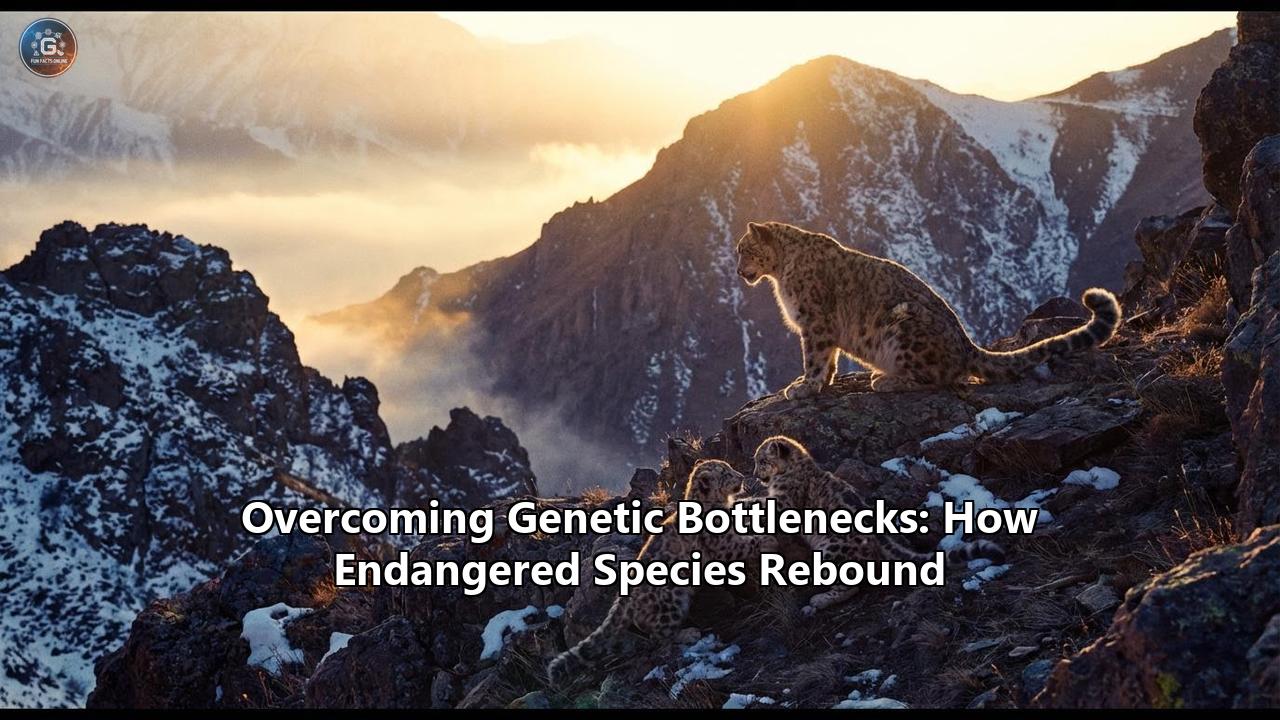
When we envision the extinction of a species, we usually picture a dramatic, visible catastrophe: a meteor striking the earth, a bulldozer clearing a rainforest, or a poacher’s rifle echoing across the savanna. Yet, for many of the world’s most endangered animals, the true battle for survival is waged invisibly, at the microscopic level of their DNA. Long after the poachers have been arrested and the habitat protected, a silent threat remains. This threat is the genetic bottleneck—a severe reduction in population size that strips a species of its genetic diversity, leaving the survivors deeply vulnerable to disease, environmental changes, and the insidious decay of inbreeding.
To understand how endangered species rebound from the brink of oblivion, we must look beyond mere population counts. Saving a species is not just about increasing its numbers; it is about rescuing its genetic legacy. Through a combination of natural evolutionary mechanisms and groundbreaking human interventions—ranging from cross-country translocations to advanced cloning and synthetic biology—scientists are discovering profound new ways to break these bottlenecks. The story of genetic bottlenecks is a story of life’s astonishing resilience, and a testament to how far we are willing to go to repair the living fabric of our planet.
The Anatomy of a Genetic Bottleneck
At its core, a genetic bottleneck is an evolutionary crucible. Imagine a species' genome as a vast, ancient library containing millions of books. These books represent the genetic diversity—the various alleles and traits—accumulated over hundreds of thousands of years of evolution. This diversity is what allows a population to adapt: if a new disease emerges, some individuals will possess the "book" containing the immune response to survive it; if the climate warms, some will have the genetic instructions to tolerate the heat.
When a population undergoes a sudden, drastic decline, the library catches fire. If a population of 100,000 animals is reduced to just 20, the vast majority of those books are burned forever. Even if conservationists step in and help those 20 survivors multiply back into a population of thousands, the new population is built entirely from the surviving library. The numbers may have recovered, but the genetic information is permanently lost.
This loss triggers a dangerous phenomenon known as "genetic drift," where chance events can cause the few remaining genetic variations to fluctuate wildly or disappear altogether. Worse, the surviving animals have no choice but to mate with their close relatives. Inbreeding increases the likelihood of "homozygosity"—a state where an individual inherits identical copies of a gene from both parents. Because many harmful, disease-causing mutations are recessive, they remain hidden in a large, diverse population. But when relatives mate, these hidden mutations suddenly find themselves paired up, expressing themselves as physical deformities, lowered fertility, and compromised immune systems. This phenomenon, known as inbreeding depression, can pull a species into an "extinction vortex," where poor health leads to fewer offspring, which leads to even more inbreeding, until the species collapses entirely.
Yet, nature has a way of defying the odds. And where nature struggles, modern science has begun to lend a hand.
The Ancient Survivor: The Cheetah’s Double Bottleneck
To see the long-term echoes of a genetic bottleneck, one need only look at the fastest land mammal on Earth. The cheetah is a marvel of biomechanical engineering, capable of reaching highway speeds in seconds. But beneath its sleek exterior lies a genome scarred by ancient traumas.
Unlike many species facing genetic crises today, the cheetah’s genetic uniformity is not primarily a modern, human-caused disaster. Scientific studies have revealed that cheetahs suffered two massive historical bottlenecks long before the invention of the rifle or the combustion engine. The first occurred roughly 100,000 years ago. Cheetahs originally descended from ancestors shared with the American puma, and as they expanded their range out of the Americas and across the Bering Strait into Asia, Europe, and Africa, the migrating populations dispersed in small groups. This rapid expansion over vast territories heavily restricted their gene flow.
The second, more devastating bottleneck took place between 10,000 and 12,000 years ago, coinciding with the end of the last Ice Age and a mass extinction event that wiped out many of the world's large vertebrates. The North American and European cheetahs were completely eradicated, leaving only a tiny handful of survivors in Africa and Asia. From this microscopic genetic pool, all modern cheetahs are descended.
The result is a species that is virtually a clone of itself. In the 1980s, researchers made a startling discovery: cheetahs possess such a uniform Major Histocompatibility Complex (MHC)—the set of genes responsible for the immune system's ability to recognize foreign invaders—that an individual cheetah will accept a skin graft from an entirely unrelated cheetah without its body rejecting the tissue. Biologically, unrelated cheetahs behave like identical twins.
This extreme lack of genetic variation comes with a heavy price. Today, cheetah populations are perilously vulnerable to diseases like Feline Coronavirus (FeCV), and they suffer from severely compromised reproductive systems. Studies show that between 70% and 80% of cheetah spermatozoa are malformed, compared to just 30% in domestic cats. While global populations hover around 6,500 to 7,100 individuals, their genetic fragility means that a single novel pathogen could theoretically wipe out the species.
To counter this, conservationists meticulously manage captive breeding programs using advanced studbooks to ensure the widest possible genetic spread. Furthermore, facilities like the Cheetah Conservation Fund have established biobanks, freezing hundreds of sperm and tissue samples. In recent years, breakthroughs in in vitro fertilization have allowed scientists to produce cheetah embryos and successfully transfer them to surrogates, buying the species vital time. The cheetah is living proof that a species can survive a near-total genetic wipeout, provided it is given enough time and space to stabilize.
The Poster Child of Genetic Rescue: The Florida Panther
While the cheetah's bottleneck is a relic of the Pleistocene, the Florida panther’s crisis was a distinctly modern tragedy—and its recovery represents one of the most successful, yet complex, human interventions in conservation history.
The Florida panther, a subspecies of the widespread puma, once roamed across the entire southeastern United States. Unrelated hunting and aggressive habitat destruction boxed the cats into less than 5% of their original territory, isolating them in the swamps of South Florida. By the 1990s, the situation was catastrophic. The wild population had plummeted to fewer than 30 individuals.
The effects of the genetic bottleneck were highly visible and gruesome. The panthers were suffering severe inbreeding depression: males exhibited cryptorchidism (undescended testicles) leading to sterility, congenital heart defects were rampant, and many animals sported distinctive kinked tails and cowlicks of fur on their backs. Scientists predicted that without immediate intervention, the Florida panther would be extinct within a century.
In 1995, conservationists made a highly controversial decision. To introduce fresh DNA and break the cycle of inbreeding, they translocated eight female pumas from West Texas into the Everglades. The logic was grounded in history: before human expansion fragmented their habitats, Texas pumas and Florida panthers would have naturally interbred at the edges of their territories.
The strategy, known as "genetic rescue," worked almost miraculously. The introduction of the Texas females rapidly reduced the occurrence of debilitating inbreeding traits, bolstering survival and reproductive rates. Thirty years later, the Florida panther population has rebounded tenfold, rising to an estimated 200 individuals.
However, genetic rescue is not without its anxieties. A major concern was "genetic swamping"—the fear that the unique genetic ancestry that made the Florida panther a distinct subspecies would be completely overridden and erased by the Texas DNA. But a landmark study published in the Proceedings of the National Academy of Sciences (PNAS) in July 2025 put these fears to rest. Researchers from UCLA, UC Berkeley, and the Florida Fish and Wildlife Conservation Commission sequenced the genomes of the post-translocation panthers. They found that while the rescue successfully decreased harmful homozygosity and increased overall genetic diversity, the original local ancestry of the Florida panther remained highly prevalent. Natural selection had favored the retention of traits suited to the Florida swamps while utilizing the Texas DNA to mask the harmful recessive mutations.
Yet, the 2025 study also offered a sobering caveat. While the total number of expressed harmful mutations dropped, those deleterious alleles were not entirely purged from the gene pool; they were simply hidden in a heterozygous state (paired with a healthy, dominant gene). The researchers warned that the benefits of the 1995 genetic rescue may be transient. As the population remains geographically boxed in, inbreeding will eventually inevitably rise again, meaning the Florida panther is now a "conservation-reliant" species that will require ongoing human management and perhaps future genetic infusions to survive.
Back from the Dead: The Black-Footed Ferret and the Clone Wars
If the Florida panther required a genetic rescue, the black-footed ferret required a biological resurrection. The story of North America’s only native ferret pushes the boundaries of modern science, taking us from the brink of extinction into the realm of synthetic biology and cloning.
The black-footed ferret, a slender predator that depends almost entirely on prairie dogs for food and shelter, was severely collateral damage in the 20th century. As farmers and ranchers systematically poisoned and exterminated prairie dogs across the American West, the ferret population crashed. By the mid-1970s, the species was presumed globally extinct.
Then, in 1981, a miraculous accident occurred. A ranch dog in Meeteetse, Wyoming, dropped a freshly killed animal on its owner’s porch. It was a black-footed ferret. This discovery led biologists to a tiny, hidden relict population. However, disease soon swept through the remaining colony. In a last-ditch effort to save the species, the U.S. Fish and Wildlife Service captured the remaining 18 wild ferrets to start a captive breeding program. Only seven of those individuals bred and passed on their genes. Every single black-footed ferret alive for the next three decades was descended from just those seven "founders," representing an extraordinarily tight genetic bottleneck.
As the population was reintroduced to the wild—slowly growing to around 400 to 500 individuals—the lack of genetic diversity left them highly susceptible to diseases like the sylvatic plague. But conservationists had a secret weapon: the "Frozen Zoo."
In the 1980s, visionary scientists at the San Diego Zoo Wildlife Alliance had the foresight to cryopreserve the living cells of several ferrets, including a female named Willa, who had died in 1988 without ever contributing offspring to the captive population. Because Willa was entirely distinct from the seven original founders, her frozen cells contained lost variations of the black-footed ferret genome.
Decades later, a biodiversity nonprofit named Revive & Restore partnered with cloning company ViaGen Pets and government agencies to attempt the impossible. Using interspecies somatic cell nuclear transfer (SCNT), scientists took Willa’s frozen genetic material, injected it into an empty egg cell from a domestic ferret, and implanted the embryo into a domestic ferret surrogate. On December 10, 2020, history was made: Elizabeth Ann was born. She was the first-ever clone of a native U.S. endangered species.
Elizabeth Ann proved that cloning was a viable tool to reach back in time and break a genetic bottleneck. However, her journey was not without hiccups. As she matured, Elizabeth Ann developed a condition known as hydrometra (fluid retention in the uterus) and an underdeveloped uterine horn, rendering her unable to breed. Because these conditions are common in ferrets, they were not attributed to the cloning process itself, but it temporarily stalled hopes of passing her vital DNA into the gene pool.
Scientists did not give up. Knowing the technique worked, they repeated it. In May 2023, two more clones from Willa’s cell line—Antonia and Noreen—were born. In 2024, the breakthrough finally arrived: Antonia mated and gave birth to three kits. This marked the first time in history that a clone carrying previously lost genetics successfully contributed offspring to an endangered population.
The success cascaded. By the summer of 2025, four more litters—a total of 12 kits—were born to Antonia, Noreen, and Antonia’s offspring. Willa, who had been dead for over 35 years, officially became the eighth founder of the species. By breaking the seven-founder bottleneck, scientists artificially restored genetic diversity that nature had erased. Furthermore, researchers are currently exploring CRISPR gene-editing technology as a complementary tool, hoping to tweak ferret DNA to make them innately resistant to the sylvatic plague. The ferret has shifted from a cautionary tale of extinction into a frontier of "intended consequences," proving that human biotechnology can actively heal the genetic fabric of the wild.
Avian Resurrections: Tracing Genomic Erosion
The skies, too, host survivors of intense genetic bottlenecks. The California Condor, North America’s largest land bird, provides a stark visualization of how a bottleneck permanently truncates a species' evolutionary history.
Due to lead poisoning, hunting, and habitat destruction, the California Condor population plunged to an agonizingly low 22 individuals by 1982. Conservationists made the dramatic choice to capture every remaining wild bird. The entire modern population, which now exceeds 500 individuals, is descended from just 14 genetic founders representing three genetic clans.
To understand what was lost in this process, scientists recently utilized "museomics"—extracting ancient DNA from historical museum specimens dating back centuries. The findings were staggering. Ancient DNA analysis revealed that prior to the bottleneck, the historical condor population possessed a minimum of 18 different mitochondrial DNA (mtDNA) haplotypes. The 14 founders of the captive program brought only 3 haplotypes with them. In essence, the California Condor lost more than 80% of its maternal genetic lineages in a matter of decades. While the birds have been saved from total extinction, their "genomic erosion" leaves them navigating a rapidly changing modern environment with only a fraction of their ancestral evolutionary tools.
Similar genomic erosion has been documented in island species, which are inherently prone to bottlenecks due to geographic isolation. The Seychelles Magpie Robin, an endangered passerine bird, faced a decline that coincided with human settlement of the islands about 250 years ago. The population cratered to a mere 20 to 30 individuals. Through intense conservation translocations, habitat restoration, and the provision of medical care and supplementary feeding, the population has rebounded to approximately 500 individuals spread across five islands. However, computer simulations analyzing their genome highlight the immense value of continued translocations—moving birds between islands—to enact continuous "genetic rescue" and halt the ongoing genomic erosion caused by island inbreeding.
The Paradox of Purging: How Do Some Thrive?
Given the devastating consequences of genetic bottlenecks, one might wonder: how do some species experience severe bottlenecks and yet emerge seemingly unscathed? This brings us to a fascinating evolutionary phenomenon known as "purging."
Consider the Northern Elephant Seal. In the late 19th century, commercial hunting for their valuable blubber decimated the species. By the 1890s, the global population of Northern Elephant Seals was reduced to an estimated 20 to 100 individuals on a single island off the coast of Mexico. From this incredibly tight bottleneck, the species was protected, and they exploded in number. Today, there are hundreds of thousands of Northern Elephant Seals dominating the Pacific coastline.
Despite undergoing a bottleneck as tight as the Florida panther’s or the black-footed ferret’s, the elephant seals show almost no signs of inbreeding depression. They don't have kinked tails; they don't have mass fertility issues. Why?
The answer lies in the speed and severity of the bottleneck, and the historic genetic load of the species. When populations decline slowly over thousands of years, slightly harmful recessive traits can drift and accumulate. But when a bottleneck happens instantly—such as a mass slaughter over a few decades—and the resulting extreme inbreeding happens quickly, the lethal and severely detrimental mutations are abruptly exposed in the homozygous state. The individuals carrying these twin defective genes simply die before they can reproduce.
This process rapidly "purges" the worst of the genetic load from the gene pool. The survivors of the Northern Elephant Seal slaughter happened to be relatively free of deleterious alleles. Thus, when they rebuilt their population, they were essentially building from a genetically narrow, but fundamentally healthy, set of blueprints.
However, purging is a dangerous gamble. It only works if the species has a high reproductive rate and a relatively clean gene pool to begin with, and it usually results in an absolute loss of adaptive diversity. Elephant seals might be thriving today, but their uniform genetics mean that if a novel respiratory virus adapted to marine mammals sweeps through the Pacific, the entire population could be uniquely vulnerable. They survived the bottleneck, but the invisible sword of genetic uniformity still hangs over their heads.
The Toolkit of Tomorrow: Biobanking and Synthetic Biology
As we move deeper into the 21st century, the fight to overcome genetic bottlenecks has evolved from a purely ecological discipline into a cutting-edge molecular science. We are no longer limited to just shuffling the remaining deck of living animals; we are learning how to print new cards.
Biobanking is the foundation of this new era. Facilities like the Frozen Zoo act as biological time machines, storing living cells, sperm, eggs, and embryos of thousands of threatened species at temperatures of -196°C. These repositories ensure that even if an animal dies without reproducing, its genetic diversity is not lost to the species. The successful cloning of Elizabeth Ann, Antonia, and Noreen from 35-year-old frozen cells is proof of concept that extinction is no longer necessarily permanent, so long as the DNA is preserved.
Looking forward, technologies like CRISPR-Cas9 offer the tantalizing possibility of targeted genetic rescue. If a bottleneck has stripped a species of its disease resistance, scientists could theoretically edit those defensive genes back into the population. For the black-footed ferret, researchers are already investigating how to edit immunity to the sylvatic plague directly into the genome. For species facing climate change, genes granting higher heat tolerance or better water retention could be synthesized and introduced.
This leads to a profound paradigm shift in conservation biology. For decades, the prevailing philosophy was one of preservation—fencing off habitats and minimizing human interference. Today, conservationists acknowledge the "Power of Intended Consequences". As the Revive & Restore team noted regarding the ferret cloning milestones, inaction and fear of the unknown often guarantee the extinction of a bottlenecked species. By actively intervening with advanced biotechnology, we can restore genetic diversity rather than accepting the bottleneck as an inevitable death sentence.
Conclusion: Stewards of the Helix
A genetic bottleneck is a stark reminder of the fragility of life. It demonstrates that a species' survival is dictated not just by the abundance of its habitat, but by the microscopic, invisible variability woven into its cells. When a species loses this diversity—whether through ancient glacial shifts like the cheetah, or modern human encroachment like the Florida panther—it loses the flexibility to navigate a changing world.
Yet, the rebounds of these species are equally a testament to extraordinary resilience. Nature possesses an astonishing capacity to persist, to purge its weaknesses, and to multiply against the odds. And where nature hits its absolute limit, human ingenuity has stepped into the breach.
We are the species that forced so many others through the terrifying crucible of a genetic bottleneck. But we are also the only species capable of understanding the double helix, sequencing genomes, tracking alleles, and using cloning and genetic rescue to undo our own damage. The recovery of the Florida panther, the cloning of the black-footed ferret, and the intensive management of the California condor show that extinction is not always a one-way street. By combining ecological conservation with cutting-edge genetics, we are not just saving animals; we are securing the ancient, complex, and beautiful library of life for generations to come.
Reference:
- https://blog.londolozi.com/2022/10/18/a-genetic-bottleneck-the-changes-of-cheetah-throughout-history/
- https://a-z-animals.com/articles/the-cheetahs-genetic-curse-how-ancient-inbreeding-still-haunts-the-fastest-cat-on-earth/
- https://pmc.ncbi.nlm.nih.gov/articles/PMC46261/
- https://pmc.ncbi.nlm.nih.gov/articles/PMC7149701/
- https://fastercapital.com/keyword/genetic-bottlenecks.html/1
- https://newsroom.ucla.edu/releases/florida-panther-conservation-success
- https://humanprogress.org/texas-puma-genes-rescue-florida-panthers-from-extinction/
- https://pubmed.ncbi.nlm.nih.gov/40720660/
- https://www.pnas.org/doi/10.1073/pnas.2410945122
- https://www.wusf.org/environment/2025-07-28/study-shows-recovery-florida-panthers-genetic-success-story
- https://www.nationalgeographic.com/animals/article/black-footed-ferret-clone-conservation-milestone
- https://viagenpets.com/news-article/elizabeth-ann-is-the-first-cloned-black-footed-ferret/
- https://en.wikipedia.org/wiki/Elizabeth_Ann
- https://reviverestore.org/five-years-later-black-footed-ferret-cloning-success-proves-the-power-of-intended-consequences/
- https://genedrivenetwork.org/es/blog/science-in-action-bringing-the-black-footed-ferret-back-from-the-brink/
- https://bioone.org/journals/the-condor/volume-118/issue-4/CONDOR-16-35.1/Ancient-DNA-reveals-substantial-genetic-diversity-in-the-California-Condor/10.1650/CONDOR-16-35.1.pdf
- https://pmc.ncbi.nlm.nih.gov/articles/PMC11212007/