
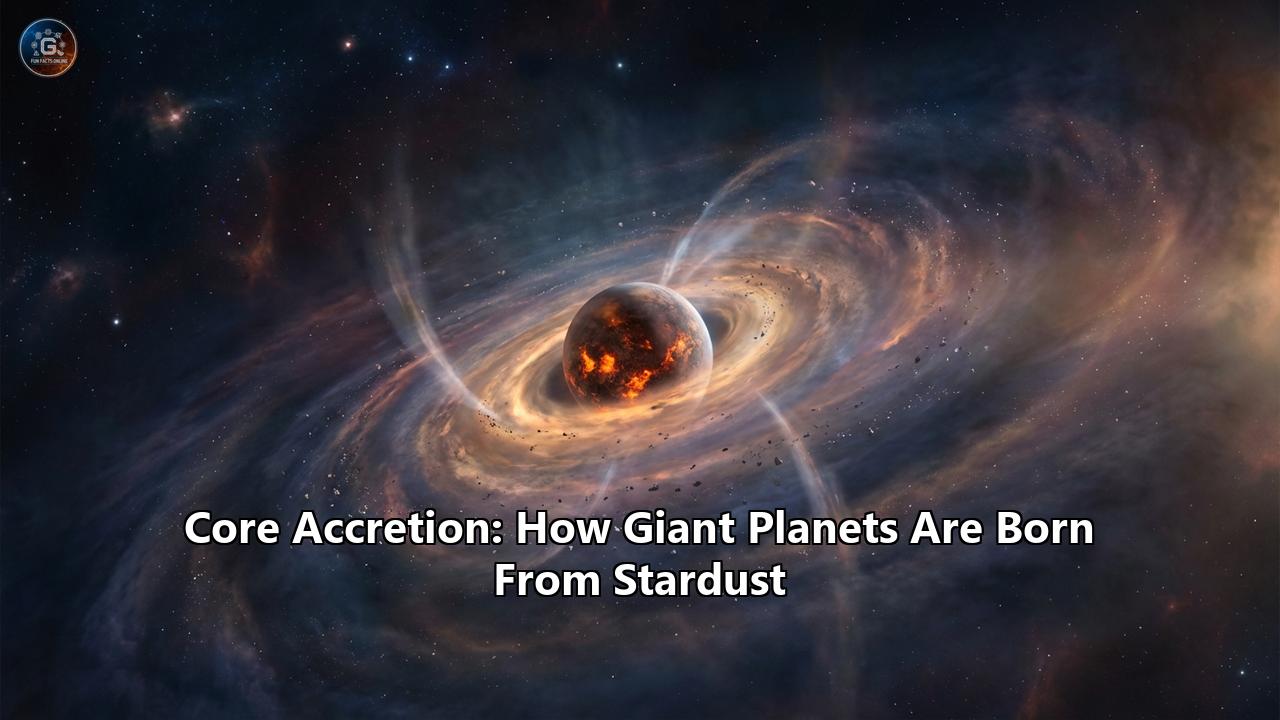
The darkness of a molecular cloud is not empty; it is pregnant with potential. In the vast, cold expanses between the stars, where temperatures hover just above absolute zero, the story of giant planets begins long before the first photon of a new sun cuts through the gloom. It is a story of gravity, friction, and an impossible race against time. It is the story of Core Accretion, the dominant theory explaining how the cosmos constructs its behemoths: Jupiter, Saturn, and the thousands of gas giants astronomers have detected in the deep dark of the Milky Way.
To understand the birth of a giant, one must first understand the architecture of its nursery. Stars are born from the collapse of giant molecular clouds, vast reservoirs of hydrogen gas and dust. As a fragment of this cloud collapses under its own gravity, conservation of angular momentum spins the material into a flattened, rotating disk. This is the protoplanetary disk, a swirling maelstrom of gas and solids that will serve as the feeding ground for the newborn planets.
In the center, the protostar ignites, bathing the inner disk in heat and radiation. But further out, beyond the "snow line"—the distance where it is cold enough for volatile compounds like water, ammonia, and methane to freeze into solid ice—the conditions are ripe for the construction of giants. Here, the density of solid material is effectively tripled. It is here, in the freezing outer reaches, that the seed of a Jupiter is planted.
The Dust Cycle: From Smoke to Pebbles
The most counterintuitive aspect of planet formation is that it starts with the smallest constituents imaginable. The "dust" in a protoplanetary disk is finer than cigarette smoke—microscopic grains of silicates, carbon, and ices no larger than a fraction of a micron. These grains are suspended in the gas, coupled tightly to its motions.
In the chaotic turbulence of the young disk, these dust grains collide. In the earliest stages, these collisions are gentle. Weak electrostatic forces, known as Van der Waals forces, allow the grains to stick together, forming fluffy, fractal aggregates. It is the cosmic equivalent of dust bunnies forming under a bed.
However, as these aggregates grow to the size of sand grains and then pebbles, they encounter the first of many "Great Barriers" in planet formation. This is the Radial Drift Problem.
To understand radial drift, we must look at the aerodynamics of the disk. The gas in the disk is supported by pressure; it orbits the star slightly slower than the velocity required by pure gravity (Keplerian velocity). The solid particles, however, do not feel this pressure support; they want to orbit at the full Keplerian speed. The result is a constant headwind. The gas drags on the solid particles, sapping their orbital energy and causing them to spiral inward toward the star.
For microscopic dust, this effect is negligible. For kilometer-sized rocks, the drag is irrelevant. But for objects roughly a meter in size, this drag is catastrophic. Mathematical models suggest that a meter-sized boulder in a protoplanetary disk should spiral into the sun in as little as 100 years. If this were the whole story, planets would never form; the building blocks would be incinerated in the star before they ever had the chance to coalesce.
The Pebble Revolution
For decades, the "Meter-Size Barrier" plagued astrophysicists. The classical solution was that if you could somehow force enough material together quickly, gravity would take over. But how?
The answer came with the realization of a hydrodynamic phenomenon known as the Streaming Instability. This is a mechanism that allows solids to skip the meter-size phase entirely. When pebbles—centimeter-sized icy rocks—concentrate in the midplane of the disk, they begin to affect the gas around them. If enough pebbles gather, they can force the gas to move with them, reducing the headwind. This creates a feedback loop: a clump of pebbles reduces drag, causing it to drift slower than individual pebbles. Faster-moving isolated pebbles catch up to the clump, joining the traffic jam.
Rapidly, the density of this pebble swarm becomes so high that the collective gravity of the swarm causes it to collapse instantly. In a geological blink of an eye, a cloud of pebbles transforms into a solid object 100 to 1,000 kilometers across. A "planetesimal" is born.
This is the foundation of the modern understanding of Core Accretion. We no longer view it as a slow, steady sticking of rocks. It is a dynamic, violent process where aerodynamic physics concentrates solids into the seeds of worlds.
Oligarchic Growth: The Battle for Mass
Once a population of planetesimals exists, the rules of the game change. Gravity becomes the dominant force. The largest planetesimals, the "oligarchs," begin to dominate their local neighborhoods.
This phase is governed by gravitational focusing. A large body acts like a gravitational net. As smaller rocks fly past, the gravity of the oligarch bends their paths, pulling them in for a collision. The larger the oligarch gets, the stronger its gravity, and the more effectively it attracts more mass. This is a runaway process.
However, the classical view of planetesimals smashing into planetesimals has recently been upgraded by the theory of Pebble Accretion. This is perhaps the most significant shift in planetary science in the 21st century.
In the old models, a protoplanet grew by colliding with other large rocks. This was slow—painfully slow. It would take tens of millions of years to build a core large enough to become Jupiter. But observations of other stars show that gas disks dissipate in only 2 to 3 million years. The old theory was too slow to work.
Pebble accretion solves the time crisis. A large planetary embryo, roughly the mass of the Moon, interacts differently with the sea of small pebbles flowing past it. As pebbles drift by, they are slowed by gas drag within the embryo’s gravitational field. This drag robs the pebbles of their energy, causing them to spiral down onto the embryo.
Because pebbles are so abundant and because the embryo can pull them in from a huge cross-section of the disk, the growth rate explodes. A planetary core can grow from the mass of Mars to 10 Earth masses in just a few hundred thousand years. This speed is the key that unlocks the formation of giant planets. It explains how a world can grow big enough, fast enough, to catch the gas before it vanishes.
The Critical Mass: Crossing the Threshold
The goal of a budding giant planet is to reach the "Critical Core Mass." This is generally calculated to be around 10 times the mass of Earth.
At this stage, the protoplanet is a massive ball of rock and ice, likely surrounded by a thick, steaming atmosphere of gas it has gravitationally bound from the nebula. But it is not yet a gas giant. It is a "Super-Earth" or a "Mini-Neptune." The atmosphere is in hydrostatic equilibrium; the heat generated by the impacting pebbles keeps the gas hot and pressurized, preventing it from collapsing.
This is a delicate stalemate. The core is trying to pull more gas in, but the heat of formation pushes the gas out. The rate of growth is limited by how fast the planet can cool down. It must radiate its heat away into space to allow the atmosphere to contract and make room for more gas.
But as the mass of the core increases, a tipping point is reached. The gravity becomes so intense that the pressure support of the gas can no longer hold it back. The equilibrium breaks.
Runaway Gas Accretion: The Feeding Frenzy
Once the critical mass is crossed, the process shifts from linear growth to exponential explosion. The atmosphere collapses onto the core. This collapse increases the gravity, which pulls in more gas, which increases the gravity further.
This is the birth scream of a gas giant. In a period of perhaps only 10,000 to 100,000 years—a fleeting moment in cosmic time—the planet consumes everything in its vicinity. It becomes a hydrodynamic sink. Gas from the disk flows onto the planet in streams, often forming a circumplanetary disk (a miniature version of the solar nebula) around the equator of the growing giant.
It is within this circumplanetary disk that moons form. The Galilean moons of Jupiter—Io, Europa, Ganymede, and Callisto—are essentially a miniature solar system formed from the leftovers of Jupiter's gluttonous feast.
The planet grows until it opens a gap in the disk. Its gravity is now so dominant that it clears a lane in the protoplanetary nebula. The gas supply begins to choke off. The flow of gas changes from a deluge to a trickle, fed only by streamers that bridge the gap.
At this point, the planet has reached its final mass. Jupiter, for instance, stopped at 318 times the mass of the Earth. Saturn stopped at 95.
The Dilute Core: A New Mystery
For decades, the standard model of Core Accretion ended with a neat picture: a distinct, solid core of rock and ice (about 10-20 Earth masses) buried beneath a massive envelope of metallic hydrogen and helium.
However, science is never settled. The NASA Juno mission, which arrived at Jupiter in 2016, provided gravity measurements of unprecedented precision. These measurements allowed scientists to peer deep into the planet’s interior. What they found shocked the planetary science community.
Jupiter does not appear to have a compact, solid core. Instead, it has a "dilute" or "fuzzy" core. The heavy elements (rock and ice) are spread out across nearly half the planet's radius, gradually mixing with the hydrogen envelope. There is no sharp boundary where the rock ends and the gas begins.
This discovery has forced a rewrite of the Core Accretion history. How do you get a fuzzy core?
There are two leading theories. The first is a violent youth. Perhaps Jupiter formed with a solid core, but shortly after its formation, it was impacted by a massive planetary embryo—a collision with a body 10 times the mass of Earth. Such an impact would have shattered the core and churned the heavy elements up into the gas envelope, creating the diffuse structure we see today.
The second theory is "erosion." As the massive amount of gas accreted onto the core during the runaway phase, the immense heat and pressure might have dissolved the core. Just as water dissolves a sugar cube, the metallic hydrogen ocean might have eaten away the rocky center, redistributing the material upward.
This implies that the "Core" in Core Accretion is not a permanent monument, but a transient scaffold—essential for construction, but dissolved by the very structure it helped build.
The Ice Giant Problem: Uranus and Neptune
If Core Accretion is so efficient, why are Uranus and Neptune so small? They are roughly 14 and 17 Earth masses, respectively—barely above the critical threshold. They have massive atmospheres, but they are not true gas giants like Jupiter. They are "Ice Giants," dominated by water, ammonia, and methane ices rather than hydrogen and helium.
The answer lies in the timeline. The solar nebula was not uniform. It was denser in the center and thinner at the edges. Uranus and Neptune formed much further out, where the density of pebbles and planetesimals was lower.
They grew slower. By the time their cores reached the critical mass of 10 Earth masses—the starting gun for runaway gas accretion—the race was already over. The sun had blown the gas disk away.
Photoevaporation, driven by the intense ultraviolet light of the young sun (and nearby massive stars), strips the protoplanetary disk of its gas after a few million years. Uranus and Neptune were the late bloomers. They were just starting to pull in gas when the kitchen closed. They are "aborted giants," planetary embryos that were frozen in time, never allowed to reach their full potential.
Migration: The Wandering Worlds
Planets do not stay where they are born. This realization, solidified by the discovery of "Hot Jupiters" in other solar systems, is a crucial addendum to Core Accretion.
As a planet grows in the disk, it generates waves in the gas, much like a boat moving through water. The gravity of these density waves pulls on the planet. This interaction, known as Type I Migration, usually robs the planet of orbital energy, causing it to spiral inward rapidly.
This poses a danger. If migration is too fast, the growing core will fall into the star before it can become a giant. Theoretical models struggle to explain why all planets don't die this way. It likely involves "traps" in the disk—regions where changes in temperature or density (like the snow line) halt the inward migration.
Once the planet becomes a giant and opens a gap, it enters Type II Migration. It becomes locked to the viscous evolution of the disk itself. If the disk is spiraling into the star, the planet rides along with it.
In our own solar system, the "Grand Tack" hypothesis suggests that Jupiter migrated inward to where Mars is today, before being caught by Saturn (which migrated in faster) and pulled back out by a gravitational resonance. This wandering sculpted the asteroid belt and stunted the growth of Mars, explaining why the Red Planet is so small compared to Earth.
The Legacy of Stardust
The theory of Core Accretion is a triumph of modern astrophysics, linking the microscopic physics of dust grains to the macroscopic architecture of solar systems. It explains the correlation between a star's "metallicity" (abundance of heavy elements) and its likelihood of hosting giant planets. Stars with more heavy elements have more dust; more dust means faster core growth; faster core growth means a higher chance of beating the clock to become a giant.
Today, instruments like the Atacama Large Millimeter/submillimeter Array (ALMA) allow us to see this process in action. We see the dark rings in the disks of young stars like HL Tauri—the footprints of invisible giants clearing their lanes. We see the clumps and the spirals. We are witnessing the birth of new worlds.
Giant planets are the anchors of planetary systems. Their gravity shields inner terrestrial worlds from cometary bombardment or, conversely, hurls water-rich asteroids inward to deliver the oceans. They are the architects. And it all begins with the humble accretion of a core, a seed of ice and rock that dared to grow large enough to capture the sky.
Section II: The Physics of the Nursery
To truly appreciate the mechanism of Core Accretion, one must delve deeper into the physical environment of the Protoplanetary Disk. This is not merely a cloud of gas; it is a complex, evolving machine governed by thermodynamics, magnetohydrodynamics (MHD), and chemistry.
The disk is flared, meaning it gets thicker as you move away from the star, shaped like two Frisbees glued back-to-back. This geometry is crucial. It dictates how much starlight the outer disk intercepts. The surface layers of the disk are hot, bombarded by X-rays and UV radiation from the star. The midplane—the "equator" of the disk where planets form—is cold and dark, shielded by the dust.
The Snow Line (or Frost Line):This boundary is the single most important demarcation in planet formation. Inside the snow line (closer to the star), water exists only as vapor. Solids here are purely rocky (silicates) and metallic. Since rock and metal make up only about 1% of the mass of the nebula, there is very little material available to build planets. This is why the inner planets (Mercury, Venus, Earth, Mars) are small and rocky.
Outside the snow line, water freezes into solid ice grains. Since water is abundant (made of Hydrogen and Oxygen, the 1st and 3rd most common elements in the universe), the amount of solid material jumps by a factor of 3 to 4. Suddenly, there is enough "stuff" to build massive cores quickly. This explains why the gas giants in our solar system—and many exoplanetary systems—are found at distances of 5 AU and beyond.
Turbulence and the Dead Zone:The gas in the disk is not stagnant. It is turbulent, stirred by magnetic fields interacting with ionized gas (the Magnetorotational Instability, or MRI). Turbulence is a double-edged sword. On one hand, it prevents dust from settling into a razor-thin layer, which delays the formation of planetesimals. On the other hand, it creates pressure bumps and vortices—hurricane-like storms in the disk.
These vortices can act as "dust traps." Just as leaves collect in the eddy of a river, dust and pebbles can get trapped in the high-pressure center of a disk vortex. In these traps, the local density of solids can skyrocket, triggering the streaming instability and birthing planetesimals in batches.
Modern simulations suggest that the "Dead Zone"—a region in the disk where the gas is too cool and neutral to be ionized, and thus immune to magnetic turbulence—is the ideal location for planet formation. The air is "still" here, allowing dust to settle and pile up. It is no coincidence that the Earth and Jupiter likely formed near the boundaries of these quiescent zones.
Section III: The Enigma of Super-Earths
One of the most surprising discoveries of the Kepler Space Telescope was the abundance of "Super-Earths" and "Sub-Neptunes"—planets with masses between Earth and Neptune. Our solar system has none. Yet, they appear to be the most common type of planet in the galaxy.
Core Accretion explains these worlds as "stalled" giants. They are cores that formed late, or in gas-poor disks. They grew large enough to accrete some gas (becoming puffy sub-Neptunes) but missed the window for runaway growth.
Alternatively, they may be the result of "in-situ" formation. Standard Core Accretion suggests giants form far out. But what if the disk is massive enough to form rocky cores close to the star? This is difficult because of the lack of ices. However, if a swarm of icy pebbles drifts inward from the outer disk, they can sublime (turn to gas) as they cross the snow line, or they can be accreted by rocky embryos just inside the line.
Recent theories propose that Super-Earths are actually failed gas giant cores that migrated inward. As they moved close to the star, the intense radiation stripped away their thick gas envelopes, leaving behind the naked, rocky core. This population of "Evaporated Cores" links the formation of gas giants directly to the rocky worlds we observe.
Section IV: The Future of the Theory
Core Accretion is currently the champion of planet formation theories, defeating the rival "Disk Instability" theory (which proposes planets form from the direct gravitational collapse of gas clumps, like mini-stars) for the vast majority of observed planets. Disk Instability is still required to explain massive planets that orbit very far from their stars (at 50 or 100 AU), where core accretion is too slow to work.
However, Core Accretion is facing new challenges. The "Core Mass Mystery" remains: why are some exoplanet cores apparently much lighter or heavier than theory predicts? The answer likely lies in the complex chemistry of the disk—how carbon, nitrogen, and oxygen are partitioned between gas and dust.
The James Webb Space Telescope (JWST) is currently revolutionizing this field by measuring the atmospheric composition of exoplanets. If Core Accretion is true, the atmospheres of giant planets should be enriched in heavy elements relative to their stars (because they ate so many solid planetesimals). If Disk Instability is true, the composition should match the star perfectly.
Early results from JWST strongly favor Core Accretion. We are seeing high metallicities, water features, and carbon enrichment that speak of a history of violent consumption of solids.
As we stare up at Jupiter, we are not just seeing a ball of gas. We are looking at a fossil of the early solar system. We are looking at the winner of a chaotic, violent race that took place 4.5 billion years ago. We are looking at the "King of the Gods," born from the humblest of beginnings: a single grain of dust, sticking to another, in the cold dark.
Deep Dive: The Hydrodynamics of Gas Capture
To fully grasp the "Runaway Growth" phase—the most dramatic event in a planet's life—we must look at the thermodynamics of the envelope.
When a core is small (Earth-mass), the gas atmosphere around it is thin and transparent. Heat generated by the accretion of new planetesimals radiates away into space easily. The atmosphere stays cool and static.
As the core grows to 5 or 10 Earth masses, the atmosphere becomes thick and opaque. It acts like a blanket, trapping heat. This trapped heat prevents the gas from compressing. The planet is "choked" by its own warmth. Growth slows down. This is the bottleneck of planet formation.
The breakthrough happens when the mass of the envelope equals the mass of the core. This is the "Crossover Mass." At this point, the self-gravity of the gas becomes significant. The weight of the gas compresses the layers below, which increases the density, which increases the cooling rate (paradoxically, denser gas can sometimes cool more efficiently depending on opacity). The atmosphere becomes unstable. It collapses catastrophically.
This collapse creates a vacuum effect. Fresh gas from the disk rushes in to fill the void. This fresh gas brings its own gravity, triggering further collapse. The growth rate is now limited only by how fast the disk can supply gas.
This is where the geometry of the flow becomes complex. It is not a spherical inflow. Because the planet is rotating and orbiting, the gas enters via two polar streams and flows out through the equator, creating a "meridional circulation." This complex 3D flow determines how much rotation the planet ends up with. It is why Jupiter spins so fast (a day on Jupiter is less than 10 hours).
The Role of Magnetic Fields
We often ignore magnetic fields in simple models, but they are crucial. The young sun has a powerful magnetic field, and the protoplanetary disk is slightly ionized. This couples the disk to the star.
As the planet opens a gap, it might sever the magnetic field lines, or it might funnel ionized gas along field lines onto its poles (similar to an aurora). This magnetic interaction can act as a brake, slowing the planet's rotation, or as a funnel, speeding up accretion.
The interaction between the planet's own emerging magnetic field (generated by its churning metallic hydrogen core) and the disk's field is a frontier of modern research. It is thought that this interaction might help truncate the disk, stopping the planet from growing indefinitely and becoming a brown dwarf.
Detailed Look: The Nice Model and the Grand Tack
We cannot talk about the formation of Jupiter and Saturn without discussing how they shaped the rest of the solar system. The "Grand Tack" hypothesis proposes a dramatic dance.
Phase 1: Inward Migration.Jupiter formed first. It began to migrate inward due to Type II migration (riding the viscous conveyor belt of the disk). It moved from perhaps 3.5 AU into 1.5 AU. As it plowed through the asteroid belt region, it scattered material everywhere, truncating the disk of material available for Mars. This explains why Mars is only 10% the mass of Earth—Jupiter ate its lunch.
Phase 2: The Resonance.Saturn formed later and migrated inward faster. Eventually, it caught up to Jupiter. The two giants locked into a 2:3 Mean Motion Resonance (Jupiter orbits 3 times for every 2 Saturn orbits).
Phase 3: The U-Turn (The Tack).This resonance changed the torque balance on the planets. Instead of clearing the disk in a way that pushed them in, the gap overlap caused the net torque to reverse. The two planets, locked in a gravitational embrace, reversed course. They migrated outward, plowing back through the asteroid belt a second time, and settling into their current orbits of 5.2 and 9.5 AU.
Phase 4: The Instability (The Nice Model).Billions of years later (or perhaps just millions), the interaction with the leftover debris field (the Kuiper Belt) destabilized the orbits of the giants again. Jupiter moved slightly in; Saturn, Uranus, and Neptune moved out. In many simulations, Neptune and Uranus actually swapped places. This violent reshuffling triggered the "Late Heavy Bombardment," a period of intense meteor impacts that scarred the Moon and Earth.
This narrative underscores that Core Accretion is not just about building a planet; it is about setting the stage for the dynamical evolution of the entire system.
Exoplanetary Context: Hot Jupiters
The discovery of 51 Pegasi b in 1995—the first exoplanet around a sun-like star—broke the classical Core Accretion model. It was a Jupiter-mass planet orbiting its star in just 4 days. It was hotter than a blast furnace.
Core Accretion says you cannot form a gas giant that close. There is no ice there. The "stuff" needed to build the core doesn't exist at 0.05 AU.
This forced the introduction of migration theory. 51 Pegasi b formed far out, past the snow line, via standard Core Accretion. Then, it migrated inward. But unlike Jupiter, it didn't have a Saturn to pull it back. It kept going until it stopped just short of the star, likely halted by the tidal interaction with the star or the inner edge of the disk (where the magnetic field of the star clears a hole).
These "Hot Jupiters" are the lonely survivors. For every one we see, there may be dozens of planets that migrated all the way in and were consumed by their stars. Core Accretion is a dangerous game; it produces many failures for every success.
Conclusion: The Universal Recipe
Core Accretion appears to be the universal recipe for planet formation. From the dust bunnies under a bed to the majestic rings of Saturn, the physics is continuous. It relies on the simple power of sticking together, the relentless pull of gravity, and the complex dance of gas and dust.
As we look to the future, with missions like the Roman Space Telescope and the Habitable Worlds Observatory, we will test the limits of this theory. We will look for Earth-twins. If Core Accretion is correct, they should be there, hidden in the data, the quiet, rocky siblings of the boisterous giants.
The story of a giant planet is a story of luck. It must start early. It must grow fast. It must avoid spiraling into the fire. And it must stop eating before it becomes a star. Jupiter is the winner of this cosmic lottery, and because it won, it shielded the inner solar system, allowing a small, wet rock called Earth to survive and dream about how it all began.
Reference:
- https://www.stsci.edu/contents/news-releases/2025/news-2025-113
- https://www.almaobservatory.org/en/press-releases/exoalma-survey-reveals-incredible-images-of-structures-in-protoplanetary-disks/
- https://astrobiology.com/2025/05/alma-inspires-new-models-for-the-evolution-of-planet-forming-disks.html
- https://blog.planethunters.org/tag/core-accretion/
- https://en.wikipedia.org/wiki/Pebble_accretion
- https://www.youtube.com/watch?v=XO0P9G5dmTA
- https://www.quantamagazine.org/scientists-debate-if-cosmic-pebbles-create-rocky-planets-like-earth-20211103/
- https://www.semanticscholar.org/paper/100601fe31b17329f5847159c9783bb5973408b0
- https://academic.oup.com/mnras/article/464/1/428/2194698
- https://www.researchgate.net/publication/343398054_Pebbles_versus_planetesimals_The_outcomes_of_population_synthesis_models
- https://www.spacedaily.com/reports/Jupiter_core_mystery_not_explained_by_giant_planetary_impact_999.html
- https://www.youtube.com/watch?v=iTHApjlyVa0
- https://science.nasa.gov/jupiter/jupiter-facts/
- https://www.missionjuno.swri.edu/science-findings/jupiters-dilute-core
- https://en.wikipedia.org/wiki/Jupiter
- https://aasnova.org/2025/05/28/monthly-roundup-a-deep-view-of-planet-forming-disks-with-alma/
- https://www.universetoday.com/articles/alma-observes-the-missing-link-in-exoplanet-formation
- https://scitechdaily.com/james-webb-unveils-a-mysterious-planet-unlike-anything-in-our-solar-system/
- https://www.space.com/astronomy/james-webb-space-telescope/how-are-gas-giant-exoplanets-born-james-webb-space-telescope-provides-new-clues