
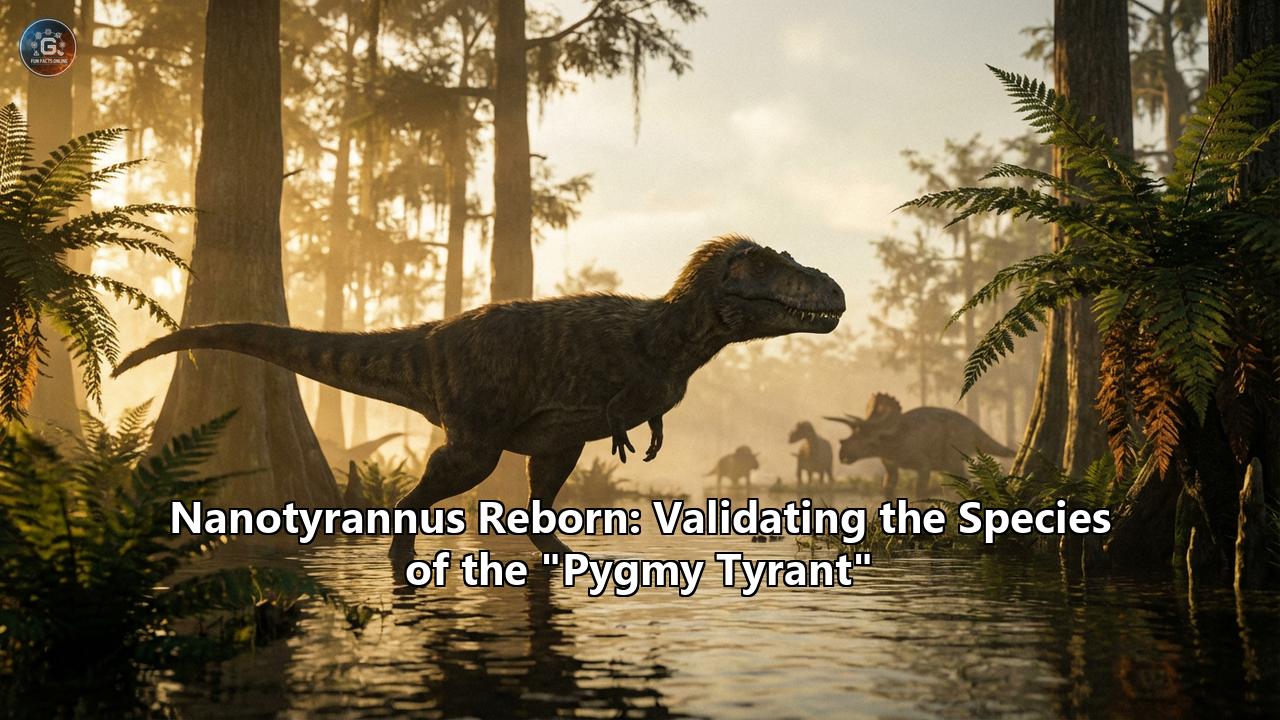
For nearly eighty years, a phantom has haunted the badlands of Montana. In the shadow of the most famous dinosaur of all time, Tyrannosaurus rex, a smaller, sleeker, and more mysterious predator stalked the Cretaceous floodplains. For decades, paleontologists have fought a bitter civil war over this creature's identity. Was it merely a "Teen Rex"—an awkward adolescent destined to grow into a bone-crushing giant? Or was it something else entirely? A distinct species of "pygmy tyrant" that lived, hunted, and died alongside the King?
As of late 2025, the debate that has fractured the paleontological community has been blown wide open. Thanks to a "one-two punch" of groundbreaking studies, a stunning new fossil skeleton, and a microscopic look at a throat bone, the verdict is in: Nanotyrannus is reborn.
This is the story of how new technology and old bones combined to rewrite the final chapter of the Age of Dinosaurs.
Part I: The History of a Headache
To understand the magnitude of the recent discoveries, we must first understand why Nanotyrannus has been the most controversial dinosaur in history.
The story began in 1942, when a field crew from the Cleveland Museum of Natural History unearthed a small, beautifully preserved skull in the Hell Creek Formation of Montana. It was unmistakably a tyrannosaur—sharp teeth, boxy snout, forward-facing eyes—but it was tiny, barely two feet long. In 1946, it was described as a new species of Gorgosaurus.
It wasn't until 1988 that legendary paleontologist Robert Bakker, along with colleagues Phil Currie and Michael Williams, re-examined the skull. They noticed the skull bones were fused tight—a sign of adulthood in many animals. They argued this wasn't a baby anything. It was a pocket-sized predator, a new genus they christened Nanotyrannus lancensis ("Small Tyrant from the Lance").
But the victory was short-lived. In 1999, paleontologist Thomas Carr published a seminal paper arguing that tyrannosaurs underwent drastic changes as they grew. He proposed that the "distinctive" features of Nanotyrannus—the higher tooth count, the compressed teeth, the elongated snout—were simply juvenile traits that would disappear as the animal bulked up into a T. rex. The "Pygmy Tyrant" was demoted to a "Teen Rex."
For twenty years, this was the consensus. Famous specimens like "Jane," a juvenile tyrannosaur found by the Burpee Museum in 2001, were labeled as juvenile T. rex. The idea of a separate small tyrannosaur species was treated as a fringe theory, kept alive by only a handful of die-hard supporters.
Until now.
Part II: The Dueling Dinosaurs Revelation (2024-2025)
The tide began to turn in January 2024, when researchers Nick Longrich and Evan Saitta published a controversial study in Fossil Studies. They identified over 150 anatomical differences between Nanotyrannus and T. rex, arguing that no amount of growth could transform one into the other. They noted that the growth rings in the bones of Nanotyrannus specimens were packing together towards the outside—a tell-tale sign that the animals were slowing down their growth, effectively reaching adulthood at a fraction of T. rex's size.
But the real "mic drop" moment arrived in October 2025, with the publication of a landmark paper in Nature by Lindsay Zanno and James Napoli.
The focus of their study was the "Dueling Dinosaurs" specimen—one of the most spectacular fossils ever found. Discovered in 2006 but locked in legal battles and private storage for years, the fossil preserves a Triceratops and a tyrannosaur buried together, seemingly in combat. When the North Carolina Museum of Natural Sciences finally acquired the specimen, Zanno's team went to work.
The tyrannosaur, nicknamed "Bloody Mary," was the Rosetta Stone the Nanotyrannus camp had been waiting for.
The Arms That Changed History
The most shocking revelation came from the arms. Tyrannosaurus rex is infamous for its tiny, two-fingered arms. The logic of the "Teen Rex" hypothesis was that a juvenile's arms would start small and stay small.
"Bloody Mary" shattered this assumption. The specimen possessed massive, powerful arms—proportionally far longer than any T. rex, adult or juvenile. Even more damning, the hand preserved a clear vestigial third finger. T. rex has two fingers. For a Nanotyrannus to grow into a T. rex, it would have to shrink its arms, lose a finger, and completely restructure its shoulder girdle. As Zanno noted, "For Nanotyrannus to be a juvenile T. rex, it would need to defy everything we know about vertebrate growth."
The Tale of the Tail
The differences didn't stop at the arms. The researchers counted the vertebrae in the tail. T. rex typically has a long, balancing tail with roughly 40-44 vertebrae. The Nanotyrannus specimen? Only 35. Animals do not grow extra vertebrae as they age. This fixed anatomical difference was a nail in the coffin for the "Teen Rex" theory.
Part III: The Smoking Gun in the Throat
If the "Dueling Dinosaurs" provided the anatomical map, a study published just two months later, in December 2025, provided the biological clock.
Led by Christopher Griffin of Princeton University and published in Science, this team tackled the original 1942 Cleveland skull (the holotype). Since the skull lacked legs (where paleontologists usually count growth rings), its age had always been ambiguous. Griffin used a novel technique: he sliced into the hyoid bone—the delicate, wishbone-shaped strut in the throat that supports the tongue.
In many reptiles and dinosaurs, the hyoid preserves a record of growth similar to a tree trunk. When Griffin placed the Nanotyrannus hyoid under the microscope, he didn't see the wide, spacious rings of a fast-growing youngster. He found tight, compacted lines at the bone's surface—an "External Fundamental System" (EFS).
An EFS only forms when an animal has stopped growing. It is the biological signature of maturity.
"The throat bone did not lie," Griffin stated. The holotype specimen—the very fossil that defined Nanotyrannus—was not a baby. It was an adult animal that died at full size.
Part IV: A Tale of Two Nanos
The revival of the genus brought another surprise. As researchers re-examined all the fossils previously lumped into the "juvenile T. rex" bin, they realized they weren't looking at just one species.
The 2025 Zanno & Napoli paper proposed a split in the Nanotyrannus family tree:
- _Nanotyrannus lancensis_: This is the classic "Pygmy Tyrant," represented by the original Cleveland skull and the new "Bloody Mary" specimen. It is the smaller of the two, a nimble hunter weighing around 700-800 kg (1,500 lbs).
- _Nanotyrannus lethaeus_: This new species was named for the famous "Jane" specimen (BMRP 2002.4.1). Previously the poster child for the "Teen Rex" hypothesis, "Jane" was found to be distinct from the lancensis type. N. lethaeus (named after the River Lethe, the river of forgetfulness, symbolizing how the species was "forgotten" by science) was a larger, more robust animal, potentially reaching 1,200 kg (2,600 lbs).
This means the Hell Creek ecosystem wasn't just home to one tyrant; it was a dynasty of different species.
Part V: Anatomy of a Ghost
So, what did Nanotyrannus actually look like? If you were standing on a Cretaceous floodplain 66 million years ago, how would you tell it apart from a young T. rex?
- The Speed Demon: While T. rex was a power-walker built for endurance and crushing force, Nanotyrannus was built for speed. It had incredibly long metatarsals (foot bones) and a gracile, lightweight frame. It was likely the cheetah to the T. rex's lion.
- The Arms: As mentioned, the arms were formidable. While T. rex arms were small grappling hooks, Nanotyrannus had long, slashing forelimbs with large claws. They were likely used actively in hunting, perhaps to snag smaller, faster prey that T. rex couldn't catch.
- The Teeth: T. rex is famous for its "railroad spike" teeth—thick, round bananas designed to crush bone. Nanotyrannus had "ziphodont" teeth—thin, blade-like, and laterally compressed. These were slicing knives, not bone crushers.
- The Brain: CT scans of the skull reveal a different brain structure. Nanotyrannus had a distinct arrangement of cranial nerves and sinuses, suggesting it engaged with its environment differently than its larger cousin.
Part VI: The Ecological Shockwave
The validation of Nanotyrannus forces a complete rewrite of Late Cretaceous ecology.
For years, the dominant theory was "Ontogenetic Niche Partitioning." This idea suggested that T. rex babies filled all the ecological roles: hatchlings ate bugs, teenagers ate medium-sized dinosaurs, and adults ate the big stuff. In this model, T. rex was so dominant it squeezed out all other mid-sized predators.
The return of Nanotyrannus destroys this monopoly. It proves that the "mid-sized predator" niche was actually filled by a distinct, specialized species (or two!).
Imagine the Hell Creek ecosystem now:
- The Apex: Adult T. rex (8 tons) hunting Edmontosaurus and Triceratops.
- The Middleweight: Nanotyrannus lethaeus (1.2 tons) taking down sub-adult herbivores.
- The Welterweight: Nanotyrannus lancensis (700 kg) chasing down swift ornithomimids and pachycephalosaurs.
- The Raptor: Dakotaraptor (300 kg) acting as the ambush predator.
This was a diverse, complex, and dangerous world—far more crowded than we previously thought.
Part VII: The Skeptics Remain
Science is rarely unanimous. Despite the "mic drop" evidence of 2025, some paleontologists remain unconvinced. The "Juvenile T. rex" camp, led by researchers like Thomas Carr and Holly Woodward, has argued that the "EFS" found in the hyoid could be a false signal, or that the "distinct" features are just extreme individual variations.
They point out that we still lack a complete growth series for T. rex if we remove all the Nanotyrannus specimens. Where are the actual teenage T. rexes? Proponents of Nanotyrannus argue they are simply rare, or that fossils like the "Jordan Theropod" represent the true juvenile T. rex form, which looks nothing like Nanotyrannus.
However, with the convergence of evidence from anatomy (the arms), osteology (the tail counts), and histology (the growth rings), the burden of proof has shifted. The "Teen Rex" hypothesis now has to explain how a dinosaur could shrink its arms, lose a finger, change its tooth shape, and lose tail vertebrae as it grew—a biological feat that seems increasingly impossible.
Conclusion: The King Has Company
The resurrection of Nanotyrannus is more than just a name change. It is a testament to the self-correcting nature of science. For decades, we looked at the same bones and saw what we expected to see. We saw a baby King because we assumed the King ruled alone.
But the fossils have finally spoken for themselves. Nanotyrannus was real. It was a fierce, agile, and successful predator that thrived in the shadow of giants for a million years. The "Pygmy Tyrant" has reclaimed its throne, reminding us that even in the most studied rocks on Earth, there are still monsters waiting to be discovered.
Reference:
- https://scienceblog.com/wildscience/2025/12/05/teenage-t-rex-theory-collapses-under-microscope/
- https://blog.everythingdinosaur.com/blog/_archives/2025/11/04/nanotyrannus-taxon-confirmed-a-new-chapter-in-tyrannosaur-evolution.html
- https://www.sciencenews.org/article/nanotyrannus-still-no-teenage-t-rex
- https://southshorepress.com/stories/676060939-new-research-shows-nanotyrannus-is-not-a-young-tyrannosaurus-rex
- https://en.wikipedia.org/wiki/Nanotyrannus
- https://news.unl.edu/article/pousts-expertise-helps-confirm-nanotyrannus-was-distinct-species-from-t-rex
- https://www.reddit.com/r/Paleontology/comments/1owms37/okay_nanotyrannus_is_valid_so_what_is_jane/
- https://www.sciencenews.org/article/nanotyrannus-not-teenaged-t-rex
- https://www.eurekalert.org/news-releases/1103512
- https://burpee.org/jane/
- https://www.reddit.com/r/Paleontology/comments/1ok4aih/nanotyrannus_is_back_and_theres_two_species/
- https://www.youtube.com/watch?v=Y5EB6zcrCOU