
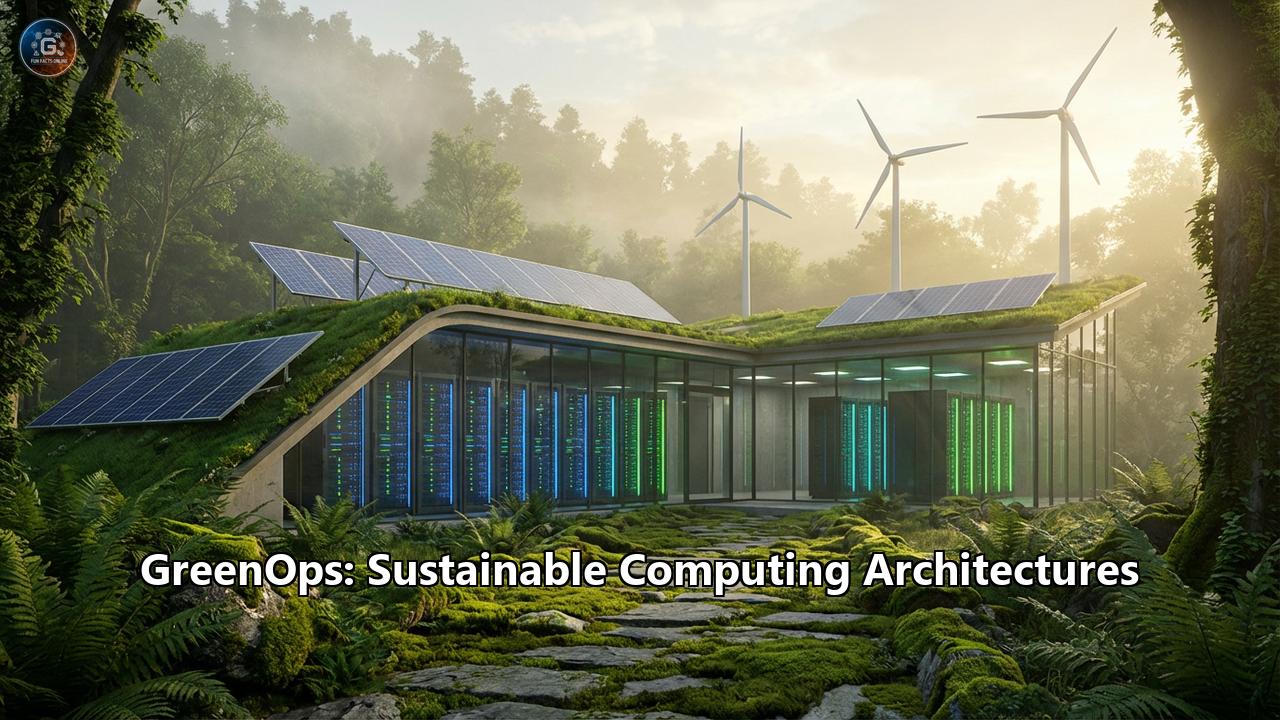
As the digital era accelerates, the invisible infrastructure that powers our modern lives—data centers, cloud networks, and the billions of lines of code running continuously—has begun to cast a long and heavy shadow over the planet. The digital world is not ethereal; it is physical, heavy, and hot. It consumes electricity with voracious appetite and drinks water by the millions of gallons for cooling. In response to this growing crisis, a new discipline has emerged at the intersection of operational excellence, financial stewardship, and environmental responsibility: GreenOps.
This comprehensive guide explores the depths of GreenOps and the sustainable computing architectures that underpin it. From the atomic level of silicon chip design to the global orchestration of cloud workloads, we will traverse the landscape of a technology sector attempting to save the world it helped connect.
Part I: The Genesis of GreenOps
1. The Invisible Crisis: Why GreenOps Now?
For decades, the primary metrics of success in computing were performance (speed) and availability (uptime). Later, with the advent of the cloud, cost optimization (FinOps) joined the pantheon of critical KPIs. Today, however, we face a fourth pillar: Sustainability.
The statistics are sobering. By 2025, data centers are projected to consume nearly 4.5% of global electricity production. If the IT sector were a country, it would be the third-largest consumer of electricity in the world, trailing only China and the United States. The rise of Artificial Intelligence (AI), particularly Large Language Models (LLMs), has exacerbated this trajectory. A single training run of a GPT-class model can emit as much carbon as five cars over their entire lifetimes.
GreenOps is the industry’s answer. It is not merely a "nice-to-have" CSR initiative; it is an operational imperative driven by three forces:
- Regulatory Pressure: The EU’s Corporate Sustainability Reporting Directive (CSRD) and potential SEC climate disclosure rules are forcing companies to account for their Scope 1, 2, and 3 emissions.
- Economic Reality: In a volatile energy market, energy efficiency is synonymous with cost efficiency. The kilowatt-hour you don't use is the cheapest one to buy.
- Existential Necessity: As climate change impacts supply chains and physical infrastructure, building resilient, low-carbon systems is a survival strategy.
2. Defining GreenOps: A Convergence of Disciplines
GreenOps is not a software product; it is a cultural and technical practice. It can be defined as:
“The practice of minimizing the carbon footprint of technical systems through software architecture, hardware selection, and operational efficiency, integrated continuously into the development lifecycle.”It sits at the center of a Venn diagram containing DevOps (speed and automation), FinOps (cost management), and Sustainability Science.
- DevOps says: "Deploy faster."
- FinOps says: "Deploy cheaper."
- GreenOps says: "Deploy cleaner."
Crucially, GreenOps introduces a new currency to the technical budget: Carbon. Just as teams have a financial budget, GreenOps advocates for a "Carbon Budget," where architectural decisions are weighed against their environmental cost.
Part II: Core Principles and Metrics
To manage sustainability, we must first measure it. GreenOps relies on a specific set of metrics that move beyond simple electricity bills.
1. The Holy Trinity of Green Metrics
- PUE (Power Usage Effectiveness): The traditional metric for data center efficiency. It is the ratio of total facility energy to IT equipment energy. A PUE of 1.0 is perfect (all energy goes to servers). Google and Microsoft hover around 1.10. However, PUE is flawed; it doesn't account for how the energy was generated (coal vs. wind) or the efficiency of the software running on the servers.
- CUE (Carbon Usage Effectiveness): This measures the carbon emissions produced per unit of IT energy. It introduces the concept of Carbon Intensity (gCO2eq/kWh)—how "dirty" the electricity grid is at any given moment.
- WUE (Water Usage Effectiveness): Often overlooked, data centers consume massive amounts of water for evaporative cooling. WUE measures liters of water used per kWh of IT energy.
2. SCI: The Software Carbon Intensity Specification
The Green Software Foundation introduced the SCI score, a critical metric for software architects. Unlike PUE, which focuses on the building, SCI focuses on the code.
The formula is:
$$SCI = ((E \times I) + M) / R$$
Where:
- E (Energy): Energy consumed by the software (in kWh).
- I (Intensity): Carbon intensity of the energy grid (in gCO2/kWh).
- M (Embodied Carbon): The carbon emitted during the manufacturing and disposal of the hardware the software runs on.
- R (Functional Unit): A unit of value (e.g., per user, per API call, per transaction).
This formula reveals the three levers of GreenOps:
- Energy Efficiency: Use less code/compute (Reduce E).
- Carbon Awareness: Run code when/where the grid is green (Reduce I).
- Hardware Efficiency: Extend hardware life or use fewer servers (Reduce M).
Part III: Sustainable Data Center Architecture
The physical foundation of GreenOps lies in the data center. Modern sustainable architecture here is a marvel of engineering, moving far beyond "air conditioning for computers."
1. Cooling Technologies: The Liquid Revolution
Traditional air cooling is inefficient. Air is a poor conductor of heat. The future is liquid.
- Direct-to-Chip Liquid Cooling: Cold plates sit directly on CPUs and GPUs, piping water or dielectric fluid right to the heat source. This captures 70-80% of heat directly.
- Immersion Cooling: The "deep end" of cooling. Servers are submerged in baths of non-conductive dielectric fluid. This eliminates fans (which can consume 20% of a server's power) and allows for incredibly high rack densities. It also stabilizes thermal temperatures, potentially extending hardware lifespans.
- Free Cooling: Leveraging geography. Building data centers in the Nordics or Canada allows operators to use outside air for cooling for 300+ days a year, drastically dropping PUE.
2. Waste Heat Recovery (District Heating)
In a circular economy, waste is a resource. A data center is essentially a massive heater.
- The Stockholm Model: In Stockholm, heat from data centers is captured and piped into the municipal district heating system, warming thousands of homes.
- Greenhouse Integration: Projects in the Netherlands pipe waste heat to adjacent agricultural greenhouses, reducing the carbon footprint of growing food while cooling the servers.
3. Power Architecture and Battery Storage
Sustainable data centers are becoming active participants in the energy grid, not just passive consumers.
- UPS as Grid Reserve: Uninterruptible Power Supplies (UPS) contain massive battery banks. Modern architectures allow these batteries to push power back to the grid during peak demand, stabilizing the grid and enabling higher penetration of variable renewables like wind and solar.
- Hydrogen Backup: Replacing diesel generators with hydrogen fuel cells for backup power eliminates the massive carbon spike during outages and testing.
Part IV: Hardware Architectures for Sustainability
The silicon itself plays a massive role. The demise of Moore’s Law (or its slowing) has forced architects to look for efficiency in specialization.
1. The Rise of ARM and RISC-V
For decades, x86 (Intel/AMD) was king. However, the x86 instruction set is complex and power-hungry.
- ARM Efficiency: Originally designed for mobile phones where battery life is paramount, ARM processors (like AWS Graviton, Ampere Altra, and Apple Silicon) have invaded the data center. They offer significantly higher performance-per-watt than x86. Moving a workload from an x86 instance to an ARM instance can often reduce carbon emissions by 20-40% instantly with no code changes for interpreted languages like Python or Node.js.
- RISC-V: The open-source instruction set architecture allows for custom, stripped-down chip designs that include only the logic needed for specific tasks, eliminating "dark silicon" waste.
2. Domain-Specific Architectures (ASICs)
General-purpose CPUs are "jacks of all trades, masters of none."
- TPUs and LPUs: Google’s Tensor Processing Units (TPUs) and Groq’s Language Processing Units (LPUs) are Application-Specific Integrated Circuits designed solely for matrix math (AI). They are orders of magnitude more energy-efficient for AI workloads than a general CPU.
- Video Transcoding ASICs: YouTube and Netflix use custom silicon for video processing, consuming a fraction of the power of software-based encoding.
3. Extending Hardware Lifespan (Reducing 'M')
The "M" in the SCI equation stands for Embodied Carbon. Manufacturing a server is carbon-intensive.
- Hyperscale Lifecycle Extension: Traditionally, servers were refreshed every 3 years. Amazon and Google are now pushing this to 5 or 6 years. This simple administrative change drastically amortizes the embodied carbon over a longer useful life.
- Circular Hardware: Companies like ITRenew take decommissioned hyperscale gear (which is still very powerful) and repackage it for secondary markets (the "Sesame" open compute rack), effectively recycling the embodied carbon.
Part V: Sustainable Software Architecture
This is where the software architect or developer has the most agency. How we design systems dictates how much energy they demand.
1. Carbon-Aware Computing
This is the "killer app" of GreenOps. It involves making software intelligent enough to understand the energy grid.
- Temporal Shifting (Do it later): If the wind isn't blowing in Germany right now, the grid is likely burning coal. A carbon-aware batch job (like a backup or a machine learning training run) checks the grid intensity API (e.g., Electricity Maps or WattTime). If intensity is high, it pauses. It waits for the wind to pick up or the sun to rise.
- Spatial Shifting (Do it elsewhere): If the grid is dirty in Virginia but clean in Montreal, the workload moves. Kubernetes clusters federated across regions can route traffic or jobs to the greenest region in real-time. This is "Follow the Sun" or "Follow the Wind" routing.
2. Green Coding and Language Efficiency
Not all programming languages are created equal.
- The Energy Hierarchy: A famous 2017 study analyzed the energy efficiency of languages. C and Rust were the undisputed kings. Python and Ruby were at the bottom, often consuming 50x to 70x more energy for the same task.
- The Rust Revolution: The move to rewrite core infrastructure in Rust (seen in the Linux kernel, AWS Lambda, and Azure) is a major GreenOps win. It provides the memory safety of high-level languages with the energy profile of C.
- Bloatware Reduction: Removing unused libraries, optimizing loops, and reducing image sizes all contribute to lower CPU cycles and network transfer energy.
3. Serverless and Scale-to-Zero
Idle servers are the enemy. A virtual machine running at 5% utilization still consumes nearly 50-60% of its peak power draw due to leakage currents and baseline overhead.
- Serverless (FaaS): Technologies like AWS Lambda or Google Cloud Functions spin up exactly when needed and vanish when done. This is the ultimate "scale-to-zero" architecture. It ensures that no energy is wasted on "zombie" infrastructure waiting for a request.
4. Data Minimization and Storage Policies
Data has weight. Storing 1TB of data on an HDD consumes energy for the disk rotation. Storing it on SSD consumes energy for the controller. Moving it across the network consumes router energy.
- Hot/Cool/Cold Tiering: aggressive lifecycle policies are essential. Data that isn't accessed should move to "Cold Storage" (often tape libraries, which consume zero energy when sitting on a shelf).
- Dark Data: Up to 60-70% of enterprise data is "dark"—collected, stored, and never used. Deleting this data is the single most effective GreenOps action many companies can take.
Part VI: Implementation Strategy – The "Crawl, Walk, Run" Approach
How does an organization move from zero to GreenOps hero?
Phase 1: Visibility (Crawl)
- Tagging Strategy: You cannot optimize what you do not own. Implement rigorous cloud tagging to attribute carbon emissions to specific teams or applications.
- Baseline Measurement: Use tools like the Cloud Carbon Footprint (CCF) open-source tool or native cloud provider dashboards (AWS Customer Carbon Footprint Tool, Azure Emissions Impact Dashboard) to establish a baseline.
- Empowerment: Give developers visibility. If a developer sees the carbon cost of their query in their IDE or pull request, they will optimize it.
Phase 2: Optimization (Walk)
- Rightsizing: Aggressively downsize over-provisioned instances. If a VM is running at 10% CPU, cut it in half.
- Spot Instances: Use Spot instances. These are spare capacity servers that the cloud provider would otherwise leave idle. Using them is effectively "carbon neutral" from a marginal perspective because the server was already turned on.
- ARM Migration: Mandate that all new non-legacy workloads deploy on ARM-based silicon.
Phase 3: Transformation (Run)
- Carbon-Aware Automation: Integrate carbon APIs into CI/CD pipelines. Builds fail if the forecasted carbon intensity is too high (non-critical builds).
- SLA Renegotiation: Challenge the "5 Nines" (99.999%) availability requirement. Does that internal reporting app really need 24/7 instant availability? Relaxing SLAs allows for aggressive power-saving modes (like putting dev environments to sleep at night).
- Green Software Development Life Cycle (SDLC): Embed sustainability reviews alongside security and architecture reviews.
Part VII: The Role of AI – Savior or Villain?
AI presents a paradox in GreenOps. It is both a massive consumer of energy and a powerful tool for optimization.
The Consumption Problem
Training a model like GPT-4 requires thousands of GPUs running for months. The inference (running the model) is even costlier in the long run. The "Jevons Paradox" warns us that as AI becomes more efficient, we will simply use more of it, potentially increasing total consumption.
The Optimization Solution
However, AI is also driving GreenOps efficiency:
- DeepMind & Google Cooling: Google used DeepMind's AI to control the cooling systems in its data centers. The AI tweaked knobs and dials (fan speed, water flow) in ways humans hadn't predicted, reducing cooling energy by 40%.
- Grid Balancing: AI is essential for managing the "Smart Grid," predicting solar/wind output and balancing it with demand to minimize fossil fuel peaker plant usage.
Part VIII: Challenges and The Road Ahead
The path to sustainable computing is paved with obstacles.
- Data Transparency: Cloud providers are often secretive about the exact source of their energy and the specific hardware embodied carbon. We need more open data (Scope 3 transparency).
- Jevons Paradox: Efficiency improvements often lead to increased usage. We must decouple growth from emissions.
- The Crypto Question: While Proof-of-Stake has largely solved Ethereum's energy issue, Bitcoin remains a massive Proof-of-Work energy sink. Integrating crypto-mining with renewable curtailment (mining only when there is excess wasted solar power) is a potential, albeit controversial, path.
Future Trends
- DNA Storage: Storing exabytes of data in synthetic DNA could eliminate the energy cost of storage almost entirely, as DNA is stable at room temperature for centuries.
- Orbital Computing: Putting data centers in space to use solar radiation and the infinite cold of the vacuum for cooling? It sounds sci-fi, but prototypes exist.
- Photonics: Replacing electrons with photons (light) for interconnects inside the chip could drastically reduce heat and resistance.
Conclusion: The Green Architect's Oath
GreenOps is not a trend; it is a fundamental shift in the definition of "quality" in software engineering. For too long, we have treated computing resources as infinite and the environment as an externality.
The Sustainable Computing Architect of the future understands that every line of code has a carbon cost. They design not just for the user, but for the planet. They build systems that breathe with the grid, sleep when idle, and sip energy rather than gulp it.
We are the architects of the digital world. It is time we ensure that our digital creations do not destroy our physical home. The era of GreenOps has arrived.
Reference:
- https://www.lincolninst.edu/publications/land-lines-magazine/articles/land-water-impacts-data-centers/
- https://grokipedia.com/page/greenops
- https://www.forrester.com/blogs/greenops-finops-and-the-sustainable-cloud/
- https://www.nrgplc.com/blog/2025/01/greenops-a-sustainable-approach-to-it-and-cloud-computing
- https://medium.com/@naeemulhaq/the-greenops-imperative-quantifying-and-optimizing-carbon-footprints-of-cloud-workloads-3123e61eb330
- https://gatling.io/blog/greenops
- https://www.architectureandgovernance.com/uncategorized/greenops-and-finops-strategic-convergence-in-the-cloud-transformation-journey/
- https://www.quinnox.com/blogs/revolutionizing-cloud-cost-management-sustainable-approach-with-greenops/
- https://www.sigarch.org/designing-computer-systems-for-sustainability/
- https://www.researchgate.net/publication/371506776_Quantifying_the_Benefits_of_Carbon-Aware_Temporal_and_Spatial_Workload_Shifting_in_the_Cloud
- https://datagarda.com/sustainable-data-center-cooling-innovations-in-liquid-and-immersion-cooling/
- https://www.trgdatacenters.com/resource/liquid-cooling-vs-immersion-cooling/
- https://rnt.de/en/know-how/cooling-methods-for-data-centres-liquid-cooling-vs-immersion-cooling/
- https://www.redhat.com/en/blog/sustainable-software-architecture-architects