
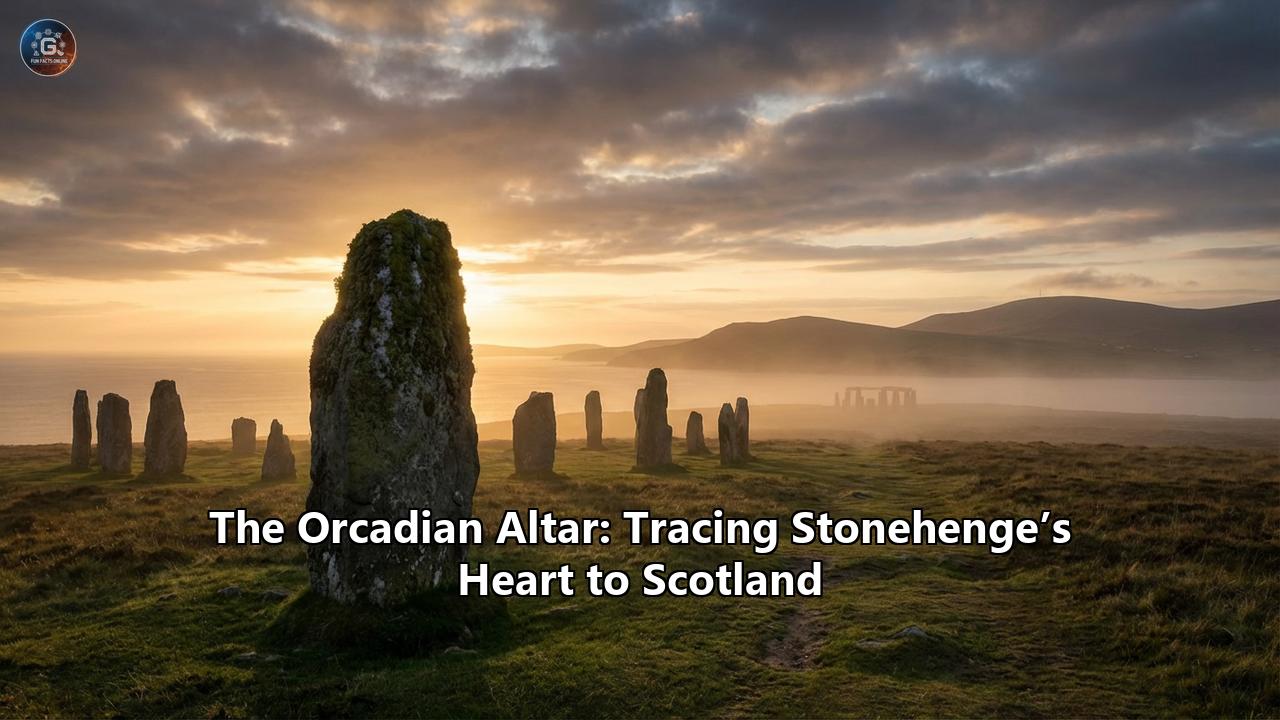
For centuries, the moss-clad monolith lying supine at the center of Stonehenge has been a silent riddle. Known as the "Altar Stone," this six-ton slab of grey-green sandstone has always been the outlier—geologically distinct from the towering sarsens of the outer circle and the smaller "bluestones" that form the inner horseshoe. For the last hundred years, the accepted wisdom was that it, like its bluestone cousins, had been dragged from the Preseli Hills of Wales. It was a journey of 140 miles—an impressive feat for Neolithic people, but a manageable one.
But in August 2024, that comfortable narrative was shattered.
A groundbreaking study published in the journal Nature revealed a truth so startling it has forced archaeologists to rewrite the history of Stone Age Britain. The Altar Stone did not come from Wales. It did not come from England. Its chemical fingerprint belongs to the Orcadian Basin of northeast Scotland—a staggering distance of over 460 miles (750 kilometers) away.
This is the story of that discovery, the stone that traveled the length of a kingdom, and the ancient, forgotten connection between the rolling plains of Wiltshire and the storm-lashed cliffs of the Scottish north.
Part I: The Stranger in the Circle
To understand the magnitude of this discovery, one must first understand the architecture of Stonehenge. The monument is a masterpiece of prehistoric engineering, built in several phases between 3000 BC and 1500 BC.
The most famous stones are the Sarsens—the massive, upright sandstones capped with lintels that form the iconic outer ring and the inner horseshoe of trilithons. These giants, weighing up to 30 tons, were sourced from the Marlborough Downs, a mere 15 miles to the north. Their transport was a Herculean task, but a local one.
Then there are the Bluestones. These are the smaller, darker stones standing between the sarsen arrangements. In 1923, the geologist H.H. Thomas famously traced their origin to the Mynydd Preseli in Pembrokeshire, west Wales. This connection cemented the idea that Stonehenge was a monument of unification, binding the west of Britain to the south.
And then, there was Stone 80.
Lying half-buried beneath the fallen wreckage of the tallest sarsen trilithon, Stone 80 is the Altar Stone. It is unique in almost every way.
- Shape: unlike the rough, pillar-like bluestones, the Altar Stone is a flat, dressed slab, approximately 5 meters (16 feet) long.
- Geology: It is a micaceous sandstone, meaning it glitters with tiny flakes of mica, unlike the dolerite and rhyolite of the Welsh bluestones.
- Position: It sits at the geometric heart of the monument, aligned perfectly with the midwinter sunset and midsummer sunrise axis.
For decades, it was lumped in with the "bluestones" simply because it wasn't a sarsen. Geologists assumed it came from the Senni Beds of the Old Red Sandstone formation in Wales, near the source of the other stones. It was a convenient assumption. It fit the map. But as technology improved, the map began to fray.
Over the last decade, a team of researchers led by Richard Bevins of Aberystwyth University and Rob Ixer of UCL began re-examining the Welsh theory. They blasted samples with X-rays and analyzed the mineral content. One by one, the Welsh outcrops were ruled out. The barium content was wrong. The zircon ages didn't match. By 2023, the team had reached a frustrating but exciting conclusion: The Altar Stone was an orphan. It did not belong to Wales.
The search radius had to be widened. They turned their gaze north.
Part II: The Fingerprint of the North
The breakthrough came via a technique that looks less like archaeology and more like planetary science. The team, now including Anthony Clarke from Curtin University in Australia, used uranium-lead dating on mineral grains extracted from the stone.
Sandstone is a sedimentary rock, essentially a compressed archive of ancient sands. These sands are made of eroded crystals from even older mountain ranges. By dating these individual crystals—specifically zircon, apatite, and rutile—geologists can build a "distinctive age profile" or fingerprint. It’s like checking the birth dates of every person in a crowd to figure out which city they came from.
When they analyzed the Altar Stone, they found a specific mix of crystals:
- Some were derived from 1-billion-year-old granite.
- Others were from 450-million-year-old geological events.
This specific cocktail of ages does not exist in Wales. It does not exist in England. In the entire geological map of Great Britain, there is only one place where the rocks sing this specific song: The Orcadian Basin.
This geological basin encompasses parts of northeast mainland Scotland (Caithness, Sutherland, Inverness) and extends out to the Orkney Islands and Shetland.
The data was irrefutable. The heart of Stonehenge was Scottish.
Part III: The Impossible Journey
The distance from the Orcadian Basin to Stonehenge is roughly 750 kilometers (466 miles) as the crow flies. In the Neolithic era, there were no crows flying straight lines for logistics managers. There were dense, wolf-haunted forests, treacherous bogs, and no roads. The wheel had not yet arrived in Britain.
This raises the central, jaw-dropping question: How?
The Overland Myth
Moving a six-ton slab overland from Scotland to Wiltshire would have been a nightmare of epic proportions. The route would require crossing the Grampian Mountains, the Pennines, and countless unbridged rivers like the Forth, the Tyne, and the Trent. The friction, the terrain, and the sheer caloric requirement for the hundreds of people needed to drag the stone on rollers make this hypothesis highly unlikely.
The Marine Highway
The only plausible answer is the sea. The discovery of the Altar Stone’s origin forces us to reimagine Neolithic Britain not as a collection of isolated tribes huddled in clearings, but as a sophisticated maritime society.
To transport the stone, the builders would have needed a vessel capable of carrying a six-ton deadweight. This wasn't a job for a simple dugout canoe. They likely used:
- Log Rafts: Massive platforms of lashed timber, stable but slow.
- Skin Boats: Large currach-style vessels, made of animal hides stretched over wooden frames. These are surprisingly buoyant and tough, capable of navigating the rough waters of the North Sea.
The route would have been perilous. Leaving the coast of northeast Scotland, they would have hugged the eastern coastline of Britain, paddling past what is now Aberdeen, down the coast of Yorkshire, past the Humber estuary, and around the bulbous coast of East Anglia. Finally, they would have navigated up the Thames or the Hampshire Avon to reach the Salisbury Plain.
This was not a casual trip. It was an odyssey. It would have required intimate knowledge of tides, currents, and landmarks. It implies a "marine highway" connecting the north and south—a trade route where ideas, cattle, pottery, and eventually, giant stones, flowed freely.
Part IV: Why Orkney?
Why go to such trouble? Why travel 500 miles for a slab of sandstone when the Marlborough Downs were full of perfectly good rocks?
The answer likely lies in the spiritual geography of the time.
In 2600 BC, the Orkney Islands were not a remote periphery; they were the center of the world. Neolithic Orkney was a bustling hub of innovation and culture that outshone the south.
- The Ness of Brodgar: A massive temple complex on Orkney, guarded by stone walls, filled with decorated pottery and art. It was occupied for a thousand years.
- Skara Brae: The best-preserved Neolithic village in Europe, boasting stone furniture and drains.
- The Ring of Brodgar and Stones of Stenness: Giant stone circles that predate the major stone phases of Stonehenge.
Archaeologists have long known that ideas flowed from Orkney to the south. Grooved Ware pottery, a distinct style of decorated ceramics, was invented in Orkney and spread across Britain, reaching Stonehenge at the exact time the monument was being expanded. The design of Neolithic houses at Durrington Walls (the builders' camp near Stonehenge) mimics the stone houses of Orkney, right down to the central hearths and stone dressers.
The Altar Stone was likely a gift, a tribute, or a relic brought to solidify an alliance. It physically cemented the bond between the two great power centers of Neolithic Britain: the ancestral hub of the North and the rising power of the South.
Imagine the arrival. The stone, perhaps already ancient and revered in Scotland, is loaded onto a boat. The journey takes weeks, maybe months. When it finally arrives at the riverbank in Wiltshire, it is greeted not just as building material, but as a visiting dignitary. Placing it at the very center of the Stonehenge horseshoe wasn't an architectural choice; it was a political and religious statement. It said: We are one.
Part V: The Altar that isn't an Altar
We call it the Altar Stone because Inigo Jones, the 17th-century architect, thought it looked like a place for sacrifice. In reality, its purpose was likely celestial.
The stone lies perpendicular to the sun's path. During the Summer Solstice, the sun rises over the Heel Stone and casts its first rays directly into the heart of the circle, striking the Altar Stone. Conversely, during the Winter Solstice—the most important event for the Stonehenge builders—the sun sets between the uprights of the Great Trilithon, plunging the Altar Stone into the longest night of the year.
With the new Scottish connection, this alignment takes on a new poetry. The stone comes from the land of the "midnight sun," where the summer days are long and the winter nights are profound. Bringing a stone from the extreme north to the south may have been an attempt to capture or merge the solar cycles of different latitudes.
Part VI: A New Mystery
While the "Orcadian Basin" is the confirmed geological source, a follow-up study has added a delicious twist. Researchers compared the Altar Stone to the specific stones used in the famous Orkney monuments (the Stones of Stenness and Ring of Brodgar). The result? No match.
The Altar Stone did not come from the exact same quarries as the Orkney circles. It came from the broader region—perhaps Caithness, or a different island in the archipelago. This suggests that the stone might not have been "stolen" from an existing monument, but quarried specifically for the journey, or taken from a site we have not yet discovered.
The hunt is now on to find the specific outcrop in Scotland. Somewhere on a wind-swept cliff or a quiet glen in the north, there is a hole in the ground shaped exactly like the heart of Stonehenge.
Conclusion: The Stone of Unity
The Altar Stone has transformed from a static slab of rock into a dynamic testament to human endeavor. It proves that Neolithic Britain was a unified, interconnected world, capable of feats of logistics that rival the construction of the Pyramids.
It tells us that 5,000 years ago, people looked across the dark waters of the North Sea not with fear, but with ambition. They bound their island together not with laws or roads, but with stone. The grey slab at the center of Stonehenge is no longer just an altar; it is a bridge. A bridge that spans 500 miles and 5,000 years, tracing the heartbeat of a lost civilization from the white chalk of Wiltshire to the red sandstone of the Scottish north.
Reference:
- https://www.sapiens.org/archaeology/stonehenge-altar-stone-origins-discovery/
- https://news.artnet.com/art-world/stonehenge-altar-stone-not-from-orkney-2533524
- https://www.nessofbrodgar.co.uk/altar-stone-2024/
- https://en.wikipedia.org/wiki/Altar_Stone_(Stonehenge))
- https://www.cbsnews.com/news/stonehenge-altar-stone-came-from-scotland-not-wales-research/
- https://www.quora.com/What-do-you-think-is-a-possible-explanation-for-the-Scottish-connection-to-Stonehenge
- https://eos.org/articles/from-sandstone-basin-to-stonehenge-altar
- https://journals.uclpress.co.uk/ai/article/id/3293/
- https://spectator.com/article/how-was-the-stonehenge-altar-stone-moved-from-scotland/
- https://www.atlasobscura.com/articles/stonehenge-altar-stone-from-scotland
- https://www.scottishbanner.com/2024/09/13/scotlands-link-to-stonehenge/
- https://www.quora.com/How-did-the-Neolithic-people-transport-the-Stonehenge-altar-stone-from-Scotland-all-the-way-to-England
- https://en.wikipedia.org/wiki/Stonehenge
- https://the-past.com/news/scottish-origins-for-the-stonehenge-altar-stone-geological-clues-to-an-astonishing-neolithic-journey/
- https://www.google.com/search?q=time+in+Orkney,+GB
- https://www.sci.news/archaeology/stonehenge-altar-stone-scotland-13178.html
- https://en.wikipedia.org/wiki/Prehistoric_Orkney
- https://www.nationalgeographic.com/history/article/120127-stonehenge-ness-brodgar-scotland-science
- https://www.ap.org/news-highlights/spotlights/2024/stonehenges-altar-stone-originally-came-from-scotland-and-not-wales-new-research-shows/