
Whispers on the Wind: How Nuclear Archaeology Unlocks the Secrets of the Atom for a Safer World
In the high-stakes world of international diplomacy and nuclear arms control, the truth can be as elusive as a phantom. When a nation agrees to dismantle its nuclear weapons program or opens its facilities to inspection, how can the global community be certain that all materials and activities have been declared? The answer may lie not in confessions or overt intelligence, but in the silent, lingering whispers of the atom itself. This is the realm of nuclear archaeology, a captivating and crucial field that uses the faintest of environmental traces to reconstruct the history of nuclear activities and verify compliance with international treaties.
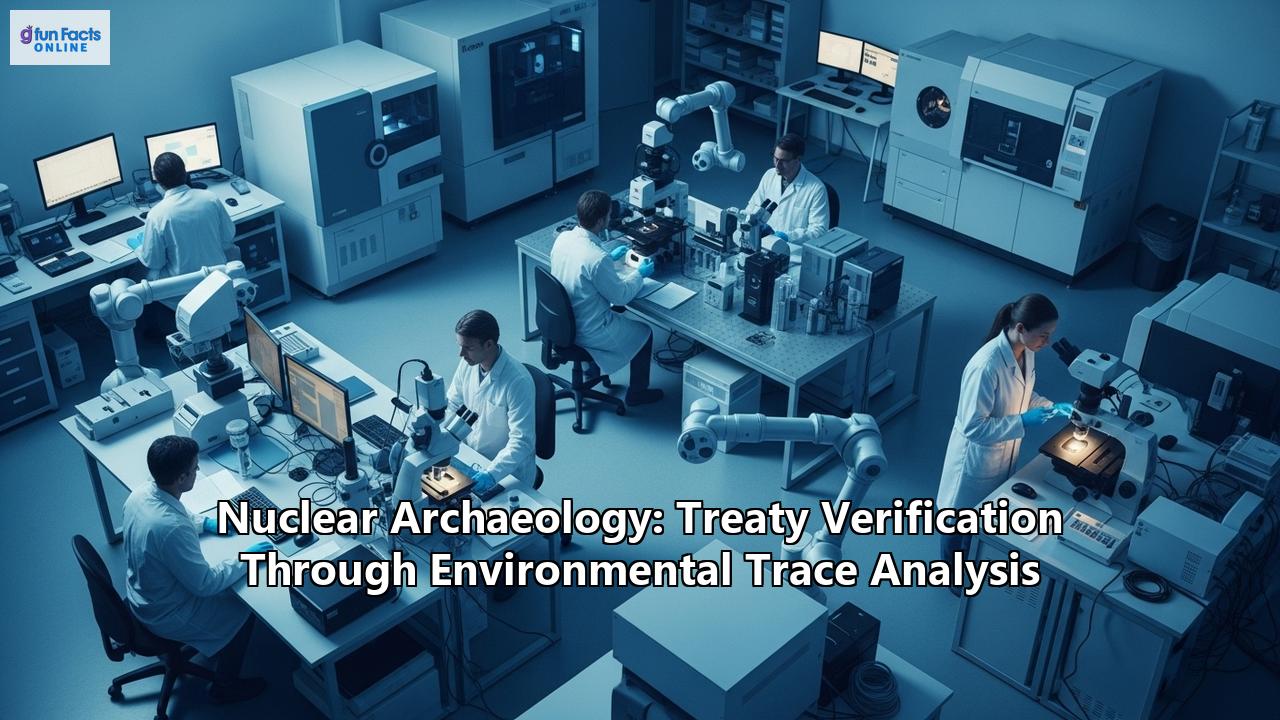
Imagine detectives who don't dust for fingerprints, but for isotopes. Instead of a magnifying glass, their primary tool is a mass spectrometer, capable of detecting minute quantities of radioactive materials. These "nuclear archaeologists" can analyze microscopic particles collected from soil, water, air, and even the structural components of a decommissioned reactor to piece together a story that a nation might be unwilling or unable to tell.
The Science of Atomic Detective Work
At its core, nuclear archaeology is the systematic study of the material evidence left behind by nuclear processes. When a nuclear reactor is operational, or a weapon is tested, it releases a unique cocktail of radioactive isotopes into the surrounding environment. These isotopes, like a unique fingerprint, can reveal a wealth of information.
One of the most powerful techniques in the nuclear archaeologist's toolkit is environmental sampling. Inspectors from organizations like the International Atomic Energy Agency (IAEA) can take seemingly innocuous samples, such as cotton swipes of dust from a facility, and uncover a treasure trove of information. Analysis of these samples can determine not only if nuclear material is present, but also its type (such as plutonium or highly enriched uranium), its age, and the processes it has undergone. This allows inspectors to verify the accuracy of a country's declarations about its past and present nuclear activities.
Another key method is the analysis of structural materials. When a nuclear reactor is decommissioned, the permanent components of its core, such as graphite moderators or steel pressure vessels, hold a record of its operational history. By measuring the ratios of certain isotopes within these materials—a technique known as the Isotope Ratio Method (IRM)—scientists can estimate the total amount of plutonium produced in the reactor over its lifetime. This is a critical piece of information for verifying disarmament claims.
Even the natural world can hold clues. Dendrochronology, the study of tree rings, can provide a historical record of nuclear activity. Trees absorb elements from the environment, and significant events like atmospheric nuclear tests can leave behind detectable traces of specific isotopes, such as Strontium-90, in their annual growth rings. This provides a dated timeline of past radioactive contamination.
The International Framework: A Global Watchdog
The work of nuclear archaeologists doesn't happen in a vacuum. It is a critical component of a broader international framework designed to prevent the spread of nuclear weapons and promote disarmament. The International Atomic Energy Agency (IAEA) is at the forefront of these efforts, using nuclear archaeology techniques as part of its safeguards to verify that nuclear material and technology are used for peaceful purposes. The IAEA's experience in countries like Iraq has been instrumental in shaping modern verification practices. The lessons learned there, such as the power of environmental sampling and the importance of unannounced inspections, have significantly strengthened the global non-proliferation regime.
The Comprehensive Nuclear-Test-Ban Treaty Organization (CTBTO) also relies on environmental trace analysis to monitor for any sign of nuclear explosions. A global network of monitoring stations constantly "sniffs" the air for radioactive particles and noble gases that could indicate a clandestine nuclear test.
Furthermore, international collaborations like the International Partnership for Nuclear Disarmament Verification (IPNDV) bring together countries with and without nuclear weapons to develop the procedures and technologies needed to verify nuclear disarmament. This partnership is crucial for building the global expertise and capacity required to tackle the complex challenges of a world with fewer nuclear weapons.
Case Studies: From Disarmament to Detection
The real-world application of nuclear archaeology has provided some of the most compelling evidence of its effectiveness.
South Africa: When South Africa voluntarily dismantled its nuclear weapons program in the early 1990s, the IAEA was tasked with verifying the completeness of their declaration. Nuclear archaeology played a crucial role in this process, helping to reconstruct the production history of the country's fissile materials and providing confidence that all nuclear weapons had been accounted for. This case remains a landmark example of successful nuclear disarmament verification. Iraq: The discovery of Iraq's clandestine nuclear weapons program in the 1990s was a watershed moment for nuclear verification. IAEA inspectors, using a combination of on-site inspections and environmental sampling, were able to uncover a secret program that had been hidden from the world. The experience in Iraq demonstrated the critical need for more intrusive and robust verification measures and led to the development of the Additional Protocol, which gives the IAEA greater authority to inspect for undeclared nuclear activities. North Korea: Looking to the future, nuclear archaeology is seen as an indispensable tool for any potential denuclearization of North Korea. If a political agreement is ever reached, verifying the completeness of North Korea's declaration of its nuclear materials and facilities will be a monumental task. The ability to analyze samples from its reactors and waste sites will be essential for building international confidence in any disarmament process.The Future of Nuclear Archaeology: Challenges and Innovations
The field of nuclear archaeology is constantly evolving to meet new challenges. One of the primary difficulties is the limited availability of well-characterized reference materials for validating analytical techniques. The complexity of nuclear materials and the inherent uncertainties in data interpretation also present ongoing hurdles.
However, exciting advancements are on the horizon. The integration of machine learning and artificial intelligence is poised to revolutionize data analysis and interpretation. New analytical techniques, driven by progress in nanotechnology and materials science, are enabling the analysis of nuclear materials at an unprecedented level of detail.
Scientists are also developing innovative, portable devices that can rapidly analyze the composition of materials on-site, which would be a significant advantage during inspections. These new tools will allow inspectors to make faster and more informed assessments.
In a world where the threat of nuclear proliferation remains a stark reality, nuclear archaeology provides a powerful, science-based approach to building trust and transparency. By listening to the faint whispers of the atom, we can gain a clearer understanding of the past and work towards a more secure future for all.
Reference:
- https://scienceandglobalsecurity.org/editorial/2014/02/the_future_of_nuclear_archaeol.html
- https://d-nb.info/1240390874/34
- https://vcdnp.org/lessons-learned-from-the-iaea-inspections-in-iraq-in-the-1990s/
- https://www.tandfonline.com/doi/abs/10.1080/08929882.2014.874217
- https://wiredspace.wits.ac.za/items/14be6b9b-48f7-4847-944c-b3f4176da888
- https://www.numberanalytics.com/blog/comprehensive-guide-nuclear-forensics-techniques
- https://www.sipri.org/sites/default/files/EU-NPC_no-47.pdf
- https://www.iaea.org/newscenter/news/nuclear-forensics-and-radiological-crime-scene-management-key-elements-of-nuclear-security
- https://www.iaea.org/sites/default/files/publications/magazines/bulletin/bull46-1/46102486468.pdf
- https://www.tandfonline.com/doi/pdf/10.1080/01636609209550118
- https://www.numberanalytics.com/blog/advanced-nuclear-forensics-techniques
- https://www.osti.gov/servlets/purl/1525301
- https://www.google.com/search?q=time+in+%D8%A7%D9%84%D9%81%D9%84%D9%88%D8%AC%D8%A9,+IQ
- https://www.google.com/search?q=time+in+Pixley+ka+Seme-distriksmunisipaliteit,+ZA
- https://worldarchaeologicalcongress.com/wac10/nuclear-heritage-and-contemporary-archaeology-constructing-narratives-of-industrial-military-scientific-ventures-material-culture-and-places/
- https://www.rroij.com/open-access/nuclear-forensics-significance-of-security-and-safety.pdf
- https://www.nonproliferation.org/wp-content/uploads/npr/tucker33.pdf
- https://pmc.ncbi.nlm.nih.gov/articles/PMC7433040/
- https://nepis.epa.gov/Exe/ZyPURL.cgi?Dockey=P100K0JX.TXT