
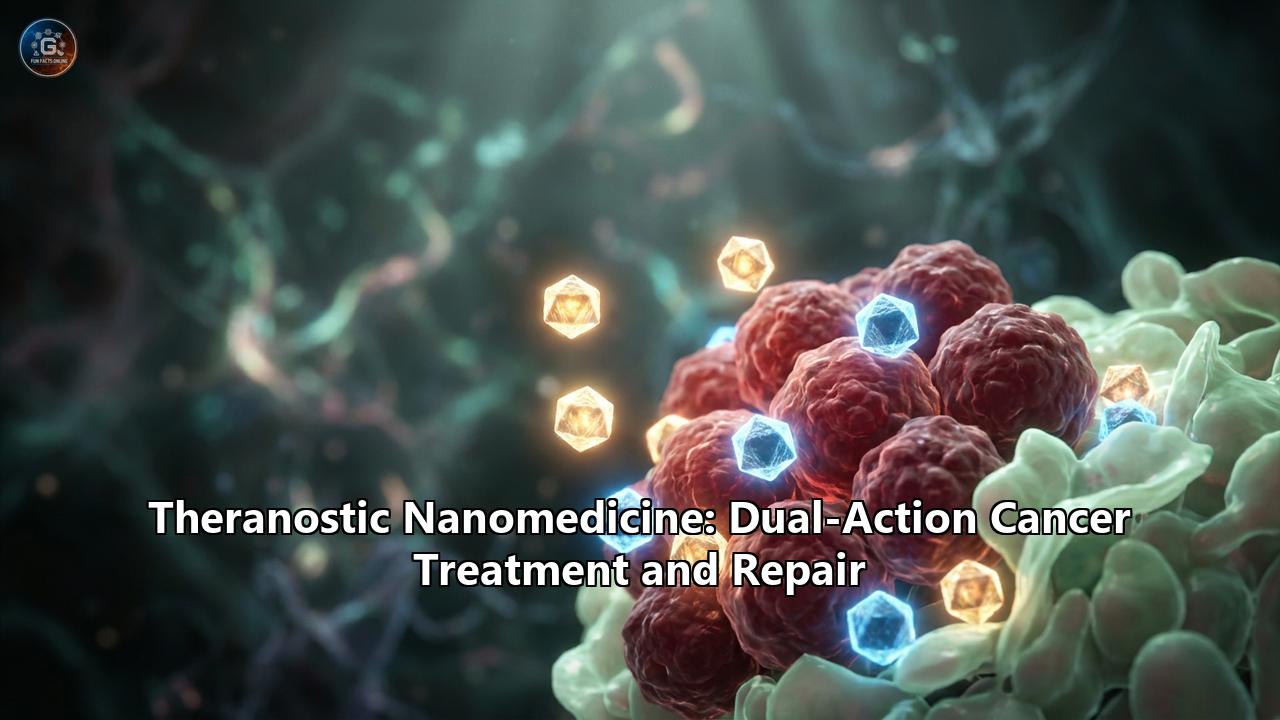
The dawn of the 21st century has witnessed a paradigm shift in oncology, moving away from the "slash and burn" tactics of traditional surgery and chemotherapy toward the era of precision medicine. Yet, even the most advanced targeted therapies often leave a trail of destruction—collateral damage to healthy tissue, large surgical defects, and a microenvironment inflamed and primed for recurrence. The next frontier involves not just killing the cancer, but simultaneously rebuilding what was lost. Enter Dual-Action Theranostic Nanomedicine: a revolutionary class of smart materials engineered to act as both executioner and architect. These nanoplatforms do not simply deliver a drug; they orchestrate a complex biological symphony, eliminating malignant cells while signaling native stem cells to regenerate bone, skin, and soft tissue.
This comprehensive exploration delves into the science, applications, and future of this transformative field, where the boundary between oncology and regenerative medicine dissolves.
1. The Convergence: Merging Destruction and Creation
To understand the magnitude of this innovation, we must first appreciate the limitation of current standards. A patient undergoing osteosarcoma resection often faces a cruel dichotomy: the surgery required to save their life may leave them with a critical bone defect that will never fully heal, leading to lifelong disability. Similarly, the removal of a large melanoma can require disfiguring grafts that carry their own morbidity.
Theranostic nanomedicine traditionally refers to the combination of Therapy and diagNostics—using a single agent to image a tumor and treat it. However, the "Dual-Action" paradigm expands this definition to Therapy and Repair. This emerging field utilizes "bifunctional scaffolds" and "smart hydrogels" that possess two distinct operational modes:
- The Ablative Phase: Triggered by external stimuli (light, magnetic fields) or internal cues (pH, enzymes), the nanomaterial releases cytotoxic agents or generates heat to sterilize the surgical margin, ensuring no microscopic disease remains.
- The Regenerative Phase: Once the threat is neutralized, the material transitions into a pro-healing scaffold. It releases growth factors, recruits stem cells, and provides a physical template for new tissue to grow, effectively filling the void left by the tumor.
2. The Toolbox: Smart Materials of the Future
The magic of these dual-action systems lies in their material composition. Scientists are utilizing the unique physics of the nanoscale—where gold interacts with light, and iron interacts with magnetism—to create these biological machines.
2.1. Magnetic Nanocomposites
Iron oxide nanoparticles are the workhorses of this field. When exposed to an alternating magnetic field (AMF), they oscillate and generate heat—a process called magnetic hyperthermia. This heat can be tuned to 42–45°C to cook cancer cells, which are more heat-sensitive than healthy cells.
- The Repair Twist: By coating these magnetic cores with bioactive glass or hydroxyapatite, researchers have created particles that, after heating, release calcium and silicate ions. These ions are potent signals for osteoblasts (bone-building cells), triggering them to lay down new mineral matrix. The magnetic field itself has also been shown to mechanically stimulate stem cells, encouraging them to differentiate into bone.
2.2. Two-Dimensional (2D) Nanomaterials
Graphene oxide, Black Phosphorus (BP), and MXenes are atomically thin sheets with immense surface areas.
- Black Phosphorus (BP): BP is a rising star because it is biodegradable. It is an excellent photothermal agent, heating up rapidly under near-infrared (NIR) light to ablate tumors. As it degrades, it breaks down into harmless phosphate ions, which are the natural building blocks of bone. Thus, the "waste" product of the cancer treatment becomes the "food" for bone regeneration.
- MXenes: These transition metal carbides exhibit metallic conductivity and excellent biocompatibility. Recent studies have shown that MXene-integrated scaffolds not only kill osteosarcoma cells via photothermal therapy (PTT) but also promote angiogenesis (blood vessel formation), which is critical for healing large wounds.
2.3. Stimuli-Responsive Hydrogels
For soft tissue repair, hydrogels—networks of polymer chains that hold water—are the preferred vehicle.
- The "Trojan Horse" Gel: These gels can be injected as a liquid into an irregular surgical cavity (like a brain tumor resection site) and then solidified using light or body temperature. They can carry liposomes loaded with chemotherapy (e.g., doxorubicin or paclitaxel) that release slowly to kill residual cells. Simultaneously, the hydrogel matrix mimics the extracellular matrix (ECM) of the brain or skin, preventing scar tissue formation and allowing healthy cells to migrate back in.
3. Clinical Applications: Rebuilding the Body, Cell by Cell
The dual-action approach is not a one-size-fits-all solution; it is tailored to the specific biology of the tissue involved.
3.1. Bone Oncology: The "Kill and Fill" Strategy
Osteosarcoma and metastatic bone cancer present the most compelling case for this technology. The standard treatment—removing a section of bone—requires a metal implant or a bone graft. Metal implants often fail due to infection or poor integration, and grafts can be rejected.
- Bifunctional Scaffolds in Action:
Recent breakthroughs involve 3D-printed bioceramic scaffolds doped with CuFeSe2 nanocrystals. In preclinical models, these scaffolds are implanted into the bone defect.
1. Step 1 (Treatment): The limb is exposed to NIR light. The nanocrystals heat the scaffold, selectively destroying any cancer cells clinging to the bone margins.
2. Step 2 (Repair): The scaffold, porous and osteoconductive, begins to release copper and iron ions. These ions stimulate the expression of VEGF (Vascular Endothelial Growth Factor) and BMP-2 (Bone Morphogenetic Protein-2). Over weeks, the scaffold is replaced by the patient's own living bone, resulting in a seamless repair that is biologically indistinguishable from the original tissue.
3.2. Skin Cancer: Regenerating the Shield
Melanoma excision often leaves deep, wide wounds that heal with disfiguring scars or require painful skin grafts.
- Nano-Micelle Hydrogels:
Researchers have developed "bioabsorbable nano-micelle hybridized hydrogels." These gels contain chemotherapy-loaded micelles (tiny lipid spheres) linked to the gel structure.
1. Mechanism: The gel is applied to the wound bed. It responds to the high oxidative stress typical of a tumor environment by releasing the chemotherapy only where cancer signals are detected.
2. Healing: The hydrogel backbone is made of modified gelatin and hyaluronic acid. As the drug works, the gel provides a moist environment that accelerates keratinocyte migration (skin closure) and reduces inflammation. Studies in mice have shown these gels can prevent melanoma recurrence and result in scar-free healing, complete with hair follicle regeneration—a feat traditional grafts rarely achieve.
3.3. Glioblastoma: Treating the Unseen
Brain tumors are notoriously difficult to treat because "safety margins" are impossible—you cannot remove extra brain tissue just to be safe. Recurrence is almost guaranteed.
- The Post-Resection Cavity:
Injectable photopolymerizable hydrogels are changing the prognosis. After the surgeon removes the main tumor, a liquid containing nanomedicines (like lipid nanocapsules) is poured into the cavity and hardened with UV light.
1. Sustained Defense: The gel acts as a depot, releasing drugs for weeks to kill the migrating glioblastoma cells that surgery missed.
2. Neuro-Restoration: While regenerating brain tissue is complex, these hydrogels can dampen the "cytokine storm" (massive inflammation) that usually follows surgery. By reducing this neuro-inflammation, the gel protects surrounding healthy neurons from secondary damage, preserving cognitive function.
4. Advanced Mechanisms: How It Works at the Molecular Level
The true elegance of these systems lies in their ability to manipulate cell signaling pathways.
- The Angiogenic Switch: Tumors hijack blood vessels to grow. Traditional therapies starve the tumor (anti-angiogenesis), which ironically impairs wound healing. Dual-action nanomedicines can solve this paradox. For example, Zinc Nanoflowers can be engineered to be toxic to the chaotic, leaky vessels of a tumor but, at lower concentrations or different release phases, stimulate the healthy, organized vessel formation needed for tissue repair.
- Immunomodulation: A major barrier to healing is chronic inflammation. Nanoparticles containing peptides like Ac2-26 (an annexin A1 mimetic) can actively "resolve" inflammation. They stop the recruitment of neutrophils (destructive white blood cells) and encourage macrophages to switch from the "attack" phenotype (M1) to the "repair" phenotype (M2). This shift is critical for moving from the cancer-killing phase to the tissue-rebuilding phase.
5. Challenges and the Path Forward
Despite the immense promise, the path from the lab to the clinic is paved with obstacles.
- Complexity of Scale-Up: Manufacturing a nanoparticle that has a magnetic core, a bioactive coating, and a drug payload is difficult to reproduce at an industrial scale. Batch-to-batch consistency is a major regulatory hurdle.
- Long-Term Toxicity: While biodegradable materials like Black Phosphorus are promising, non-degradable metallic nanoparticles (like gold or iron) may accumulate in the liver or spleen. Ensuring they are cleared from the body after their job is done is a key design requirement.
- The Regulatory Gap: The FDA and EMA have established pathways for drugs and devices, but these "combination products" fit into a grey area. Is it a drug? An implant? A device? This regulatory ambiguity can slow down approval.
6. Future Perspectives: The Era of "Intelligent" Healing
The future of theranostic nanomedicine lies in responsiveness. We are moving toward systems that are not just "programmed" but "interactive."
- Logic-Gated Systems: Imagine a nanoparticle that only releases its chemo-payload if it detects both high acidity (typical of tumors) and a specific cancer enzyme. If it detects only inflammation (typical of a healing wound), it releases a growth factor instead. This "AND/OR" logic would allow for unprecedented safety and efficacy.
- Wearable Integration: For skin cancer, future smart bandages could contain sensors that monitor the wound's pH and temperature, wirelessly transmitting data to a smartphone. If the bandage detects signs of recurrence or infection, it could trigger the release of therapeutic nanoparticles via a weak electrical pulse—all controlled by the patient or doctor from an app.
Conclusion
Theranostic nanomedicine represents the ultimate convergence of our ability to destroy disease and our capacity to heal the body. By designing materials that can multitask—obliterating cancer cells while simultaneously whispering the chemical language of regeneration to stem cells—we are approaching a future where a cancer diagnosis does not mean permanent loss. Instead of scars and deficits, patients may look forward to true restoration, returning to their lives not just cancer-free, but whole. The age of dual-action treatment and repair has arrived, and it promises to reshape the landscape of modern medicine.