
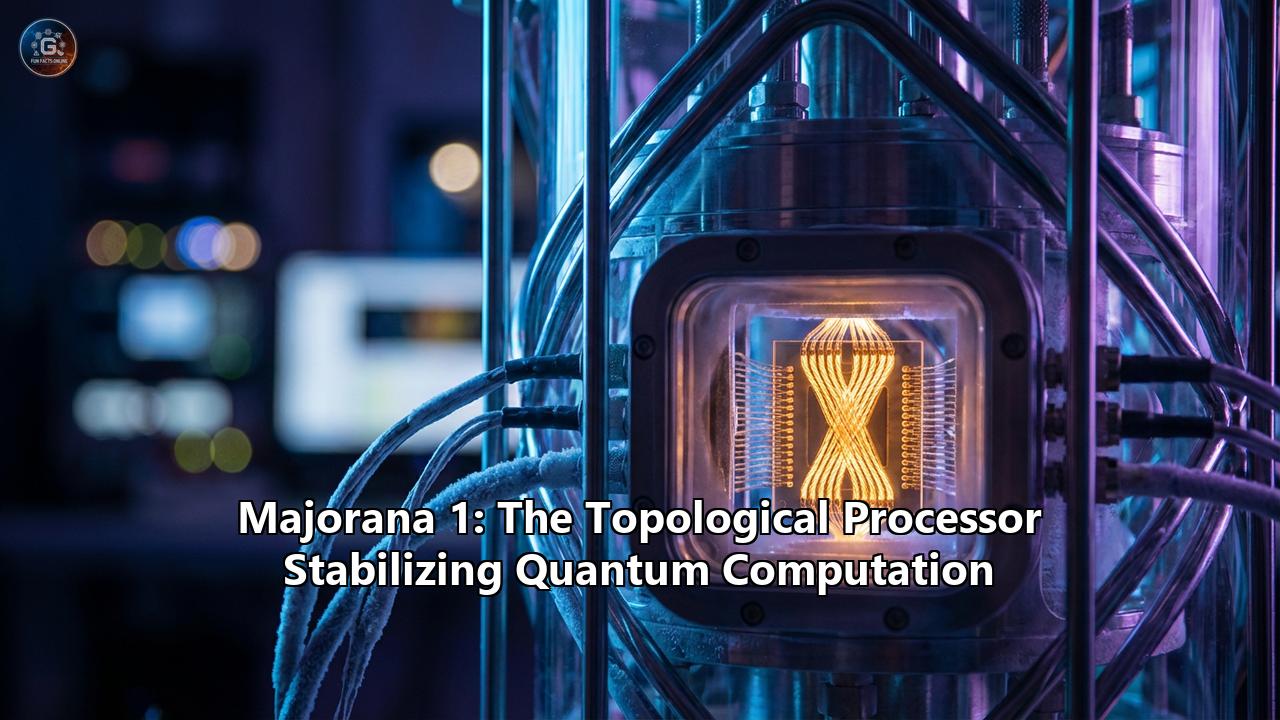
On February 19, 2025, the landscape of quantum computing shifted. For decades, the field has been defined by a brutal trade-off: you can have a quantum processor that is fast, or you can have one that is stable, but rarely both. Companies like Google and IBM have built impressive machines using superconducting transmon qubits, but they are plagued by "noise"—environmental interference that causes calculation errors within microseconds. The industry has been waiting for a savior: a qubit that is inherently protected from these errors by the laws of physics themselves.
Enter Majorana 1.
Announced by Microsoft Azure Quantum, the Majorana 1 is the world’s first Quantum Processing Unit (QPU) powered by a "Topological Core." It is not just another incremental step with slightly better coherence times; it represents a fundamental divergence in how we build quantum computers. Built from a new class of materials called "topoconductors," this processor promises to turn the noisy, fragile quantum bits of today into the stable, scalable logic of tomorrow. With a roadmap to fit one million qubits on a chip the size of a credit card, Majorana 1 is being hailed as the "transistor for the quantum age."
But what makes it different? Why has it taken nearly two decades to build? And how does a particle that acts like its own antiparticle solve the biggest problem in computing history?
1. The Physics of Protection: Why Topology Matters
To understand Majorana 1, you must understand the enemy of quantum computing: decoherence.
In a standard quantum computer, a qubit (quantum bit) is like a coin spinning on a table. It can be heads (0), tails (1), or a blur of both (superposition). But if a breeze blows (thermal noise) or the table shakes (electromagnetic interference), the coin falls flat, and the calculation fails. This is why current quantum computers are kept in giant, golden chandeliers cooled to near absolute zero—they are trying to stop the "wind."
Topological Quantum Computing takes a different approach. Instead of trying to stop the wind, it changes the shape of the coin so it cannot fall over.The Majorana Zero Mode (MZM)
The secret sauce of Majorana 1 is the Majorana Zero Mode (MZM). Predicted by Italian physicist Ettore Majorana in 1937, this quasiparticle has a unique property: it is its own antiparticle.
In Microsoft’s architecture, information isn't stored in a single sensitive particle. Instead, a single bit of quantum information is "split" and stored non-locally across a pair of Majorana particles at opposite ends of a nanowire.
- Imagine a shoelace: If you want to know if the shoelace is knotted (1) or unknotted (0), you have to look at the whole lace. If a fly lands on one end of the lace (local noise), it doesn't change the fact that the lace is knotted.
- The Protection: Because the information is delocalized, a local error affecting just one end of the wire cannot flip the bit. To destroy the information, noise would have to hit both ends of the wire simultaneously and in a coordinated way—an event that is statistically almost impossible.
This "topological protection" means the hardware itself corrects errors before they happen, theoretically reducing the error rate from 1 in 1,000 (standard qubits) to 1 in a trillion.
2. The Hardware: Inside the Majorana 1 Chip
The Majorana 1 chip is a marvel of materials science, the result of nearly 20 years of research at Microsoft Station Q and its global satellite labs.
The Material: "Topoconductor"
The foundation is a new state of matter Microsoft calls a topoconductor. This isn't found in nature; it is grown atom-by-atom.
- The Recipe: It combines a semiconductor (Indium Arsenide) with a superconductor (Aluminum).
- The Magic: When cooled to millikelvin temperatures and subjected to a magnetic field, the interface between these materials becomes a topological superconductor. Electrons in this material split into Majorana Zero Modes at the ends of the wires, creating the protected environment needed for computation.
The Architecture: The "Tetron" Design
Unlike the grid of crosses seen in Google’s Sycamore chip, the Majorana 1 uses a unit cell called a Tetron.
- The Shape: Imagine the letter "H". The vertical lines are the topological nanowires, and the horizontal bar connects them.
- The Qubit: A single logical qubit is encoded using four Majorana Zero Modes (located at the tips of the H).
- Scalability: These H-shaped tiles can be tessellated (tiled) across a silicon wafer. Because the "protection" is built into the electron states, the qubits can be much smaller than traditional ones. Microsoft claims they can fit one million of these qubits on a chip that fits in the palm of your hand.
3. The Breakthrough: Digital Control via Measurement
For years, the theory was that to compute with Majoranas, you had to physically move them around each other, a process called "braiding" (like plaiting hair). If you braid the particles, their history records the calculation.
However, moving particles physically is slow and difficult to engineer on a chip. The breakthrough in Majorana 1, detailed in a February 2025 Nature paper, is a shift to Measurement-Based Topological Quantum Computing (MBTQC).
Instead of physically moving the particles, the processor uses "virtual braiding."
- How it works: The chip uses digital voltage pulses to couple and decouple tiny sensors (quantum dots) to the nanowires.
- The "Teleportation" Trick: By measuring the "parity" (whether the number of electrons is even or odd) of adjacent pairs of Majoranas in a specific sequence, the quantum information is effectively "teleported" or braided without the particles ever moving.
- Why it's a game-changer: This turns an analog physics problem (moving particles precisely) into a digital control problem (turning switches on and off). It allows the processor to be controlled by standard digital electronics, drastically simplifying the wiring and control stack.
4. Roadmap: From Proof to Supercomputer
The announcement of Majorana 1 is just the beginning. Microsoft has outlined a clear three-step path to a commercially viable quantum supercomputer.
- Level 1: Foundational (Current Status)
Goal: Demonstrate the physics.
Achievement: The current 8-qubit Majorana 1 chip has demonstrated the ability to create MZMs and perform the critical "parity measurements" (Pauli X and Z operations) needed for logic. This is the "Kitty Hawk" moment—proving the machine can fly.
- Level 2: Resilient
Goal: Error correction.
Next Step: Microsoft plans to connect these Tetrons into a 4x2 array. They will demonstrate that the topological protection actually works in practice by showing that the logical error rate decreases as they make the system larger.
- Level 3: Scale
Goal: The Quantum Supercomputer.
The Vision: A full-scale system with millions of physical qubits. Because the Tetron units are so small and the control is digital, scaling up doesn't require building a computer the size of a football stadium. The target is a machine capable of solving problems in chemistry and materials science that would take a classical computer the age of the universe to crack.
5. Skepticism and Reality
It is important to note that the scientific community remains "cautiously optimistic." The history of Majorana fermions is riddled with false starts and retracted papers (including a high-profile retraction by Microsoft researchers in 2021).
While the commercial announcement of Majorana 1 is bullish, calling it a "QPU," the accompanying scientific papers are more reserved. They demonstrate the components of a qubit (the parity measurements and the energy gaps) rather than a fully programmable, general-purpose computer ready for users today. We are not yet running Python code on Majorana 1.
However, the peer-reviewed confirmation of the "Topological Gap" (the energy barrier that protects the qubit) and the successful parity measurements are widely considered the "smoking gun" evidence that was previously missing. This is no longer just theory; it is engineering.
Conclusion: The End of the Beginning
Majorana 1 is not just a new chip; it is a validation of a high-risk, high-reward bet. While competitors raced to build more qubits, Microsoft spent 20 years trying to build better ones.
If Majorana 1 scales as predicted, it solves the two bottlenecks of quantum computing: size and error. It offers a future where quantum computers are not just experimental curiosities for physicists, but practical tools for engineers designing new batteries, carbon-capture catalysts, and life-saving drugs.
The age of the topological processor has arrived. The quantum noise is finally quieting down.
Reference:
- https://news.microsoft.com/source/features/innovation/microsofts-majorana-1-chip-carves-new-path-for-quantum-computing/
- https://www.usaii.org/ai-insights/microsoft-majorana-1-chip-all-you-need-to-know-guide
- https://news.ucsb.edu/2025/021760/topological-quantum-processor-marks-breakthrough-computing
- https://insidehpc.com/2025/02/toward-a-million-qubits-microsoft-says-quantum-chip-based-onnew-state-of-matter/
- https://rewrite.technology/en/majorana-1-quantum-processor-microsoft/
- https://www.sciencemediacentre.org/expert-reaction-to-study-from-microsoft-azure-quantum-on-measuring-topological-qubits/
- https://azure.microsoft.com/en-us/blog/quantum/2025/02/19/microsoft-unveils-majorana-1-the-worlds-first-quantum-processor-powered-by-topological-qubits/
- https://www.youtube.com/watch?v=NetIKPxrShY
- https://en.wikipedia.org/wiki/Majorana_1
- https://medium.com/@sahin.samia/microsofts-majorana-1-a-new-era-in-quantum-computing-fc9fcee5d909
- https://modernsciences.org/microsoft-quantum-breakthrough-quantum-physicist-explains-february-2025/
- https://scitechdaily.com/quantum-breakthrough-microsoft-and-purdue-unlock-the-future-of-topological-qubits/
- https://postquantum.com/quantum-modalities/topological-quantum-computing/
- https://quantumcomputing.stackexchange.com/questions/1429/how-does-topological-quantum-computing-differ-from-other-models-of-quantum-compu
- https://postquantum.com/quantum-research/microsofts-majorana1-chip-data/
- https://arpitarora22.substack.com/p/microsoft-a-step-closer-to-topological