
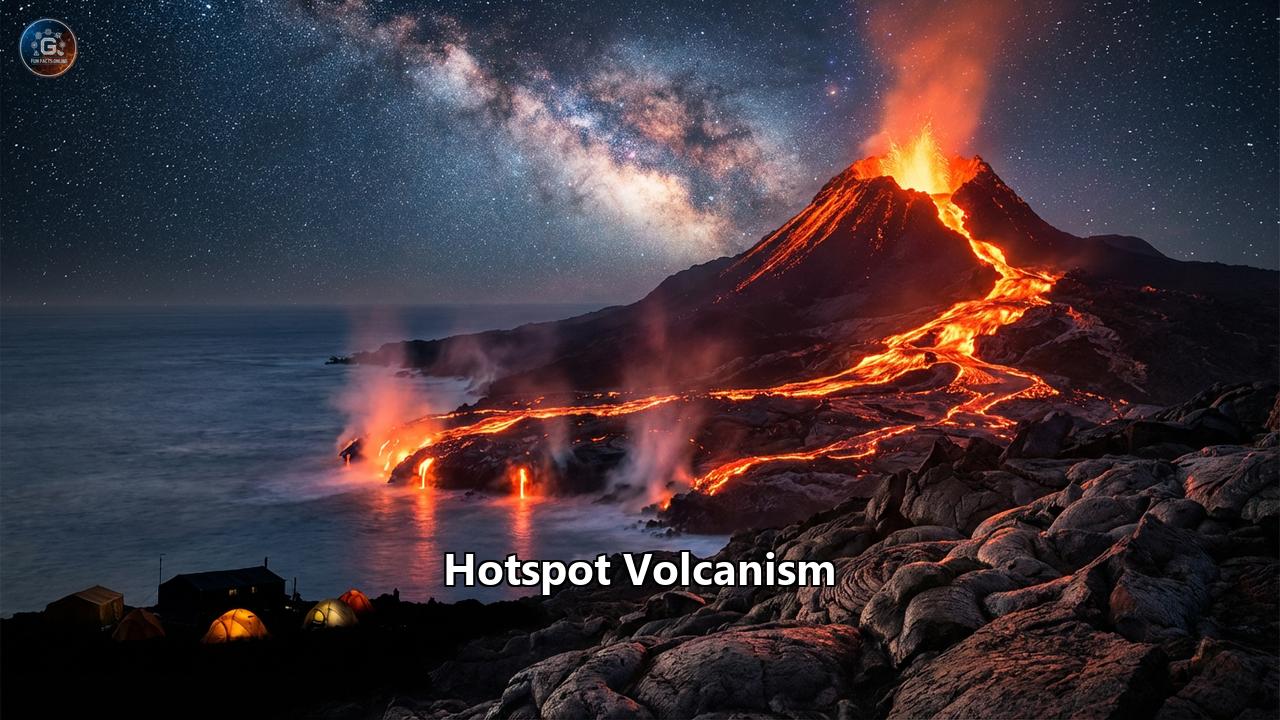
Introduction: The Fiery Needles of the Earth
Beneath the seemingly solid ground we stand on lies a churning, dynamic engine of heat and rock. While most of our planet’s dramatic volcanic activity occurs at the seams of tectonic plates—where continents collide or oceans spread apart—there exists a more mysterious and potent class of volcanism that defies these boundaries. These are hotspots: anomalies of intense heat that pierce through the Earth's crust like a blowtorch, creating chains of islands, supervolcanoes, and massive flood basalts that have shaped the destiny of life on Earth.
Hotspot volcanism represents a direct line of communication between the Earth's deep core and its surface. Unlike the friction-driven melting at plate boundaries, hotspots are fueled by mantle plumes—vast columns of superheated rock rising from the abyss, independent of the drifting tectonic plates above them. From the paradise islands of Hawaii to the geysers of Yellowstone and the frozen fires of Iceland, hotspots are responsible for some of the most spectacular landscapes and cataclysmic events in geological history.
Part I: The Mechanics of the Deep
1.1 The Mantle Plume Hypothesis
In 1963, geophysicist J. Tuzo Wilson noticed something peculiar about the Hawaiian Islands: they formed a linear chain, with the islands getting progressively older to the northwest. He proposed that a stationary "hotspot" deep in the mantle was punching holes in the moving Pacific Plate, much like a sewing machine needle punching holes in a moving piece of fabric.
This idea was refined in 1971 by W. Jason Morgan, who introduced the Mantle Plume Theory. According to this theory, hotspots are fed by narrow streams of hot rock rising from the Core-Mantle Boundary (CMB), nearly 2,900 kilometers (1,800 miles) beneath our feet.
- The Head: As a plume starts to rise, it develops a large, mushroom-shaped head. When this massive head reaches the bottom of the lithosphere (the rigid outer shell of the Earth), it flattens out and melts, causing massive, flood-like eruptions. This phase creates Large Igneous Provinces (LIPs).
- The Tail: After the head dissipates, a narrow "tail" continues to channel hot material to the surface for tens or hundreds of millions of years. This steady stream creates the familiar tracks of volcanoes we see today.
1.2 Thermal Buoyancy and Thermodynamics
The driving force behind a mantle plume is thermal buoyancy. The rock within a plume is not liquid magma (except near the very top); it is solid rock that is hotter and less dense than the surrounding mantle. This density difference causes it to rise slowly, at speeds of perhaps a few centimeters per year.
As the solid rock rises, it experiences a drop in pressure. Because the temperature remains high, the rock undergoes adiabatic decompression melting. Essentially, the pressure holding the rock’s crystal lattice together is removed, allowing it to liquefy into magma, which then burns through the crust to erupt as lava.
1.3 The "Plate Theory" Counter-Argument
While the Plume Theory is the dominant explanation, a minority of scientists argue for the Plate Theory. This hypothesis suggests that "hotspots" are not deep anomalies but shallow features caused by cracks or fissures in the lithosphere that allow normal upper-mantle melt to escape. However, recent advances in seismic imaging and geochemistry (discussed in Part V) have heavily tipped the scales in favor of the deep-mantle plume model.
Part II: A Tour of Fire – Major Global Hotspots
2.1 Hawaii: The Archetype of Ocean Island Volcanism
The Hawaiian-Emperor Seamount Chain is the textbook example of a hotspot track. Stretching over 6,000 kilometers across the Pacific, it records over 80 million years of plate motion.
- The Assembly Line: The Big Island of Hawaii is currently situated over the hotspot, fueling Mauna Loa and Kilauea. To the northwest, the islands of Maui, Oahu, and Kauai are progressively older and more eroded.
- The "Bend": A sharp 60-degree bend in the chain marks a dramatic moment in history about 47 million years ago. For decades, this was thought to be a change in the Pacific Plate's direction. New research suggests it was actually the hotspot itself moving in the mantle wind before stabilizing.
- Loihi: South of the Big Island lies Loihi, a submarine volcano growing 1,000 meters beneath the waves. It is the next island in the chain, destined to break the surface in 10,000 to 100,000 years.
2.2 Yellowstone: The Continental Supervolcano
When a hotspot sits beneath a thick continental plate, the results are explosive. The Yellowstone hotspot has burned a path across North America, creating the Snake River Plain in Idaho before arriving in Wyoming.
- Rhyolitic Fury: Unlike the fluid basalt of Hawaii, the continental crust melts to form sticky, silica-rich rhyolitic magma. This traps gas and leads to colossal explosions.
- The Track: The trail of "dead" supervolcanoes stretches southwest from Yellowstone, marking where the North American plate has slid over the plume.
- Current State: Today, the hotspot powers the world's largest concentration of geysers and hot springs. While the "supervolcano" eruption scenario attracts media attention, the most likely future activity is hydrothermal explosions or smaller lava flows.
2.3 Iceland: Where Fire Meets Ice
Iceland is unique because it sits atop both a hotspot and a divergent plate boundary (the Mid-Atlantic Ridge).
- The Interaction: The extra heat from the plume causes excess melting along the ridge, creating a crust that is over 40 km thick—far thicker than normal oceanic crust. This is why Iceland rises above sea level while the rest of the ridge remains underwater.
- Laki and Eyjafjallajökull: Icelandic eruptions can have global climate impacts. The 1783 Laki eruption released enough sulfur dioxide to cool the Northern Hemisphere and cause crop failures across Europe.
2.4 The Galapagos: The Evolutionary Crucible
Located on the Nazca Plate near the Cocos and Pacific plates, the Galapagos hotspot interacts with a spreading center in a complex dance. The result is a scattered archipelago rather than a neat line. The isolation provided by these volcanic islands created the perfect laboratory for evolution, inspiring Charles Darwin’s theory of natural selection.
Part III: The Deep Science – Fingerprinting the Mantle
How do we know these plumes come from the core? The evidence lies in the "DNA" of the lava and the "X-rays" of the Earth.
3.1 Geochemistry: The Helium Signal
The strongest chemical evidence for deep plumes is the ratio of Helium-3 (He-3) to Helium-4 (He-4).
- Helium-4 is produced continually by the radioactive decay of uranium and thorium in the Earth's crust and upper mantle.
- Helium-3 is "primordial"—it was trapped inside the Earth during its formation 4.5 billion years ago.
- The Smoking Gun: Mid-Ocean Ridge Basalts (MORB) have low He-3/He-4 ratios because the upper mantle has been degassed over billions of years. Hotspot lavas (OIB - Ocean Island Basalts) often have extremely high He-3/He-4 ratios. This signals that the magma is sourced from a pristine, isolated reservoir deep in the lower mantle that has not mixed with the upper layers since the dawn of the planet.
3.2 Seismic Tomography: Seeing the Unseen
Using earthquake waves like a medical CT scan, scientists have imaged the Earth's interior.
- LLSVPs (Large Low Shear Velocity Provinces): Tomography has revealed two massive, continent-sized blobs of dense, hot rock sitting at the bottom of the mantle—one under Africa ("Tuzo") and one under the Pacific ("Jason").
- Plume Generation Zones: Nearly all major hotspots on Earth can be traced back to the edges of these LLSVPs. It appears that plumes originate from the margins of these deep thermochemical piles, rising like smoke from a chimney.
Part IV: Agents of Destruction – Large Igneous Provinces (LIPs)
When the "head" of a new mantle plume first strikes the lithosphere, the result is a cataclysm known as a Large Igneous Province. These are flood basalt events of unimaginable scale that can alter the planet's climate.
4.1 The Deccan Traps & The Dinosaurs
About 66 million years ago, the Reunion hotspot (now under Reunion Island) was situated under India. It unleashed the Deccan Traps, covering 500,000 square kilometers in lava. The massive release of volcanic gases (CO2 and SO2) likely stressed global ecosystems, making life vulnerable to the Chicxulub asteroid impact that finished off the non-avian dinosaurs.
4.2 The Siberian Traps & The Great Dying
252 million years ago, a massive plume beneath Siberia created the Siberian Traps. This event released trillions of tons of carbon and methane, warming the planet and acidifying the oceans. It triggered the End-Permian Mass Extinction, wiping out 96% of marine species—the closest life on Earth has ever come to being completely extinguished.
Part V: The Gift of Fire – Ecological and Economic Benefits
Despite their destructive potential, hotspots are vital for life and civilization.
5.1 Geothermal Energy
Iceland generates over 25% of its electricity and 90% of its home heating from geothermal energy derived from its hotspot. This provides a clean, renewable, and virtually limitless energy source.
5.2 Fertile Soils
Volcanic ash and basalt break down into some of the most fertile soils on Earth, rich in iron, magnesium, and potassium. This supports lush rainforests in Hawaii and productive agriculture in regions like Java and the slopes of Mount Etna.
5.3 Biodiversity Hotspots
Remote volcanic islands formed by hotspots are blank slates for life. Arriving species undergo adaptive radiation, evolving into unique forms found nowhere else. The Hawaiian honeycreepers and Galapagos finches are classic examples of this biological novelty driven by geological isolation.
Conclusion
Hotspot volcanism is more than just a geological curiosity; it is a fundamental process of our living planet. It recycles material from the deep Earth to the atmosphere, regulates the long-term carbon cycle, and creates new land for life to colonize. From the microscopic helium atoms trapped in lava to the massive provinces that have dictated the fate of species, hotspots remind us that the Earth is connected from its core to its crust. As we continue to monitor these sleeping giants with satellites and seismometers, we gain not only a better understanding of natural hazards but also a deeper appreciation for the fiery engine that drives our world.
Reference:
- https://pmc.ncbi.nlm.nih.gov/articles/PMC3574918/
- https://en.wikipedia.org/wiki/Mantle_plume
- https://vcresearch.berkeley.edu/news/ct-scan-earth-links-deep-mantle-plumes-volcanic-hotspots
- https://www.gktoday.in/deep-mantle-plumes/
- https://meetingorganizer.copernicus.org/EGU2014/EGU2014-16479.pdf
- https://newradargas.com/wx/xwxq.aspx?id=25
- https://www.youtube.com/watch?v=8pusDMQckdI
- https://www.youtube.com/watch?v=srv1XMi9eGI
- https://www.internetgeography.net/cambridge-igcse-geography/cambridge-igcse-the-natural-environment/what-opportunities-do-volcanoes-present-to-people/
- https://www.bgs.ac.uk/discovering-geology/earth-hazards/volcanoes/living-with-volcanoes/
- https://www.youtube.com/watch?v=tHDOV-a-GBY