
Imagine standing on the shoreline of the Pacific Ocean, gazing out at the seemingly infinite expanse of blue water. The waves crashing against the sand represent the lifeblood of our planet, the very reason Earth is a vibrant oasis in a desolate solar system. For generations, we have been taught that this surface water is a rare and precious anomaly. The prevailing scientific narrative suggested that Earth was born as a parched, violently glowing rock, and that our oceans were delivered millions of years later by a barrage of icy comets and asteroids—a cosmic delivery service often referred to as the "Late Veneer."
But what if that vast, blue horizon is merely a drop in the planetary bucket?
Over the past few years, a quiet revolution has been brewing deep beneath our feet. Modern planetary science and geophysics have shattered the myth of the dry early Earth. Advanced seismic mapping, extreme-pressure laboratory simulations, and atomic-scale tomography have converged to reveal a staggering truth: the deepest, most inaccessible regions of our planet harbor a colossal reservoir of hydrogen, the primary building block of water.
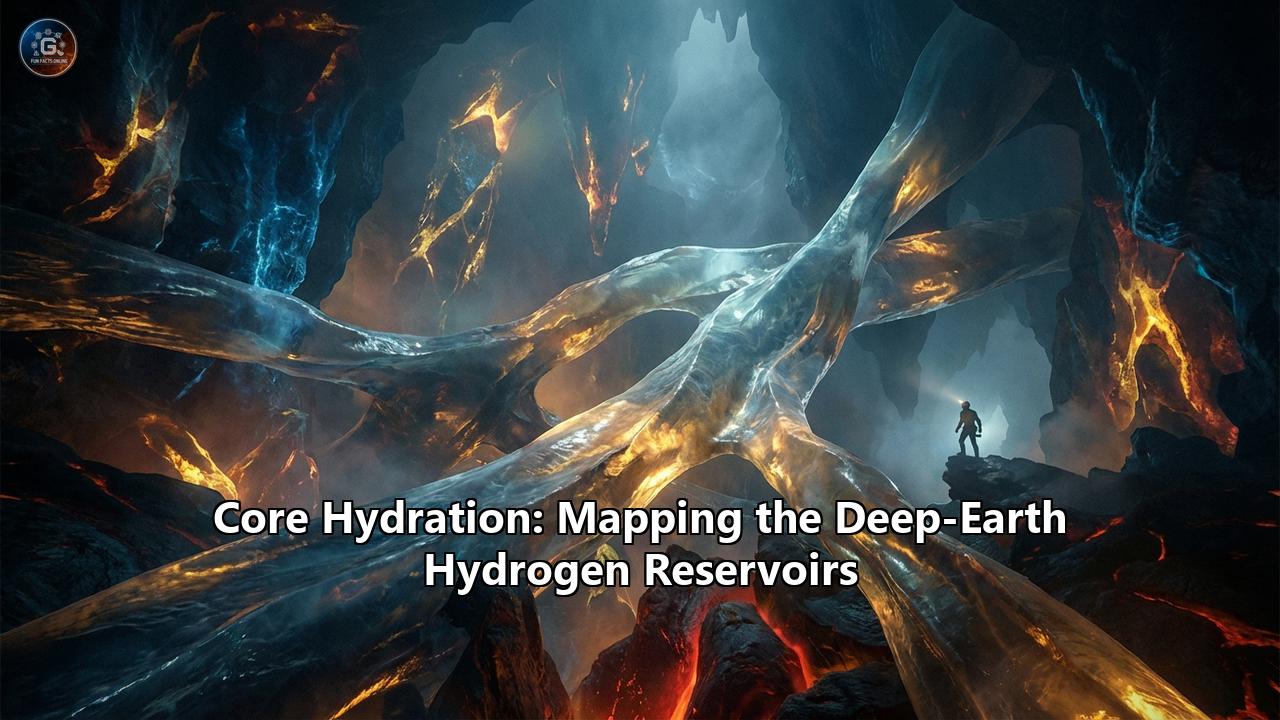
Far beneath the crushing weight of the mantle, locked away in the metallic heart of the Earth, lies a subterranean vault of hydrogen so immense that it is estimated to equal the volume of up to 45 global oceans. This phenomenon, known as "Core Hydration," is not just a geological curiosity. It is a fundamental rewrite of our planet’s history, offering profound new insights into how Earth formed, how it generates its protective magnetic field, and how life itself has managed to endure for billions of years.
To understand the sheer magnitude of this discovery, we must take a journey deep into the Earth, peeling back the layers of our world to map the hidden reservoirs of deep-Earth hydrogen.
The Architecture of the Abyss: A Descent into the Earth
To comprehend how water—or more accurately, hydrogen—can exist thousands of miles underground, we must first abandon the mental image of subterranean oceans sloshing around in dark, cavernous voids. Deep-Earth hydration is a story of extreme chemistry, not hidden lakes.
The Earth is constructed like a series of concentric spheres. Beneath the thin, brittle crust upon which we live lies the mantle, a 1,800-mile-thick layer of slowly churning, semi-solid silicate rock. Below that is the core-mantle boundary (CMB), a chaotic zone where rock meets the outer core, a swirling ocean of liquid iron and nickel. Finally, at the very center of the planet, lies the inner core—a solid sphere of iron and nickel roughly the size of Pluto, compressed by pressures exceeding three million times the atmospheric pressure at sea level, and baking at temperatures upward of 5,000 to 6,000 Kelvin.
For decades, the core was viewed as a relatively simple, heavy metallic vault devoid of lighter elements. Geologists knew that the inner core's density was slightly lower than that of pure iron, a discrepancy known as the "density deficit," but the exact mix of lighter elements—such as sulfur, silicon, oxygen, carbon, and hydrogen—that caused this deficit remained a fiercely debated mystery. Hydrogen, being the lightest element in the universe, was long disregarded as a major player because it was assumed it could not dissolve into iron under such conditions, or that it would have boiled away during the violent, fiery days of Earth’s formation.
However, nature operates under different rules when subjected to the crushing forces of the deep Earth.
The Mantle Sponges: Ringwoodite and Bridgmanite
The first clues that our planet was secretly hoarding water came not from the core, but from the mantle. In 2014, scientists analyzing a battered, unappealing diamond that had been violently ejected to the surface by a deep-source volcanic eruption made a historic discovery. Trapped inside this diamond was a tiny, microscopic flaw—a fleck of a sapphire-blue mineral called ringwoodite.
Ringwoodite is a high-pressure polymorph of olivine, the most common mineral in the upper mantle. Scientists had long theorized that ringwoodite existed in the mantle's "transition zone" (between 410 and 660 kilometers deep), but this was the first time a natural sample had ever been found. When researchers analyzed the mineral, they found that it contained about 1.5% water by weight. This water was not liquid; rather, it was trapped as hydroxide (OH-) ions bound within the crystal lattice of the mineral itself. Extrapolating this finding to the entire transition zone suggested that this layer of the mantle alone could hold as much water as all of Earth's surface oceans combined.
But the mantle’s capacity to store water goes even deeper. In late 2025, researchers simulating the extreme high-temperature and high-pressure conditions of the lower mantle (the layer just above the core) turned their attention to bridgmanite. Bridgmanite makes up roughly 60% of the Earth's mantle, making it the most abundant mineral on the planet.
By utilizing ultra-high-pressure laser-heated diamond anvil cells, researchers recreated the hellish conditions of the early Earth’s magma ocean, reaching temperatures of 4,100 degrees Celsius. They discovered that as the primordial magma cooled and crystallized, bridgmanite acted like an insatiable microscopic sponge. The hotter the environment, the more water bridgmanite could lock into its structure—retaining between 5 to 100 times more water than prior models had ever predicted. The lower mantle, it turned out, was the planet's first great water reservoir, holding between 10 and 100 times more water than originally estimated as the early Earth solidified.
Yet, even these staggering mantle reservoirs pale in comparison to the revelations hidden beneath them in the planet's metallic core.
The 45-Ocean Vault: Penetrating the Iron Heart
In early 2026, a groundbreaking series of studies published in major scientific journals fundamentally shifted our understanding of planetary formation. Led by researchers such as Dongyang Huang of Peking University and Motohiko Murakami of ETH Zurich, these investigations definitively proved that the Earth’s core is the single largest reservoir of hydrogen on the planet.
Because no drill can ever survive the journey to the core, scientists must rely on extreme laboratory simulations to recreate the deep Earth. The researchers utilized a device called a laser-heated diamond anvil cell. By placing a tiny sample of iron, silicon, and water between the tips of two flawless synthetic diamonds, they applied physical pressure equivalent to the center of the Earth. Simultaneously, they fired high-energy lasers through the diamonds to heat the sample to thousands of degrees, melting the iron just as it would have melted during Earth's primordial core formation.
Once the sample was subjected to these apocalyptic conditions, the researchers rapidly "froze" or quenched it to preserve the atomic structure, and then utilized state-of-the-art atom probe tomography. This technology acts like an ultra-high-resolution chemical CT scan, applying a carefully controlled high voltage to ionize and literally count the atoms one by one, allowing scientists to generate 3D images of the chemical composition at the atomic scale.
The results were paradigm-shattering. The scientists directly observed how hydrogen atoms behaved within the metallic iron. Instead of boiling off or remaining separate, the hydrogen was strongly "siderophile," or iron-loving, under extreme pressure. It aggressively dissolved into the liquid iron, chemically packing itself into the core's material by forming iron hydrides tied to silicon- and oxygen-rich nanostructures. The atom probe tomography revealed a surprisingly consistent ratio: for every atom of silicon incorporated into the iron matrix, there was approximately one atom of hydrogen.
By taking this 1:1 hydrogen-to-silicon ratio and combining it with highly established geophysical estimates of the amount of silicon present in the core, the researchers calculated the total mass of deep-Earth hydrogen. They concluded that hydrogen makes up roughly 0.07% to 0.7% of the core's total weight.
While a fraction of a percent might sound insignificant, the sheer mass of the Earth's core is almost incomprehensible. When translated into volume, this tiny percentage equates to an astronomical amount of hydrogen. The conservative minimum estimate indicates the presence of enough hydrogen to fill 9 global oceans. The maximum estimate suggests a breathtaking 45 oceans' worth of hydrogen locked inside the metallic center of our planet.
This discovery fundamentally reclassifies the core. It is no longer just a dense ball of iron and nickel; it is the dominant hydrogen reservoir of the entire planet. The surface oceans, which cover 70% of the Earth and define its identity, represent only the smallest, most superficial fraction of the planet's actual water budget.
The Physics of the Deep: Superionic Iron Hydrides
What exactly does "water" look like inside the core? It is crucial to dispel the illusion of liquid water existing at 5,000 degrees Kelvin. Deep-Earth hydrogen does not sit in the core as a free gas, nor does it form the H2O molecules we drink. The extreme thermodynamics of the inner Earth force matter into bizarre, exotic states that defy everyday logic.
Under the crushing pressures of the core, hydrogen reacts chemically with iron to form a compound known as iron hydride (FeH). Recent experimental data has shown that the addition of hydrogen actually induces a phase change in the atomic lattice of the iron. Instead of the traditional hexagonal close-packed (hcp) crystal structure normally assumed for pure iron at those depths, the incorporation of hydrogen causes the iron to adopt a face-centered cubic (fcc) lattice.
Even more fascinating is the discovery of the "superionic" state of this iron hydride. First predicted in the extreme environments of giant planets like Uranus and Neptune, superionicity is a hybrid phase of matter that exists somewhere between a solid and a liquid. In 2024, advanced computer simulations and quantum mechanics modeling demonstrated that the face-centered cubic iron hydride (fcc-FeH) in the Earth's core enters this superionic state at temperatures between 2,000 and 3,000 Kelvin.
In a superionic state, the heavier iron and silicon atoms remain locked in a rigid, solid crystal lattice. However, the hydrogen atoms become entirely unbound. Stripped of their electrons, the hydrogen protons flow freely and rapidly through the solid iron framework, migrating like a fluid through a sponge.
This ghostly, flowing hydrogen has successfully solved some of the most enduring mysteries of seismology. For years, as seismologists bounced earthquake waves through the center of the planet to map its interior, they observed bizarre anomalies. At the core-mantle boundary (CMB), they found patches called Ultra-Low Velocity Zones (ULVZs), where seismic waves inexplicably slowed down to a crawl. Furthermore, the shear wave velocities passing directly through the solid inner core were far lower than what pure solid iron should allow.
The existence of superionic iron hydride perfectly explains these anomalies. The rapid diffusion of liquid-like hydrogen through the solid iron lattice drastically lowers the shear strength of the metal, causing "shear softening". This gives the inner core an intermediate elasticity between a solid and a liquid, resulting in the sluggish seismic velocities observed by global earthquake monitors. At the core-mantle boundary, the accumulation of iron hydride—created when water carried down by subducting tectonic plates reacts chemically with the liquid iron of the outer core—forms dense, highly sound-absorbent patches that perfectly match the profile of ULVZs.
We are not just mapping static elements; we are mapping dynamic, flowing currents of superionic hydrogen navigating the metallic heart of our world.
Rewriting Planetary History: The End of the Cosmic Delivery Myth
The realization that the Earth's core holds 45 oceans of hydrogen forces a massive rewrite of how our planet formed. If the core contains the vast majority of the planet's water, it means the water had to be present during the core's formation.
More than 4.5 billion years ago, the young Earth was a violent, accreting mass of rock, dust, and gas circling the newborn Sun. As the planet grew, gravitational friction and radioactive decay generated so much heat that the entire surface melted into a global magma ocean. Heavy metals, primarily iron and nickel, liquefied and sank relentlessly toward the center of gravity, forming the core.
If Earth had acquired its water late in its development via comet impacts, that water would have remained in the crust and upper mantle; the extreme pressure barriers would have prevented it from migrating thousands of miles down into an already solidified metallic core. The fact that the hydrogen is intimately locked inside the core's iron matrix proves that hydrogen was deeply involved in the primary stages of Earth's growth.
Scientists now believe that the early Earth acquired massive amounts of hydrogen directly from the solar nebula—the cloud of gas and dust that formed the solar system—or from hydrogen-rich carbonaceous chondrite meteors during its primary accretion phase. As the molten iron rained down through the silicate magma ocean to form the core, its "siderophile" (iron-loving) nature under high pressure caused it to aggressively bond with hydrogen. The sinking iron effectively dragged the hydrogen down with it, sequestering it in the deep Earth.
This early sequestration was an incredible stroke of planetary luck. In the turbulent first million years of the solar system, the young Sun frequently erupted with intense, violent solar winds that could easily strip the atmosphere and volatile elements from a developing planet. By locking its hydrogen deep inside a heavy, metallic vault, the Earth protected its water supply from being blasted into deep space. The core acted as a massive, heavily armored chemical battery, preserving the building blocks of life through the apocalypse of planetary accretion.
"Earth's core would store most of the water in the first million years of Earth's history," notes Dongyang Huang. "The surface—where life resides—contains the least". We are not the beneficiaries of random, late-arriving space ice; we are living on the skin of a world that was born wet and has fiercely protected its water since day one.
The Engine of Life: Why Core Hydrogen Matters
Why does it matter that a 45-ocean reservoir of hydrogen is trapped 1,800 miles beneath our feet? Because that hydrogen is the hidden engine that drives the habitability of the surface world. The deep-Earth hydrogen vault is inextricably linked to the atmospheric conditions that allow humanity to exist.
First, hydrogen plays a pivotal role in the geodynamo—the mechanism that generates the Earth's magnetic field. Pure iron is incredibly dense. For the liquid outer core to churn and convect, it requires lighter elements to lower its density and drive fluid dynamics. The presence of massive amounts of hydrogen dissolved in the outer core lowers the melting temperature and the density of the iron alloy. As the inner core slowly solidifies and cools over billions of years, it expels lighter elements like hydrogen and silicon into the liquid outer core. This upward migration of light elements acts as a powerful buoyant force, violently stirring the liquid iron. This immense convection of electrically conductive metal generates the planet's magnetosphere.
Without the magnetosphere, the Earth would be continuously bombarded by lethal cosmic radiation. Our atmosphere would be stripped away by solar winds—a fate that likely befell Mars, whose core cooled and ceased its dynamo billions of years ago. The hydrogen deep within the Earth is literally powering the magnetic shield that protects the air we breathe.
Secondly, the core is not completely sealed. Over geological timescales, there is evidence that this deep-seated hydrogen gradually leaks or seeps from the core-mantle boundary back into the overlying mantle. As the hydrogen escapes the iron lattice and enters the silicate rocks, it reacts with oxygen to form water (hydroxyl ions).
This deep water fundamentally alters the physical properties of the Earth's interior. Water significantly lowers the melting point of mantle rocks, acting as a geological flux. This makes the mantle more pliable, allowing it to slowly churn and circulate. The resulting generation of magma and the convective currents within the mantle are the primary drivers of plate tectonics.
The slow, grinding movement of tectonic plates—the force that builds mountains, carves deep ocean trenches, and triggers volcanic eruptions—relies heavily on the lubricating presence of deep-Earth water. Volcanic eruptions, in turn, outgas essential molecules like water vapor and carbon dioxide into the atmosphere, regulating the global climate over millions of years through the deep carbon cycle. Without the steady, incredibly slow release of hydrogen and water from the deep interior, tectonic activity would seize up. The planet would become geologically dead, nutrient cycling would halt, and life on the surface would eventually starve.
Conclusion: The Living Leviathan Beneath Our Feet
The mapping of the deep-Earth hydrogen reservoirs represents one of the most profound shifts in modern geosciences. It tears down the outdated image of our planet as an inert rock topped with a fragile, lucky puddle of water. Instead, it reveals the Earth for what it truly is: a deeply integrated, complex, and resilient biological and geological machine.
Through the marvels of atomic-scale imaging, diamond anvil cells, and supercomputing, we have peered into the unimaginable pressures of the abyss and found a planetary vault holding up to 45 oceans of water. We have mapped superionic hydrogen flowing like a phantom river through a cage of solid iron, dictating the seismic heartbeats of the world. We have uncovered the protective mechanism that allowed Earth to survive its violent birth and evolve into a lush, life-bearing jewel.
When we stand on the beach and look at the ocean, we are not looking at all the water the Earth has to offer. We are merely looking at the condensation on the outside of a massive, hydrogen-fueled engine. The true ocean—the one that drives the continents, powers the magnetic field, and breathes life into the surface—is far beneath us, beating in the iron heart of a living planet.
Reference:
- https://insights.made-in-china.com/45-Oceans-Deep-The-Secret-Hydrogen-Vault-Inside-Our-Planet_bGhtEFoLVnDm.html
- https://www.mixvale.com.br/2026/02/20/earths-core-may-contain-hydrogen-equivalent-to-up-to-45-oceans-according-to-new-research-en/amp/
- https://www.energylivenews.com/2026/02/16/hidden-oceans-of-hydrogen-in-earths-core-reshape-climate-science/
- https://www.chinadaily.com.cn/a/202512/14/WS693ed757a310d6866eb2e87d.html
- https://www.pnas.org/doi/10.1073/pnas.2406386121
- https://www.zmescience.com/science/astronomy/scientists-say-earths-core-could-be-hiding-the-equivalent-of-up-to-45-oceans-of-water/
- https://www.researchgate.net/publication/363213563_Iron_Hydride_in_the_Earth's_Inner_Core
- https://pubs.aip.org/aip/acp/article-pdf/309/1/943/12013554/943_1_online.pdf
- https://www.sciencenews.org/article/earths-deep-interior-holds-vast-reservoir-water
- https://www.futura-sciences.com/en/a-massive-water-reservoir-may-have-been-trapped-inside-earths-mantle-since-the-beginning_22409/
- https://eladelantado.com/en/earth-core-hydrogen-formation/
- https://www.researchgate.net/publication/341465462_The_Earth's_core_as_a_reservoir_of_water
- https://www.ekhbary.com/news/earths-core-a-hidden-ocean-of-hydrogen-fueling-geological-processes-865-2.html
- https://aquaterrex.com/unveiling-the-mysteries-of-deep-seated-water-aquaterrexs-journey-into-earths-hidden-reservoirs/