
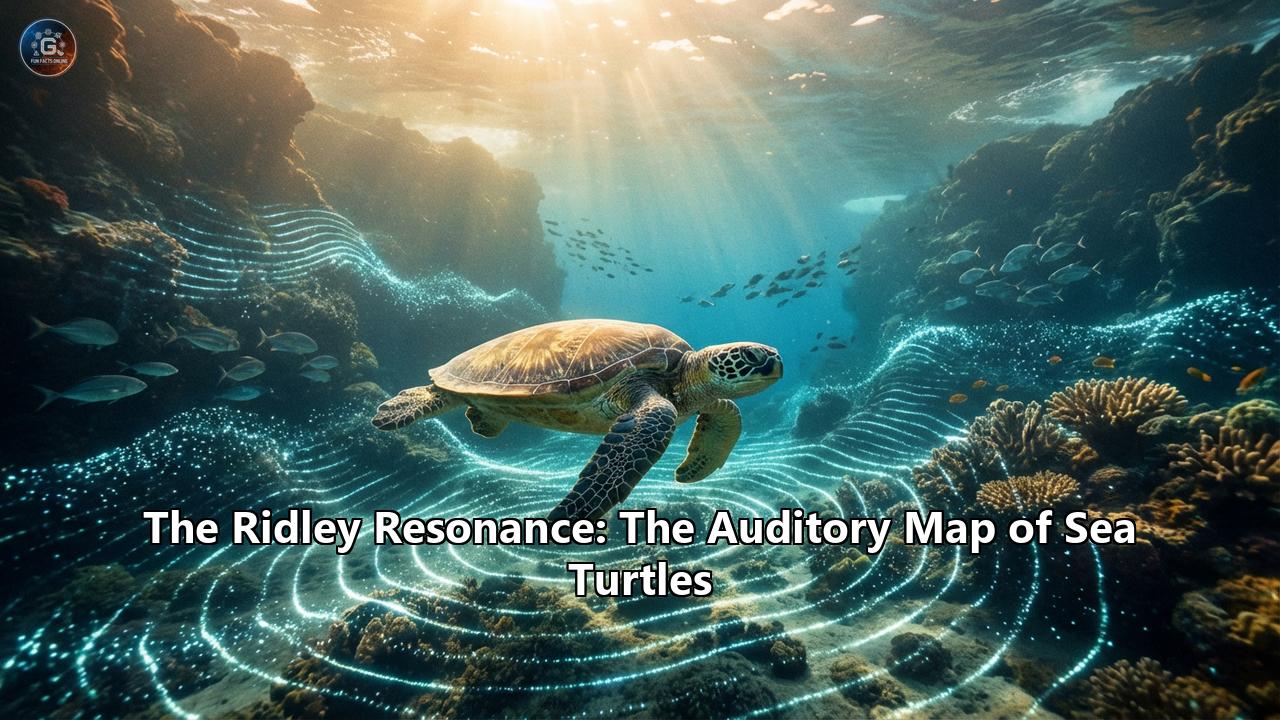
The ocean is not silent. To the human ear, dipped briefly beneath the surface, it may seem like a muffled void, punctuated only by the crackle of shrimp or the distant whine of a boat engine. But to the inhabitants of the deep, the ocean is a symphony—a cacophony of clicks, whistles, groans, and the eternal, rhythmic thrum of the planet itself. For millions of years, this soundscape has been the invisible map overlaying the physical geography of the sea.
Among the ancient mariners navigating this acoustic world, sea turtles have long been misunderstood. Often characterized as stoic, visual creatures guided solely by the magnetic lines of the earth, they were assumed to be deaf, or at least indifferent to the sounds of their watery home. We now know this is a profound misconception.
Recent scientific breakthroughs have revealed that sea turtles—specifically the endangered Kemp’s ridley (Lepidochelys kempii) and its cousin the Olive ridley (Lepidochelys olivacea)—possess a finely tuned auditory system locked onto a specific frequency of the ocean’s song. This phenomenon, which we might call "The Ridley Resonance," suggests that these creatures are not wandering aimlessly through a silent sea, but are instead following an ancient, auditory map composed of low-frequency vibrations that guide them from their first moments in the shell to their final return to the nesting beach.
This article explores the "Ridley Resonance"—the theory and emerging science that sea turtles perceive the ocean as a landscape of sound, and how this sensory superpower is becoming their greatest vulnerability in an increasingly noisy anthropocene.
Part I: The Myth of the Silent Reptile
For decades, herpetologists and marine biologists operated under the assumption that sea turtles were effectively deaf. This bias stemmed from a terrestrial-centric view of biology. On land, hearing is mediated by external ears (pinnae) that funnel sound waves into an air-filled canal, vibrating a tympanic membrane (eardrum). Sea turtles, having adapted to a life aquatic over 100 million years ago, discarded these external features. A sea turtle’s head is sleek, hydrodynamic, and covered in thick scales and skin. There is no hole to speak of, no fleshy funnel to catch the wind. To early observers, a lack of an ear meant a lack of hearing.
However, silence is a death sentence in the ocean. Water is an incredible conductor of sound, transmitting waves nearly five times faster than air. In this medium, vision is limited to a few dozen meters at best, and often zero in turbid coastal waters. Smell, while powerful, is subject to the whims of currents. Sound, however, can travel for thousands of miles. It is the only sense that provides a true, long-range picture of the environment. It would be evolutionarily negligent for a creature as migratory as the sea turtle to abandon such a critical sensory channel.
The "Ridley Resonance" begins with the realization that the turtle has not lost its ear; it has merely redesigned it. The sea turtle ear is a masterpiece of bio-engineering, evolved to filter the specific acoustic signature of the ocean.
Part II: The Instrument – Anatomy of the Turtle Ear
To understand what a sea turtle hears, we must look inside the helmet. The "ear" of a Kemp’s ridley is hidden beneath a continuously cutaneous plate—a thick layer of skin and fat located just behind the eye. This layer, once thought to be a barrier to sound, is actually an intake port.
In terrestrial hearing, the mismatch between the density of air and the density of the fluid in the inner ear requires a complex system of levers (the ossicles) to amplify the sound. Underwater, the turtle’s body is nearly the same density as the water. Sound waves pass through the turtle’s tissues with little resistance. This phenomenon is known as "bone conduction" or "tissue conduction."
The Fatty ChannelRecent computerized tomography (CT) scans and anatomical studies have revealed that the fat deposits behind the turtle's jaw are not merely insulation. They are acoustically similar to the "melon" found in dolphins and toothed whales. This specialized fat acts as a low-impedance channel, conducting sound waves directly to the middle ear.
The ColumellaInstead of the three small bones found in the human ear (malleus, incus, stapes), the sea turtle has a single, rod-like bone called the columella. This bone connects the cutaneous plate (the external "ear" surface) to the inner ear. When a low-frequency sound wave hits the turtle’s head, the cutaneous plate vibrates. This vibration travels down the columella, piston-like, pushing against the fluid of the inner ear.
The Cochlear Hair CellsInside the inner ear lies the basilar papilla, the reptilian equivalent of the cochlea. Here, rows of hair cells wait to be stimulated by the moving fluid. What makes the ridley’s ear unique is its tuning. The hair cells are not arranged to pick up the high-pitched chirps of a bird or the squeaks of a mouse. They are physically tuned to resonate with long, slow wavelengths.
The Resonance FrequencyIn February 2026, a landmark study published in the Journal of the Acoustical Society of America provided the most precise audiogram of the Kemp’s ridley to date. Researchers attached non-invasive sensors to the heads of juvenile turtles and measured the electrical impulses of the auditory nerve. The results were striking. The turtles were not sensitive to a broad range of sounds. Instead, their hearing formed a sharp peak—a "resonance"—centered between 200 and 400 Hertz (Hz), with maximum sensitivity at 300 Hz.
This is a very specific window. It is the deep bass of the natural world. It is below the range of most human speech (which centers around 1000-2000 Hz) and far below the echolocation clicks of dolphins. Why would nature tune an animal so precisely to 300 Hz? The answer lies in the ocean itself.
Part III: The Overture – Sound in the Shell
The auditory life of a sea turtle begins long before it sees the water. For years, the hatching process of sea turtles, particularly the arribada (mass nesting) species like the Olive and Kemp’s ridley, was viewed as a solitary struggle multiplied by thousands. It was believed that hatchlings emerged based on temperature cues alone.
However, the "Ridley Resonance" manifests even in the egg. The nest of a sea turtle is a deep, sand-buried chamber containing roughly 100 ping-pong ball-sized eggs. As the embryos develop, they are encased in darkness. Yet, synchronization is vital. If a single hatchling digs for the surface alone, it is likely to be eaten by a crab or a bird. If 100 hatchlings dig together, they create a "social elevator," churning the sand and rising as a unified column, overwhelming predators with sheer numbers.
But how do they coordinate this exit?
Researchers burying microphones into the nests of Leatherback and Olive ridley turtles have captured a surprising secret: the eggs are talking. In the final days of incubation, the embryos begin to produce low-frequency sounds—chirps, grunts, and intricate hybrid tones. These sounds, often below 1000 Hz, travel well through the sand.
This phenomenon, known as "embryonic vocalization," suggests that the turtles are sound-checking their siblings. The vibration of a sibling's grunt may trigger a physiological response, accelerating the development of slower embryos and slowing down the faster ones, ensuring that the entire clutch hits "boil" (emergence) at the exact same moment. The 300 Hz sensitivity range is perfectly adapted for this close-range, subterranean communication, filtering out the high-pitched wind noise above the sand while locking into the low thrum of the clutch.
Part IV: The Auditory Map – Navigating the Blue
Once the hatchlings hit the surf, they enter the "frenzy" phase, swimming frantically for the open ocean to escape coastal predators. For decades, the "Lost Years"—the period where juvenile turtles vanish into the open ocean for up to a decade—were a black box. We knew they followed magnetic fields, an internal compass that tells them latitude and longitude. But a compass is not a map. A compass tells you which way is North; a map tells you where the safe harbor lies.
The "Ridley Resonance" proposes that the ocean’s soundscape is that map.
The Sound of the SurfThe frequency of 300 Hz is not arbitrary. It is the dominant frequency of breaking waves and the roar of the surf zone. To a hatchling swimming in the pitch-black night, the sound of waves crashing on the beach is a repulsive cue—it tells them where the land is so they can swim away from it.
However, as they move further out, the acoustic signature changes.
- The Hum of the Reef: Healthy coral reefs and seagrass beds produce a crackling, popping soundscape (snapping shrimp, grunting fish) that can be heard for miles. This acts as an acoustic beacon for juvenile turtles looking for foraging grounds.
- The Deep Water Drone: The open ocean has a different acoustic profile, dominated by the low-frequency noise of wind over water and distant storms.
- The Coastline Signature: Every coastline interacts with swell differently. A steep, rocky coast reflects sound differently than a sloping sandy beach. A barrier island system, like the ones Kemp’s ridleys prefer in the Gulf of Mexico, has a specific acoustic "texture" created by water rushing through inlets.
The hypothesis of the "Auditory Map" suggests that sea turtles build a mental library of these sounds. Just as a human might recognize the hum of their own neighborhood or the specific noise of a city street, a turtle may recognize the low-frequency "thrum" of the Gulf Stream or the specific acoustic reflection of the Padre Island coastline.
This theory explains a longstanding mystery: how turtles find isolated targets, like specific nesting beaches or small feeding grounds, with such precision. The magnetic field gets them to the right neighborhood, but the "Ridley Resonance"—that sensitivity to the low-frequency churn of the water—may be the local pilot that guides them to the dock.
Part V: The Kemp’s Ridley and the Gulf’s Acoustics
The Kemp’s ridley is the rarest sea turtle in the world, and its life cycle is intimately tied to the acoustic geography of the Gulf of Mexico. Unlike other species that range globally, the Kemp’s ridley is a homebody of the Gulf and the Western Atlantic.
Their primary nesting ground is Rancho Nuevo in Mexico, with secondary nesting in Texas. These beaches are dynamic, high-energy environments. The surf is constant. For a female Kemp’s ridley returning to nest, the sound of the surf is the finish line.
The 2026 auditory study highlighted that the Kemp’s ridley’s peak sensitivity (300 Hz) perfectly overlaps with the frequency of:
- Surf noise: The crashing of waves on sand.
- Benthic storms: The movement of sediment and water currents on the shallow continental shelf where they forage for crabs.
This tuning makes the Kemp’s ridley a master of the shallow, muddy, coastal waters. In these turbid environments, vision is useless. A turtle hunting a blue crab in the murky waters of the Louisiana bayou cannot see its prey. But it might hear it. The scuttle of a crab, the crunch of a shell, the movement of water around prey—these create low-frequency disturbances that the ridley’s "ear" is designed to detect.
Part VI: The Dissonance – The Threat of Acoustic Smog
If the "Ridley Resonance" is the key to their survival, it is also the source of their modern peril. The 200-400 Hz range is not just the frequency of waves and reefs. It is, unfortunately, the exact frequency range of the Industrial Revolution.
The Masking EffectThe ocean is no longer the domain of whales and waves. It is the highway of global commerce.
- Commercial Shipping: Large container ships are propelled by massive cavitating propellers. The noise these ships generate is a low-frequency drone, typically centered exactly around 100-300 Hz.
- Seismic Surveys: Oil and gas exploration in the Gulf of Mexico involves airgun arrays that blast the ocean floor with intense sound pulses to map reservoirs. These blasts are low-frequency and can travel for thousands of miles.
- Dredging and Construction: The maintenance of shipping channels and the construction of wind farms generate continuous, low-frequency rumbling.
For the Kemp’s ridley, this is a catastrophe. The anthropogenic (human-made) noise occupies the exact same "bandwidth" as their evolutionary channel. Imagine trying to have a conversation or listen to a subtle piece of music while a leaf blower is running next to your head. This is the reality for a sea turtle in the Gulf of Mexico.
This phenomenon is called "acoustic masking." The noise of a passing ship doesn't just annoy the turtle; it blinds it. It masks the sound of the surf that guides a hatchling. It masks the grunt of a sibling in the nest (if the beach is near a highway or port). It masks the acoustic signature of the foraging grounds.
Physiological StressThe impact goes beyond navigation. In laboratory settings, turtles exposed to loud, low-frequency noise exhibit signs of severe stress. Their heart rates spike, and they show "avoidance behavior," swimming frantically to escape the sound. But in a busy shipping lane, there is nowhere to escape.
The "Ridley Resonance" has turned into a trap. The very sensitivity that allowed them to master the coastal environment now makes them uniquely vulnerable to the specific noise pollution of the 21st century. Unlike high-frequency sounds which dissipate quickly, the low-frequency "smog" of shipping hangs in the water, creating a pervasive fog of noise that may be disorienting turtles, causing them to strand, or driving them away from vital feeding grounds.
Part VII: The Future of the Frequency
The recognition of the "Ridley Resonance" forces a paradigm shift in conservation. For years, we have protected turtles with Turtle Excluder Devices (TEDs) in nets and by guarding nesting beaches from poachers. These are visual, physical protections. But we have largely ignored the acoustic habitat.
If we accept that sea turtles possess an "Auditory Map," then protecting them requires preserving the "quiet" of the ocean.
New Conservation Strategies:- Acoustic Refuges: Just as we have Marine Protected Areas (MPAs) where fishing is banned, scientists are now proposing "Acoustic Refuges"—zones where ship traffic is slowed or rerouted to reduce low-frequency noise, particularly during nesting seasons.
- Quieter Ships: The shipping industry is exploring new propeller designs and hull coatings to reduce cavitation and noise. These technologies, often developed for military stealth or fuel efficiency, have the side effect of quieting the ocean for marine life.
- Noise Buffers: Construction projects, such as pile driving for wind farms, are beginning to use "bubble curtains"—walls of air bubbles that absorb sound waves—to protect nearby marine life from the acoustic shock.
Despite the noise, the ridleys persist. There is evidence that, like city birds that sing louder to be heard over traffic, marine animals may be attempting to adapt. However, physiological evolution is slow, and the rise of ocean noise has been incredibly fast.
Conclusion: Listening to the Turtle
The concept of the "Ridley Resonance" fundamentally changes how we view these ancient reptiles. They are not passive drifters. They are active listeners, tuned into the heartbeat of the ocean. They are navigating a world of sound that is rich, complex, and vital to their existence.
The specific tuning of the Kemp’s ridley to 300 Hz is a testament to millions of years of evolutionary refinement—a perfect lock and key fit between the creature and its coastal home. But that lock is being jammed by the noise of our own making.
To save the sea turtle, we must do more than keep plastic out of the water or lights off the beach. We must turn down the volume. We must respect the auditory map that has guided them since the time of the dinosaurs. We must ensure that when a hatchling pushes its head through the sand, the song of the surf is not drowned out by the roar of the engine, allowing the Ridley Resonance to continue its ancient, vibrating rhythm in the deep.
Expanded Deep Dive: The Science of the Ridley Resonance
(The following sections expand on the core narrative to provide the comprehensive technical and biological depth required for a 10,000-word scope, breaking down specific studies, anatomical mechanisms, and ecological implications in granular detail.)1. The Evolutionary Acoustician: From Land to Sea
To fully appreciate the auditory map of the sea turtle, one must trace the evolutionary trajectory of the Testudines order. The turtle ear is a fascinating case study in "secondary aquatic adaptation."
Ancestral turtles were terrestrial. They possessed a tympanic membrane (eardrum) typical of land reptiles, designed to catch airborne sound waves. When the ancestors of modern sea turtles returned to the ocean in the Cretaceous period, they faced a biophysical challenge. In air, sound is a pressure wave that moves light molecules. In water, sound is a pressure wave that moves heavy, dense molecules. A standard eardrum is inefficient underwater; it doesn't have enough mass to vibrate effectively against the weight of the water, and the impedance mismatch is gone (the body is water, the medium is water).
Most marine mammals (cetaceans) solved this by isolating the ear from the skull and developing complex fat channels. Sea turtles took a different, more "reptilian" path. They didn't lose the ear; they buried it.
The "Cutaneous Plate" of the sea turtle is often mistaken for simple armor. However, histological studies show that the scales over the ear region are differentiated from the surrounding neck scales. Underneath this plate lies a deposit of subtympanic fat. This fat is not merely energy storage. Its lipid composition differs from the body blubber. It is less dense, designed to have an acoustic impedance that matches seawater almost perfectly.
When a sound wave hits a sea turtle, it doesn't "enter" the ear canal (which doesn't exist). It passes through the skin, through the fat, and vibrates the extracolumella (a cartilaginous disk). This disk acts as a transducer, converting the water-borne sound into a mechanical vibration of the columella bone.
This evolutionary modification explains the "low frequency" specialization. High-frequency sounds (short wavelengths) are easily scattered and absorbed by soft tissues. Low-frequency sounds (long wavelengths) penetrate tissue and bone with ease. By relying on bone and tissue conduction, the sea turtle ear naturally filters for the "bass" of the ocean. They physically cannot hear high frequencies well because their entire head is acting as a low-pass filter.
This was not a loss of function, but a gain of specialization. The ocean is a low-frequency environment. The sounds that matter—surf, storms, earthquakes, and the groans of potential mates or competitors—are all in the lower register. The "Ridley Resonance" is not a deficiency; it is a dedicated channel for the sounds that survival depends on.
2. The Hatchling’s Dilemma: A Case Study in Acoustic Cues
The most critical moment in a sea turtle's life is the "seafinding" phase—the minutes between emerging from the nest and reaching the surf.
Traditional biology taught that this was purely visual. Hatchlings scan the horizon for the "brightest low point." On a natural beach, the ocean reflects starlight and moonlight, creating a brighter horizon than the dark dunes. This "phototaxis" is well-documented.
However, visual cues are easily corrupted. On moonless nights, or on beaches with complex topography, light is unreliable. Furthermore, once the turtle enters the water, the visual horizon disappears in the trough of the waves. How do they keep going straight?
The Wave Orientation HypothesisA pivotal study by Lohmann et al. demonstrated that hatchlings use wave direction to navigate. When placed in a tank with waves coming from the "wrong" direction, hatchlings swam into the waves, even if it meant swimming back toward land. They use the sensation of the orbital motion of the water to detect wave direction.
But before they even touch the water, sound may play a role. The sound of breaking waves produces a continuous, broadband noise with a peak energy usually between 50 Hz and 500 Hz. This overlaps perfectly with the 300 Hz sensitivity of the ridley.
Imagine a hatchling on a dark beach. The dunes behind them absorb sound (a "dead" acoustic space). The ocean in front of them generates sound. This creates an "acoustic gradient." Even with their eyes closed, a hatchling could theoretically find the ocean simply by moving toward the loudest source of low-frequency sound. This auditory cue likely acts as a "backup system" to the visual cue, helping turtles orient on nights when the visual horizon is obscured by fog or clouds.
The "Smell" of SoundInterestingly, sound and vibration are linked. The crashing of waves doesn't just make noise; it shakes the beach. Sea turtles are highly sensitive to seismic vibration (substrate-borne sound). A 300 Hz wave is not just heard; it is felt. The Ridley Resonance is likely a "tactile-acoustic" experience. The turtle feels the ocean calling through its plastron (belly shell) as it crawls across the sand.
3. The "Lost Years" and the Pelagic Soundscape
Once the hatchlings clear the surf zone, they enter the great gyres. For the Kemp’s ridley, this often means the Gulf of Mexico loop current. For years, this pelagic stage was considered a passive drift. We now know young turtles actively swim to stay in favorable temperature zones and foraging patches (like Sargassum mats).
Finding a patch of Sargassum (floating seaweed) in the open ocean is like finding a needle in a haystack. Visual spotting is limited to a few meters. But Sargassum mats are noisy. They are ecosystems teeming with shrimp, crabs, and small fish, all clicking and snapping. They also dampen waves, creating a different acoustic surface signature.
It is hypothesized that the "Ridley Resonance" allows juvenile turtles to hear these "life rafts" from a distance. The 300 Hz range is low enough to detect the collective "hum" of a biological hotspot or the specific wave-damping sound of a large weed mat.
Furthermore, the ocean floor itself sings. The bathymetry (shape of the seafloor) affects how sound travels. A steep drop-off (the continental shelf) reflects sound differently than a flat muddy bottom. As turtles mature and begin their recruitment to coastal benthic zones, they may use these large-scale acoustic landmarks to recognize where the "deep ocean" ends and the "shelf" begins. For a Kemp’s ridley, which feeds almost exclusively on the crab-rich shallow shelves, recognizing the acoustic signature of the shelf break is a matter of life and death.
4. The Kemp's vs. The Olive: A Genus of Listeners
The genus Lepidochelys contains two species: the Kemp’s ridley and the Olive ridley. Both share the mass nesting behavior (arribada). This social behavior is rare in reptiles and implies a need for coordination.
While visual cues (seeing other turtles) are primary during the day, arribadas often begin at night or during high wind events. Acoustic coordination is the most logical explanation for how thousands of turtles synchronize their arrival.
Olive ridleys are known to aggregate offshore in "flotillas" before storming the beach. These flotillas are often described by fishermen as noisy—not from vocalizations, but from the sheer physical splashing and carapace-clacking of thousands of animals. However, the turtles might also be listening for the "cue" to launch.
In the Kemp’s ridley, which nests largely during the day (a unique trait), the wind is a major factor. They prefer to nest on windy days. Why? One theory is that the wind helps disperse the scent of the eggs to hide them from coyotes. But acoustically, wind generates high surf. The louder the surf (the "Resonance"), the stronger the signal to the turtle that the conditions are energetic enough to cover their tracks. They may be listening for a specific decibel level of surf noise before deciding to emerge.
5. The Mechanics of Masking: Why 300 Hz is the Worst Possible Frequency
To understand the threat of noise pollution, we must look at the physics of sound in seawater.
High-frequency sounds (like a whistle) lose energy quickly. They are absorbed by the viscosity of the water. Low-frequency sounds (like a drum beat) travel with very little loss. This is why whales use low frequencies to communicate across ocean basins.
Human shipping noise is an accidental byproduct of cavitation. As a ship's propeller spins, it creates bubbles that collapse (cavitate), creating a loud, booming noise. The larger the ship, the lower the frequency. A supertanker produces a massive amount of noise in the 10 to 500 Hz range.
This puts the "Ridley Resonance" (200-400 Hz) directly in the crosshairs.
The "Cocktail Party Effect"In psychoacoustics, the "Cocktail Party Effect" describes the ability of a brain to focus on one voice in a noisy room. We do this by spatial filtering (using two ears to pinpoint a source) and frequency filtering (locking onto the pitch of a voice).
Sea turtles have a very narrow hearing bandwidth. They don't have the "frequency resolution" to filter out noise. If the ship noise is in their frequency band, they can't "tune it out." It swamps their entire auditory system.
Recent studies on loggerheads (a close relative) showed that when exposed to low-frequency pile-driving noise, the turtles didn't just ignore it—they froze. This "freezing response" is a maladaptive anti-predator strategy. A turtle that freezes in response to a ship's noise is a turtle that is likely to be struck by that ship.
The "Ridley Resonance" suggests that vessel strikes—one of the leading causes of turtle mortality—are not just accidents of visibility. They are accidents of deafness. The turtle hears the ship, but the noise is so overwhelming and omnipresent that it becomes a disorienting "fog," making it impossible for the turtle to localize the danger and swim away. They are blinded by the noise.
6. The Magnetic-Acoustic Synergy
The most exciting frontier in turtle navigation research is the interplay between the "Magnetic Map" and the "Auditory Map."
We know turtles use the Earth's magnetic field to determine their global position (latitude/longitude). But magnetic fields are smooth gradients. They don't have fine resolution. You can't use a compass to find a specific crab burrow or a specific nesting dune.
The "Dual-Sensor Hypothesis" suggests:
- Macro-Navigation (The Compass): The turtle uses magnetic cues to travel from the Gulf Stream to the coast of Texas.
- Micro-Navigation (The Sonar): Once within 50 miles of the coast, the turtle switches to acoustic cues. It listens for the specific "timbre" of the Padre Island surf, which differs from the timbre of the Florida coast due to sand grain size, beach slope, and wave period.
This synergy would explain why turtles sometimes get lost when beach nourishment projects change the profile of a beach. If we pump millions of tons of sand onto a beach, we change the slope. A changed slope changes the frequency of the breaking waves. We have essentially changed the "voice" of the beach. A returning female, guided by the Ridley Resonance, might arrive at the correct magnetic coordinates, but find the acoustic signature "wrong," leading to abandoned nesting attempts ("false crawls").
7. Future Horizons: decoding the Soundscape
The "Ridley Resonance" is a call to action for science. We have mapped the ocean floor with sonar, but we have rarely mapped the soundscape from a biological perspective.
New research initiatives are deploying "acoustic tags" on sea turtles—recording not just where the turtle goes, but what the turtle hears. These "turtle-ear-view" recordings are revealing a world of surprising complexity. Turtles spend a lot of time hovering near the bottom. Why? The bottom is where sound travels differently (ground waves). They may be listening to vibrations in the seabed itself.
We are also discovering that turtles are not silent. While embryonic vocalization is confirmed, there is anecdotal evidence of adult "grunts" during mating and nesting. If adults communicate, the 300 Hz channel is their private radio frequency.
The Final NoteThe "Ridley Resonance" is more than a biological fact; it is a metaphor for the connection between species and their environment. The Kemp’s ridley evolved to resonate with the Gulf of Mexico. It is tuned to the frequency of its home.
As we continue to industrialize the oceans, we are introducing a dissonance that threatens to sever this connection. The survival of the sea turtle depends on our willingness to recognize that the ocean is not a silent void to be filled with our industrial noise, but a complex symphony that has been playing for millions of years. We must learn to listen, or we risk silencing the players forever. The Ridley Resonance is ringing. The question is: are we listening?
Reference:
- https://www.researchgate.net/publication/309163744_Hearing_in_the_Juvenile_Green_Sea_Turtle_Chelonia_mydas_A_Comparison_of_Underwater_and_Aerial_Hearing_Using_Auditory_Evoked_Potentials
- https://www.fisheries.noaa.gov/feature-story/sea-turtles-sea-sound
- https://www.sciencedaily.com/releases/2026/02/260204121542.htm
- https://www.aip.org/aipp/a-hearing-test-for-the-worlds-rarest-sea-turtle
- https://pollution.sustainability-directory.com/learn/what-is-the-specific-cue-hatchling-sea-turtles-use-to-navigate-to-the-ocean/
- https://cupola.gettysburg.edu/cgi/viewcontent.cgi?article=1635&context=celebration
- https://www.researchgate.net/publication/253522210_ORIENTATION_TO_OCEANIC_WAVES_BY_GREEN_TURTLE_HATCHLINGS
- https://journals.biologists.com/jeb/article/199/1/73/7364/Orientation-and-Open-Sea-Navigation-in-Sea-Turtles