
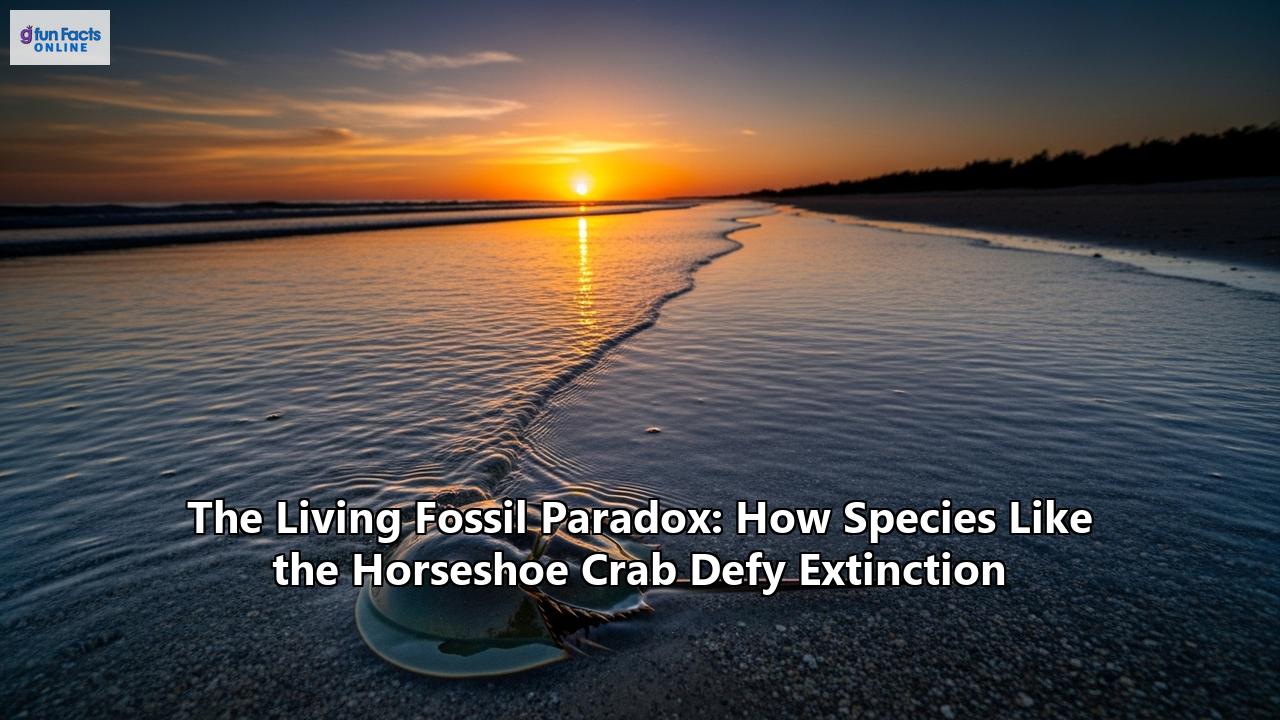
In the grand, tumultuous theater of life on Earth, the script is one of constant, relentless change. Species rise, adapt, and, with unnerving regularity, fall. Over 99% of all species that have ever lived are now extinct. Yet, a few enigmatic actors have seemingly refused to exit the stage. They are the "living fossils," organisms that appear to have been frozen in time, bearing a striking resemblance to their ancestors who thrived hundreds of millions of years ago. This apparent defiance of the evolutionary mandate to "change or die" presents a captivating puzzle: The Living Fossil Paradox. How have these biological time capsules navigated the gauntlet of mass extinctions and planetary upheavals, seemingly unaltered? The story of their survival is not one of stopping evolution, but of perfecting a different kind of evolutionary strategy. At the heart of this tale is perhaps the ultimate survivor: the horseshoe crab.
The Ultimate Survivor: A Deep Dive into the Horseshoe Crab's Story
To gaze upon a horseshoe crab is to look back in time. These armored arthropods have been scuttling across the seafloor and spawning on moonlit beaches for an astonishing 450 million years. They crawled through primordial seas before the dinosaurs took their first steps, witnessed the rise and fall of great marine reptiles, and survived at least five catastrophic mass extinctions, including the Permian-Triassic "Great Dying" which annihilated over 90% of marine species, and the asteroid impact that sealed the dinosaurs' fate 66 million years ago.
An Ancient Blueprint More Spider Than CrabDespite their name, horseshoe crabs are not true crabs at all. They are chelicerates, a group that includes modern spiders and scorpions, making them more closely related to an arachnid than a crustacean. Today, only four species remain: one, Limulus polyphemus, along the Atlantic coast of North America and the Gulf of Mexico, and three others in the coastal waters of South and Southeast Asia.
Their enduring success is a testament to an incredibly effective body plan that has required little modification for eons. This anatomical toolkit is a masterclass in survival. The body is divided into three main sections:
- The Prosoma: This is the large, helmet-like front shell shaped like a horseshoe. It acts as a formidable shield, protecting the delicate organs and appendages beneath it.
- The Opisthosoma: The hinged middle section, or abdomen, is fringed with movable spines for added protection.
- The Telson: The long, rigid tail is not a stinger, as is often feared, but a crucial tool for steering and, most importantly, for righting the crab if it gets flipped over by a wave—a simple but life-saving innovation.
Beyond their armor, horseshoe crabs possess a suite of extraordinary biological features that have equipped them for long-term survival.
Their most famous attribute is their milky-blue blood. Unlike our iron-based red blood, their blood uses a copper-based protein called hemocyanin to transport oxygen, giving it a distinct blue hue. But the true marvel lies within. Their blood contains specialized immune cells called amebocytes. When these cells detect the presence of invading bacteria, they release a substance that instantly clots, forming a gel-like barrier that traps and neutralizes the pathogens. This rapid, highly effective immune response, known as Limulus Amebocyte Lysate (LAL), is so reliable that it has become an indispensable tool in modern medicine, used to test vaccines, injectable drugs, and medical implants for bacterial contamination.
Their sensory apparatus is equally well-honed for their lifestyle. A horseshoe crab has a total of ten eyes of varying complexity. Two large compound eyes on the sides of its shell are excellent at detecting mates, while other simpler eyes, including some on its tail, are photoreceptors that sense ultraviolet light from the sun and reflected light from the moon. This allows the crab to time its all-important spawning rituals with the high tides of the new and full moons, a rhythm it has followed for millions of years.
Furthermore, horseshoe crabs are generalists. They are not picky eaters, foraging in the sediment for a variety of small mollusks, worms, and algae. This flexible diet is a critical survival trait. While highly specialized species are vulnerable when their single food source disappears, generalists can adapt to changing food availability, a key advantage during the chaos of a mass extinction.
A Gallery of Ancients: Other Masters of Survival
The horseshoe crab is not alone in its temporal defiance. Other lineages across the tree of life have also mastered the art of longevity.
The Coelacanth: A Fish Out of TimePerhaps the most dramatic "living fossil" story is that of the coelacanth. Known only from fossils, this group of lobe-finned fish was believed to have gone extinct alongside the dinosaurs 66 million years ago. The scientific community was therefore stunned when, in 1938, a museum curator named Marjorie Courtenay-Latimer discovered a freshly caught specimen on a fishing trawler in South Africa. It was the biological equivalent of finding a living Triceratops. The coelacanth became the quintessential "Lazarus Taxon"—a species that vanishes from the fossil record only to reappear, seemingly resurrected.
With a lineage stretching back 420 million years, the coelacanth is of immense evolutionary importance. As a lobe-finned fish, its fleshy, bone-supported fins are a crucial link to understanding how the ancestors of all land vertebrates, including humans, made the transition from water to land. Its survival strategy appears to be one of refuge. The two known living species inhabit deep, rocky, cave-filled environments, a stable and dimly lit world where evolutionary pressures are likely less intense.
The Ginkgo Biloba: The Tree That Time ForgotIn the plant kingdom, no species better exemplifies endurance than the Ginkgo biloba. Its distinctive fan-shaped leaves are found in fossils dating back 270 million years. What makes the ginkgo truly remarkable is that it is the sole surviving species of its entire taxonomic order. All of its relatives have long since vanished.
The ginkgo's resilience is legendary. It is highly resistant to insects, diseases, and pollution, which is why it's a favored street tree in modern cities. This toughness was put to the ultimate test in 1945. Six ginkgo trees growing near the epicenter of the atomic bomb blast in Hiroshima survived, budded, and are still alive today, revered in Japan as symbols of hope and endurance. The ginkgo's survival into the modern era was also aided by human cultivation in Chinese monastery gardens, which protected the last wild populations from extinction. This botanical relic, with its massive and complex genome, is a testament to the power of sheer hardiness.
The Nautilus: The Spiraled SubmarineThe chambered nautilus is another veteran of deep time, a cephalopod with a lineage extending back 500 million years. While its relatives, the ammonites, perished with the dinosaurs, the nautilus persisted. Its iconic, spiraled shell is its key to survival. The shell is divided into a series of gas-filled chambers, which the nautilus can flood or empty to precisely control its buoyancy, allowing it to migrate vertically through the water column. When threatened, it can retreat completely into its shell, sealing the opening with a leathery hood.
Like the coelacanth, the nautilus's strategy involves seeking refuge in the stable, cold, dark depths of the Indo-Pacific oceans. However, its ancient success story faces a modern threat. Its beautiful, pearlescent shell is highly sought after for jewelry and ornaments, and overfishing now places this half-billion-year-old survivor at risk of extinction.
Solving the Paradox: The Science of Standing Still
How can we explain these astounding feats of survival? The term "living fossil" itself is a source of scientific debate. Coined by Charles Darwin, the phrase is catchy but misleading. Many scientists today avoid it because it implies that these organisms have stopped evolving, which is not true. Molecular studies have shown that the DNA of horseshoe crabs, coelacanths, and others has been changing and accumulating mutations just like any other species. The paradox, therefore, is not an absence of evolution, but an absence of significant morphological evolution.
Not Static, but Stable: Unpacking Evolutionary StasisThe key to this puzzle lies in a process called stabilizing selection. Evolution isn't always about driving change; it can also be about maintaining what works. If a species has a body plan that is highly effective and well-adapted to a stable environment, natural selection will actively work to preserve it. Individuals with significant mutations or novel traits are often less successful and are weeded out, while those that hew to the successful ancestral form thrive. In this light, the stasis of a horseshoe crab isn't a failure to evolve, but an active, ongoing evolutionary success story in maintaining a winning design.
The Secrets to Their SuccessSeveral key strategies, often used in combination, emerge from the stories of these ancient survivors:
- Finding a Safe Harbor: Many living fossils are relict populations—the last remnants of once diverse and widespread groups. They often survive in isolated, stable environments like the deep sea or remote islands, where they face fewer competitors and predators. The deep-sea caves of the coelacanth and the oceanic depths of the nautilus are perfect examples of such refuges.
- A Winning Generalist Formula: As seen with the horseshoe crab, being a generalist is a powerful strategy for surviving mass extinctions. When ecosystems collapse, specialists who rely on a single food source or habitat are wiped out. Generalists, with their flexible diets and tolerance for a wide range of conditions, have a much better chance of finding what they need to persist.
- Sheer Resilience: For some, like the ginkgo tree, survival comes down to being incredibly tough. The ability to withstand disease, pollution, and even nuclear radiation has allowed it to endure when less robust species have withered.
- A Bit of Luck: We cannot discount the role of chance. Surviving a global catastrophe sometimes comes down to being in a location that was less affected or happening to possess a trait that, by coincidence, was advantageous in the new, post-extinction world.
Conclusion: Lessons from the Earth's Oldest Survivors
The Living Fossil Paradox, upon closer inspection, begins to dissolve. These time-defying species are not supernatural oddities that have paused evolution. They are, in fact, stunning exemplars of an alternative evolutionary strategy: one of stability over radical change, of resilience over specialization, and of finding refuge when the world is in turmoil. They are living proof that there is more than one way to win the game of survival.
The horseshoe crab, coelacanth, ginkgo, and nautilus are more than just evolutionary curiosities. They are messengers from deep time, carrying within their genes and ancient body plans the stories of a world we can otherwise only glimpse through rock and fossil. They remind us of the planet's immense history and the incredible tenacity of life. Yet, their stories also carry a sobering, modern postscript. After enduring for hundreds of millions of years, weathering asteroid impacts and volcanic apocalypses, many of these ancient survivors now face their most perilous threat: humanity. Overfishing, habitat destruction, and climate change are pushing these ultimate survivors to the brink. Their past endurance is no guarantee of a future, and their fate now rests in our hands, a profound responsibility for the keepers of a planet so rich in ancient history.
Reference:
- https://www.encyclopedia.com/environment/encyclopedias-almanacs-transcripts-and-maps/relict-species
- http://www.extinctblog.org/extinct/2018/9/1/rethinking-living-fossils
- https://en.wikipedia.org/wiki/Relict
- http://www.extinctblog.org/extinct/2023/9/2/living-fossils
- https://www.researchgate.net/publication/267815900_Relict_species_A_relict_concept
- https://news.ncsu.edu/2023/10/how-does-constant-evolution-keep-species-stable/
- https://en.wikipedia.org/wiki/Relict_(biology))
- https://www.blackwellpublishing.com/ridley/a-z/Living_fossils.asp
- https://wakelab.berkeley.edu/wp-content/uploads/sites/50/2020/11/112_WakeRothWake_JTB83.pdf
- https://academic.oup.com/bioscience/article/68/10/760/5065827
- https://evolution.berkeley.edu/how-to-survive-a-mass-extinction/
- https://www.researchgate.net/publication/286127407_The_evolutionary_truth_about_living_fossils
- https://www.oxfordreference.com/display/10.1093/oi/authority.20110803100412909
- https://www.frozenevolution.com/evolutionary-stasis
- https://www.ted.com/talks/lauren_sallan_how_to_win_at_evolution_and_survive_a_mass_extinction/transcript
- https://en.wikipedia.org/wiki/Living_fossil
- https://unews.utah.edu/how-to-survive-extinction-live-fast-die-young/
- https://www.cambridge.org/core/journals/philosophy-of-science/article/abs/epistemic-value-of-the-living-fossils-concept/346270CFFB134C3FA53F60A9C7D15483
- https://scienceandculture.com/2014/10/what_do_living_/
- https://www.quora.com/Why-does-the-fossil-record-show-so-much-evolutionary-stasis-when-natural-selection-is-supposed-to-be-continually-busily-at-work-I-believe-in-evolution
- https://pmc.ncbi.nlm.nih.gov/articles/PMC7848522/
- https://www.theguardian.com/science/2016/jul/06/why-its-time-to-make-living-fossils-extinct
- https://www.theguardian.com/science/lost-worlds/2012/sep/20/dinosaurs-fossils