
Introduction: The New King of the Solar System
In the silent, freezing expanse of the outer solar system, a violent history has finally been unveiled. For decades, Jupiter reigned supreme as the undisputed "Moon King," boasting a massive retinue of satellites that seemed insurmountable. But the cosmos is full of surprises, and the most recent one has shifted the balance of power in our celestial neighborhood forever.
In a stunning announcement that has rocked the astronomical community, scientists have confirmed the discovery of 128 new irregular moons orbiting Saturn. This massive haul brings the ringed planet’s total count to a staggering 274, definitively dethroning Jupiter (which currently holds 95) and cementing Saturn's status as the true architect of satellite chaos.
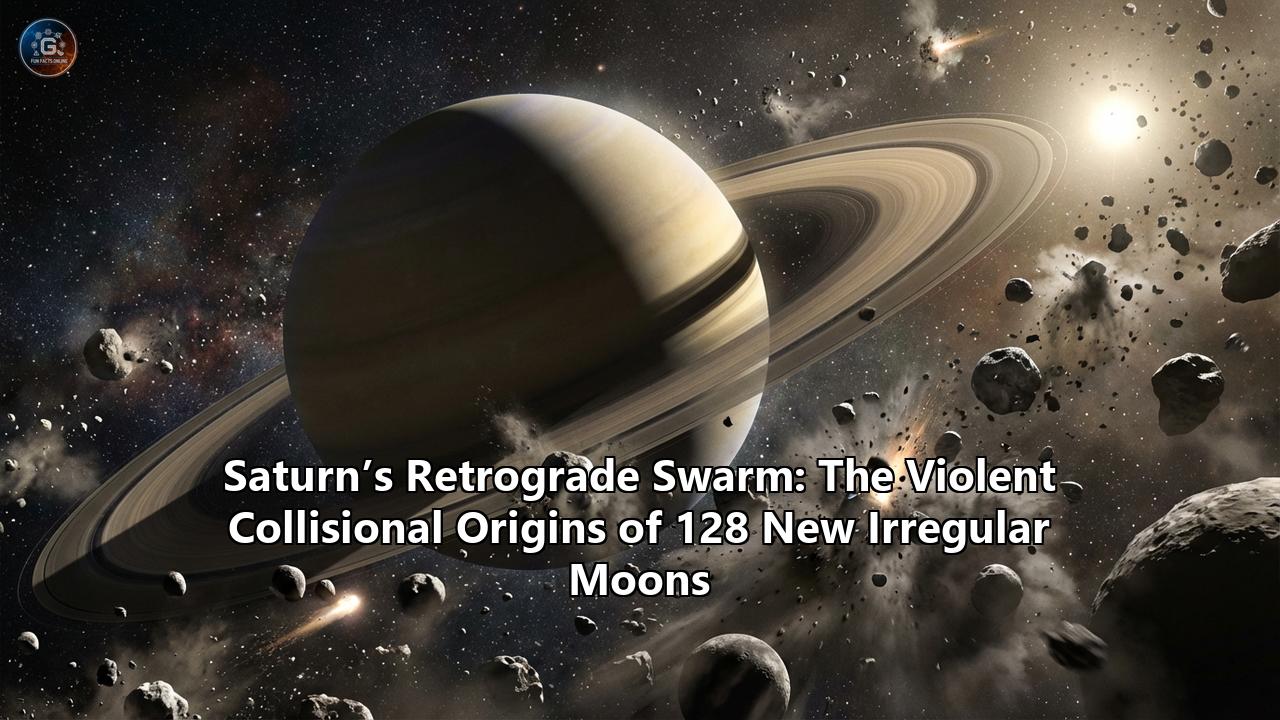
But these are not the serene, spherical worlds like Enceladus or Titan. These are "irregular" moons—jagged, dark scars of cosmic violence. They orbit backwards, tumble erratically, and tell a terrifying story of destruction that occurred relatively recently in astronomical terms. These 128 new objects are not just rocks; they are the shrapnel of a catastrophic celestial collision that shattered a moon and birthed a swarm.
This is the story of Saturn’s retrograde swarm, the forensic hunt that found them, and the violent past they reveal about our own solar system.
Part I: The Invisible Swarm
The Hunt for the Faint and Fleeing
For astronomers, finding a moon around a giant planet is like spotting a specific grain of dust hovering next to a lighthouse beam. Saturn shines brilliantly, reflecting sunlight with an albedo that washes out the surrounding sky. Its major moons were discovered centuries ago because they are large and bright. But the "irregular" moons are different. They are small—often just a few kilometers wide—and dark as coal, reflecting almost no light.
To find them, a team of astronomers led by Dr. Edward Ashton (Academia Sinica Institute of Astronomy and Astrophysics) and Professor Brett Gladman (University of British Columbia) had to push modern technology to its absolute limit. They didn't just look through a telescope; they had to invent a new way of "seeing."
The Magic of "Shift-Stacking"
The discovery was made using the Canada-France-Hawaii Telescope (CFHT) atop Mauna Kea in Hawaii. The method used is called "shift-stacking."
Standard long-exposure photography doesn't work for these moons because they move. If you keep the shutter open to catch faint light, the moon moves across the frame, leaving a smeared streak that is indistinguishable from background noise or cosmic rays.
"Shift-stacking" involves taking hundreds of sequential images. Then, using complex algorithms, the computer shifts the images to match the predicted speed and direction of a potential moon. It effectively "freezes" the moon in place while the stars streak in the background. When these shifted images are stacked on top of each other, the faint signal of the moon amplifies, popping out of the darkness like a beacon.
It was this painstaking technique—processing terabytes of data over years—that allowed Ashton’s team to spot the 128 new faint drifters that had eluded humanity for all of history.
Part II: Anatomy of an Irregular Moon
What is an "Irregular" Moon?
To understand why this discovery is so significant, we must distinguish between "regular" and "irregular" moons.
- Regular Moons (The Family): Moons like Titan, Rhea, and Iapetus formed from the disk of gas and dust that surrounded Saturn when it was born. They orbit the planet’s equator, move in circular paths, and spin in the same direction Saturn rotates. They are the "native" children of the system.
- Irregular Moons (The Adoptees): These new 128 moons are different. They orbit far from the planet, on highly elliptical (egg-shaped) and inclined paths. Crucially, most of them are retrograde—they orbit in the opposite direction of Saturn's spin.
This retrograde motion is the "smoking gun." You cannot form a retrograde moon from the planet's original dust disk. Physics forbids it. Therefore, every single one of these 128 moons was captured. They were once asteroids or comets floating freely in the solar system until they wandered too close to Saturn's immense gravity and were ensnared.
The Norse Group: A Family of Giants
Saturn’s irregular moons are grouped into "families" based on their orbits, named after different mythologies: the Inuit group, the Gallic group, and the massive Norse group.
The vast majority of the 128 new discoveries belong to the Norse group. These are the retrograde orbiters, the rebels of the Saturnian system. Astronomers realized that these moons weren't just random captures; their orbits were suspiciously similar. They clustered together in space, sharing the same inclination and orbital distance.
This clustering implies they are not strangers to one another—they are siblings.
Part III: The Violent Origin Story
Forensics of a Celestial Crime Scene
The sheer number of these small moons (all roughly 2 to 5 kilometers in diameter) presented a puzzle. If Saturn had simply captured 100 separate asteroids, their orbits would be random and scattered. Instead, we see tight families.
The only explanation is collisional cascading.
Dr. Gladman and his team propose a dramatic scenario: roughly 100 million years ago—a time when dinosaurs were at their peak on Earth—a medium-sized moon was orbiting Saturn in a retrograde path. Let's call it the "Progenitor."
Suddenly, violence struck.
Perhaps it was a wayward comet zooming through the outer solar system, or perhaps two captured moons crossed paths in a fatal intersection. The result was a cataclysmic impact. The Progenitor was shattered, blown apart by the energy of the collision.
The Shrapnel Field
The explosion didn't vaporize the moon; it fragmented it. The core of the moon likely remained as the largest member of the group (potentially the moon Phoebe or another large irregular), while the crust and mantle were blasted into thousands of pieces.
What we are seeing today—these 128 new moons—is the debris field of that ancient crash. They are the shrapnel, slowly drifting apart over millions of years but still following the "ghost orbit" of their destroyed parent.
This theory explains why there are so many of them and why they are so small. We are looking at the aftermath of a destruction event that turned one moon into hundreds.
Why "Recent" Matters
The estimate that this collision happened within the last 100 million years is startling. In the 4.5-billion-year history of the solar system, 100 million years is a blink of an eye. It means the solar system is not a dead, static place. It is dynamic, dangerous, and evolving.
If the collision had happened billions of years ago, the tiny moons would have been ground to dust by micrometeoroids or spiraled into Saturn. The fact that they are still here, sharp and numerous, proves they are fresh wreckage.
Part IV: The Implications for Science
Saturn vs. Jupiter: The Moon Wars
For years, the "Moon Race" was a friendly rivalry between the gas giants. Jupiter, being larger, was assumed to catch more asteroids. But Saturn’s new count of 274 blows Jupiter’s 95 out of the water.
Why does Saturn have so many more?
It is likely not because Saturn captures more objects, but because Saturn’s captured objects have been destroyed more effectively. Jupiter might have captured one big moon that survived. Saturn captured one big moon that got hit by a comet, turning one moon into 200. It’s a matter of "quantity over quality" in terms of size.
A Window into Chaos
These irregular moons act as time capsules. Because they are captured asteroids, they are made of pristine material from the early solar system—the same stuff that built the planets.
By studying their spectral signatures (the light they reflect), we can tell if they are carbon-rich asteroids from the outer belt or icy comets from the Kuiper Belt. This tells us about the "migration" of planets. When Jupiter and Saturn moved into their current positions billions of years ago, they scrambled the solar system, tossing rocks everywhere. The Norse group is a fossil record of that chaotic migration.
Part V: Future Exploration
Can We Visit Them?
The discovery of 128 new targets tantalizes mission planners. While NASA’s upcoming Dragonfly mission is headed for Titan, the irregular moons offer a different kind of treasure. A spacecraft passing through the outer Saturnian system could potentially do a "flyby tour," visiting several of these small worlds.
Because they are small and have almost no gravity, landing on them would be more like "docking." A sample return mission from one of these moons would be equivalent to bringing back a piece of the primal solar nebula, unchanged for 4 billion years.
The Limit of Discovery
Dr. Ashton has noted that we may be reaching the limit of what is possible with current ground-based telescopes. These 128 moons are at the edge of visibility. To find smaller ones—the 1-kilometer or 500-meter rocks—we will need the next generation of super-telescopes, like the Extremely Large Telescope (ELT) currently under construction in Chile.
When those eyes open, we may find that Saturn’s 274 moons are just the tip of the iceberg. The swarm could number in the thousands.
Conclusion: The Ringed Planet’s Dark Halo
When you look at Saturn through a backyard telescope, you see the serene beauty of the rings and the golden glow of the atmosphere. It looks peaceful.
But the discovery of the Retrograde Swarm changes that image. We now know that surrounding that beauty is a vast, invisible cloud of black debris—a dark halo born of violence.
These 128 new moons serve as a reminder that space is active. Collisions happen. Worlds are destroyed. And sometimes, the destruction leaves behind a swarm of witnesses that dance in the dark, waiting for us to find them.
Saturn is no longer just the Lord of the Rings. It is the Lord of the Swarm, the keeper of the solar system’s most chaotic graveyard, and the undisputed King of Moons.
Reference:
- https://www.iflscience.com/i-dont-think-jupiter-will-ever-catch-up-128-new-moons-found-orbiting-saturn-78391
- https://www.theguardian.com/science/2025/mar/11/astronomers-discover-128-new-moons-orbiting-saturn
- https://en.wikipedia.org/wiki/Moons_of_Saturn
- https://www.livescience.com/space/planets/128-new-moons-discovered-orbiting-saturn-nearly-doubling-the-ringed-planets-total
- https://phas.ubc.ca/2025-discovery-more-saturnian-moons
- https://www.smithsonianmag.com/smart-news/astronomers-discover-128-new-moons-orbiting-saturn-cementing-the-planets-title-of-moon-king-180986214/
- https://www.techexplorist.com/saturn-adds-128-new-moons-list-totaling-274-moons/97845/
- https://www.ctvnews.ca/vancouver/article/canada-linked-team-finds-saturn-has-128-more-moons-leaving-jupiter-in-cosmic-dust/
- https://en.wikipedia.org/wiki/Norse_group
- https://spacemesmerise.com/es/blogs/planets/the-future-of-saturn-exploration-what-lies-ahead-for-our-mission-to-the-ringed-planet
- https://www.youtube.com/watch?v=q8FYMhOE6TE
- https://arxiv.org/html/2503.01351v1