
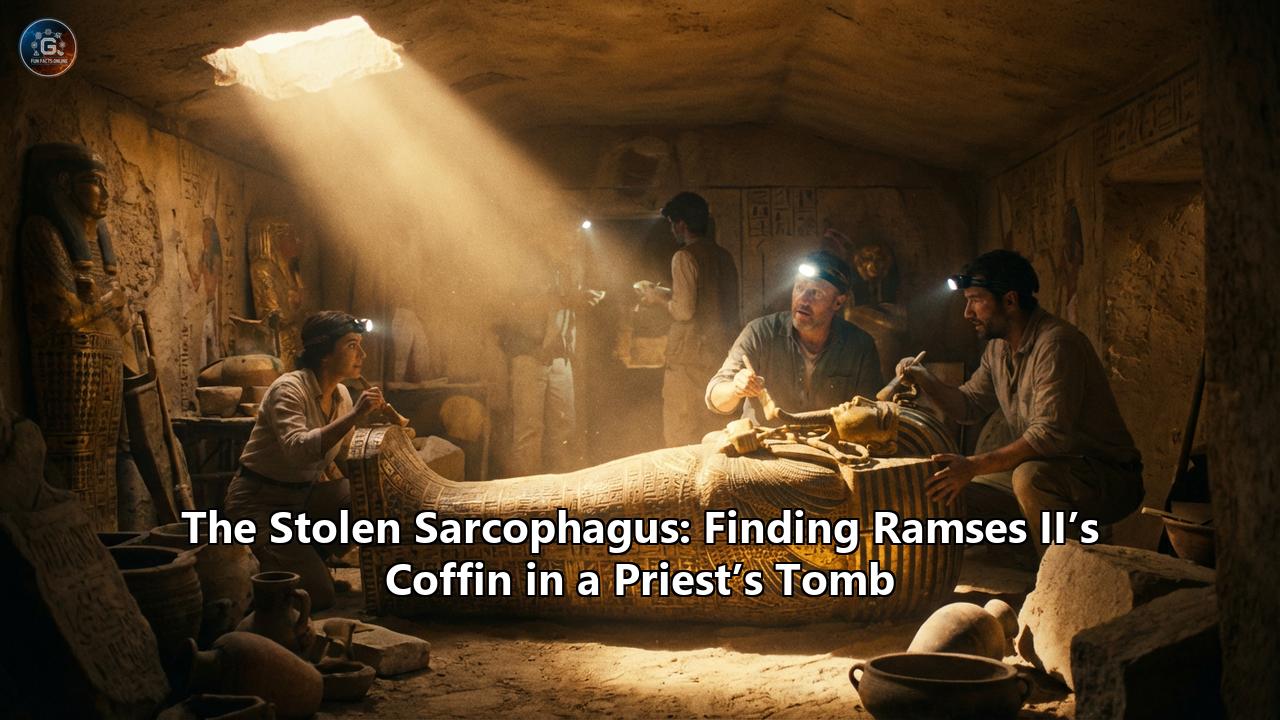
The air inside the tomb was stagnant, hot, and thick with the dust of three millennia. It was July 6, 1881. Émile Brugsch, a German Egyptologist working for the Cairo Museum, lowered himself down a narrow, hidden shaft in the cliffs of Deir el-Bahari. He had been led there by a local villager who had confessed—under duress—to knowing the location of a "treasure."
Brugsch expected to find a few ushabti figures or perhaps a minor official’s burial. He crawled through a low corridor, his candle flickering in the gloom. As he turned a corner into a rough-hewn chamber, the light danced over a chaotic pile of wooden cases. He froze. There, unceremoniously stacked like firewood, were the coffins of the greatest kings of Egypt. He read the names inked on the wood: Seti I, Thutmose III, Amenhotep I.
And there, in a plain, reused coffin stripped of its gold, lay the body of the mightiest of them all: Ramses II.
For over 3,000 years, the world believed Ramses the Great lay in his magnificent tomb in the Valley of the Kings (KV7). But KV7 was empty. The King of Kings had been stolen—not by his enemies, but by the very priests sworn to protect him. This is the incredible, comprehensive story of the "stolen" sarcophagus, the secret exile of a god-king, and the detective work that is still rewriting history today.
Part I: The Golden Dream (The Original Burial)
To understand the tragedy of Ramses’s final resting place, we must first envision the glory of his original burial. When Ramses II died in 1213 B.C., he was roughly 90 years old. He had ruled for 66 years. He was not just a king; he was a living institution.
His original tomb, KV7, was designed to be an underworld palace. It is one of the largest tombs in the Valley of the Kings, burrowing deep into the bedrock with a bent-axis design meant to confuse evil spirits (and thieves).
The Missing SarcophagiA Pharaoh of Ramses's stature was not placed in a single coffin. He was encased in a Russian-nesting-doll arrangement of protective shells, each more valuable than the last:
- The Outer Sarcophagus: A massive box of red granite, carved with the Book of Gates to guide him through the netherworld.
- The Inner Sarcophagus: A translucent, glowing alabaster chest, glowing white in the torchlight.
- The Coffins: Inside the alabaster lay a series of anthropoid (human-shaped) coffins. The innermost would have been made of solid gold, likely weighing over 100 kilograms (220 lbs), similar to Tutankhamun’s but larger.
For a century, Ramses slept in peace. But the empire he built was crumbling. By the time of the 20th Dynasty, Egypt’s economy collapsed. The workmen who built the tombs were starving, and the gold buried beneath their feet became too tempting to ignore.
Part II: The Great Robbery
The "theft" of Ramses II was not a single event; it was a slow, agonizing process of dismantling a god.
The First ViolationHistorical records from the reign of Ramses IX and XI detail the trials of tomb robbers. We know that gangs of thieves, often colluding with corrupt guards, smashed into KV7. They didn't just pick locks; they shattered history. The alabaster sarcophagus was smashed into thousands of fragments (which archaeologists would find millennia later scattered on the floor). The solid gold coffin was likely stripped down or melted.
The State-Sanctioned TheftHere lies the twist: The greatest thieves were not the peasants, but the High Priests of Amun. By the 21st Dynasty (c. 1070–945 B.C.), the High Priests ruled Upper Egypt from Thebes, independent of the Pharaohs in the north. They were broke. They needed gold to pay their mercenary armies and "restore" the economy.
Under the guise of "protecting" the royal mummies from robbers, the priests initiated a secret program. They opened the royal tombs, "processed" the mummies, and stripped them of their valuables. The gold amulets were cut from the wrappings; the gold coffins were melted down and reused.
Ramses II was evicted from his own tomb. His body, now stripped of its treasures, was a liability. He needed to be hidden.
Part III: The Detective Story of the Granite Sarcophagus (The 2024 Discovery)
For over a century, Egyptologists wondered: Where did the massive granite sarcophagus go? It was too heavy to just disappear.
The answer remained a mystery until May 2024, when a startling discovery by Egyptologist Frédéric Payraudeau from Sorbonne University shocked the archaeological world.
He was examining a large fragment of a red granite sarcophagus that had been found in 2009 in a Coptic monastery in Abydos. For years, this stone was believed to belong to a High Priest named Menkheperre. The inscriptions bore Menkheperre's cartouche.
But Payraudeau looked closer. The stone had been "palimpsested"—re-carved. Beneath the rougher carvings of the priest, there were faint, elegant traces of an earlier owner. The text contained titles that only a Pharaoh could hold: "King of Upper and Lower Egypt, Usermaatre Setepenre."
The Thief RevealedIt was Ramses II’s throne name. The High Priest Menkheperre had not just moved Ramses; he had stolen his sarcophagus for himself. The priest had transported the massive granite box from the Valley of the Kings to Abydos, plastered over the great Pharaoh’s name, and carved his own name on top.
This was the ultimate indignity. Ramses II wasn't just robbed of his gold; his very stone shell was hijacked by the priest who was supposed to be guarding him.
Part IV: The Flight of the Mummy
With his tomb looted and his sarcophagus stolen by the High Priest, the mummy of Ramses II began a pathetic game of musical chairs. We know this because the priests, perhaps out of guilt or bureaucratic obsession, wrote "dockets" (notes) on the wooden coffin they eventually shoved him into.
The Itinerary of the Dead:- Year 10 of Siamun: The mummy was removed from KV7 and moved to KV17, the tomb of his father, Seti I. The priests likely hoped the father could protect the son.
- Year 10 (Later): KV17 was deemed unsafe. Ramses was moved again to the Tomb of Queen Inhapy (a secure "holding cell").
- The Final Move: Finally, under the High Priest Pinedjem II, a decision was made to consolidate the "refugee kings." They needed a place so obscure, so difficult to access, that no thief would ever find it.
They chose a tomb originally built for Pinedjem II’s family: The Royal Cache (TT320).
Part V: The Priest’s Tomb (TT320)
This is the tomb from your title. Located in a jagged cleft of rock south of Deir el-Bahari, the tomb is invisible from the valley floor. It consists of a vertical shaft dropping 40 feet into the rock, followed by a long, winding corridor leading to a burial chamber.
It was here that the priests brought the bodies. They carried Ramses II, Thutmose III, Seti I, and dozens of others down the shaft.
The Wooden CoffinSince his original coffins were gone, the priests found a substitute for Ramses. They took a coffin from the late 18th Dynasty (possibly prepared for a noble or a striped-down royal coffin), scraped off the original decoration, and painted a simple yellow background.
On the lid, they inked a humble inscription identifying the occupant: " The King of Upper and Lower Egypt, Usermaatre Setepenre, the Son of Re, Ramses Meryamun."
They wrapped his body in new linen (the original sheets having been torn off by thieves looking for jewels) and tucked dried flowers into the bands. Then, they lowered him into the dark, stacked him amidst the other displaced kings, and sealed the shaft.
There he lay, silent and safe, for nearly 3,000 years.
Part VI: The Betrayal (1871–1881)
The irony of the "Stolen Sarcophagus" story is that Ramses was stolen twice. First by the priests, and second by a family of goat herders.
In 1871, a goat belonging to the Abd el-Rassul family of the village of Qurna strayed up the cliffs. Ahmed Abd el-Rassul went to retrieve it and noticed a dark hole where the sand had shifted. He lowered himself down and found himself face-to-face with the Royal Cache.
The family kept the secret for ten years. They didn't sell the big items (which would attract attention). Instead, they mined the tomb like a savings account. A scarab here, a papyrus scroll there. They sold these on the black market to tourists in Luxor.
Eventually, the influx of royal-quality artifacts caught the eye of Gaston Maspero, the head of the Egyptian Antiquities Service. He initiated a sting operation. The police arrested one of the Abd el-Rassul brothers. He was interrogated (and likely tortured) until he broke. He agreed to lead the archaeologists to the tomb.
Part VII: The Unveiling
When Émile Brugsch entered the tomb in 1881, the sight was overwhelming. He later wrote that he felt he was in a dream. He wasn't just looking at mummies; he was looking at the history books of Egypt, stacked in a pile.
"I soon made out Seti I... and then Ramses II. I was almost petrified. I found myself in the presence of the illustrious dead of whom I had only known the names." — Émile Brugsch
The evacuation was frantic. Terrified that local villagers would riot or attack the site to reclaim "their" treasure, Brugsch ordered the tomb emptied in 48 hours. Three hundred workers formed a human chain.
The King's River CruiseThey loaded the mummies onto a steamship bound for Cairo. As the boat sailed down the Nile, a strange phenomenon occurred. The villagers along the banks—men firing rifles in salute, women wailing and tearing their hair—lined the river. They knew who was on the boat. The "Amir" (Prince) was leaving Thebes. It was a funeral procession 3,000 years late.
Part VIII: The Afterlife of the Body
When the mummy was unwrapped in Cairo in 1886, Ramses II revealed one final surprise. He was not a fragile skeleton. He was a dried, powerful old man. He had a shock of white hair (dyed yellow by embalming spices), a hooked, aristocratic nose, and a set of teeth that showed he had died in pain from an abscess.
His arms were crossed high on his chest, a pose of power. But in the ultimate irony, when researchers examined the mummy in the 1970s, they found that his neck was broken. It hadn't happened in life; the embalmers had to break it to force his head into the undersized wooden coffin they had found for him.
Conclusion: The Puzzle Completed
The story of Ramses II’s coffin is a story of contrast.
- He built the largest statues in Egypt, but ended up in a borrowed box.
- He was the richest King, but was found with nothing but dried flowers.
- He was "protected" by priests who stole his granite sarcophagus for themselves.
The 2024 identification of the granite fragment in Abydos brings the story full circle. We now know exactly who stole his final resting place (Menkheperre). We know where he went (TT320). And we know that despite the thefts, the indignities, and the cheap wooden coffin, Ramses II achieved the one thing every Pharaoh desired:
He is still spoken of. His name has not perished. In the end, the priests saved his body, even if they stole his gold. The thief Menkheperre is a footnote in history, remembered only for his crime, while Ramses the Great rests in the National Museum of Egyptian Civilization, the eternal king of the Nile.Reference:
- https://www.reddit.com/r/OutoftheTombs/comments/10343xr/the_coffin_of_ramesses_ii_12791213_bc19th_dynasty/
- https://madainproject.com/sarcophagus_of_ramesses_ii
- https://en.wikipedia.org/wiki/Ramesses_II
- https://www.biblicalarchaeology.org/daily/ancient-cultures/ancient-egypt/the-sarcophagus-of-ramesses-the-great/
- https://news.cnrs.fr/articles/the-long-lost-sarcophagus-of-ramses-ii-has-finally-been-found
- https://www.smithsonianmag.com/smart-news/ramses-II-long-lost-sarcophagus-finally-been-identified-180984441/
- https://www.popularmechanics.com/science/archaeology/a61074086/ramses-ii-sarcophagus-discovery/
- https://archaeologymag.com/2024/05/original-sarcophagus-of-ramesses-ii/
- https://www.reddit.com/r/OutoftheTombs/comments/1bcxl72/wooden_coffin_of_king_ramesses_ii_made_of_cedar/
- https://english.ahram.org.eg/News/493061.aspx
- https://members.tripod.com/anubis4_2000/mummypages2/19A.htm
- https://www.nationalgeographic.com/premium/article/mystery-mummies-pharaoh-tomb-ancient-egypt
- https://www.ancient-origins.net/ancient-places-africa/db320-uncovering-impressive-cache-hidden-pharaohs-005190
- https://www.ancient-origins.net/artifacts-other-artifacts/living-god-wooden-box-whose-coffin-was-ramesses-ii-buried-009456